What does a senior information assurance analyst do?
Senior information assurance analyst responsibilities
Here are examples of responsibilities from real senior information assurance analyst resumes:
- Manage the IAVM program for the CNDSP.
- Log analysis & managing the accuracy of DLP identification to lowering/avoiding false positives and negatives.
- Conduct annual FISMA self-assessments through interview, documentation review, analyzing scan results, and reviewing other audits/reviews for applicable findings.
- Provide technical assistance and solutions to system owners and DISA IA personnel worldwide.
- Train new reviewers and assist in the maintenance and management of FISMA information systems.
- Assist the ISSO, system owners, and SMEs with the system decommissioning process.
- Assume the role of SME for current leadership, and oversee the IMI project from RFP to delivery.
- Assign tasks and promptly communicate assignments to SME's according to individual expertise in various products and areas of the Systems/Applications.
- Provide technical security engineering support for complex DoD software/hardware/network systems.
- Process and review firewall requests for new business initiatives involving new access to systems containing sensitive information.
- Assist with configuration of university firewall technology and make recommendations for ongoing network and application operating system security.
- Provide project management assistance and oversight--addressed organization concerns and questions about baseline architecture requirements and its enhance system-computing environments.
- Perform COMSEC incident investigations and provide resolutions.
Senior information assurance analyst skills and personality traits
We calculated that 10% of Senior Information Assurance Analysts are proficient in RMF, DOD, and POA. They’re also known for soft skills such as Analytical skills, Detail oriented, and Problem-solving skills.
We break down the percentage of Senior Information Assurance Analysts that have these skills listed on their resume here:
- RMF, 10%
Prepared systems for DoD IA Certification & Accreditation (C&A) Process (DIACAP) to DoD RMF transition.
- DOD, 9%
Implemented operational training for IT personnel in support of DoD 8570 certification requirements.
- POA, 7%
Experience in writing and executing test cases, POA & M's and policies.
- Windows, 5%
Enabled remote administration for Windows 7 implementation.
- End-To-End Testing, 4%
Performed database testing in source and target and performed end-to-end testing with integrated applications to ensure correct data flow.
- End Testing, 4%
Project was in end to end testing of the RP Studio Rollout Phase II.
"rmf," "dod," and "poa" are among the most common skills that senior information assurance analysts use at work. You can find even more senior information assurance analyst responsibilities below, including:
Analytical skills. To carry out their duties, the most important skill for a senior information assurance analyst to have is analytical skills. Their role and responsibilities require that "information security analysts must carefully study computer systems and networks and assess risks to determine how security policies and protocols can be improved." Senior information assurance analysts often use analytical skills in their day-to-day job, as shown by this real resume: "validated/documented dod 8500.2 ia controls within enterprise information technology data repository (eitdr) and emass. "
Detail oriented. Many senior information assurance analyst duties rely on detail oriented. "because cyberattacks can be difficult to detect, information security analysts must pay careful attention to computer systems and watch for minor changes in performance.," so a senior information assurance analyst will need this skill often in their role. This resume example is just one of many ways senior information assurance analyst responsibilities rely on detail oriented: "generate system evaluation documentation detailing the corrective measures necessary to ensure compliance with dod and nsa requirements. "
Problem-solving skills. Another skill that relates to the job responsibilities of senior information assurance analysts is problem-solving skills. This skill is critical to many everyday senior information assurance analyst duties, as "information security analysts must respond to security alerts and uncover and fix flaws in computer systems and networks." This example from a resume shows how this skill is used: "collaborated and briefed senior dod officials on incident and problem management resolution. "
The three companies that hire the most senior information assurance analysts are:
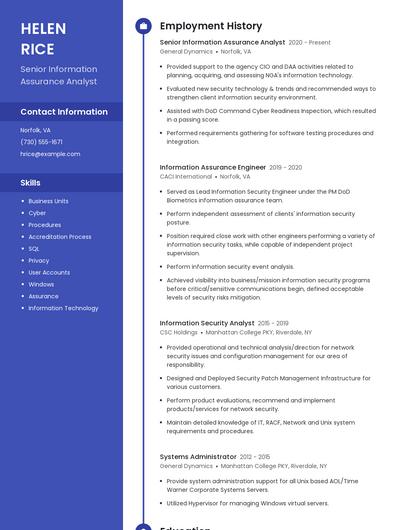
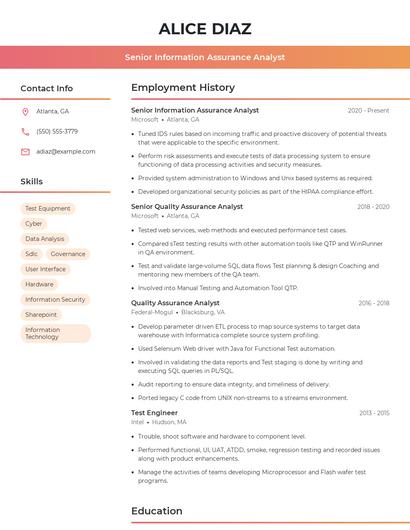
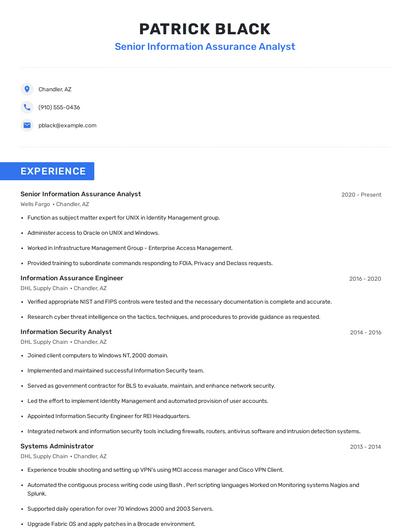
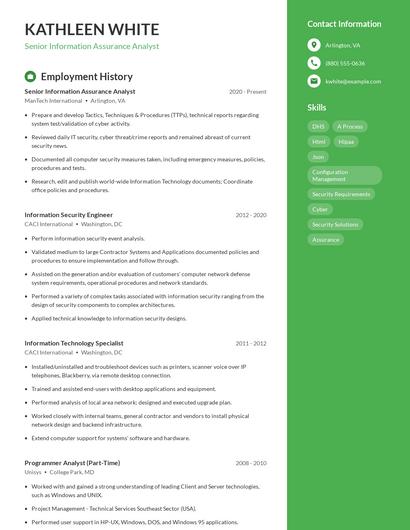
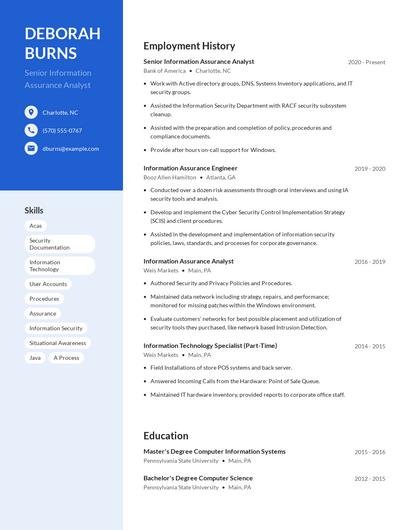
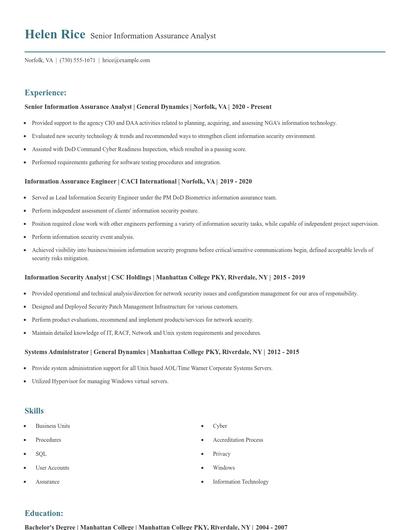
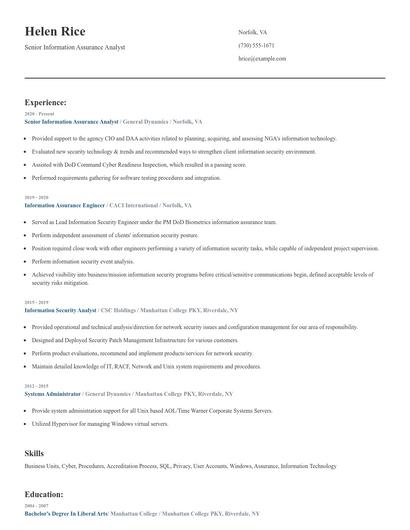
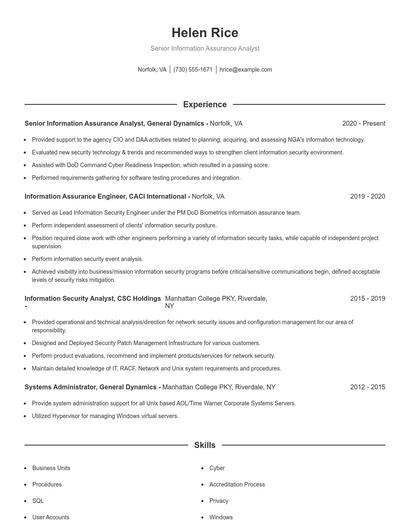
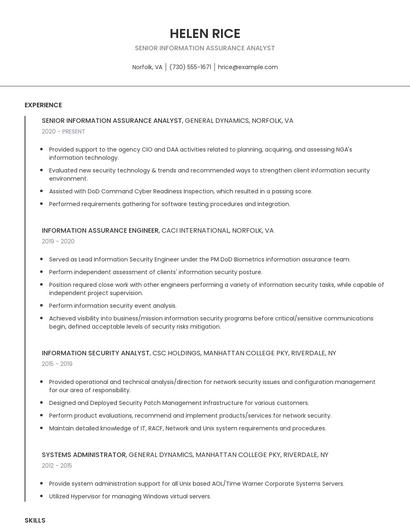
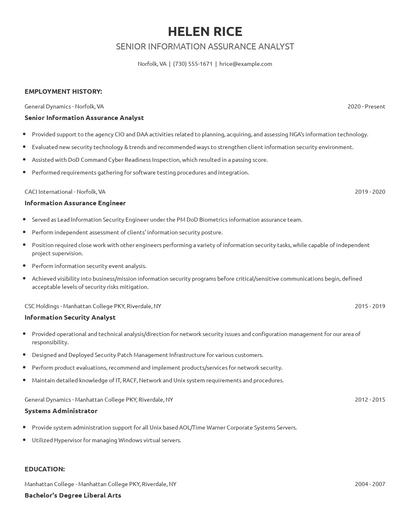
Choose from 10+ customizable senior information assurance analyst resume templates
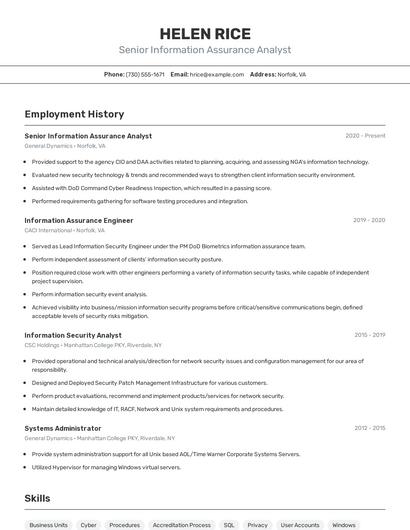
Build a professional senior information assurance analyst resume in minutes. Our AI resume writing assistant will guide you through every step of the process, and you can choose from 10+ resume templates to create your senior information assurance analyst resume.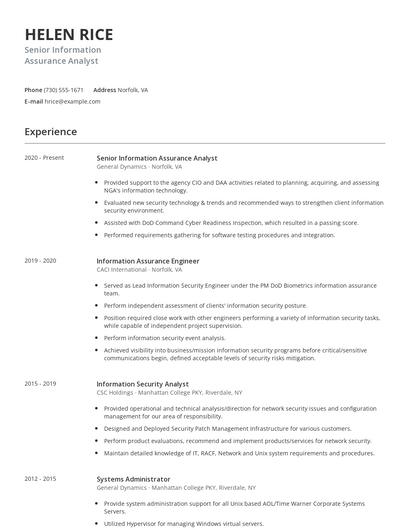
Compare different senior information assurance analysts
Senior information assurance analyst vs. Security engineer
Security engineers are responsible for developing and overseeing data and security software to help prevent data breaches, leaks, and taps related to cybercrime. Other duties and responsibilities include developing new systems to help protect computer networks and assets, configuring firewalls, and conducting penetration testing to pinpoint vulnerabilities. Additionally, security engineers are responsible for investigating attacks and help prevent cybersecurity threat. They are also responsible for creating new processes for authorization, encryption algorithms, and authentication, and analyzing current security policies.
These skill sets are where the common ground ends though. The responsibilities of a senior information assurance analyst are more likely to require skills like "rmf," "end-to-end testing," "end testing," and "test cases." On the other hand, a job as a security engineer requires skills like "java," "cloud security," "infrastructure," and "application security." As you can see, what employees do in each career varies considerably.
Security engineers tend to make the most money working in the technology industry, where they earn an average salary of $126,572. In contrast, senior information assurance analysts make the biggest average salary, $121,997, in the hospitality industry.The education levels that security engineers earn slightly differ from senior information assurance analysts. In particular, security engineers are 5.4% less likely to graduate with a Master's Degree than a senior information assurance analyst. Additionally, they're 0.6% less likely to earn a Doctoral Degree.Senior information assurance analyst vs. Personal security specialist
A personnel security specialist is responsible for conducting background checks and collecting requirements for security clearance. Personnel security specialists write background check reports, coordinate with other institutions for further investigations, and determining the eligibility of candidates for clearance. They must have excellent communication and researching skills to identify and gather data suitable for employment purposes. A personnel security specialist verifies and processes information according to security procedures and protocols, providing accurate information and managing data disputes.
In addition to the difference in salary, there are some other key differences worth noting. For example, senior information assurance analyst responsibilities are more likely to require skills like "rmf," "poa," "windows," and "end-to-end testing." Meanwhile, a personal security specialist has duties that require skills in areas such as "customer service," "emergency situations," "product knowledge," and "sales floor." These differences highlight just how different the day-to-day in each role looks.
Personal security specialists earn lower levels of education than senior information assurance analysts in general. They're 15.2% less likely to graduate with a Master's Degree and 0.6% less likely to earn a Doctoral Degree.What technology do you think will become more important and prevalent for senior information assurance analysts in the next 3-5 years?
Eduardo Zambrano
Professor of Economics, Orfalea College of Business
Senior information assurance analyst vs. Personnel security specialist
Analysts are employees or individual contributors with a vast experience in a particular field that help the organization address challenges. They help the organization improve processes, policies, and other operations protocol by studying the current processes in place and determining the effectiveness of those processes. They also research industry trends and data to make sound inferences and recommendations on what the company should do to improve their numbers. Analysts recommend business solutions and often help the organization roll out these solutions. They ensure that the proposed action plans are effective and produce the desired results.
Some important key differences between the two careers include a few of the skills necessary to fulfill the responsibilities of each. Some examples from senior information assurance analyst resumes include skills like "rmf," "poa," "windows," and "end-to-end testing," whereas a personnel security specialist is more likely to list skills in "sci," "jpas," "e-qip," and "personnel security. "
Personnel security specialists make a very good living in the technology industry with an average annual salary of $77,737. On the other hand, senior information assurance analysts are paid the highest salary in the hospitality industry, with average annual pay of $121,997.personnel security specialists typically earn lower educational levels compared to senior information assurance analysts. Specifically, they're 7.3% less likely to graduate with a Master's Degree, and 1.0% less likely to earn a Doctoral Degree.Senior information assurance analyst vs. Analyst
Even though a few skill sets overlap between senior information assurance analysts and analysts, there are some differences that are important to note. For one, a senior information assurance analyst might have more use for skills like "rmf," "poa," "windows," and "end-to-end testing." Meanwhile, some responsibilities of analysts require skills like "customer service," "troubleshoot," "data analysis," and "project management. "
In general, analysts earn the most working in the technology industry, with an average salary of $79,330. The highest-paying industry for a senior information assurance analyst is the hospitality industry.The average resume of analysts showed that they earn lower levels of education compared to senior information assurance analysts. So much so that theyacirc;euro;trade;re 7.3% less likely to earn a Master's Degree and less likely to earn a Doctoral Degree by 0.3%.Types of senior information assurance analyst
Updated January 8, 2025
