What does a software support manager do?
A software support manager updates software, oversees a team, and ensures risk assessment activities are completed. They also create progress reports and manage documentation for their team. Ultimately, they manage, install, restore and debug software.
Software support manager responsibilities
Here are examples of responsibilities from real software support manager resumes:
- Manage Linux client problem reports and engineering responses.
- Manage programmers in the design, development, testing and debugging of sophisticate computer graphics applications.
- Develop and run SQL and PL/SQL scripts as a workaround to resolve critical billing issues.
- Focuse in the areas of Linux BSP, network protocol stacks data, control and management plane software.
- Monitor JIRA tickets to ensure completeness and accuracy both before development begins and throughout the ticket's development lifecycle.
- Used SQL, PL/SQL, data dictionaries, configuration and performance tuning utilities and operating system level scripting extensively.
- Lead engineering team responsible for building mobile and web technology base application suit for luxury automaker through all phases of SDLC.
- Implement object modeling tools to ensure QA, requirements consistency with application development.
- Establish task estimation, software engineering and QA processes resulting in continual on-time product delivery
- Revamp an aging platform from grind up, using Microservices architecture focusing on maintainability, scalability & reliability on AWS platform.
- Edit and write Perl and C/C++ code to resolve problems and add improve functionality to supply-chain systems and monitoring processes.
- Design, implementation, and oversight of VMware virtualization cluster.
- Define and build full lifecycle project plans for transforming desktop applications through rationalization, remediation, virtualization, and distribution.
Software support manager skills and personality traits
We calculated that 12% of Software Support Managers are proficient in Software Support, Software Development, and Technical Support. They’re also known for soft skills such as Business skills, Leadership skills, and Organizational skills.
We break down the percentage of Software Support Managers that have these skills listed on their resume here:
- Software Support, 12%
Managed computer software support department, providing technical support to hobby retailers.
- Software Development, 11%
Manage Customer Support and Quality Assurance teams Manage Software Development Team Hired as a Senior Software developer
- Technical Support, 8%
Managed and led a team of support engineers in delivering excellent Software Technical Support for three separate enterprise-level software applications.
- Customer Support, 6%
Reorganized the Customer Support infrastructure to obtain maximum response time to customer inquiries.
- Database, 6%
Support for the ERP software application and integrated technologies, Unix system administration, Microsoft NT/SQL database system administration support
- SQL Server, 5%
Maintained daily operations, support and planning of SQL server and 3rd party application.
Most software support managers use their skills in "software support," "software development," and "technical support" to do their jobs. You can find more detail on essential software support manager responsibilities here:
Business skills. The most essential soft skill for a software support manager to carry out their responsibilities is business skills. This skill is important for the role because "it managers must develop and implement strategic plans to reach the goals of their organizations." Additionally, a software support manager resume shows how their duties depend on business skills: "directed 13 employees within a remote software support center for business critical 1 retail applications. "
Leadership skills. Another soft skill that's essential for fulfilling software support manager duties is leadership skills. The role rewards competence in this skill because "it managers must lead and motivate it teams or departments so that workers are efficient and effective." According to a software support manager resume, here's how software support managers can utilize leadership skills in their job responsibilities: "provide input to bi-weekly ipr and life cycle management leadership brief. "
Organizational skills. This is an important skill for software support managers to perform their duties. For an example of how software support manager responsibilities depend on this skill, consider that "some it managers must coordinate the work of several different it departments to make the organization run efficiently." This excerpt from a resume also shows how vital it is to everyday roles and responsibilities of a software support manager: "participated in meetings and maintained open communication in various organizational levels to improve customer support. ".
Analytical skills. For certain software support manager responsibilities to be completed, the job requires competence in "analytical skills." The day-to-day duties of a software support manager rely on this skill, as "it managers must analyze problems and consider and select the best ways to solve them." For example, this snippet was taken directly from a resume about how this skill applies to what software support managers do: "created metrics and target goals to measure departmental performance which improved software product data entry by 15% within 1st year. "
Communication skills. A commonly-found skill in software support manager job descriptions, "communication skills" is essential to what software support managers do. Software support manager responsibilities rely on this skill because "it managers must explain their work to top executives and give clear instructions to their subordinates." You can also see how software support manager duties rely on communication skills in this resume example: "administered maintenance contracts and monitored vendor service levels for all retail computer systems and telecommunications equipment. "
The three companies that hire the most software support managers are:
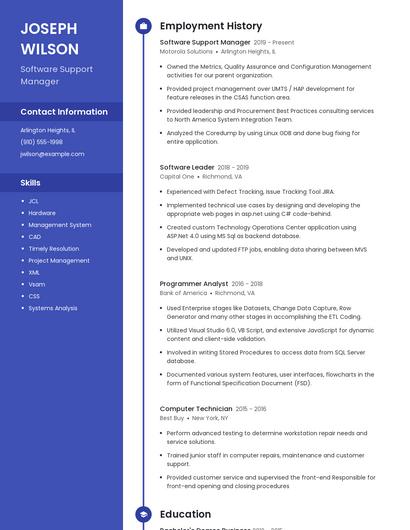
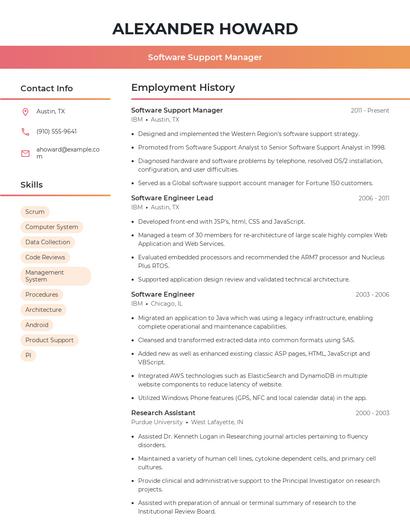
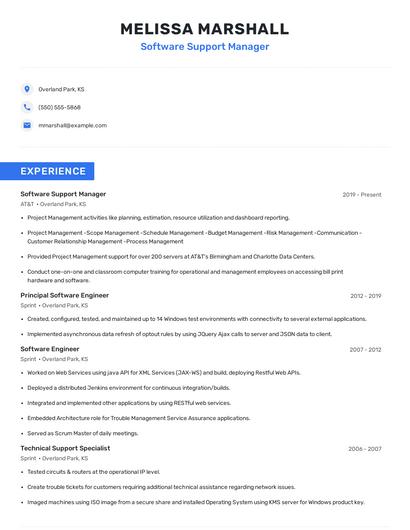
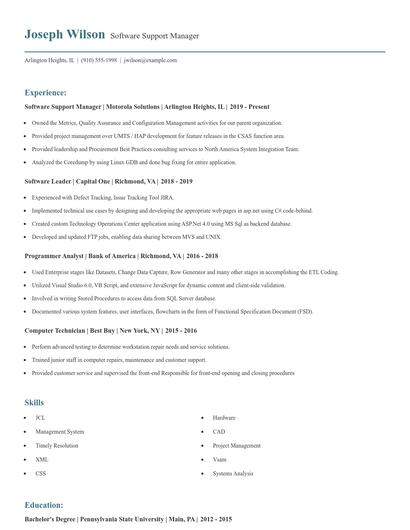
Choose from 10+ customizable software support manager resume templates
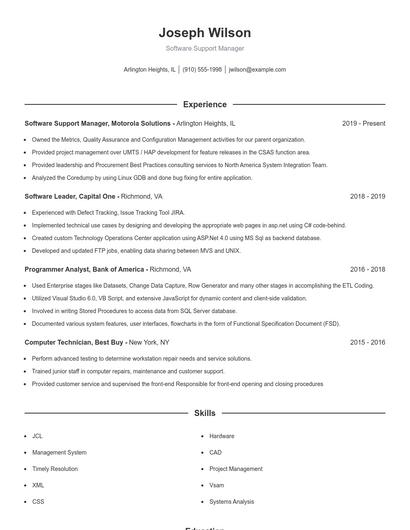
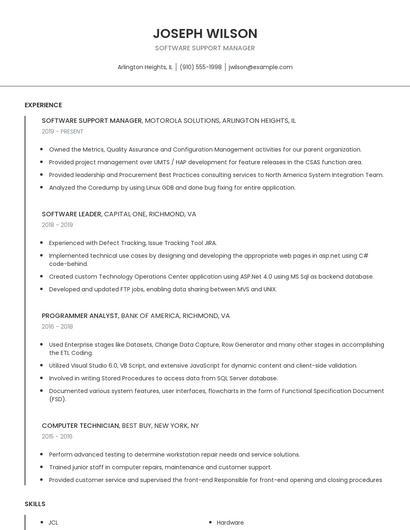
Build a professional software support manager resume in minutes. Our AI resume writing assistant will guide you through every step of the process, and you can choose from 10+ resume templates to create your software support manager resume.





Compare different software support managers
Software support manager vs. Information technology director
An information technology (IT) Director is an individual responsible for the management, strategy, and execution of an organization's IT infrastructure. He/She supervises a team of workers while working with the organization's management and external vendors and advisors. Aside from managing workers, an IT director should possess problem-solving skills and an aptitude for organizational thinking. An IT director must also identify new market opportunities and should lead an effort to improve the organization's IT process.
There are some key differences in the responsibilities of each position. For example, software support manager responsibilities require skills like "software support," "technical support," "r," and "customer support." Meanwhile a typical information technology director has skills in areas such as "customer service," "project management," "cloud," and "network infrastructure." This difference in skills reveals the differences in what each career does.
Information technology directors really shine in the technology industry with an average salary of $145,076. Comparatively, software support managers tend to make the most money in the telecommunication industry with an average salary of $116,097.information technology directors tend to reach similar levels of education than software support managers. In fact, information technology directors are 1.7% more likely to graduate with a Master's Degree and 0.6% less likely to have a Doctoral Degree.Software support manager vs. Director of software development
A director of software development is primarily in charge of overseeing the workflow and the workforce involved in the entire software development process. Their responsibilities also include creating strategies for optimal performance, coordinating with different teams and departments to identify strengths and weaknesses, implementing training and workshop programs, and liaising with external agencies, including key clients. Furthermore, as a director, it is essential to lead and encourage the team to reach new heights.
In addition to the difference in salary, there are some other key differences worth noting. For example, software support manager responsibilities are more likely to require skills like "software support," "technical support," "database," and "windows nt." Meanwhile, a director of software development has duties that require skills in areas such as "java," "cloud," "software engineering," and "tcp ip." These differences highlight just how different the day-to-day in each role looks.
On average, directors of software development earn a higher salary than software support managers. Some industries support higher salaries in each profession. Interestingly enough, directors of software development earn the most pay in the technology industry with an average salary of $163,503. Whereas software support managers have higher pay in the telecommunication industry, with an average salary of $116,097.directors of software development earn higher levels of education than software support managers in general. They're 7.1% more likely to graduate with a Master's Degree and 0.6% more likely to earn a Doctoral Degree.Software support manager vs. Senior information technology manager
A senior information technology manager is responsible for monitoring the efficiency and performance of the company's technology and network systems. Senior information technology managers oversee technology infrastructures and operations, ensuring the processes adhere to the company policies and regulations. They analyze the schematics and specifications of computer systems, maintaining the safety and security across all networks to prevent unauthorized access. A senior information technology manager must have extensive knowledge of the technology industry, as well as a strong command of programming languages.
Some important key differences between the two careers include a few of the skills necessary to fulfill the responsibilities of each. Some examples from software support manager resumes include skills like "software support," "customer support," "database," and "windows nt," whereas a senior information technology manager is more likely to list skills in "project management," "cloud," "architecture," and "strong problem-solving. "
Senior information technology managers earn the best pay in the professional industry, where they command an average salary of $143,891. Software support managers earn the highest pay from the telecommunication industry, with an average salary of $116,097.senior information technology managers typically earn higher educational levels compared to software support managers. Specifically, they're 5.7% more likely to graduate with a Master's Degree, and 0.1% more likely to earn a Doctoral Degree.Software support manager vs. Technical manager
A technical manager is responsible for maintaining the company's information systems database and analyzing technology system matters to ensure its efficiency and accuracy in supporting business operations. Technical managers perform network checks regularly to assess any possible malfunctions that might compromise the company's cybersecurity. They carefully analyze business and clients' specifications on working with systems integration, responding to end-users' concerns and inquiries. A technical manager must have excellent knowledge of the information technology systems industry, as well as a strong command on network codes to conduct adjustments and manage network infrastructure.
Types of software support manager
Updated January 8, 2025
