What does a supply chain systems manager do?
Supply chain systems manager responsibilities
Here are examples of responsibilities from real supply chain systems manager resumes:
- Manage installation of the Manhattans WMS system and conversion from Retek WMS.
- Manage a knowledgeable team with strong leadership and technical skills in demand planning, logistics management and technology development.
- Manage production and warehouse teams ensuring DOD policies and corporate rules and regulations compliance while exceeding government nuclear facility audit standards.
- Plan procurement, production, inventory control, logistics and distribution.
- Project lead to upgrade and improve the use of the ERP system.
- Recognize by CEO for outstanding on time and under budget ERP implementation accomplishment.
- Develop and implement performance metrics and KPIs to ensure business benefits are realize.
- Lead change management and cultural shift from weekly MRP batch and queue environment to daily APS flow.
- Design MRP strategies to reduce global inventory levels through business information maturity improvement.
- Manage production and warehouse teams ensuring DOD policies and corporate rules and regulations compliance while exceeding government nuclear facility audit standards.
Supply chain systems manager skills and personality traits
We calculated that 26% of Supply Chain Systems Managers are proficient in Supply Chain, Project Management, and Logistics.
We break down the percentage of Supply Chain Systems Managers that have these skills listed on their resume here:
- Supply Chain, 26%
Designed, developed and managed an enterprise-wide integrated supply chain management system that integrated into XO financial and engineering business systems.
- Project Management, 10%
Utilize expert organization, structure, planning and project management skills, to facilitate high quality decision making.
- Logistics, 8%
Supported the full life cycle of material management and logistics systems for 100 locations in 50 markets across the US.
- Chain Operations, 5%
Created and implemented strategic plans supporting financial objectives, distribution/supply chain operations, manpower/resources, and sales efforts.
- Supply Chain Planning, 5%
Developed and implemented visual supply chain planning board that improved tactical organizational efficiency and eliminated waste across all PET's.
- ERP, 5%
Implemented Oracle ERP practices into the Machine Automation Technology group to support 400% increase in activity with level resources.
"supply chain," "project management," and "logistics" are among the most common skills that supply chain systems managers use at work. You can find even more supply chain systems manager responsibilities below, including:
The three companies that hire the most supply chain systems managers are:
- Honeywell4 supply chain systems managers jobs
- Bramble Outdoor3 supply chain systems managers jobs
- Plug Power2 supply chain systems managers jobs
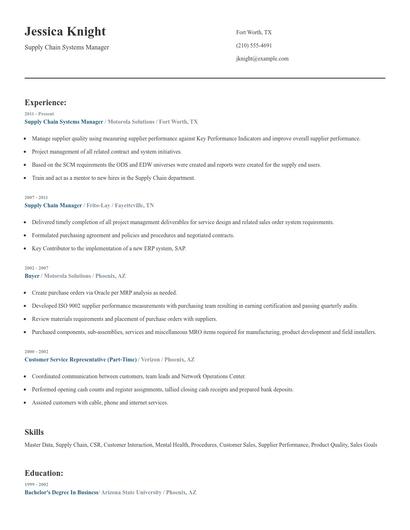
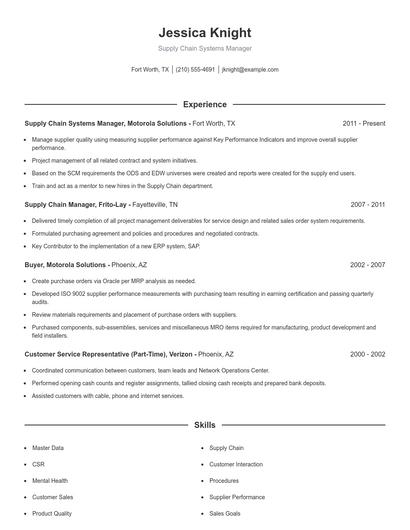
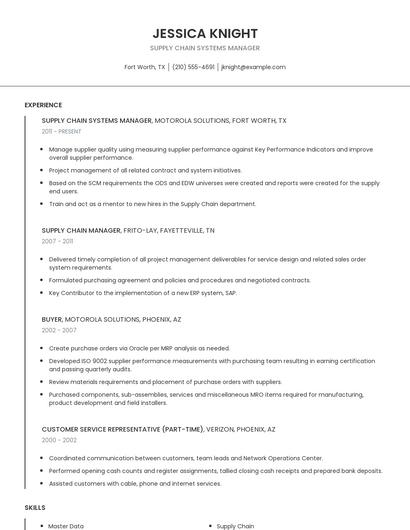
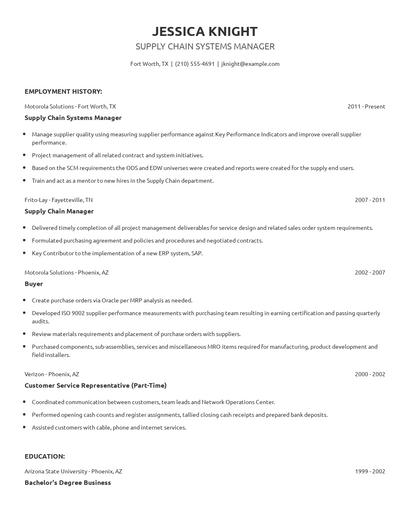
Choose from 10+ customizable supply chain systems manager resume templates
Build a professional supply chain systems manager resume in minutes. Our AI resume writing assistant will guide you through every step of the process, and you can choose from 10+ resume templates to create your supply chain systems manager resume.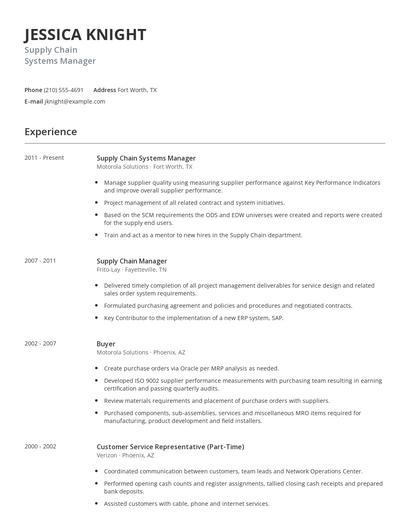
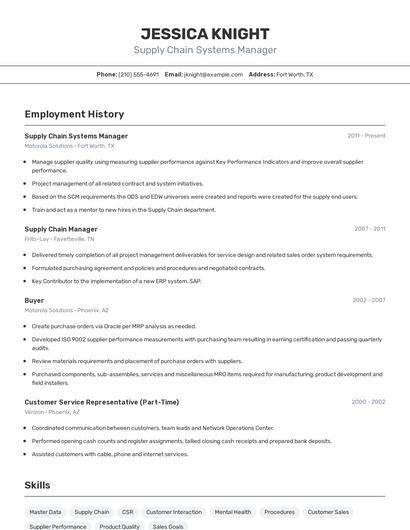


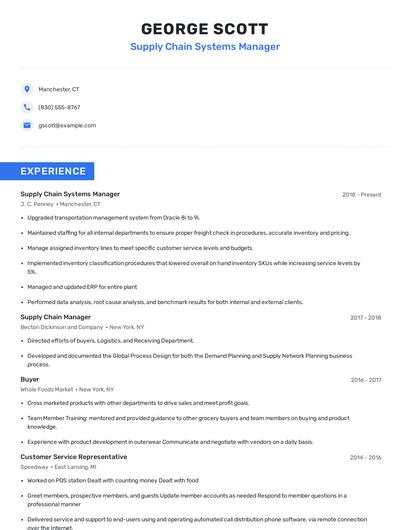


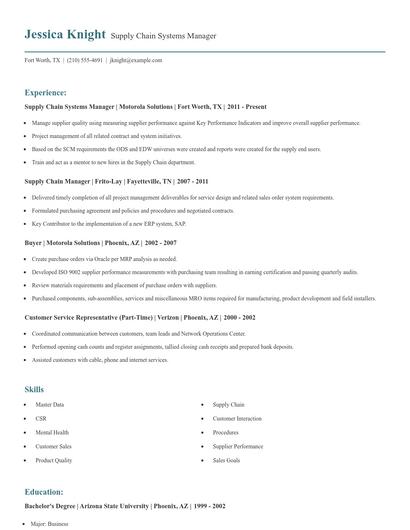
Compare different supply chain systems managers
Supply chain systems manager vs. Inventory management specialist
An inventory management specialist is responsible for maintaining the adequacy of stock supplies to support customers' needs. Inventory management specialists help develop inventory processes and strategies to keep the supplies organized and free of any defects while on storage. They also monitor inventory costs and process orders through various software tools, requiring them to have a working knowledge of computer systems and the ability to operate warehouse equipment and machinery on moving merchandise around the warehouse.
While similarities exist, there are also some differences between supply chain systems managers and inventory management specialist. For instance, supply chain systems manager responsibilities require skills such as "supply chain," "project management," "logistics," and "chain systems." Whereas a inventory management specialist is skilled in "customer service," "inventory management system," "purchase orders," and "sales floor." This is part of what separates the two careers.
Inventory management specialists earn the highest salaries when working in the government industry, with an average yearly salary of $65,378. On the other hand, supply chain systems managers are paid more in the manufacturing industry with an average salary of $130,873.On average, inventory management specialists reach lower levels of education than supply chain systems managers. Inventory management specialists are 15.3% less likely to earn a Master's Degree and 0.4% more likely to graduate with a Doctoral Degree.Supply chain systems manager vs. Inventory manager
An inventory manager is responsible for supervising the overall inventory operations, monitoring supplies and materials, and checking the accuracy of data reports from the inventory associates. Inventory managers' duties include validating stock levels using record software tools, determining the availability of stocks for purchase orders, inspecting the incoming and outgoing shipments, and addressing product concerns by communicating with suppliers and third-party vendors. An inventory manager must have excellent communication and leadership skills to handle the staff's performance and manage customers' inquiries and complaints.
Each career also uses different skills, according to real supply chain systems manager resumes. While supply chain systems manager responsibilities can utilize skills like "supply chain," "project management," "chain systems," and "chain operations," inventory managers use skills like "pet," "customer service," "manage inventory," and "customer orders."
Inventory managers earn a lower average salary than supply chain systems managers. But inventory managers earn the highest pay in the retail industry, with an average salary of $66,537. Additionally, supply chain systems managers earn the highest salaries in the manufacturing with average pay of $130,873 annually.Average education levels between the two professions vary. Inventory managers tend to reach lower levels of education than supply chain systems managers. In fact, they're 14.6% less likely to graduate with a Master's Degree and 0.4% more likely to earn a Doctoral Degree.Supply chain systems manager vs. Director of supply chain operations
A director of supply chain operations is in charge of spearheading the manufacturing processes in a company, ensuring efficiency and smooth workflow. Their responsibilities revolve around devising strategies to improve procedures and systems, setting goals and objectives, managing the workforce, liaising with key distributors and clients, and monitoring the progress of every function. Furthermore, as a director, it is essential to lead and encourage the workforce to reach goals and optimal performance, all while implementing the company's policies and regulations.
There are many key differences between these two careers, including some of the skills required to perform responsibilities within each role. For example, a supply chain systems manager is likely to be skilled in "logistics," "chain systems," "business processes," and "master data," while a typical director of supply chain operations is skilled in "customer service," "chain management," "continuous improvement," and "demand planning."
Directors of supply chain operations earn the best pay in the pharmaceutical industry, where they command an average salary of $117,181. Supply chain systems managers earn the highest pay from the manufacturing industry, with an average salary of $130,873.When it comes to education, directors of supply chain operations tend to earn similar degree levels compared to supply chain systems managers. In fact, they're 0.1% less likely to earn a Master's Degree, and 0.7% less likely to graduate with a Doctoral Degree.Supply chain systems manager vs. Inventory control manager
An inventory control manager is an individual who is responsible for directing all tasks related to inventory management of a company. They manage the allocation of materials, supplies, and finished goods as well as design strategies to minimize the cost or time to move goods. They are required to lead a team of storage or warehouse personnel to help them with the actual inventory count. Inventory control managers must also develop a business relationship with their suppliers or vendors.
Types of supply chain systems manager
Updated January 8, 2025
