What does a system integration manager do?
A system integration manager performs a variety of tasks including managing enterprise-level projects, integrating video over Internet protocol networks with broadband systems, and cultivating new business prospects. In addition, you will be responsible for managing client relationships, assessing ongoing projects, and providing feedback to the team. As a system integration manager, you will contribute to the strategic design process to identify more integration opportunities. You are also responsible for reviewing integration plans, reports, and test procedures.
System integration manager responsibilities
Here are examples of responsibilities from real system integration manager resumes:
- Manage software integration of HighwayMaster product into client-based systems (UNIX, AS400, etc .).
- Work with the architecture and business requirements leads to insure synchronize development of integrate and testable requirements.
- Work side-by-side with clients during entire SDLC using various SDLC tools to maintain a solid relationship.
- Account for development and training material for SDLC releases, training approximately 80K users on SDLC module.
- Select as team lead for EHR implementation/optimization teams.
- Deliver technical solutions to administrations utilizing ETL, data integration, etc.
- Identify opportunities for technology refresh and retirement, infrastructure optimization, and consolidation of technical infrastructure.
- Conduct post payment provider education and assist program staff in development of Medicaid policy and procedures.
- Direct top-performing architecture, design, and development teams for international firm specializing in information and communication systems.
- Identify and capitalize on opportunities to streamline procedures, eliminate obstacles and expedite day-to-day logistics and supply operations.
- Develop ITIL change management program to minimize risks relate to unplan outages to business operations and loss productivity.
- Establish policy and procedure on security and safety management, infrastructure management, system management, crisis management and emergency preparedness.
- Maintain security of both electronic and physical records against unauthorize access and release according to HIPAA, state and federal regulations.
- Develop ITIL change management program to minimize risks relate to unplan outages to business operations and loss productivity.
System integration manager skills and personality traits
We calculated that 12% of System Integration Managers are proficient in Project Management, Systems Integration, and Architecture. They’re also known for soft skills such as Analytical skills, Business skills, and Organizational skills.
We break down the percentage of System Integration Managers that have these skills listed on their resume here:
- Project Management, 12%
Realized a significant decrease in customer related issues by establishing fundamental Project Management processes and templates for design and manufacturing projects.
- Systems Integration, 9%
Managed Army Programs Human Systems Integration group consisting of Logistics Engineering, Human Factors Performance-Based Logistics and System and Software Safety.
- Architecture, 8%
Participated in Accenture's Solution Architecture and EA capability development and training/certification programs to develop practitioners from AIMS perspective.
- Java, 6%
Coordinated JADs to determine client technical requirements and current/future-state network analysis for software implementation of java based billing solutions into network.
- Infrastructure, 6%
Integrate requirements with resulting changes to security, IT infrastructure, and configuration management.
- Software Development, 6%
Performed technical functions including system administration, database administration, software development, testing and documentation.
Most system integration managers use their skills in "project management," "systems integration," and "architecture" to do their jobs. You can find more detail on essential system integration manager responsibilities here:
Analytical skills. The most essential soft skill for a system integration manager to carry out their responsibilities is analytical skills. This skill is important for the role because "it managers must analyze problems and consider and select the best ways to solve them." Additionally, a system integration manager resume shows how their duties depend on analytical skills: "developed customized dynamic java web applications using the spring framework that interacts primarily with oracle databases. "
Business skills. Another soft skill that's essential for fulfilling system integration manager duties is business skills. The role rewards competence in this skill because "it managers must develop and implement strategic plans to reach the goals of their organizations." According to a system integration manager resume, here's how system integration managers can utilize business skills in their job responsibilities: "subject matter expert on the sap business intelligence and the erp system. "
Organizational skills. system integration managers are also known for organizational skills, which are critical to their duties. You can see how this skill relates to system integration manager responsibilities, because "some it managers must coordinate the work of several different it departments to make the organization run efficiently." A system integration manager resume example shows how organizational skills is used in the workplace: "analyzed and proposed organizational, business process, mes/scada and manufacturing technical changes for a global plastics company. "
Communication skills. A big part of what system integration managers do relies on "communication skills." You can see how essential it is to system integration manager responsibilities because "it managers must explain their work to top executives and give clear instructions to their subordinates." Here's an example of how this skill is used from a resume that represents typical system integration manager tasks: "conducted multiple projects to assess current utility infrastructure versus required smart grid architecture, communications, vision, and systems requirements. "
Leadership skills. Another common skill required for system integration manager responsibilities is "leadership skills." This skill comes up in the duties of system integration managers all the time, as "it managers must lead and motivate it teams or departments so that workers are efficient and effective." An excerpt from a real system integration manager resume shows how this skill is central to what a system integration manager does: "included technical and functional leadership, earned value management, financial management, scheduling, and significant customer interaction/reviews. "
The three companies that hire the most system integration managers are:
- Kion Group13 system integration managers jobs
- DIRECTV Puerto Rico12 system integration managers jobs
- Lockheed Martin9 system integration managers jobs
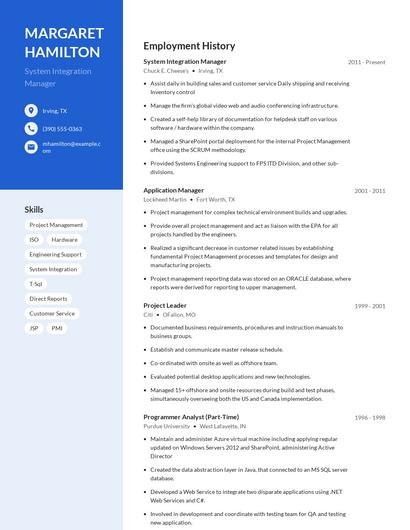
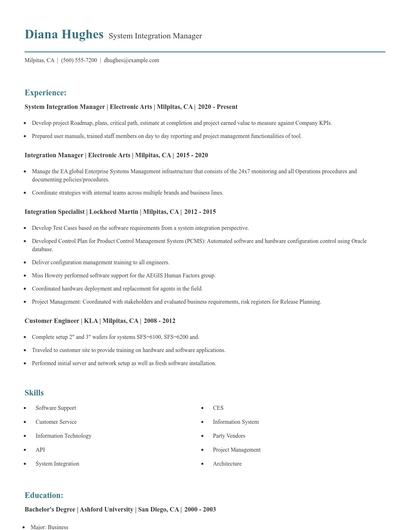
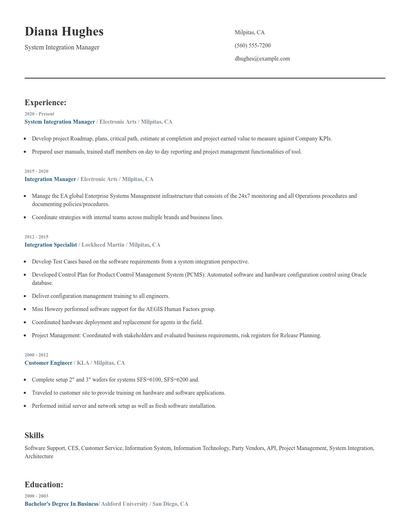
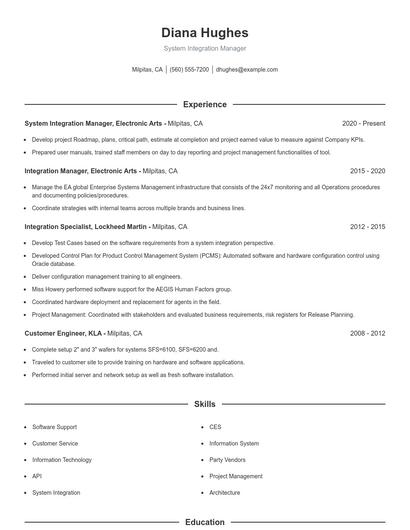
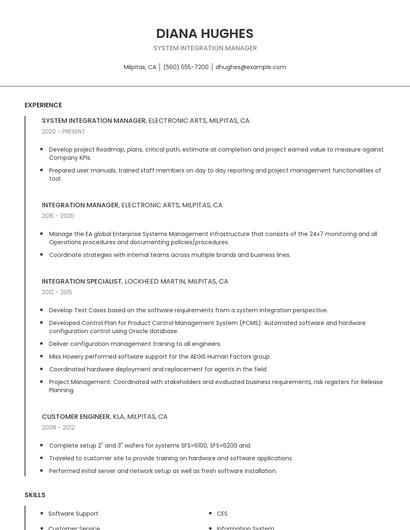
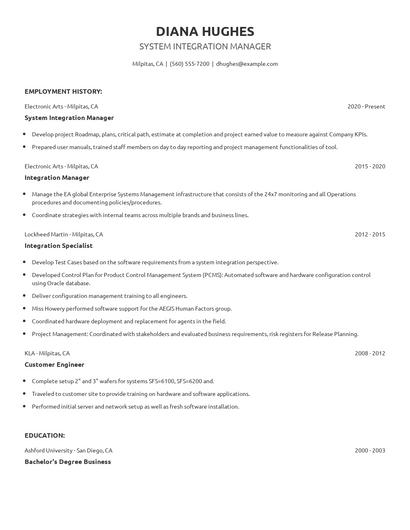
Choose from 10+ customizable system integration manager resume templates
Build a professional system integration manager resume in minutes. Our AI resume writing assistant will guide you through every step of the process, and you can choose from 10+ resume templates to create your system integration manager resume.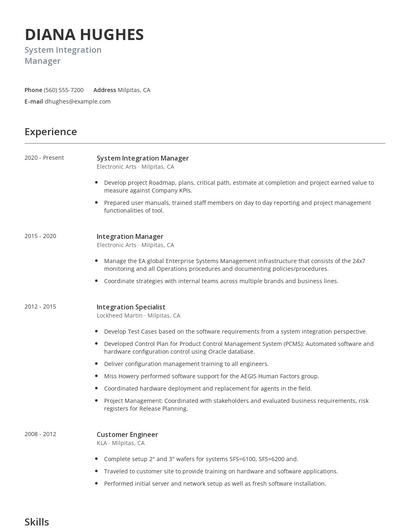


Compare different system integration managers
System integration manager vs. Manager, systems engineering
A systems engineering manager is responsible for monitoring the efficiency of the company's technology systems and network infrastructure. System engineering managers inspect the output deliverables of computer systems, identifying process improvement techniques to improve optimal performance and maintain high-quality results. They handle the department's budget and allocate adequate resources to support project management operations and requirements. A systems engineering manager must have excellent knowledge of the technology industry, handling technical complexities, and configuring system management tools.
These skill sets are where the common ground ends though. The responsibilities of a system integration manager are more likely to require skills like "systems integration," "application development," "business process," and "logistics." On the other hand, a job as a manager, systems engineering requires skills like "systems engineering," "rf," "technical leadership," and "san." As you can see, what employees do in each career varies considerably.
Managers, systems engineering really shine in the manufacturing industry with an average salary of $131,371. Comparatively, system integration managers tend to make the most money in the construction industry with an average salary of $133,999.managers, systems engineering tend to reach similar levels of education than system integration managers. In fact, managers, systems engineering are 0.1% less likely to graduate with a Master's Degree and 0.1% more likely to have a Doctoral Degree.System integration manager vs. Manager, project management
The role of a project management manager involves the planning, execution, monitoring, control, and closure of projects. Project managers oversee the scope of the entire project, the team, success or failure, and its resources. They facilitate productivity and commitment, remove obstacles, and motivate their team members. Their skills should include leadership, critical thinking, communication, negotiating, and risk management. They should also know about cost management, scheduling, and task management.
Each career also uses different skills, according to real system integration manager resumes. While system integration manager responsibilities can utilize skills like "systems integration," "architecture," "java," and "software development," managers, project management use skills like "portfolio," "customer service," "on-time delivery," and "project scope."
Managers, project management may earn a lower salary than system integration managers, but managers, project management earn the most pay in the pharmaceutical industry with an average salary of $115,297. On the other hand, system integration managers receive higher pay in the construction industry, where they earn an average salary of $133,999.Average education levels between the two professions vary. Managers, project management tend to reach similar levels of education than system integration managers. In fact, they're 2.1% more likely to graduate with a Master's Degree and 0.1% more likely to earn a Doctoral Degree.System integration manager vs. Project manager & leader
A project manager & leader is responsible for monitoring the overall project management and staff operations, ensuring the efficiency and accuracy of project deliverables to meet the client's requirements, and achieving the highest customer satisfaction. Project managers/leaders implement strategic procedures to minimize costs while maximizing operational productivity. They identify business opportunities by analyzing the current market trends to develop services that would meet the clients' demands and the public's interests. A project manager & leader also handles the department budget, allocating adequate resources, and maintaining an organized delegation of tasks for the employees.
There are many key differences between these two careers, including some of the skills required to perform responsibilities within each role. For example, a system integration manager is likely to be skilled in "systems integration," "java," "application development," and "logistics," while a typical project manager & leader is skilled in "strong problem-solving," "post implementation," "project scope," and "project plan."
Project managers & leader earn the highest salary when working in the health care industry, where they receive an average salary of $104,848. Comparatively, system integration managers have the highest earning potential in the construction industry, with an average salary of $133,999.Most project managers & leader achieve a similar degree level compared to system integration managers. For example, they're 2.6% more likely to graduate with a Master's Degree, and 0.4% more likely to earn a Doctoral Degree.System integration manager vs. Manager
Managers are responsible for a specific department, function, or employee group. They oversee their assigned departments and all the employees under the department. Managers are responsible that the department they are handling is functioning well. They set the department goals and the steps they must take to achieve the goals. They are also in charge of assessing the performance of their departments and their employees. Additionally, managers are responsible for interviewing prospective candidates for department vacancies and assessing their fit to the needs of the department. Managers also set the general working environment in the department, and they are expected to ensure that their employees remain motivated.
Types of system integration manager
Updated January 8, 2025
