What does a systems programmer do?

A systems programmer is responsible for managing and installing software systems and applications to the company's computer networks to support the efficiency of business functions and operations. Systems programmers coordinate with the systems analyst to conduct quality checks and running configuration tests to ensure the stability of applications and avoid downtimes. They also create resolution reports, design servers, and upgrade network infrastructure as often as needed. A systems programmer must have excellent communication and technical skills, especially the expert command of programming languages and codes.
Systems programmer responsibilities
Here are examples of responsibilities from real systems programmer resumes:
- Configure TCP/IP, NFS for user networking communication and manage the network security for faster and reliable performance.
- Advise CICS development on functional changes to take advantage of hardware cache enhancements, improving the performance of future CICS releases.
- Achieve improved efficiency and cost reduction goals through efforts and expertise provide in multiple LPAR eliminations and data center consolidations.
- Create and maintain programs by using the following languages: COBOL, SQL, HTML, and JavaScript.
- Develop and update internal web interfaces for study data collection in PHP, JavaScript, HTML and CSS.
- Develop AbInitio graphs and convert complex PL/SQL procedures to validate the quality of data in individual tables on the database.
- Perform maintenance and customization support for CICS gateway and CICS/TS at various version levels running under z/OS for multiple system environments.
- Document, code, debug, test, and implement mainframe COBOL, SAS, and client server SAS/EIS application programs.
- Improve stability/maintainability of UNIX computing environments by cleaning up administrative files, upgrading software, troubleshooting and debugging.
- Perform z/OS operating systems installs and customization using SMP/E, establishing operating systems environments that meet customer requirements.
- Install, customize and support: Compuware products - ECC suites (CSS, LMS, and DVS).
- Assist in generating IODFs using HCM and HCD.
- Configure and support over 300 CICS regions on zOS platform.
- Work with the QA team to ensure modules are tested thoroughly.
- Install, tune and write rules for ACF2 security for IDMS/R.
Systems programmer skills and personality traits
We calculated that 12% of Systems Programmers are proficient in Provide Technical Assistance, Video Conferencing, and C++. They’re also known for soft skills such as Detail oriented, Troubleshooting skills, and Analytical skills.
We break down the percentage of Systems Programmers that have these skills listed on their resume here:
- Provide Technical Assistance, 12%
Provide technical assistance to applications development staff and others in computer user community.
- Video Conferencing, 8%
Contributed to reduction of travel expenses and carbon footprint by supporting and implementing the virtual technologies such as video conferencing.
- C++, 7%
Designed and implemented a map projection animation application using Microsoft Visual C++ and WinG.
- Database, 5%
Installed software; administered storage; maintained, administered, and supported corporate security database and tape management system.
- Mainframe, 5%
Assisted management with business case for elimination project, gathering expense information and varying termination dates of all mainframe software.
- Technical Support, 3%
Provide operations, systems and applications programming departments with technical support for mainframe including hardware support for in-house network environment.
Most systems programmers use their skills in "provide technical assistance," "video conferencing," and "c++" to do their jobs. You can find more detail on essential systems programmer responsibilities here:
Detail oriented. To carry out their duties, the most important skill for a systems programmer to have is detail oriented. Their role and responsibilities require that "computer programmers must closely examine the code they write because a small mistake can affect the entire computer program." Systems programmers often use detail oriented in their day-to-day job, as shown by this real resume: "programmed at the system level in java language via object oriented programming style. "
Troubleshooting skills. Many systems programmer duties rely on troubleshooting skills. "an important part of a programmer’s job is to check the code for errors and fix any they find.," so a systems programmer will need this skill often in their role. This resume example is just one of many ways systems programmer responsibilities rely on troubleshooting skills: "provided z/os system and product troubleshooting for clients utilized sdlc skills to manage and ensure success of projects provided on-call support 24x7"
Analytical skills. This is an important skill for systems programmers to perform their duties. For an example of how systems programmer responsibilities depend on this skill, consider that "computer programmers must understand complex instructions in order to create computer code." This excerpt from a resume also shows how vital it is to everyday roles and responsibilities of a systems programmer: "supported bmc ims database products. ".
The three companies that hire the most systems programmers are:
- Highmark43 systems programmers jobs
- ZeniMax Media8 systems programmers jobs
- My Florida Regional Mls8 systems programmers jobs
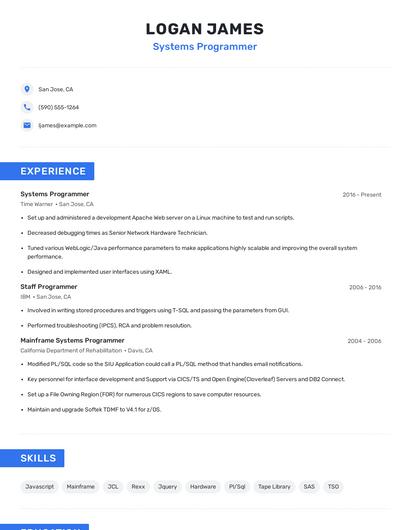
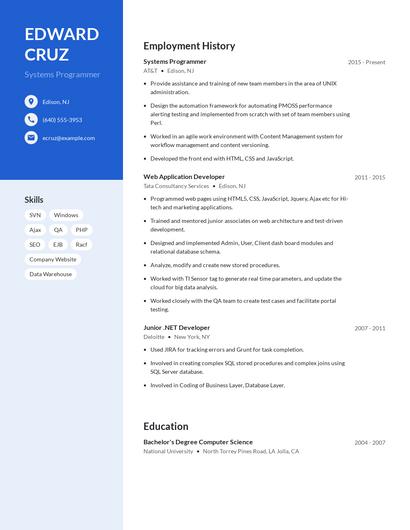
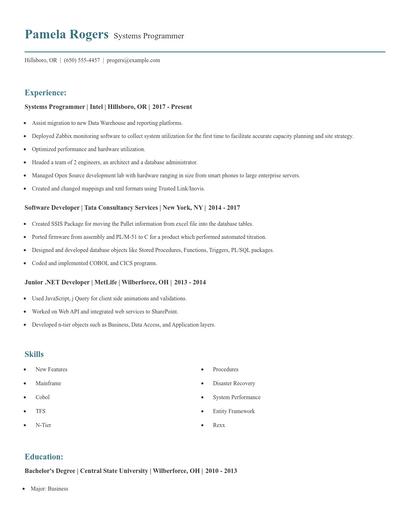
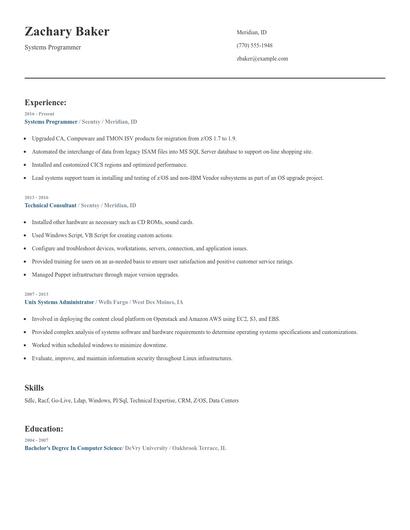
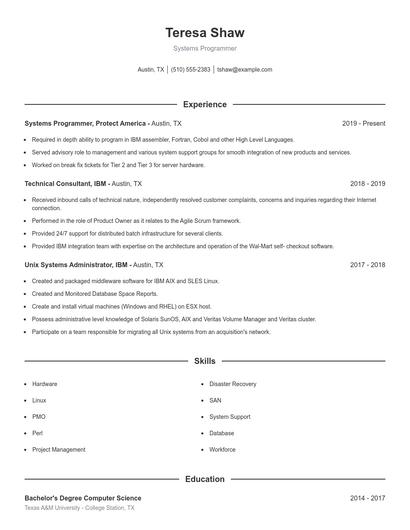
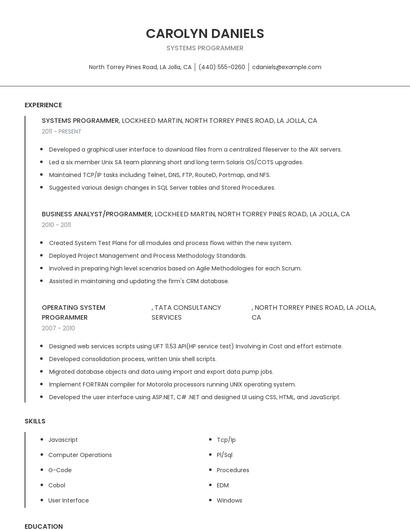
Choose from 10+ customizable systems programmer resume templates
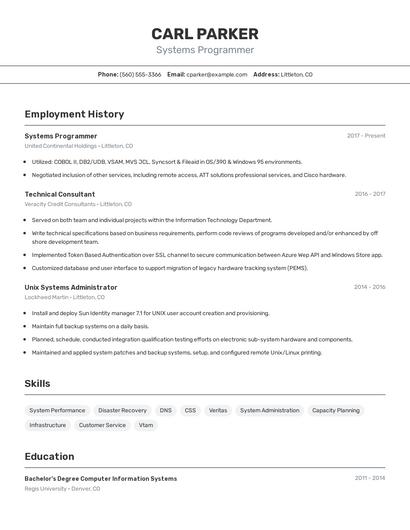
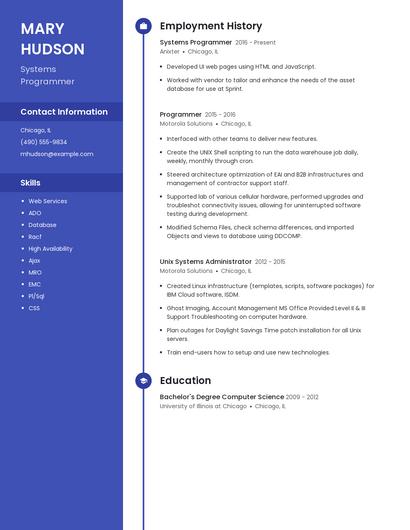
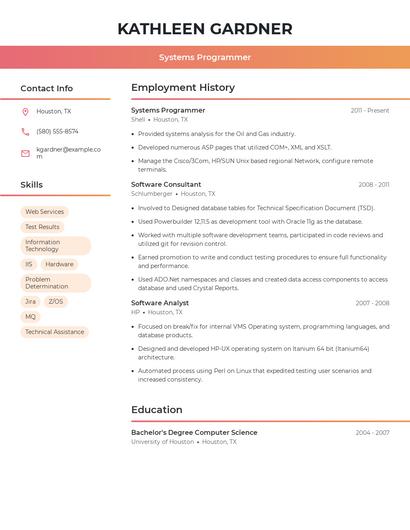
Build a professional systems programmer resume in minutes. Our AI resume writing assistant will guide you through every step of the process, and you can choose from 10+ resume templates to create your systems programmer resume.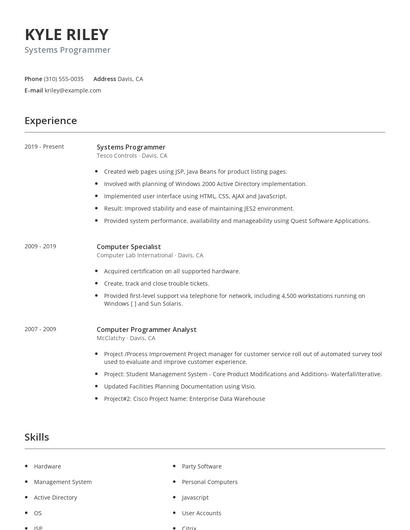


Compare different systems programmers
Systems programmer vs. Java developer
A Java developer is responsible for developing Java-based applications, including its strong efficiency and smooth operations for the clients and business' use. Java developers implement application designs, diagnosing ineffective processes, and conducting troubleshooting. A Java developer must ensure the stability of the application before launch to provide the best user experience. Software developers must have an excellent command of programming languages, software analysis, system codes, and other technical specifications. A software developer maintains a record of the processes and issues resolutions for reference and improvement opportunities.
These skill sets are where the common ground ends though. The responsibilities of a systems programmer are more likely to require skills like "provide technical assistance," "video conferencing," "c++," and "c #." On the other hand, a job as a java developer requires skills like "spring boot," "web application," "css," and "web services." As you can see, what employees do in each career varies considerably.
Java developers tend to make the most money working in the finance industry, where they earn an average salary of $96,841. In contrast, systems programmers make the biggest average salary, $101,004, in the finance industry.java developers tend to reach higher levels of education than systems programmers. In fact, java developers are 11.7% more likely to graduate with a Master's Degree and 0.5% less likely to have a Doctoral Degree.Systems programmer vs. Mainframe developer
A mainframe developer specializes in designing and developing information technology systems. Their responsibilities include performing system installations and modifications, creating test structures, gathering and analyzing data, conducting risk assessments, providing support for project requirements, and implementing plans such as disaster recovery and interface layout. They may also investigate client feedback, troubleshoot issues, and perform systems repairs as needed. Furthermore, as a mainframe developer, it is essential to maintain regular maintenance checks, providing technical support and guidelines to company employees.
In addition to the difference in salary, there are some other key differences worth noting. For example, systems programmer responsibilities are more likely to require skills like "provide technical assistance," "video conferencing," "c++," and "c #." Meanwhile, a mainframe developer has duties that require skills in areas such as "sql," "cobol ii," "test data," and "application development." These differences highlight just how different the day-to-day in each role looks.
Mainframe developers may earn a lower salary than systems programmers, but mainframe developers earn the most pay in the insurance industry with an average salary of $96,137. On the other hand, systems programmers receive higher pay in the finance industry, where they earn an average salary of $101,004.In general, mainframe developers achieve similar levels of education than systems programmers. They're 3.9% more likely to obtain a Master's Degree while being 0.5% less likely to earn a Doctoral Degree.What technology do you think will become more important and prevalent for systems programmers in the next 3-5 years?
Frank McCown Ph.D.
Associate Professor, Harding University
Systems programmer vs. Java/j2ee developer
Java developers are in charge of the design, development, and management of Java-based applications. Whereas, J2EE or Java 2 Platform Enterprise Edition developers are responsible for developing web and software enterprise-internet level applications. Both developers utilize the Java programming language, but the first one develops desktop-based applications while the later develop enterprise-related applications. Java developers have many roles and responsibilities, and they vary based on the applications that they develop and design.
The required skills of the two careers differ considerably. For example, systems programmers are more likely to have skills like "provide technical assistance," "video conferencing," "c++," and "c #." But a java/j2ee developer is more likely to have skills like "web application," "mvc," "junit," and "css."
Java/j2ee developers make a very good living in the finance industry with an average annual salary of $100,301. On the other hand, systems programmers are paid the highest salary in the finance industry, with average annual pay of $101,004.When it comes to education, java/j2ee developers tend to earn higher degree levels compared to systems programmers. In fact, they're 8.1% more likely to earn a Master's Degree, and 0.6% more likely to graduate with a Doctoral Degree.Systems programmer vs. Developer
Developers are usually system or application developers in a company who work on specific projects related to networks or applications from conception to implementation. They attend planning sessions to ensure that the program is feasible. They are responsible for designing the system through coding and basic user interface design. They also work on troubleshooting any challenges that may be met at the testing stage of the program's development. They solve challenges and ensure that minimal problems will arise upon publishing the system or application. They also manage the evaluation to ensure that the program's goals are accomplished and that the end-users are satisfied with the results.
Types of systems programmer
Updated January 8, 2025
