What does a task manager do?
The duties of a task manager depend on one's line of work or industry of employment. In general, a task manager plans and coordinates activities to ensure completion within schedules, budgets, and goals. Their responsibilities include identifying and understanding project needs, establishing guidelines and daily objectives, delegating tasks among staff, and developing strategies to optimize operations. They must also monitor the day-to-day operations and resolve issues should any arise. Moreover, a task manager must lead and encourage staff to reach goals, all while implementing and promoting the company's policies and regulations.
Task manager responsibilities
Here are examples of responsibilities from real task manager resumes:
- Manage conference logistics and record minutes at community meetings.
- Collaborate with infrastructure team to get deployment within standards, and get application security centrally manage.
- Manage, monitors and measures project portfolio status, recommending corrective action as necessary and communicate portfolio status to their management.
- Design input for hot cell manipulators and shield windows.
- Participate in proposal team which result in win of a major DoD contract.
- Provide expert guidance in the resolution of complex problems or issues impacting DHS programs.
- Develop multiple project schedules, templates, flowcharts, PowerPoint presentations, and status reports.
- Analyze DoD user SDLC programs to include software segment functionality, modules, and technical requirements.
- Serve as Webmaster on windows 2003 and windows 2008 servers running IIS 6.0 or IIS 7.5 respectively.
- Coordinate with the MacAulay-Brown director of ISR to ensure effective communications and awareness of progress, issues and/or concerns.
- Assemble all data packages in vary deliverable formats, including EPA, SW-846, and electronic data deliverables (EDD).
- Conduct lessons learned meetings with departmental stakeholders and incorporate responsive actions taken by PMO to ensure prior missteps are not repeat.
- Report infrastructure failures and actions implement.
- Develop improved project/work order management methodology for EVM reporting.
- Assist PMO with problem identification and develop solving capabilities.
Task manager skills and personality traits
We calculated that 17% of Task Managers are proficient in Project Management, Task Management, and Program Management.
We break down the percentage of Task Managers that have these skills listed on their resume here:
- Project Management, 17%
Reorganize and develop Project Management Office processes and procedures.
- Task Management, 16%
Provided administrative task management support and coordination.
- Program Management, 8%
Point of Contact for planning the MCCC Program Management Review (PMR) held approximately three times annually.
- Logistics, 5%
Provide Task Manager support to Senior Director and Program Managers for Health Care Logistics and Information Technology Organization.
- PowerPoint, 5%
Guided CBP offices to produce Talking Points, Briefing Memorandums, and PowerPoint Presentations regarding CBP activities and accomplishments.
- DOD, 5%
Produced 33 method procedures for a Department of Defense (DoD) chemical laboratory in compliance with the LQAP.
"project management," "task management," and "program management" are among the most common skills that task managers use at work. You can find even more task manager responsibilities below, including:
The three companies that hire the most task managers are:
- DHL33 task managers jobs
- Leidos10 task managers jobs
- Peraton9 task managers jobs
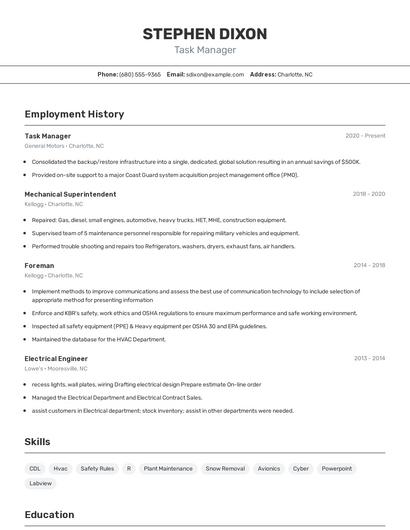
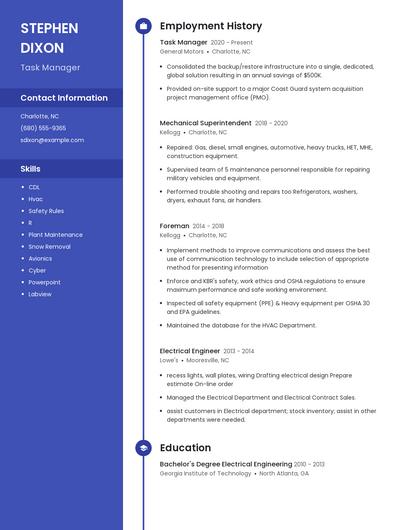
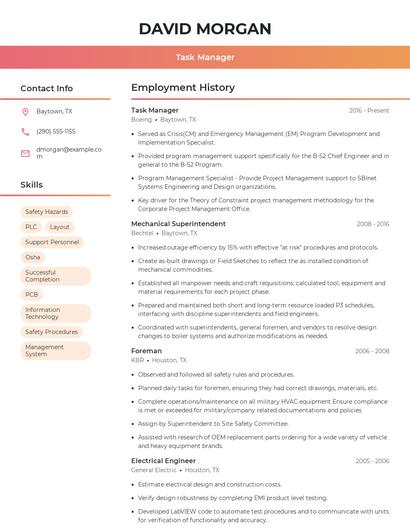
Choose from 10+ customizable task manager resume templates
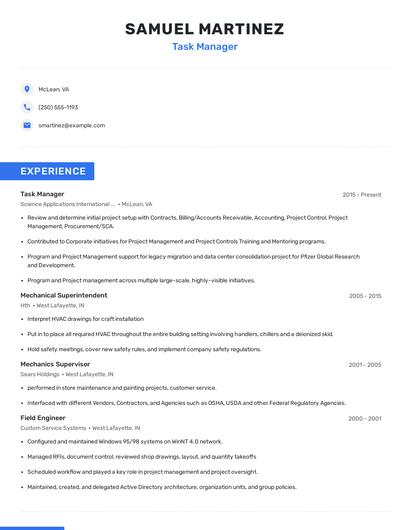
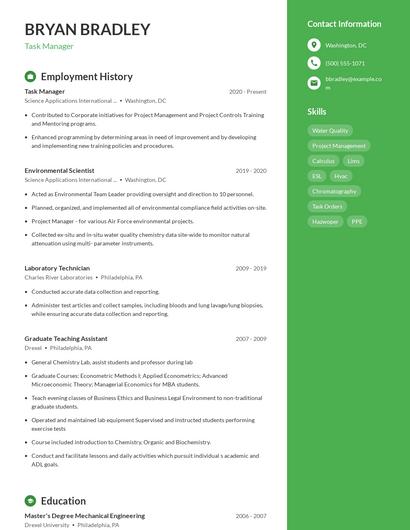
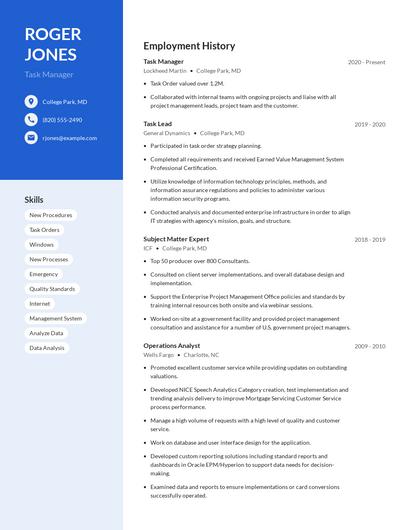
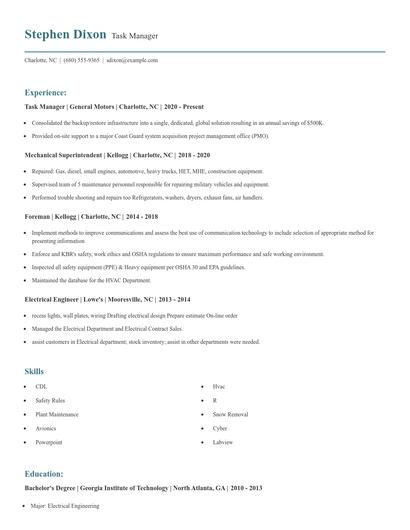
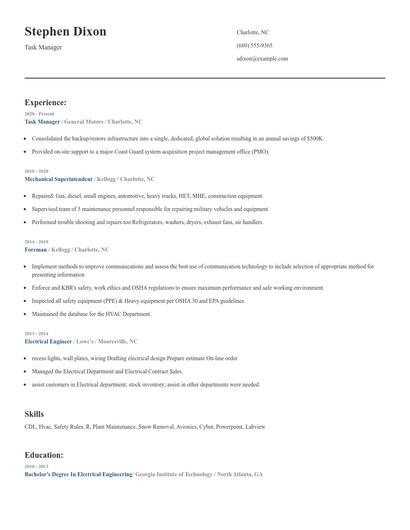
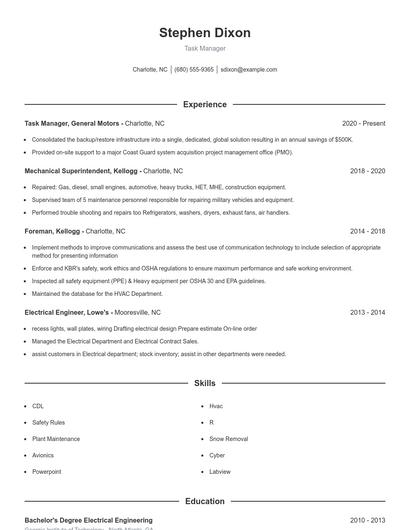
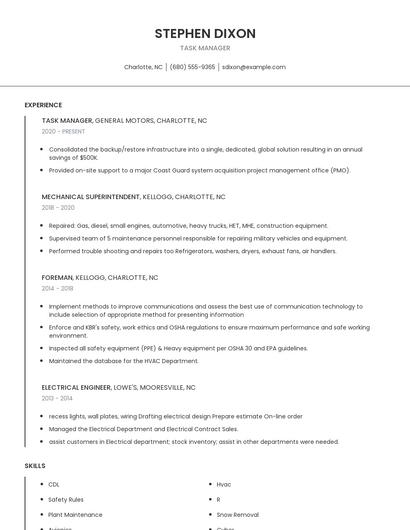
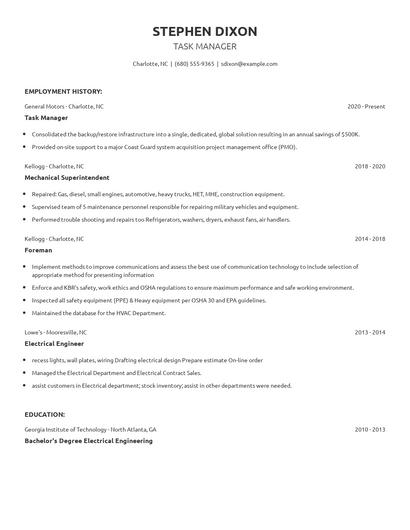
Build a professional task manager resume in minutes. Our AI resume writing assistant will guide you through every step of the process, and you can choose from 10+ resume templates to create your task manager resume.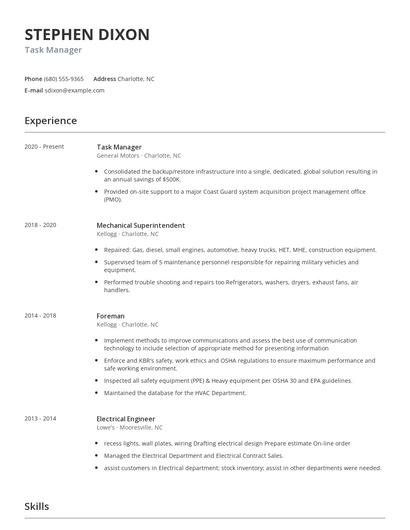
Compare different task managers
Task manager vs. Manager, project management
The role of a project management manager involves the planning, execution, monitoring, control, and closure of projects. Project managers oversee the scope of the entire project, the team, success or failure, and its resources. They facilitate productivity and commitment, remove obstacles, and motivate their team members. Their skills should include leadership, critical thinking, communication, negotiating, and risk management. They should also know about cost management, scheduling, and task management.
These skill sets are where the common ground ends though. The responsibilities of a task manager are more likely to require skills like "task management," "program management," "logistics," and "powerpoint." On the other hand, a job as a manager, project management requires skills like "risk management," "portfolio," "customer service," and "process improvement." As you can see, what employees do in each career varies considerably.
On average, managers, project management reach higher levels of education than task managers. Managers, project management are 5.6% more likely to earn a Master's Degree and 0.0% less likely to graduate with a Doctoral Degree.Task manager vs. Senior project manager
Senior project managers are experienced employees assigned to oversee a specific project in the organization. They manage the project from conception to execution. They are onboard the project from the ideation phase, providing valuable insights to ensure the success of the project. Senior project managers are also in charge of managing the budget, ensuring that the expected timelines are followed, adjusting strategies when needed, and guiding project team members. It is important for senior project managers to be good leaders and communicators. They should be able to balance the interests of all the stakeholders involved in the project. They should have good interpersonal skills and decision-making skills.
In addition to the difference in salary, there are some other key differences worth noting. For example, task manager responsibilities are more likely to require skills like "task management," "logistics," "powerpoint," and "quality standards." Meanwhile, a senior project manager has duties that require skills in areas such as "portfolio," "infrastructure," "project scope," and "risk management." These differences highlight just how different the day-to-day in each role looks.
Senior project managers earn higher levels of education than task managers in general. They're 6.9% more likely to graduate with a Master's Degree and 0.0% more likely to earn a Doctoral Degree.Task manager vs. Junior project manager
The junior project manager plans to organize and direct project-related operations in the company. Junior project managers define the scope of projects. Their duties include resource planning, developing schedules, documentation, time estimation, and activity sequencing. They should develop communication skills, risk management, and the ability to motivate, risk management, and business development and management. Orientation to detail, leadership skills, and knowledge of business are also necessary for this job.
There are many key differences between these two careers, including some of the skills required to perform responsibilities within each role. For example, a task manager is likely to be skilled in "task management," "program management," "logistics," and "powerpoint," while a typical junior project manager is skilled in "jr project," "project scope," "project documentation," and "jira."
When it comes to education, junior project managers tend to earn similar degree levels compared to task managers. In fact, they're 1.7% more likely to earn a Master's Degree, and 0.3% more likely to graduate with a Doctoral Degree.Task manager vs. Consultant/project manager
Consultants/project managers act as planners, leaders, and advisors in business enterprises. These professionals facilitate meetings and establish positive relationships with vendors, management, and clients. They make customer visits, maintain industry knowledge, procure third-party software and hardware, and deliver projects. It is also part of their duty to manage complex initiatives in an individual business unit or organization. Their skills include analytical, time and cost management, problem-solving, interpersonal skills, and proficiency in project management software.
Types of task manager
Updated January 8, 2025
