What does a technical operations specialist do?
The duties of a technical operations specialist depend on one's line of work and industry of employment. Typically, their responsibilities include overseeing the daily operations in an office or establishment, providing technical support to employees and clients, addressing issues and concerns, and performing corrective measures promptly and efficiently. They must also monitor the progress of operations, producing reports as needed. Furthermore, as a technical operations specialist, it is essential to develop strategies to optimize business operations, all while implementing the organization's policies and regulations, including its vision and mission.
Technical operations specialist responsibilities
Here are examples of responsibilities from real technical operations specialist resumes:
- Lead technical operations for an innovative workforce virtualization movement, including initial design and improvement of technical systems and processes.
- Provide on-call support for the UNIX production environment.
- Communicate directly with users to troubleshoot PC, printer, and network problems.
- Utilize VMware to provide a robust and stable virtual server environment (onsite and cloud).
- Provide support for the Cisco VPN client.
- Image OS to be upload to servers, install patches.
- Set up new add-on perepherals as needed to a LAN network.
- Create turnover report using SharePoint software, logging history of data and dates.
- Create mock websites, perform HTML updates and changes to clients websites and help write copy for new websites.
- Provide technical leadership and security oversight for a team of local Unix admins varying in size from 2 to 12 members.
- Diagnose services for OS relate problems, hardware problems, application problems or network relate issues associate with an open system.
- Maintain and renew names, create necessary DNS entries, register with search engines, and perform other domain name support.
- Implement DOD information assurance policy.
- Installed/Maintained/Administered Microsoft Sharepoint server for team.
- Enhance specialized repair turnover by improving QA assurance procedures.
Technical operations specialist skills and personality traits
We calculated that 17% of Technical Operations Specialists are proficient in Customer Service, Technical Support, and QA. They’re also known for soft skills such as Customer-service skills, Listening skills, and Problem-solving skills.
We break down the percentage of Technical Operations Specialists that have these skills listed on their resume here:
- Customer Service, 17%
Recognized by management for excellence in quality assurance monitoring; promoted from customer service professional to technical operations after five months.
- Technical Support, 12%
Ensured operation of equipment by completing preventive maintenance requirements and call for technical support.
- QA, 3%
Completed investigations for microbiology, QC/Chem, production, QA, facilities/enginnering events.
- Linux, 3%
Provided Hardware Break/Fix solutions for Enterprise IT assets including Red Hat Linux 6, Windows server 2008/2012 and Cisco networking systems.
- OS, 3%
Demonstrated experience with IT topics, clients/ server, OS, Database, networking, security, automatons and ITIL framework
- Management System, 3%
Design and Implementation of job definitions for the ActiveBatch Cross Platform Job Scheduling and Management System.
Most technical operations specialists use their skills in "customer service," "technical support," and "qa" to do their jobs. You can find more detail on essential technical operations specialist responsibilities here:
Customer-service skills. One of the key soft skills for a technical operations specialist to have is customer-service skills. You can see how this relates to what technical operations specialists do because "computer support specialists must be patient and sympathetic." Additionally, a technical operations specialist resume shows how technical operations specialists use customer-service skills: "aided customer support staff by providing technical assistance to end-users. "
Listening skills. Another essential skill to perform technical operations specialist duties is listening skills. Technical operations specialists responsibilities require that "support workers must be able to understand the problems that their customers are describing and know when to ask questions to clarify the situation." Technical operations specialists also use listening skills in their role according to a real resume snippet: "communicated with sales agents to verify technical issues. "
Problem-solving skills. technical operations specialists are also known for problem-solving skills, which are critical to their duties. You can see how this skill relates to technical operations specialist responsibilities, because "support workers must identify both simple and complex computer problems, analyze them, and solve them." A technical operations specialist resume example shows how problem-solving skills is used in the workplace: "troubleshooted and resolved web application issues escalated from customer support and other departments with a 100% success rate. "
Speaking skills. For certain technical operations specialist responsibilities to be completed, the job requires competence in "speaking skills." The day-to-day duties of a technical operations specialist rely on this skill, as "support workers must describe the solutions to computer problems in a way that a nontechnical person can understand." For example, this snippet was taken directly from a resume about how this skill applies to what technical operations specialists do: "presented a qa review of the pasce review application using word and powerpoint. "
Writing skills. Another crucial skill for a technical operations specialist to carry out their responsibilities is "writing skills." A big part of what technical operations specialists relies on this skill, since "strong writing skills are useful for preparing instructions and email responses for employees and customers, as well as for real-time web chat interactions." How this skill relates to technical operations specialist duties can be seen in an example from a technical operations specialist resume snippet: "assist in writing unix scripts for data load from and to various applications and platforms. "
The three companies that hire the most technical operations specialists are:
- Deloitte54 technical operations specialists jobs
- Forrester11 technical operations specialists jobs
- NextGen Healthcare9 technical operations specialists jobs
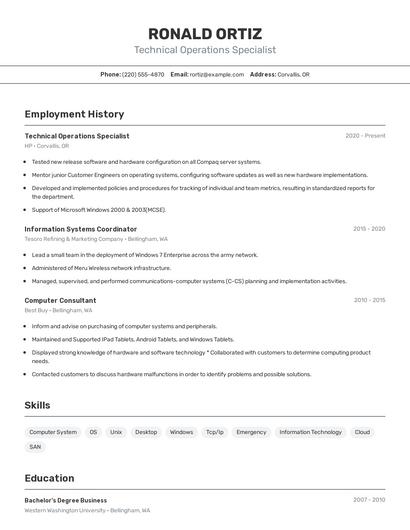
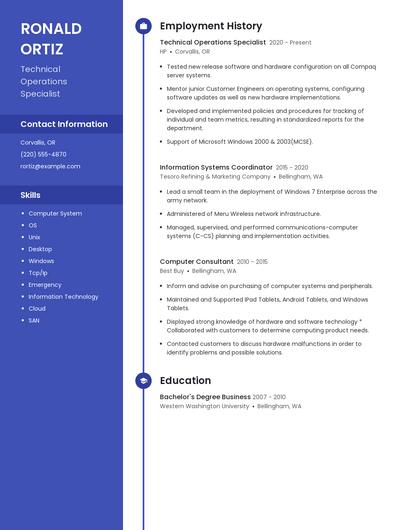
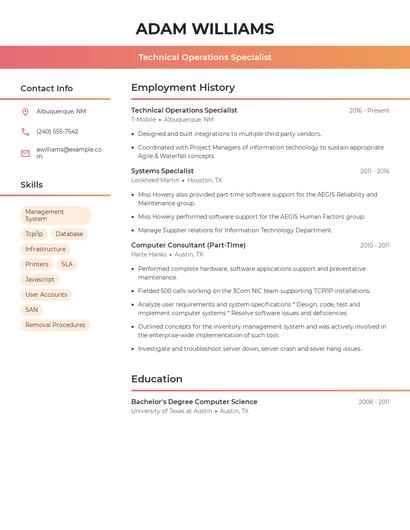
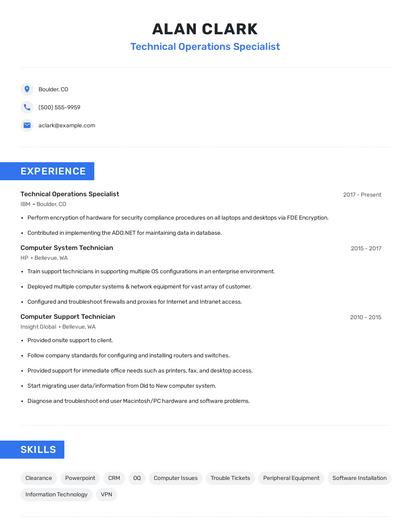
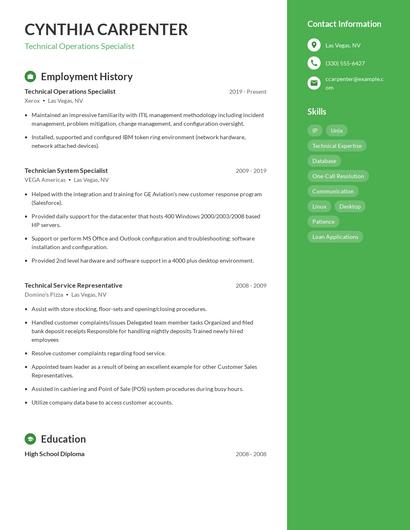
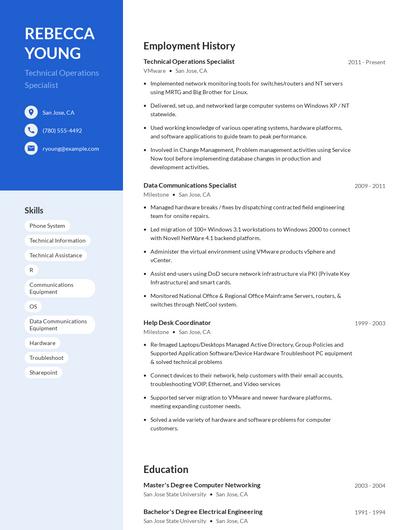
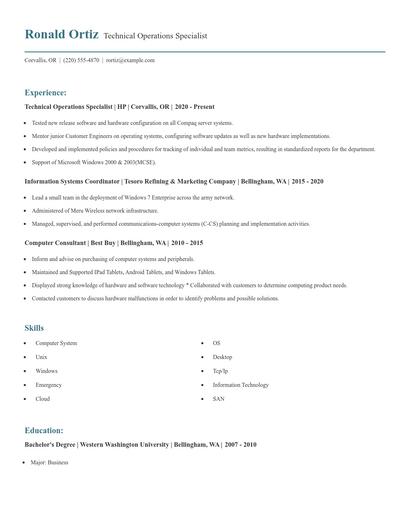
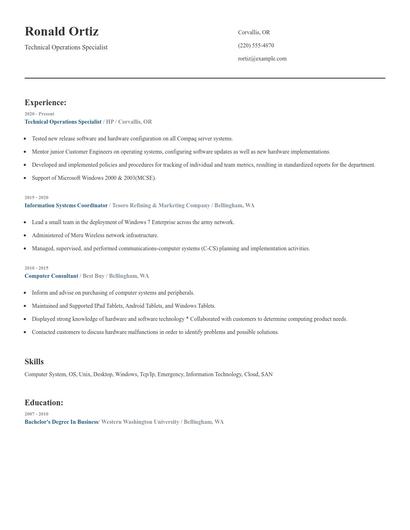
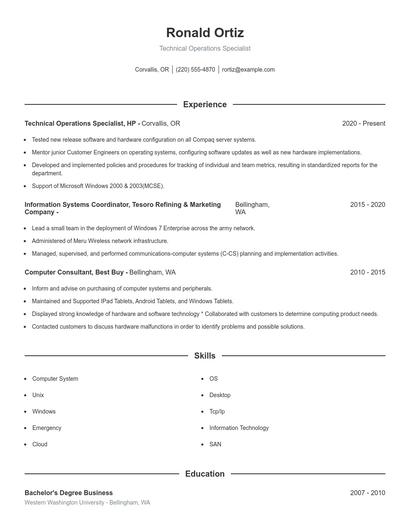
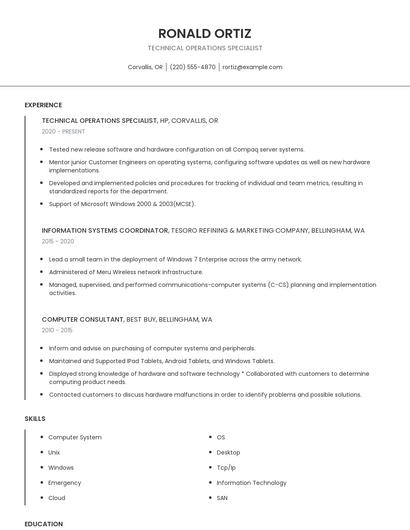
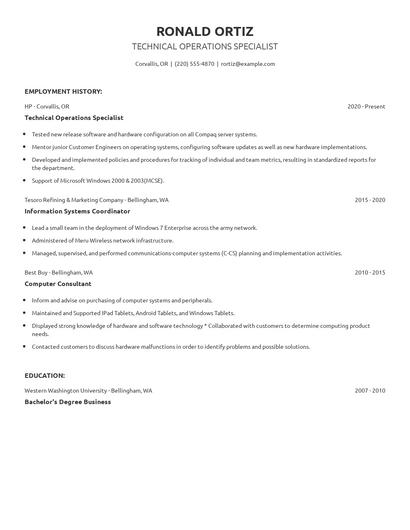
Choose from 10+ customizable technical operations specialist resume templates
Build a professional technical operations specialist resume in minutes. Our AI resume writing assistant will guide you through every step of the process, and you can choose from 10+ resume templates to create your technical operations specialist resume.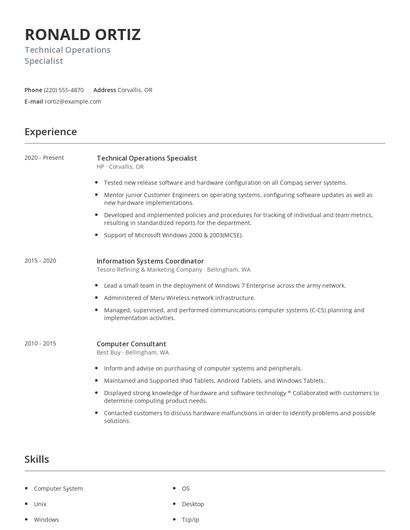
Compare different technical operations specialists
Technical operations specialist vs. Technical advisor
Technical advisors are experts in a specific field of knowledge, offering information and advice to those in the field. They develop applications, coordinate the activities of technicians, and provide technical expertise. They offer advice and suggestions to specialists. The skills they need to possess include multitasking abilities, attention to detail, and exceptional customer service. They are also required to be savvy in terms of information technology, business practices, and have significant experience in this field.
There are some key differences in the responsibilities of each position. For example, technical operations specialist responsibilities require skills like "os," "management system," "sops," and "pc." Meanwhile a typical technical advisor has skills in areas such as "project management," "troubleshoot," "excellent interpersonal," and "business development." This difference in skills reveals the differences in what each career does.
Technical advisors earn the highest salaries when working in the technology industry, with an average yearly salary of $121,374. On the other hand, technical operations specialists are paid more in the finance industry with an average salary of $93,729.technical advisors tend to reach similar levels of education than technical operations specialists. In fact, technical advisors are 3.6% more likely to graduate with a Master's Degree and 1.7% more likely to have a Doctoral Degree.Technical operations specialist vs. Senior information technology specialist
A senior information technology specialist is responsible for handling technology systems and network issues, ensuring the efficiency and optimal performance of the database by configuration and improving network infrastructures. Senior information technology specialists also design computer systems and applications to support business functions and operations, depending on the requirements and budget limitations. They create resolution reports for reference and recommend strategic techniques to prevent the reoccurrence of defects and malfunctions. A senior information technology specialist must have excellent communication and technical skills, especially in responding to the end-users' inquiries and concerns about the servers.
In addition to the difference in salary, there are some other key differences worth noting. For example, technical operations specialist responsibilities are more likely to require skills like "sops," "help support," "api," and "operational procedures." Meanwhile, a senior information technology specialist has duties that require skills in areas such as "database," "project management," "lifecycle management," and "sr." These differences highlight just how different the day-to-day in each role looks.
Senior information technology specialists may earn a higher salary than technical operations specialists, but senior information technology specialists earn the most pay in the energy industry with an average salary of $117,267. On the other hand, technical operations specialists receive higher pay in the finance industry, where they earn an average salary of $93,729.Average education levels between the two professions vary. Senior information technology specialists tend to reach similar levels of education than technical operations specialists. In fact, they're 4.0% more likely to graduate with a Master's Degree and 1.7% less likely to earn a Doctoral Degree.What technology do you think will become more important and prevalent for technical operations specialists in the next 3-5 years?
Babak Beheshti Ph.D.
Dean, Professor, New York Institute of Technology
-We will be witnessing a more widespread commercial deployment of 5G in 2020. With the implementation of the Standalone 5G devices based on the 3gpp release 16, we should be seeing the more robust mobile broadband deployment of 5G, wider availability of 5G smartphones, and a push towards an all 5G Network in select urban areas around the world.
-Significant growth in AI-based technologies, from face recognition and voice recognition to business intelligence and market predictions. As machines and deep learning algorithms get integrated into many applications, many industries will undergo substantial changes. AI systems will continue to interact with our phones; cars will interpret and analyze their surroundings and intelligently drive themselves. Online vendors will monitor our browsing habits, and Google decides what kind of search results to give us, based on who it thinks we are.
Technical operations specialist vs. Systems specialist
Systems specialists are professionals who maintain, troubleshoot, and install information and computer systems. They identify the software, data, and hardware needs of companies. Generally, they work in physically demanding indoor environments installing complicated networks. They manage, lead, and coordinate technical support for new software, upgrades, and products. Also, they configure systems for the users and assess data from different sources to make a decision.
There are many key differences between these two careers, including some of the skills required to perform responsibilities within each role. For example, a technical operations specialist is likely to be skilled in "sops," "java," "sme," and "help support," while a typical systems specialist is skilled in "veterans," "troubleshoot," "patients," and "project management."
Systems specialists earn the highest salary when working in the manufacturing industry, where they receive an average salary of $91,431. Comparatively, technical operations specialists have the highest earning potential in the finance industry, with an average salary of $93,729.Most systems specialists achieve a similar degree level compared to technical operations specialists. For example, they're 0.3% more likely to graduate with a Master's Degree, and 0.2% more likely to earn a Doctoral Degree.Technical operations specialist vs. Technical support technician
Technical support technicians are skilled professionals who resolve computer or information technology-related concerns. They may do installations, repairs, or maintenance activities of various applications or computer hardware. They are sometimes assigned specific issues or concerns to resolve so that they will not be bombarded with various issues. This means that they can now specialize in a specific family of concerns. Technical support technicians may provide on-site support, going directly to the person who needs help and doing what needs to be done or troubleshoot the problem in person. They may also be offsite and would usually be manning helpdesk hotlines. Offsite technical support technicians walk the caller through the steps they should do to fix the issues. As such, when a technical support technician is offsite, they are expected to be good communicators and will be able to provide clear instructions.
Even though a few skill sets overlap between technical operations specialists and technical support technicians, there are some differences that are important to note. For one, a technical operations specialist might have more use for skills like "sops," "java," "pc," and "sme." Meanwhile, some responsibilities of technical support technicians require skills like "patients," "mac," "sql," and "inbound calls. "
Technical support technicians enjoy the best pay in the finance industry, with an average salary of $52,365. For comparison, technical operations specialists earn the highest salary in the finance industry.The average resume of technical support technicians showed that they earn similar levels of education compared to technical operations specialists. So much so that theyacirc;euro;trade;re 4.7% less likely to earn a Master's Degree and less likely to earn a Doctoral Degree by 0.6%.Types of technical operations specialist
Updated January 8, 2025
