What does a technical scientist do?
A Technical Scientist is responsible for using established literature on laboratory techniques and basic scientific experimentation to improve processes and products. Their duties include developing solutions for routine and non-routine problems, evaluating workflow progress against objectives, inspect scientific data, and present laboratory results, and contribute to the implementation of new processes within a team. They must ensure compliance with safe working practice, quality standards, and its relevant environment and risk management system workplace guidelines. A Technical Scientist must have advanced knowledge in data analysis tools such as spreadsheets and have well-rounded communication skills for effective presentation to a wide demographic.
Technical scientist responsibilities
Here are examples of responsibilities from real technical scientist resumes:
- Develop and manage third party claim investigations and contractor remedial oversight for various insurance companies.
- Perform data analysis, GMP documentation and equipment maintenance.
- Line support expertise of the manufacturing and QC processes for cell controls.
- Participate in the methods transfer, validation, EP monograph and USP monograph using HPLC analysis of raw materials.
- Perform HPLC purification of a monoclonal antibody used as a diagnostic reagent.
- Develop characterization and validation protocols per remediation activities identify after commitment with the FDA.
- Provide method improvement and troubleshooting of assign assays within the QC microbiology testing laboratory.
- Develop and scaled-up manufacturing processes for liquid consumer products from laboratory to final GMP production scale at various external manufacturing sites.
- Communicate with FDA auditors to prevent potential problems with ongoing testing procedures and communicate possible solutions as corrective and preventative actions.
- Work closely with manufacturers, suppliers, and QA team in establishing finish product claims using raw material specifications.
- Conduct multi-step synthesis of heterocyclic small molecules for hit-to-lead and lead optimization programs and characterize compounds by utilizing LCMS and NMR.
Technical scientist skills and personality traits
We calculated that 7% of Technical Scientists are proficient in Molecular Biology, GMP, and Data Analysis.
We break down the percentage of Technical Scientists that have these skills listed on their resume here:
- Molecular Biology, 7%
Performed multiple advanced molecular biology techniques within a library construction environment associated mainly with Next Generation Sequencing.
- GMP, 6%
Reviewed Influenza vaccine documentation including manufacturing batch records and laboratory tests for GMP compliance.
- Data Analysis, 5%
Managed all aspects of qualifications and validation projects including protocol development and execution, data analysis and report development.
- Laboratory Equipment, 5%
Assisted with the daily QC and maintenance of hematology analyzers, as well as maintaining the calibration schedule for laboratory equipment.
- FDA, 5%
Analyzed manufacturing formulas and device master records, implementing changes to ensure compliance with FDA, DEA and ISO requirements.
- Cell Culture, 4%
Maintained daily operations, maintained cell cultures, organized lab inventory, placed orders for reagents and instruments.
"molecular biology," "gmp," and "data analysis" are among the most common skills that technical scientists use at work. You can find even more technical scientist responsibilities below, including:
Communication skills. To carry out their duties, the most important skill for a technical scientist to have is communication skills. Their role and responsibilities require that "medical scientists must be able to explain their research in nontechnical ways." Technical scientists often use communication skills in their day-to-day job, as shown by this real resume: "display good communication skills, practical dexterity and attention to detail. "
Observation skills. Many technical scientist duties rely on observation skills. "medical scientists conduct experiments that require monitoring samples and other health-related data.," so a technical scientist will need this skill often in their role. This resume example is just one of many ways technical scientist responsibilities rely on observation skills: "maintained a clean and safe work environment while making observations and calculations in a laboratory notebook. "
The three companies that hire the most technical scientists are:
- Amazon13 technical scientists jobs
- Takeda Pharmaceuticals U.S.A., Inc.12 technical scientists jobs
- Keurig Dr Pepper9 technical scientists jobs
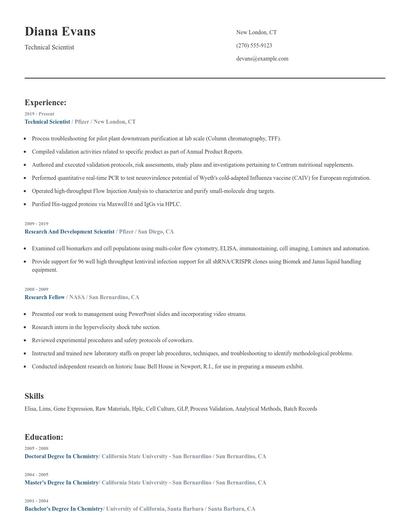
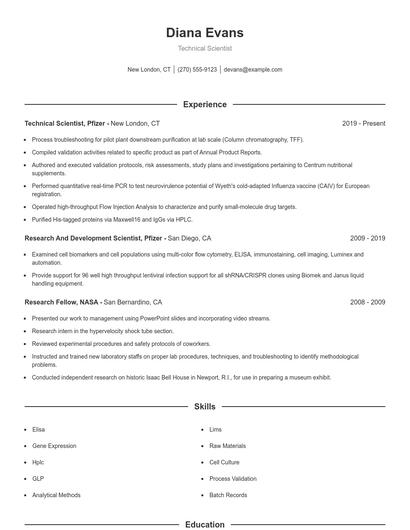
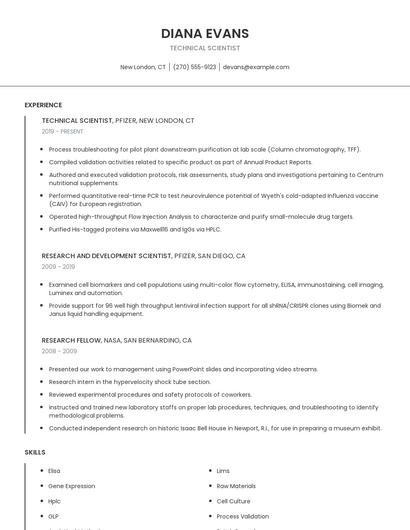
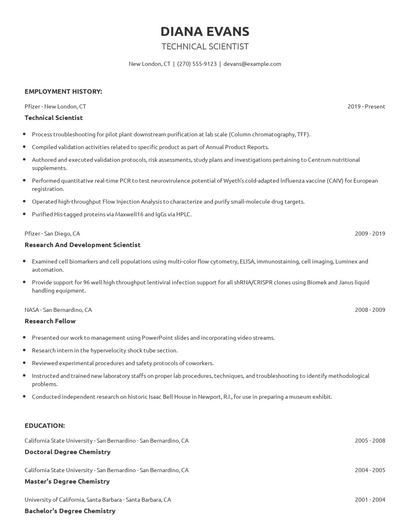
Choose from 10+ customizable technical scientist resume templates
Build a professional technical scientist resume in minutes. Our AI resume writing assistant will guide you through every step of the process, and you can choose from 10+ resume templates to create your technical scientist resume.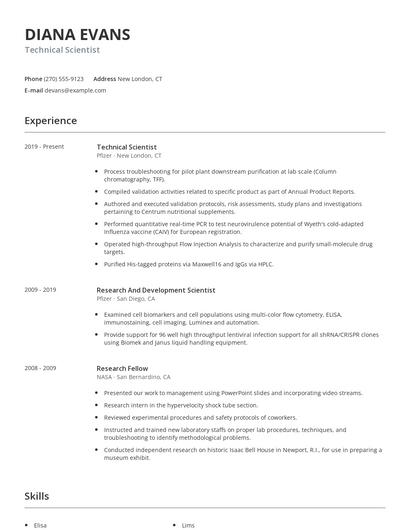
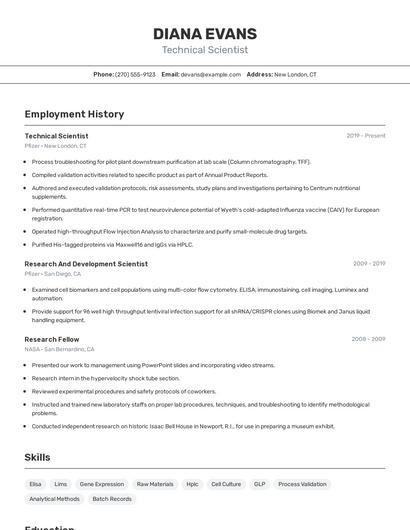
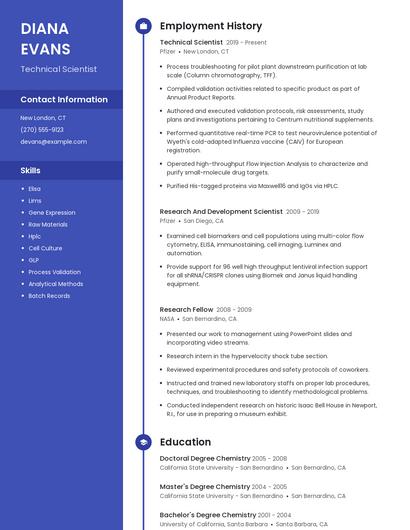
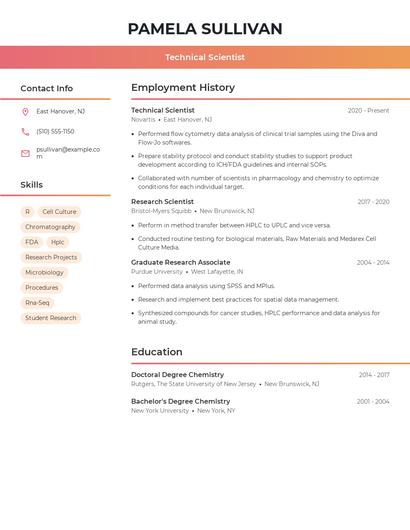
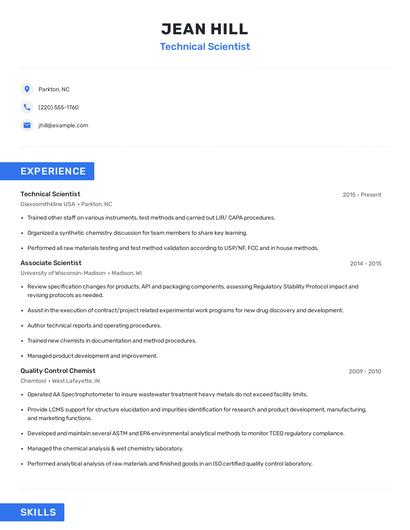
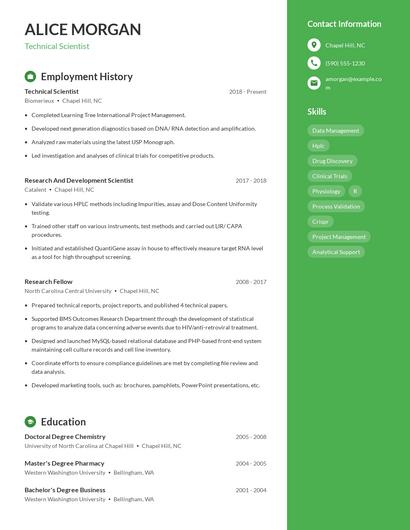
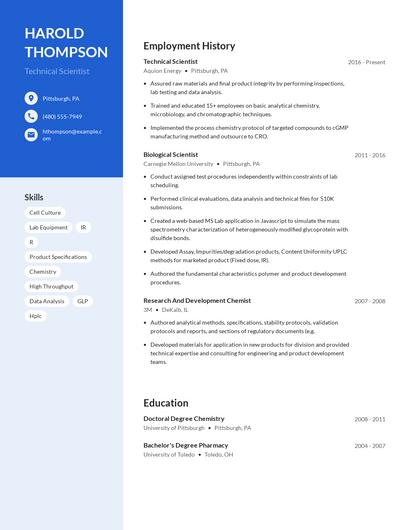
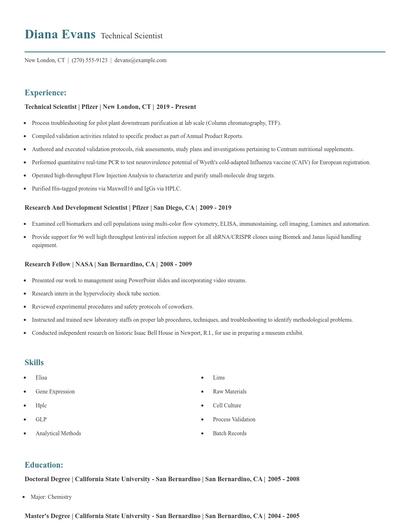
Compare different technical scientists
Technical scientist vs. Research fellow
A research fellow is an academic researcher who conducts research and analysis of comprehensive literature, data, and results and provides literature reviews. He/She supervises research assistants and recruits study participants to interview them for a particular study. To become a research fellow, a candidate should have a doctorate in a relevant discipline and publish peer-reviewed papers. Also, a research fellow can be an independent investigator or be supervised by a principal investigator.
These skill sets are where the common ground ends though. The responsibilities of a technical scientist are more likely to require skills like "molecular biology," "gmp," "laboratory equipment," and "method development." On the other hand, a job as a research fellow requires skills like "patients," "research projects," "immunology," and "crispr." As you can see, what employees do in each career varies considerably.
Research fellows tend to make the most money working in the non profits industry, where they earn an average salary of $57,261. In contrast, technical scientists make the biggest average salary, $96,878, in the health care industry.On average, research fellows reach similar levels of education than technical scientists. Research fellows are 1.1% more likely to earn a Master's Degree and 21.5% more likely to graduate with a Doctoral Degree.Technical scientist vs. Laboratory analyst
A Laboratory Analyst helps conduct experiments, run laboratory tests, and analyze results. They compile and record data for the documentation needed for testing and report preparation.
Each career also uses different skills, according to real technical scientist resumes. While technical scientist responsibilities can utilize skills like "molecular biology," "laboratory equipment," "cell culture," and "process improvement," laboratory analysts use skills like "lab equipment," "laboratory procedures," "sample preparation," and "analytical methods."
On average, laboratory analysts earn a lower salary than technical scientists. Some industries support higher salaries in each profession. Interestingly enough, laboratory analysts earn the most pay in the pharmaceutical industry with an average salary of $47,806. Whereas technical scientists have higher pay in the health care industry, with an average salary of $96,878.In general, laboratory analysts achieve lower levels of education than technical scientists. They're 10.6% less likely to obtain a Master's Degree while being 21.5% less likely to earn a Doctoral Degree.What technology do you think will become more important and prevalent for technical scientists in the next 3-5 years?
Dr. Betsy Smith
Assistant Professor of Chemistry, Elmira College
Technical scientist vs. Postdoctoral research associate
A postdoctoral research associate is responsible for assisting the educational institution's research department, writing research reports, analyzing research methods, and collecting information and related studies to support the research claims. Postdoctoral research associates must have excellent communication skills, both oral and written, reporting research updates to the research head, performing adjustments as needed, and gaining more expertise on the subject by brainstorming and discussing strategic procedures for the study. They may also conduct field investigation or coordinate with other institutions for additional reference, depending on the research's scope and limitation.
Some important key differences between the two careers include a few of the skills necessary to fulfill the responsibilities of each. Some examples from technical scientist resumes include skills like "molecular biology," "gmp," "laboratory equipment," and "fda," whereas a postdoctoral research associate is more likely to list skills in "python," "research projects," "chemistry," and "post-doctoral. "
Postdoctoral research associates earn the highest salary when working in the professional industry, where they receive an average salary of $69,999. Comparatively, technical scientists have the highest earning potential in the health care industry, with an average salary of $96,878.Most postdoctoral research associates achieve a similar degree level compared to technical scientists. For example, they're 1.4% less likely to graduate with a Master's Degree, and 36.6% less likely to earn a Doctoral Degree.Technical scientist vs. Chemist
Chemists are generally responsible for observing and investigating chemical substances to create new and safe compounds essential for practical applications. They are often grouped depending on a particular area of specialization to focus and understand the complexities of the matter. A chemist usually takes time performing research and conducting experiments to test and further improve the quality and usage of a specific chemical substance. Chemists are expected to write on their observations and findings to establish scientific results.
Even though a few skill sets overlap between technical scientists and chemists, there are some differences that are important to note. For one, a technical scientist might have more use for skills like "molecular biology," "laboratory equipment," "cell culture," and "process improvement." Meanwhile, some responsibilities of chemists require skills like "chemistry," "lab equipment," "test results," and "analytical methods. "
The manufacturing industry tends to pay the highest salaries for chemists, with average annual pay of $75,495. Comparatively, the highest technical scientist annual salary comes from the health care industry.The average resume of chemists showed that they earn lower levels of education compared to technical scientists. So much so that theyacirc;euro;trade;re 6.7% less likely to earn a Master's Degree and less likely to earn a Doctoral Degree by 7.8%.Types of technical scientist
Updated January 8, 2025
