What does a therapy program manager do?
A Therapy Program Manager provides leadership and management of the physical therapy department. They direct and coordinate the policies, objectives, and initiatives of physical therapy programs.
Therapy program manager responsibilities
Here are examples of responsibilities from real therapy program manager resumes:
- Lead a team of thirty-five (35) FTE.
- Manage a staff of 9 therapists in a CCRC setting including a 169 bed SNF.
- Achieve employee performance and satisfaction providing supervision supporting excellence in documentation, a collaborative approach with providers and compassion for members.
- Initiate department quality and process improvements to meet JACHO, MCR, CMS, CARF and other governing entity requirements.
- Provide primary physical therapy treatment to patients on caseload and complete necessary documentation for billing insurance and showing medical necessity.
- Consider a``working manager"( PTA )
- Exceed standards to pass CARF licensing with minimal/no recommendations.
- Schedule, update and record all medical appointments via CMS system.
- Work closely with MDS staff to ensure maximum reimbursement with OBRA assessments.
- Plan treatment schedules, track MDS assessments, and complete monthly billing.
- Administer the annual operations budget which include procurement, cost control, and reimbursement oversight.
- Educate staff on state and federal statues, rules and regulations governing Medicare / Medicaid.
- Streamline required insurance documents for Medicaid or Medicare process.
- Initiate individual training research and co-authore rehabilitation medicine patient education manual.
- Evaluate and provide treatment to adult population in inpatient rehabilitation setting.
Therapy program manager skills and personality traits
We calculated that 25% of Therapy Program Managers are proficient in Patients, Customer Service, and Respiratory Care. They’re also known for soft skills such as Analytical skills, Communication skills, and Leadership skills.
We break down the percentage of Therapy Program Managers that have these skills listed on their resume here:
- Patients, 25%
Provided primary physical therapy treatment to patients on caseload and completed necessary documentation for billing insurance and showing medical necessity.
- Customer Service, 12%
Service Excellence Trainer- Nominated by senior hospital management to lead hospital wide training seminars on how to excel in customer service.
- Respiratory Care, 7%
Lead developer for overall respiratory care computer charting program.
- Acute Care, 7%
Involved in direct patient treatment in order to assess competency of all incoming Physical Therapy staff in an Acute Care setting.
- Respiratory Therapy, 6%
Worked with medical director to develop respiratory therapy-driven protocols and the Advanced Respiratory Therapy Practitioner role at Duke University.
- Rehabilitation, 6%
Coordinated the activities of Physical Therapists, Occupational Therapists, and Speech-Language Pathologists in a rehabilitation setting.
"patients," "customer service," and "respiratory care" are among the most common skills that therapy program managers use at work. You can find even more therapy program manager responsibilities below, including:
Analytical skills. To carry out their duties, the most important skill for a therapy program manager to have is analytical skills. Their role and responsibilities require that "medical and health services managers review and evaluate healthcare metrics for ways to improve efficiency and meet goals." Therapy program managers often use analytical skills in their day-to-day job, as shown by this real resume: "assemble pre-evaluation data, interpret and administer physician, nurse, and recreation therapy prescription orders and schedule patients for treatment. "
Communication skills. Many therapy program manager duties rely on communication skills. "medical and health services managers must convey information to their staff, other healthcare workers, and, sometimes, patients and insurance agents.," so a therapy program manager will need this skill often in their role. This resume example is just one of many ways therapy program manager responsibilities rely on communication skills: "conducted monthly patient case conferences, in-services and staff meetings to educate staff and facilitate good communication. "
Leadership skills. Another skill that relates to the job responsibilities of therapy program managers is leadership skills. This skill is critical to many everyday therapy program manager duties, as "medical and health services managers hire, train, and direct staff." This example from a resume shows how this skill is used: "provided clinical leadership within the rehab team by setting the example of the provision of quality patient care. "
Technical skills. A big part of what therapy program managers do relies on "technical skills." You can see how essential it is to therapy program manager responsibilities because "medical and health services managers must stay up to date with advances in healthcare technology, such as the coding and electronic health record (ehr) systems their facility adopts." Here's an example of how this skill is used from a resume that represents typical therapy program manager tasks: "managed home therapy licensed personnel, direct patient care staff, indirect patient care personnel, and when necessary technical staff. "
Detail oriented. Another crucial skill for a therapy program manager to carry out their responsibilities is "detail oriented." A big part of what therapy program managers relies on this skill, since "medical and health services managers must pay attention to detail." How this skill relates to therapy program manager duties can be seen in an example from a therapy program manager resume snippet: "conducted initial and re-evaluations, took detailed history for patients and doctors. "
The three companies that hire the most therapy program managers are:
- Fresenius Medical Care North America Holdings Limited Partnership21 therapy program managers jobs
- Fresenius Medical Care Windsor, LLC20 therapy program managers jobs
- Encore Rehabilitation Services8 therapy program managers jobs
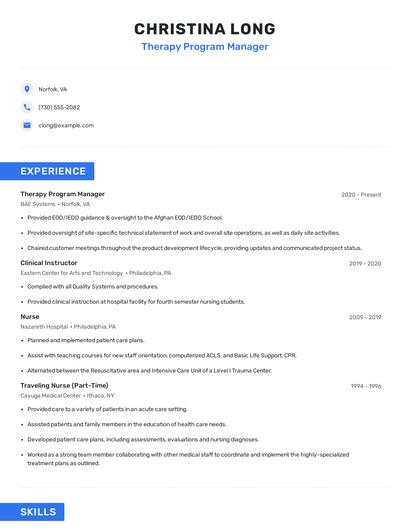
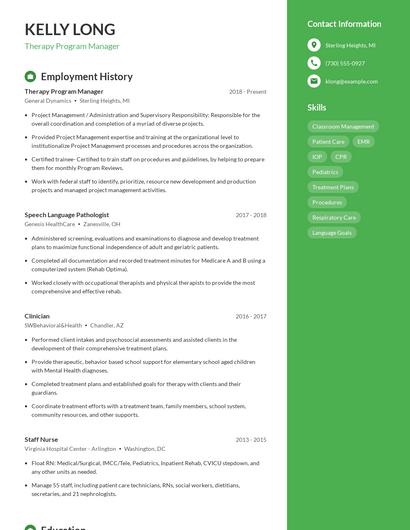
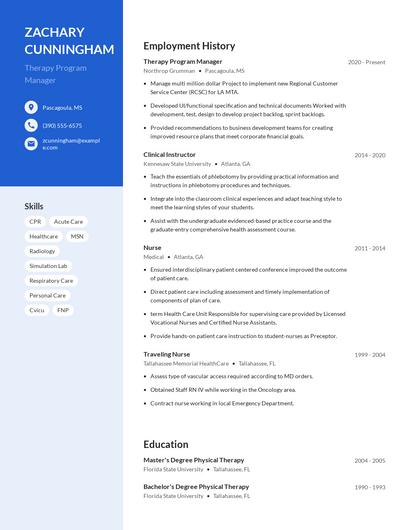
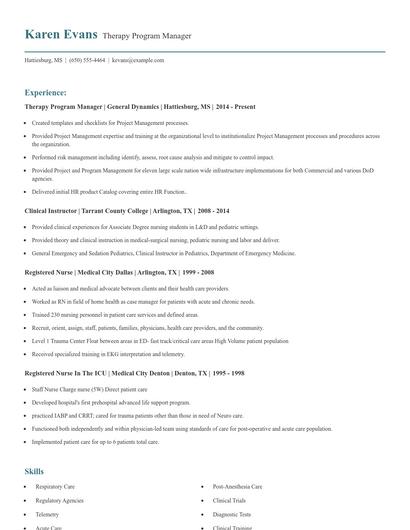
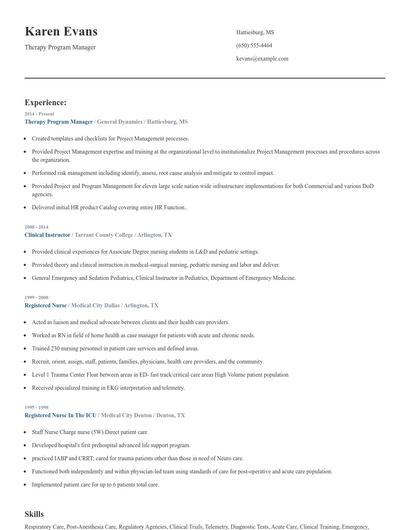
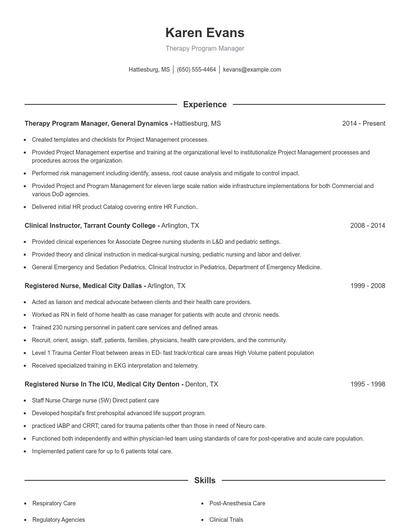
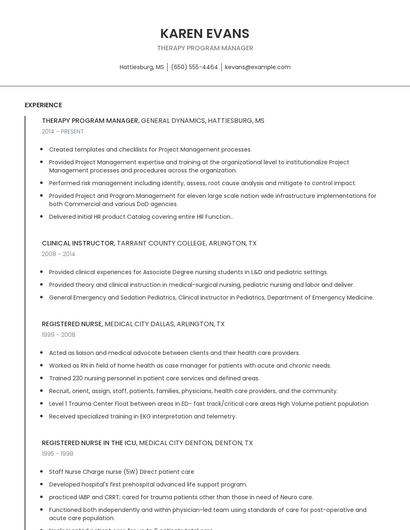
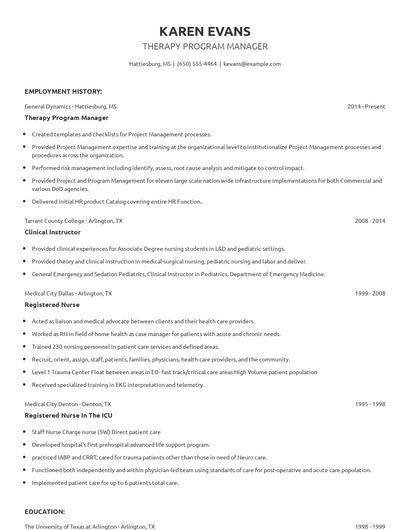
Choose from 10+ customizable therapy program manager resume templates
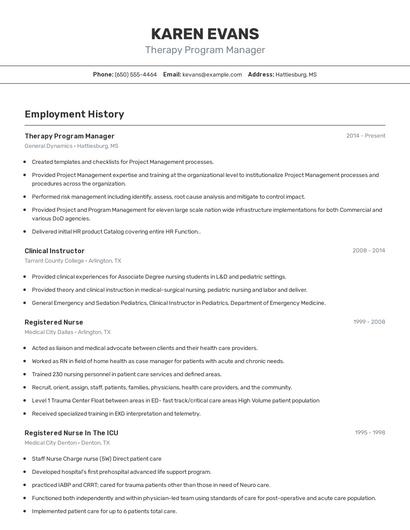
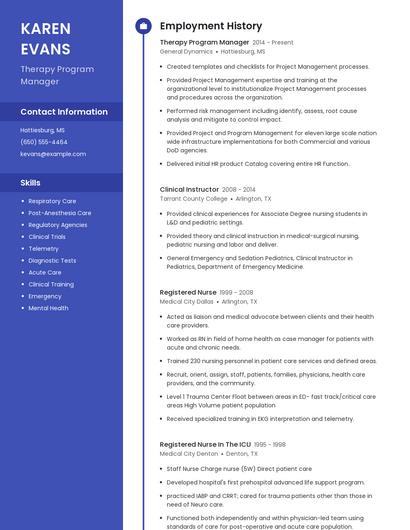
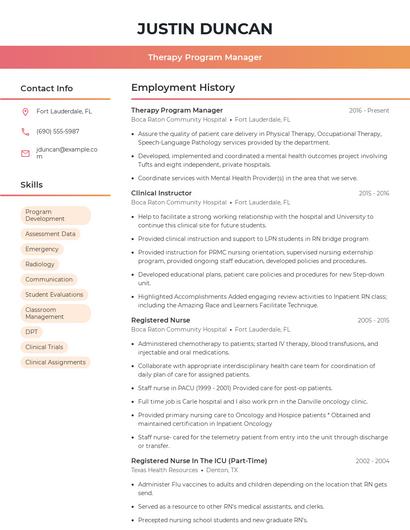
Build a professional therapy program manager resume in minutes. Our AI resume writing assistant will guide you through every step of the process, and you can choose from 10+ resume templates to create your therapy program manager resume.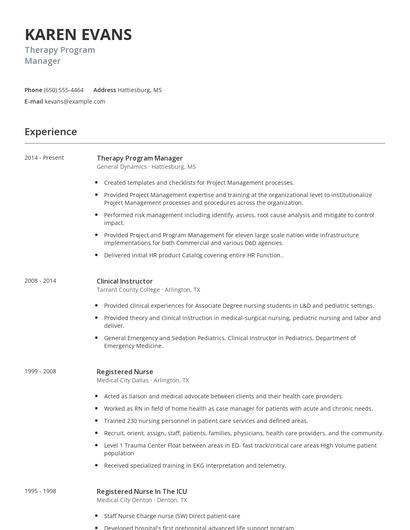
Compare different therapy program managers
Therapy program manager vs. Clinical director
A clinical director is a managing professional who manages the work of healthcare providers to ensure quality patient care is achieved. Clinical directors are responsible for organizational tasks such as adjusting staff schedules, explaining insurance benefits to the patients, and managing financial reports. They can work either in small clinics with a smaller workforce or larger hospitals with multiple departments. Clinical directors may also assist in the hiring process of healthcare providers and should establish a positive work environment.
There are some key differences in the responsibilities of each position. For example, therapy program manager responsibilities require skills like "respiratory care," "acute care," "respiratory therapy," and "direct patient care." Meanwhile a typical clinical director has skills in areas such as "clinical services," "quality improvement," "autism," and "group therapy." This difference in skills reveals the differences in what each career does.
Clinical directors earn the highest salaries when working in the health care industry, with an average yearly salary of $79,166. On the other hand, therapy program managers are paid more in the health care industry with an average salary of $93,333.The education levels that clinical directors earn slightly differ from therapy program managers. In particular, clinical directors are 12.1% more likely to graduate with a Master's Degree than a therapy program manager. Additionally, they're 6.2% more likely to earn a Doctoral Degree.Therapy program manager vs. Nursing director
A nursing director's role is to oversee and evaluate all nurse staff in a hospital or organization, ensuring their efficiency at providing care towards patients. A nursing director's responsibilities mainly revolve around administrative tasks such as coordinating with physicians and other consultants, producing reports, conducting assessments, managing the budget and expenditures, and resolving issues. Furthermore, a nursing director must keep and maintain accurate records, ensuring all procedures adhere to the highest health standards and aligns with the hospital's policies and regulations.
Each career also uses different skills, according to real therapy program manager resumes. While therapy program manager responsibilities can utilize skills like "respiratory care," "acute care," "respiratory therapy," and "ventilation," nursing directors use skills like "term care," "resident care," "cpr," and "federal regulations."
Nursing directors earn a lower average salary than therapy program managers. But nursing directors earn the highest pay in the health care industry, with an average salary of $83,602. Additionally, therapy program managers earn the highest salaries in the health care with average pay of $93,333 annually.nursing directors earn lower levels of education than therapy program managers in general. They're 9.7% less likely to graduate with a Master's Degree and 6.2% less likely to earn a Doctoral Degree.Therapy program manager vs. Medical officer
A Medical Officer delivers health and first-aid provisions for patients as well as prepares and maintains the paper and electronic health care records of clients. They ensure that all related equipment and supplies are suitably maintained at all times.
The required skills of the two careers differ considerably. For example, therapy program managers are more likely to have skills like "customer service," "respiratory care," "acute care," and "respiratory therapy." But a medical officer is more likely to have skills like "public health," "infectious disease," "diagnosis," and "internal medicine."
Medical officers make a very good living in the health care industry with an average annual salary of $124,636. On the other hand, therapy program managers are paid the highest salary in the health care industry, with average annual pay of $93,333.Most medical officers achieve a lower degree level compared to therapy program managers. For example, they're 9.4% less likely to graduate with a Master's Degree, and 14.3% less likely to earn a Doctoral Degree.Therapy program manager vs. Unit director
A unit director is a management professional who is responsible for directing and managing a group of medical professionals in an organization. This director must manage the daily clinical and administrative duties for those professionals involved in the mental health hospitalization programs. The director must assist in recruiting healthcare professionals to maximize the branch and margin profits of the medical establishment. This director should also attend meetings with the OCFS program to discuss the performance and outcome measures of the program.
Types of therapy program manager
Updated January 8, 2025
