What does a unit manager do?

Unit managers are responsible for managing the nursing unit. They primarily supervise the daily care of patients and ensure quality patient care. Usually, they perform tasks like evaluating staff performance, conducting orientation for new staff, and training new members. Also, they manage schedules, minimize expenditures, and enforce health as well as safety regulations. Unit managers are registered nursing professionals with an undergraduate or graduate degree. They are honest, adaptable, and analytical professionals with strong management and leadership skills and relevant experience in nursing and patient assessment.
Unit manager responsibilities
Here are examples of responsibilities from real unit manager resumes:
- Develop corporate culture utilizing skills attain through ERP and TQM management training.
- Set and achieve goal of entire staff certification in ACLS and EKG interpretation.
- Manage departmental resources, staffing plans, KPIs, strategic initiatives, and budget.
- Enhance scheduling visibility to reduce age work-in-progress (WIP) and achieve EBIT goal.
- Lead and manage the delivery of patient-care to a 50 patient unit in a LTC facility.
- Achieve all major milestones in preparation for major ERP system upgrade and cultural change for organization.
- Perform case management to include discharge planning, placement of patients after rehabilitation and behavior management sessions with patients.
- Manage skil unit, audits, staff education, patient/family education, risk management, QA, MDS assessments
- Oversee clinical and staffing operations of 2 LTC units.
- Ensure compliance with all JCAHO, state and federal regulations.
- Direct unit in collaboration with all disciplines to become JCAHO certify.
- Assist in the translation, and functional integrity of the new POS software system.
- Spear-Head new graduate ICU internship program to increase permanent unit staffing and reduce agency usage.
- Demonstrate compassion toward clients/residents, families and others, and works with tact and ethical awareness.
- Assist physicians with procedures such as: central line insertion, intubation, extubation, paracentesis.
Unit manager skills and personality traits
We calculated that 17% of Unit Managers are proficient in Quality Care, Patients, and Federal Regulations. They’re also known for soft skills such as Management skills, Problem-solving skills, and Time-management skills.
We break down the percentage of Unit Managers that have these skills listed on their resume here:
- Quality Care, 17%
Developed and implemented Performance Improvement initiatives based on patient, identified risks, and quality care.
- Patients, 10%
Identified patient service requirements by establishing personal rapport with potential and actual patients in a position to understand service requirements.
- Federal Regulations, 8%
Supervised overall performance of daily collection activities for assigned unit while ensuring compliance with corporate policy and state and federal regulations.
- Resident Care, 8%
Conducted investigations to evaluate the effectiveness and quality of care received by residents; follow-up any complaints regarding resident care.
- Customer Service, 6%
Lead a team of approximately 20 Consumer Customer Service/Collections associates, including day-to-day management, training, coaching and development.
- Compassion, 4%
Leveraged compassion in facilitating pain management and completing prescribed treatments including dosage changes and monitoring of effectiveness of prescribed medication.
Most unit managers use their skills in "quality care," "patients," and "federal regulations" to do their jobs. You can find more detail on essential unit manager responsibilities here:
Problem-solving skills. Many unit manager duties rely on problem-solving skills. "top executives need to identify and resolve issues within an organization," so a unit manager will need this skill often in their role. This resume example is just one of many ways unit manager responsibilities rely on problem-solving skills: "make sure individualized care plans are formed and carried on by the staff and making sure add or resolved as needed. "
Time-management skills. Another skill that relates to the job responsibilities of unit managers is time-management skills. This skill is critical to many everyday unit manager duties, as "top executives do many tasks concurrently to ensure that their work gets done and that the organization meets its goals." This example from a resume shows how this skill is used: "calculate and work out discrepancies on time sheets, settle payroll issues, and update office on issues. "
Leadership skills. A big part of what unit managers do relies on "leadership skills." You can see how essential it is to unit manager responsibilities because "top executives must be able to shape and direct an organization by coordinating policies, people, and resources." Here's an example of how this skill is used from a resume that represents typical unit manager tasks: "managed and provided strong leadership to an inbound call center team of 20, including performance management. "
Communication skills. A commonly-found skill in unit manager job descriptions, "communication skills" is essential to what unit managers do. Unit manager responsibilities rely on this skill because "top executives must be able to convey information clearly and persuasively." You can also see how unit manager duties rely on communication skills in this resume example: "lead and develop an effective team through communication, performance management, development plans, rewards & recognition practices. "
The three companies that hire the most unit managers are:
- Costco Wholesale84 unit managers jobs
- Genesis HealthCare80 unit managers jobs
- Magnolia Health Systems23 unit managers jobs
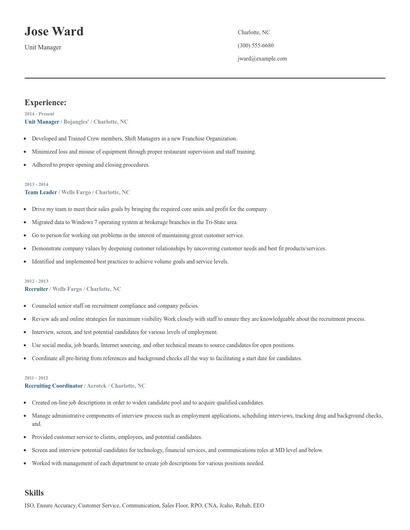
Choose from 10+ customizable unit manager resume templates
Build a professional unit manager resume in minutes. Our AI resume writing assistant will guide you through every step of the process, and you can choose from 10+ resume templates to create your unit manager resume.




Compare different unit managers
Unit manager vs. Manager, center operations
The duties of a manager of center operations depend on one's industry of employment. Typically, their responsibilities revolve around overseeing business operations, setting targets, assessing the workforce's performance, and performing corrective measures on any issues or concerns. Moreover, there are also instances where they have to produce progress reports, devise strategies for optimal business performance, delegate tasks, and even manage the budget. As a manager, it is crucial to lead and encourage the team to reach goals and sales targets while implementing the company's policies and regulations.
There are some key differences in the responsibilities of each position. For example, unit manager responsibilities require skills like "quality care," "federal regulations," "resident care," and "customer service." Meanwhile a typical manager, center operations has skills in areas such as "infrastructure," "osha," "standard operating procedure," and "continuous improvement." This difference in skills reveals the differences in what each career does.
Managers, center operations tend to make the most money working in the manufacturing industry, where they earn an average salary of $68,400. In contrast, unit managers make the biggest average salary, $85,767, in the finance industry.The education levels that managers, center operations earn slightly differ from unit managers. In particular, managers, center operations are 2.5% more likely to graduate with a Master's Degree than a unit manager. Additionally, they're 0.2% more likely to earn a Doctoral Degree.Unit manager vs. Assistant store manager/operations manager
An assistant store manager/operations manager is responsible for supervising the overall store operations, ensuring the highest customer satisfaction, and managing the staff's performance. Assistant store managers/operations managers strategize techniques to enhance the team's productivity and efficiency. They also identify business opportunities by conducting market research that would generate more revenue resources for the business and increase profits. An assistant store manager/operations manager assists the customers with their inquiries and concerns, resolve complaints, and process replacements and refunds as necessary.
Each career also uses different skills, according to real unit manager resumes. While unit manager responsibilities can utilize skills like "quality care," "patients," "federal regulations," and "resident care," assistant store manager/operations managers use skills like "front end," "store operations," "loss prevention," and "sales floor."
Assistant store manager/operations managers earn similar levels of education than unit managers in general. They're 4.2% less likely to graduate with a Master's Degree and 0.2% less likely to earn a Doctoral Degree.Unit manager vs. General manager of operations
General managers of operations are employed to oversee the overall operations of businesses. Their responsibilities include the improvement of the efficiency of the operations and overall management. They coordinate the primary performance goals for direct reporting functions and set the strategies for the organization. It is their responsibility to communicate strategy as well as results to employees. They also engage with the corporate officers in the strategic planning and development of the organization or enterprise.
Some important key differences between the two careers include a few of the skills necessary to fulfill the responsibilities of each. Some examples from unit manager resumes include skills like "quality care," "patients," "federal regulations," and "resident care," whereas a general manager of operations is more likely to list skills in "develop team," "financial statements," "logistics," and "continuous improvement. "
When it comes to education, general managers of operations tend to earn similar degree levels compared to unit managers. In fact, they're 1.8% more likely to earn a Master's Degree, and 0.1% more likely to graduate with a Doctoral Degree.Unit manager vs. Operations program manager
The role of operations program managers is to help improve organizational efficiency, particularly in the areas of administrative, financial, and programmatic operations. Their key duties and responsibilities include overseeing the collection, analysis, and reporting of data, overseeing and leading teams to achieve business goals, and managing the development and execution of operational procedures. In addition, they are responsible for developing and monitoring dashboards to measure business health and assisting with planning, reporting, and budgeting.
Types of unit manager
Updated January 8, 2025
