What does a unix administrator do?

Unix administrator responsibilities
Here are examples of responsibilities from real unix administrator resumes:
- Manage NIS, LDAP and DNS environment files to maintain security and accessibility to systems.
- Develop Linux shell scripts to accomplish redundant tasks to simplify in distribute administration.
- Configure and administer network protocols and software including TCP/IP, NIS, DNS, NFS and SMB.
- Do all UNIX server and EMC software installation and hardware configuration for UNIX servers.
- Administer servers in heterogeneous environments which include Solaris and Linux systems.
- Configure and modify bash scripts.
- Involve in migrating HPUX systems to RHEL.
- Work primarily on RHEL 4/5 and AIX operating systems.
- Provide support for LDAP base identity and access management.
- Connect and run fiber channels to EMC frame at the specific location.
- Assist developers with writing efficient SQL scripts and troubleshooting the SQL scripts.
- Design, build, and maintain efficient, and reliable python code.
- Install and configure AIX NIM server, resulting in streamlining the AIX installation process.
- Mount file systems, directories and file creation and set the securities in AIX and Linux.
- Create FTP and NIS account management web interface in PHP with bash and shell scripts running in background.
Unix administrator skills and personality traits
We calculated that 7% of Unix Administrators are proficient in Linux Servers, Solaris, and SAN. They’re also known for soft skills such as Analytical skills, Communication skills, and Problem-solving skills.
We break down the percentage of Unix Administrators that have these skills listed on their resume here:
- Linux Servers, 7%
Involved in multiple projects including installing upgrading, migrating and consolidating Unix /Linux servers.
- Solaris, 5%
Perform overall Solaris system administration duties, patch management and vulnerabilities assessment of SUN and Fujitsu servers.
- SAN, 4%
Redesigned and expanded existing SAN architecture to improve performance and system manageability.
- OS, 4%
Added Patrol alert monitoring for UNIX servers to monitor issues with file systems, OS, incoming files, and logs.
- Database, 4%
Developed internal Quoting and Inventory system using PHP & MySQL database* Developed system-tracking database to hold all system and repair information
- Web Servers, 4%
Install, configure and manage all web servers in the library as well as networking, user administration, and printing.
Common skills that a unix administrator uses to do their job include "linux servers," "solaris," and "san." You can find details on the most important unix administrator responsibilities below.
Analytical skills. The most essential soft skill for a unix administrator to carry out their responsibilities is analytical skills. This skill is important for the role because "administrators need to evaluate networks and systems to make sure that they perform reliably and to anticipate new requirements as customers’ needs change." Additionally, a unix administrator resume shows how their duties depend on analytical skills: "involved in implementation of emc power path for load balancing and redundancy in data path. "
Communication skills. Another essential skill to perform unix administrator duties is communication skills. Unix administrators responsibilities require that "administrators must describe problems and their solutions to non-it workers." Unix administrators also use communication skills in their role according to a real resume snippet: "installed puppet client software on rhel servers and established a communication between master and client through ssl certification. "
Problem-solving skills. unix administrators are also known for problem-solving skills, which are critical to their duties. You can see how this skill relates to unix administrator responsibilities, because "administrators must quickly resolve problems that arise with computer networks." A unix administrator resume example shows how problem-solving skills is used in the workplace: "involved in implementation of real time site to site dr solution using emc srdf. "
The three companies that hire the most unix administrators are:
- Expeditors4 unix administrators jobs
- SAIC3 unix administrators jobs
- Amdocs1 unix administrators jobs
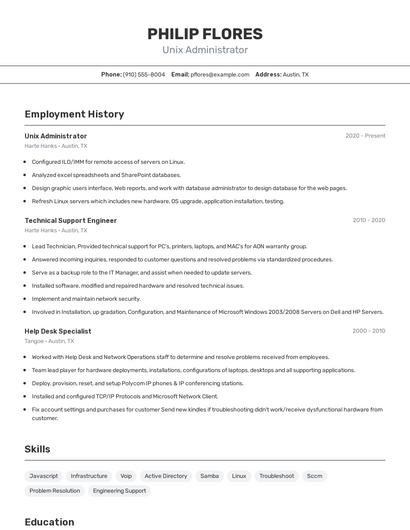
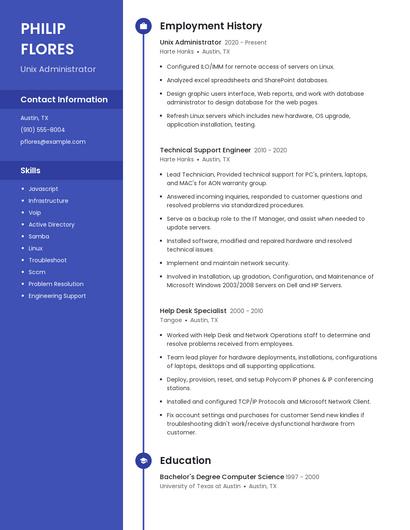
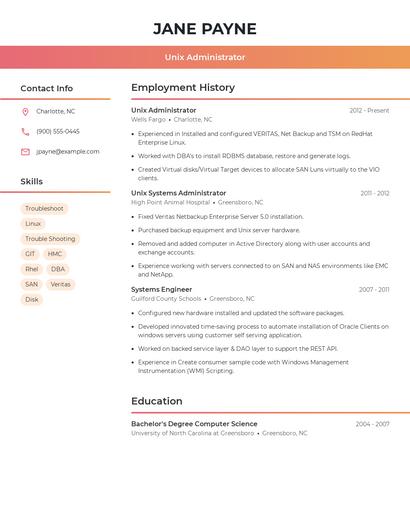
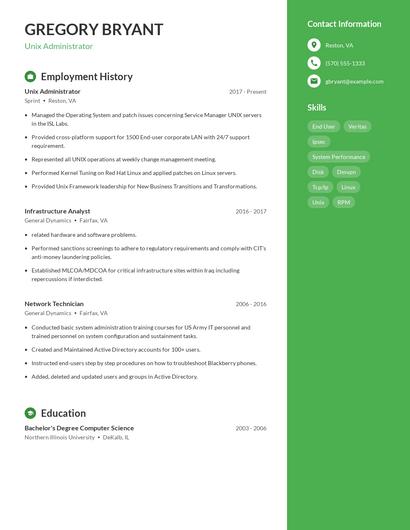
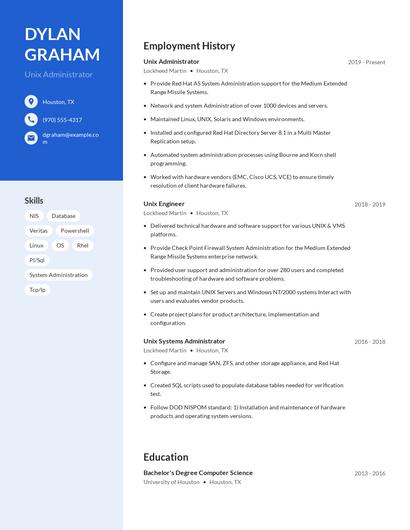
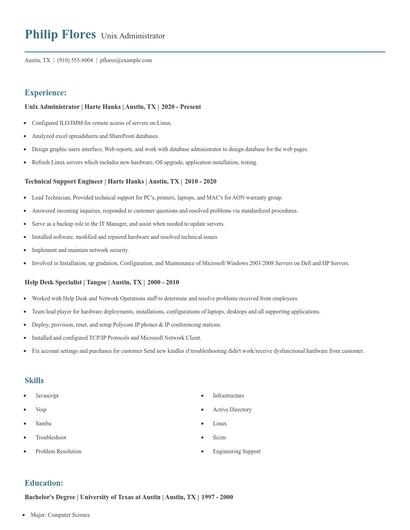
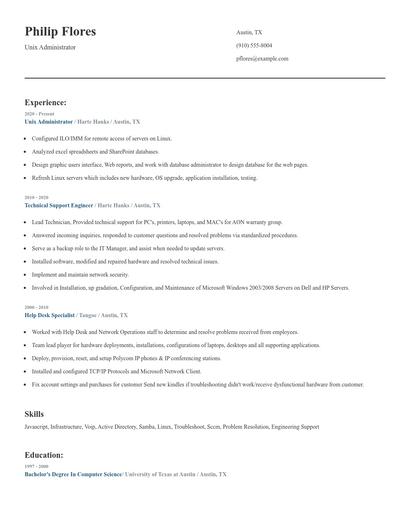
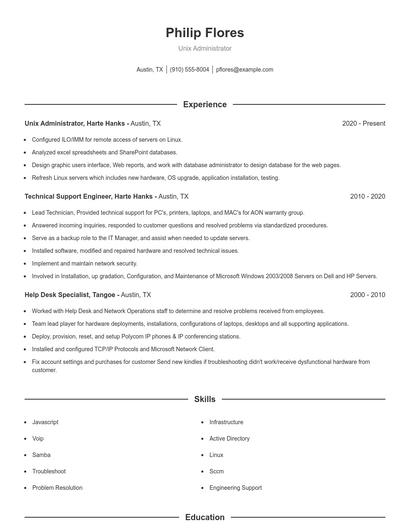
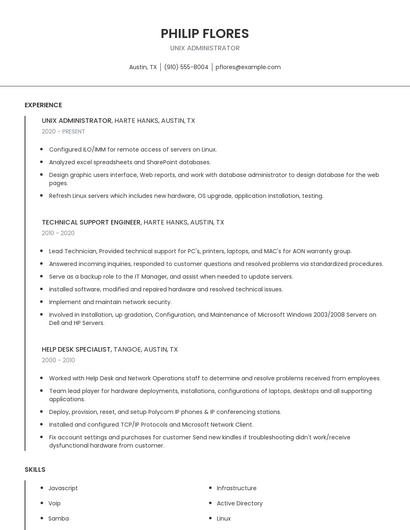
Choose from 10+ customizable unix administrator resume templates
Build a professional unix administrator resume in minutes. Our AI resume writing assistant will guide you through every step of the process, and you can choose from 10+ resume templates to create your unix administrator resume.


Compare different unix administrators
Unix administrator vs. Information technology administrator
An Information Technology (IT) administrator is an individual responsible for managing the day-to-day operation of an organization's IT systems and ensuring that the systems are running effectively. IT administrators must conduct consistent analyses of the computer system and install updates when needed. They are required to assess the organization's security programs and run the system for viruses and spyware. IT administrators also extend support to the organization's end-users and train them on desktop applications.
There are some key differences in the responsibilities of each position. For example, unix administrator responsibilities require skills like "linux servers," "solaris," "web servers," and "nfs." Meanwhile a typical information technology administrator has skills in areas such as "customer service," "troubleshoot," "vmware," and "windows server." This difference in skills reveals the differences in what each career does.
Information technology administrators earn the highest salaries when working in the finance industry, with an average yearly salary of $93,678. On the other hand, unix administrators are paid more in the finance industry with an average salary of $93,829.On average, information technology administrators reach similar levels of education than unix administrators. Information technology administrators are 4.0% less likely to earn a Master's Degree and 0.1% less likely to graduate with a Doctoral Degree.Unix administrator vs. Network/server administrator
A Network Administrator ensures an organizations' network is operational and up to date. They solve problems that arise within computer networks, maintaining computer networks, interacting with clients, and consulting with them to determine their system requirements.
In addition to the difference in salary, there are some other key differences worth noting. For example, unix administrator responsibilities are more likely to require skills like "linux servers," "database," "web servers," and "nfs." Meanwhile, a network/server administrator has duties that require skills in areas such as "customer service," "windows server," "troubleshoot," and "powershell." These differences highlight just how different the day-to-day in each role looks.
Network/server administrators earn a lower average salary than unix administrators. But network/server administrators earn the highest pay in the manufacturing industry, with an average salary of $84,609. Additionally, unix administrators earn the highest salaries in the finance with average pay of $93,829 annually.network/server administrators earn lower levels of education than unix administrators in general. They're 5.5% less likely to graduate with a Master's Degree and 0.1% less likely to earn a Doctoral Degree.Unix administrator vs. Systems administrator lead
A systems administrator lead is responsible for planning, designing, and implementing procedures for critical enterprise systems. Typical duties of systems administrators include managing the day-to-day operations of a company's computer and network systems, developing new application and system implementation plans, and establishing guidelines for installing and managing the organization's computer operating systems. In addition, you are expected to ensure the security of computer systems by preventing unauthorized use, user abuse, and acts of nature.
Some important key differences between the two careers include a few of the skills necessary to fulfill the responsibilities of each. Some examples from unix administrator resumes include skills like "linux servers," "veritas netbackup," "rhel," and "system administration," whereas a systems administrator lead is more likely to list skills in "project management," "windows server," "pc," and "dod. "
Systems administrator leads earn the highest salary when working in the telecommunication industry, where they receive an average salary of $103,205. Comparatively, unix administrators have the highest earning potential in the finance industry, with an average salary of $93,829.systems administrator leads typically earn similar educational levels compared to unix administrators. Specifically, they're 0.8% less likely to graduate with a Master's Degree, and 0.4% less likely to earn a Doctoral Degree.Unix administrator vs. Windows system administrator
A Windows System Administrator maintains the systems and servers of a Windows operating system. They evaluate and modify the system's performance.
Types of unix administrator
Updated January 8, 2025
