What does a validation scientist do?
A Validation Scientist evaluates and validates products and procedures through the scientific perspective, typically by conducting laboratory tests and experiments. They conduct extensive research and analysis to ensure that products comply with industry standards and specifications, utilizing the research findings to develop solutions and recommendations. They are also in charge of establishing guidelines and test plans, maintaining all procedures while adhering to protocols and regulations. Moreover, a Validation Scientist manages a team of validation staff, working together to reach project goals.
Validation scientist responsibilities
Here are examples of responsibilities from real validation scientist resumes:
- Manage customer complaints investigations using CAPA system.
- Develop, implement, and maintain validation procedures according to regulatory requirements/guidelines (GMP, GLP, ICH, USP).
- Perform technical writing including documentation of test methods and validation protocols in compliance with FDA regulations.
- Audit the GMP labs for inspection readiness.
- Conduct investigation process through CAPA system when adverse conditions are find.
- Provide front line technical support for document management systems and SQL LIMS.
- Review and release all stability data via LIMS including documentation such as deviations, OOS, OOT, investigations, etc.
- Maintain scrupulous documentation detailing validations/results include in formal presentation for FDA.
- Assist in manufacturing QA assessment and investigation of Synchron QC lot discrepancy by evaluating trends and observing anomalies.
- Task includes QC lot release/stability data package review, deviation management, troubleshooting, identify and implement improvement to existing assays.
- Gain experience with process centrifugation with pilot scale Westphalia disk bowl centrifuge.
- Evaluate patient samples to identify biomarkers providing the development of asthma patient stratification methods.
Validation scientist skills and personality traits
We calculated that 7% of Validation Scientists are proficient in FDA, Chemistry, and GMP.
We break down the percentage of Validation Scientists that have these skills listed on their resume here:
- FDA, 7%
Performed technical writing including documentation of test methods and validation protocols in compliance with FDA regulations.
- Chemistry, 7%
Authored and executed validation test protocols for new system software and chemistry database.
- GMP, 7%
Developed, implemented, and maintained validation procedures according to regulatory requirements/guidelines (GMP, GLP, ICH, USP).
- Data Analysis, 5%
Performed critical data analysis throughout product validation using statistical software packages and utilized product performance data to construct validation reports.
- Troubleshoot, 5%
Designed and carried out laboratory experiments to troubleshoot product related issues.
- Method Validation, 4%
Work Functions: worked on the method development of and cleaning method validations.
"fda," "chemistry," and "gmp" are among the most common skills that validation scientists use at work. You can find even more validation scientist responsibilities below, including:
Communication skills. One of the key soft skills for a validation scientist to have is communication skills. You can see how this relates to what validation scientists do because "medical scientists must be able to explain their research in nontechnical ways." Additionally, a validation scientist resume shows how validation scientists use communication skills: "coordinated equipment sampling performed by cleaning validation through constant communication with affected departments and personnel. "
Observation skills. Another soft skill that's essential for fulfilling validation scientist duties is observation skills. The role rewards competence in this skill because "medical scientists conduct experiments that require monitoring samples and other health-related data." According to a validation scientist resume, here's how validation scientists can utilize observation skills in their job responsibilities: "collected data and prepared summary report to assist in fda observation response. "
The three companies that hire the most validation scientists are:
- Bristol-Myers Squibb6 validation scientists jobs
- Eurofins6 validation scientists jobs
- Pharmaceutical Product Development
4 validation scientists jobs
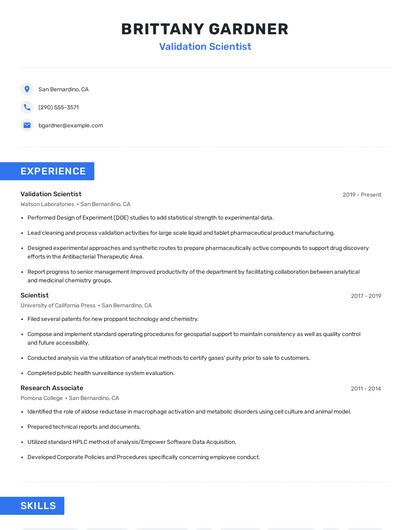
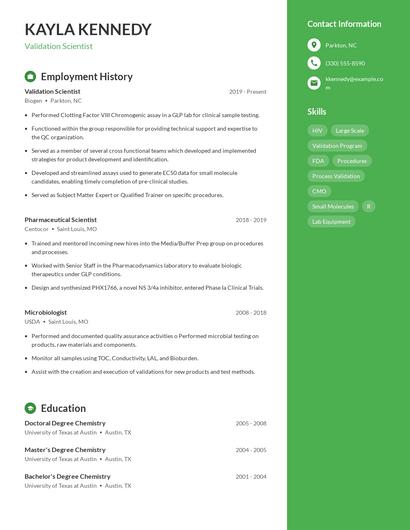
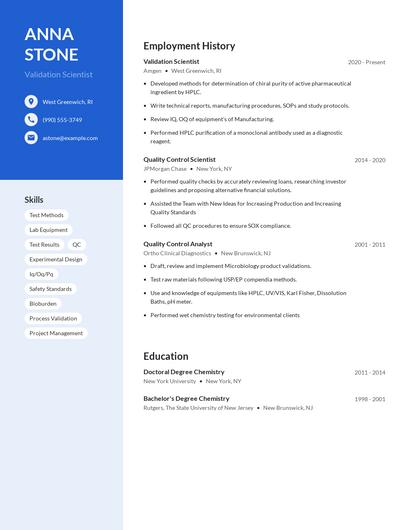
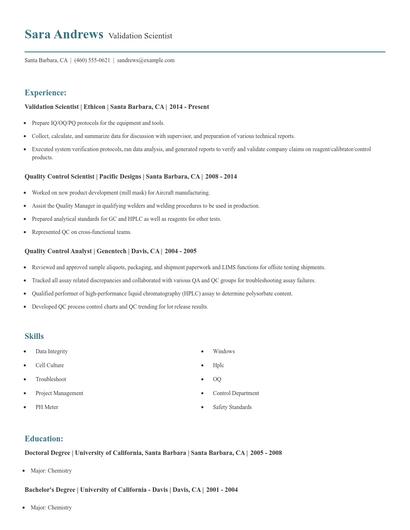
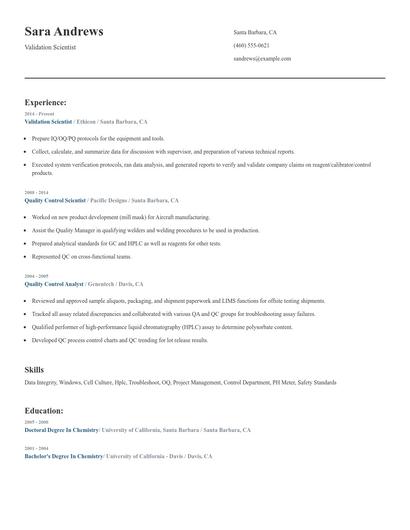
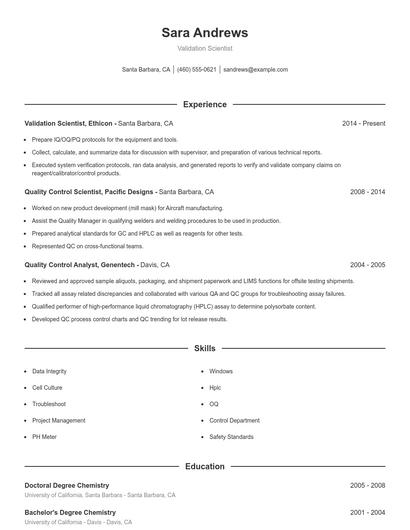
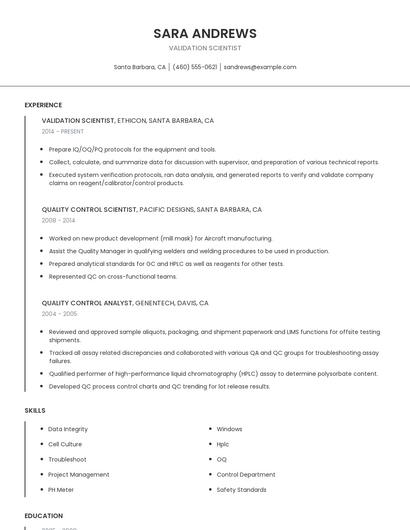
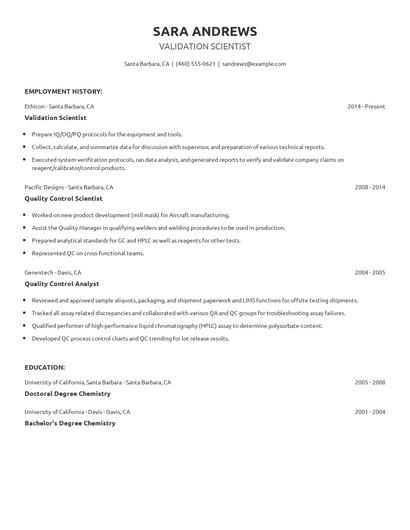
Choose from 10+ customizable validation scientist resume templates
Build a professional validation scientist resume in minutes. Our AI resume writing assistant will guide you through every step of the process, and you can choose from 10+ resume templates to create your validation scientist resume.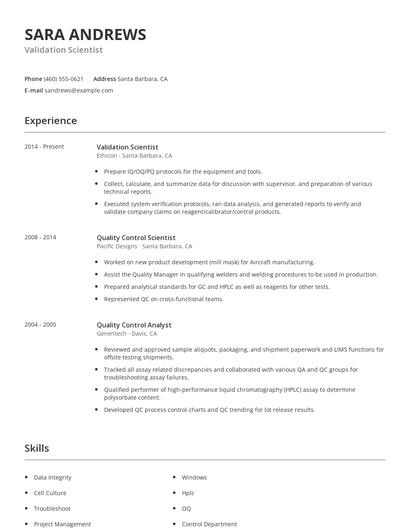
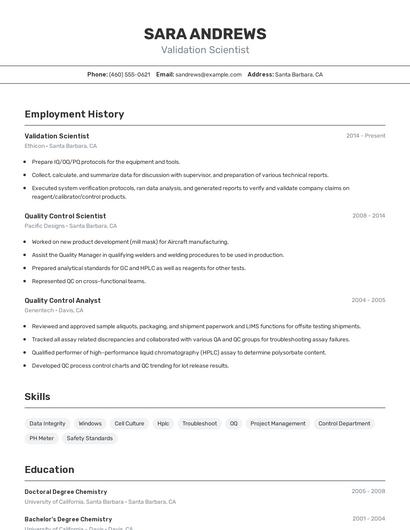
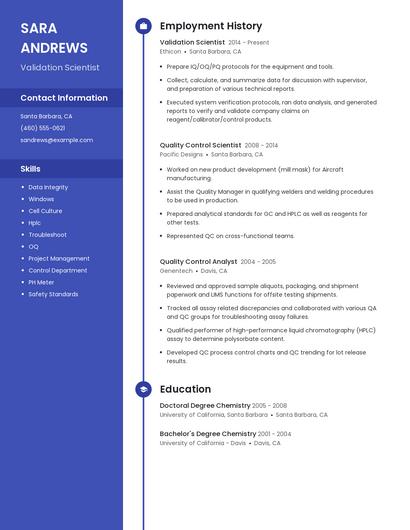
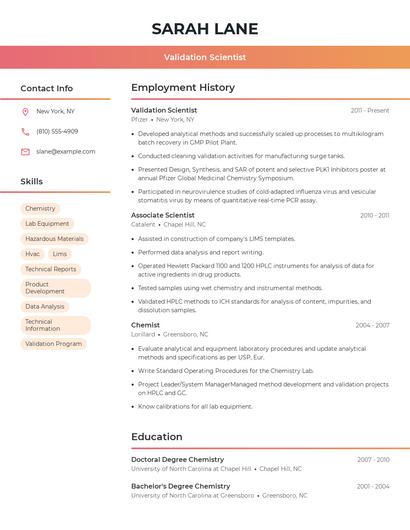
Compare different validation scientists
Validation scientist vs. Fellow
A fellow's responsibility will depend on the organization or industry where one belongs. However, most of the time, a fellow's duty will revolve around conducting research and analysis, presiding discussions and attending dialogues, handle lectures while complying with the guidelines or tasks set by supervisors, and assist in various projects and activities. Furthermore, a fellow must adhere to the institution or organization's policies and regulations at all times, meet all the requirements and outputs involved, and coordinate with every person in the workforce.
These skill sets are where the common ground ends though. The responsibilities of a validation scientist are more likely to require skills like "chemistry," "gmp," "troubleshoot," and "method validation." On the other hand, a job as a fellow requires skills like "patients," "professional development," "veterans," and "mathematics." As you can see, what employees do in each career varies considerably.
Fellows really shine in the professional industry with an average salary of $67,978. Comparatively, validation scientists tend to make the most money in the pharmaceutical industry with an average salary of $79,952.The education levels that fellows earn slightly differ from validation scientists. In particular, fellows are 4.1% more likely to graduate with a Master's Degree than a validation scientist. Additionally, they're 9.2% more likely to earn a Doctoral Degree.Validation scientist vs. Research fellow
A research fellow is an academic researcher who conducts research and analysis of comprehensive literature, data, and results and provides literature reviews. He/She supervises research assistants and recruits study participants to interview them for a particular study. To become a research fellow, a candidate should have a doctorate in a relevant discipline and publish peer-reviewed papers. Also, a research fellow can be an independent investigator or be supervised by a principal investigator.
In addition to the difference in salary, there are some other key differences worth noting. For example, validation scientist responsibilities are more likely to require skills like "gmp," "troubleshoot," "method validation," and "laboratory equipment." Meanwhile, a research fellow has duties that require skills in areas such as "patients," "research projects," "cell culture," and "immunology." These differences highlight just how different the day-to-day in each role looks.
Research fellows earn a lower average salary than validation scientists. But research fellows earn the highest pay in the non profits industry, with an average salary of $57,261. Additionally, validation scientists earn the highest salaries in the pharmaceutical with average pay of $79,952 annually.In general, research fellows achieve higher levels of education than validation scientists. They're 6.3% more likely to obtain a Master's Degree while being 9.2% more likely to earn a Doctoral Degree.What technology do you think will become more important and prevalent for validation scientists in the next 3-5 years?
Scott Johnson
Professor and Director, University of Maine
Validation scientist vs. Doctoral fellow
A doctoral fellow is a physician that has completed studies and receives a fellowship to cover his/her or her expenses while completing his/her or her medical dissertation. A doctor fellow undergoes this fellowship to get additional training for their chosen sub-specialty. During the fellowship period, a fellow can act as an attending physician or consultant physician with other physicians' direct supervision in the sub-specialty field.
The required skills of the two careers differ considerably. For example, validation scientists are more likely to have skills like "fda," "gmp," "troubleshoot," and "method validation." But a doctoral fellow is more likely to have skills like "patients," "cell culture," "research projects," and "cell biology."
Doctoral fellows earn the best pay in the pharmaceutical industry, where they command an average salary of $67,423. Validation scientists earn the highest pay from the pharmaceutical industry, with an average salary of $79,952.When it comes to education, doctoral fellows tend to earn similar degree levels compared to validation scientists. In fact, they're 4.0% more likely to earn a Master's Degree, and 41.8% more likely to graduate with a Doctoral Degree.Validation scientist vs. Phd researcher
The primary job of a Ph.D. researcher is to plan and conduct experiments and analyzing their outcome. You will collect, organize, and analyze data and opinions to solve issues and predict trends. Other tasks you will perform include doing fieldwork to collect samples, writing reports, research papers, and reviews, and organizing materials testing. In addition, you need to liaise with research and production staff, develop ways to resolve problems, and supervise junior research staff.
Types of validation scientist
Updated January 8, 2025
