What does a web manager do?

Web Managers are responsible for managing websites for organizations. Their duties include managing website upgrades, testing for website performance, implement a strategy to increase web traffic and subscribers, troubleshooting website issues, and responding to security breaches. They create content audits as well as ensuring the website has brand strategy alignment. A Web Manager ensures website compliance with all regulations and keeps abreast of the best practice of the industry. They must possess good problem-solving skills and knowledge in search engine optimization.
Web manager responsibilities
Here are examples of responsibilities from real web manager resumes:
- Plan workflow and train catalog editors to manage XML.
- Utilize 3scale tool to manage the API accessibility for external users.
- Manage UI flow, technical standards, development and maintenance for these tools.
- Manage the QA process from the business side to ensure that the proper test plans are executed.
- Manage site content including a graphic image library and product catalog using various tools including HTML and content management software.
- Design and manage daily and monthly e-newsletters publish in XML and deliver to subscribers via e-mail in ASCII and HTML formats.
- Build websites using latest standards in HTML5, CSS3, jQuery, PHP, XML
- Employ JavaScript to build dynamic features and employ CSS to separate select design elements from content in websites.
- Deploy on AWS EC2 and RDS.
- Assess social strategies to determine ROI.
- Create reusable code using Eprise and JavaScript.
- Utilize user feedback to enhance API functionality.
- Create web application prototype using jQuery and Angular.JS.
- Provide dealer with monthly audits and reports of KPIs.
- Compile report for management showing results (ROI).
Web manager skills and personality traits
We calculated that 9% of Web Managers are proficient in Digital Marketing, WordPress, and Html Css. They’re also known for soft skills such as Interpersonal skills, Organizational skills, and Analytical skills.
We break down the percentage of Web Managers that have these skills listed on their resume here:
- Digital Marketing, 9%
Conducted budget and quarterly reports for Digital Marketing department.
- WordPress, 9%
Write and manage keyword-focused blogs to maximize Search Engine Optimization using WordPress
- Html Css, 7%
Developed flow diagram, navigation design, wire-framing, visual designing, HTML CSS prototyping.
- B Testing, 6%
Planned and executed the A/B testing roadmap.
- Google Analytics, 5%
Utilized Google Analytics Data to understand current traffic performance and continually uncover opportunities for improvements.
- HTML, 4%
Designed and managed daily and monthly e-newsletters published in XML and delivered to subscribers via e-mail in ASCII and HTML formats.
Most web managers use their skills in "digital marketing," "wordpress," and "html css" to do their jobs. You can find more detail on essential web manager responsibilities here:
Interpersonal skills. One of the key soft skills for a web manager to have is interpersonal skills. You can see how this relates to what web managers do because "managers must deal with a range of people in different roles, both inside and outside the organization." Additionally, a web manager resume shows how web managers use interpersonal skills: "used website design technology (dreamweaver) as well as interpersonal skills to create a finished project. "
Organizational skills. Many web manager duties rely on organizational skills. "advertising, promotions, and marketing managers must manage their time and budget efficiently while directing and motivating staff members.," so a web manager will need this skill often in their role. This resume example is just one of many ways web manager responsibilities rely on organizational skills: "involved in cost-estimating, planning, and executing all organizational web applications. "
Analytical skills. Another skill that relates to the job responsibilities of web managers is analytical skills. This skill is critical to many everyday web manager duties, as "advertising, promotions, and marketing managers must be able to analyze industry trends to determine the most promising strategies for their organization." This example from a resume shows how this skill is used: "monitored performance data (kpis) and trends for ab testing. "
Communication skills. For certain web manager responsibilities to be completed, the job requires competence in "communication skills." The day-to-day duties of a web manager rely on this skill, as "managers must be able to communicate effectively with a broad-based team made up of other managers or staff members during the advertising, promotions, and marketing process." For example, this snippet was taken directly from a resume about how this skill applies to what web managers do: "developed intranet for electronic communication, and information and resource sharing purposes. "
Creativity. Another crucial skill for a web manager to carry out their responsibilities is "creativity." A big part of what web managers relies on this skill, since "advertising, promotions, and marketing managers must be able to generate new and imaginative ideas." How this skill relates to web manager duties can be seen in an example from a web manager resume snippet: "imported inventory using xml, update web content, manage crm software, take orders, and communicate with manufacturers. "
The three companies that hire the most web managers are:
- Citizens Alliance51 web managers jobs
- Black & Veatch50 web managers jobs
- Wpp Us Holdings Inc11 web managers jobs
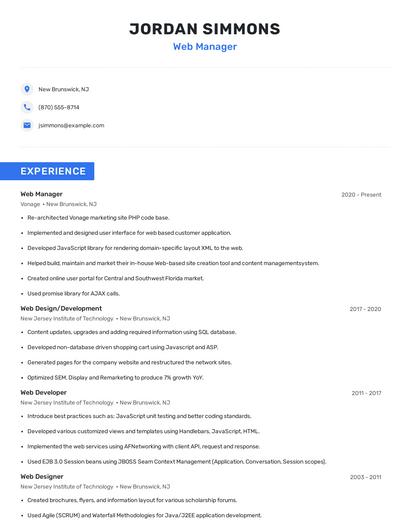
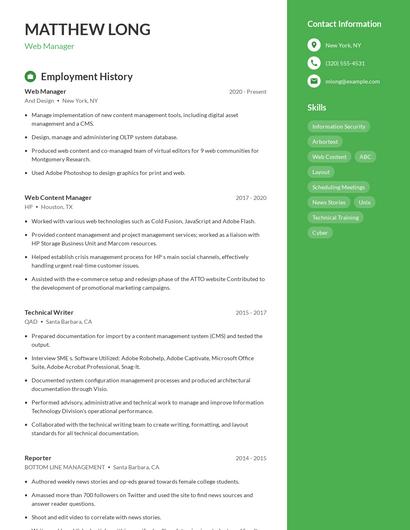
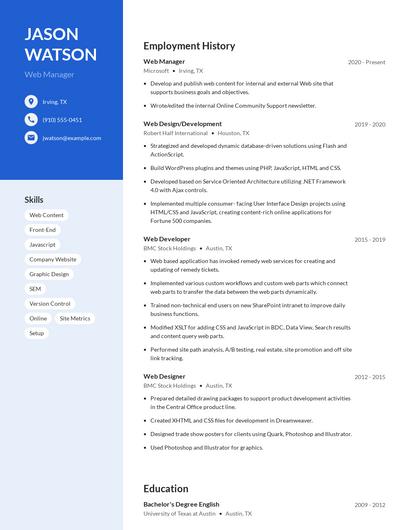
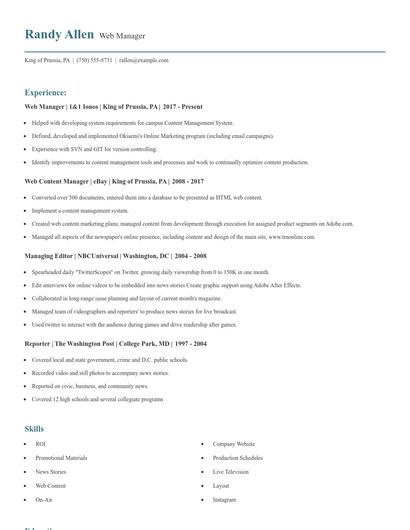
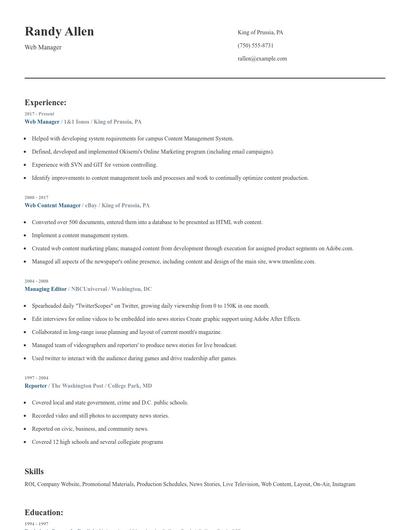
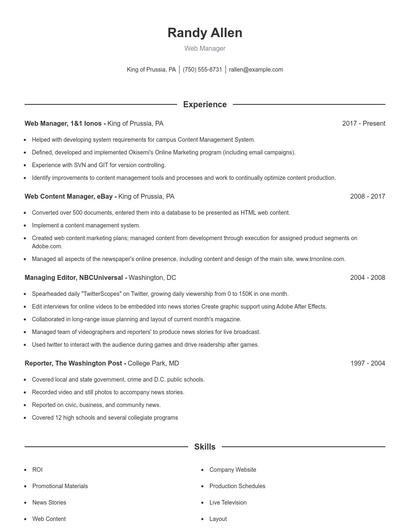
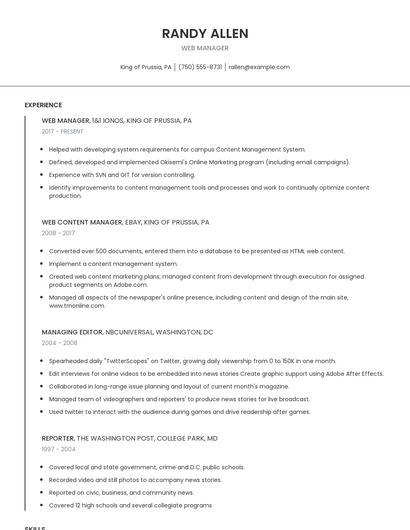
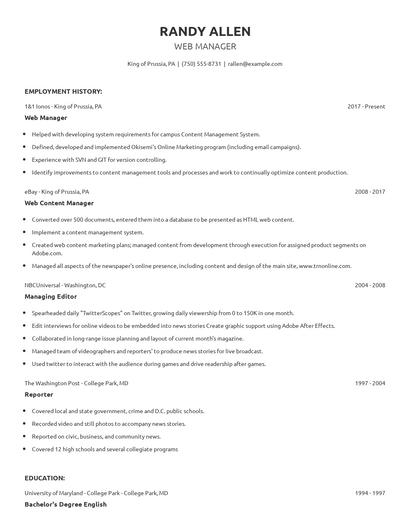
Choose from 10+ customizable web manager resume templates
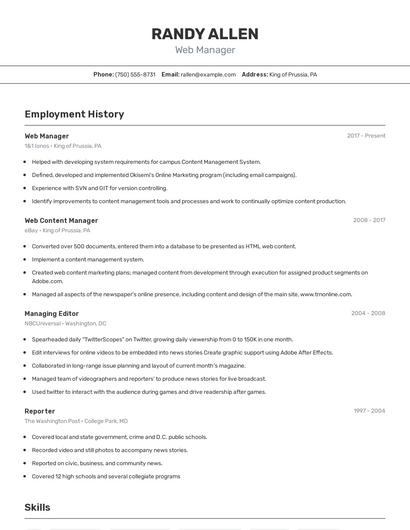
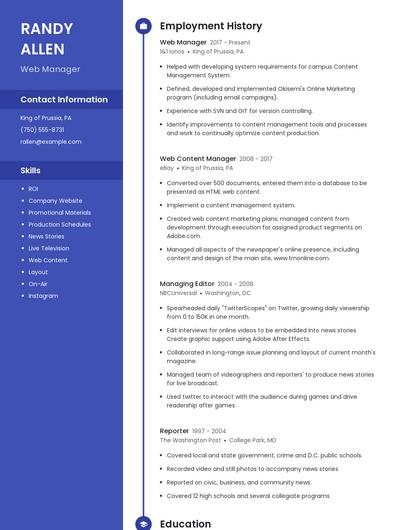
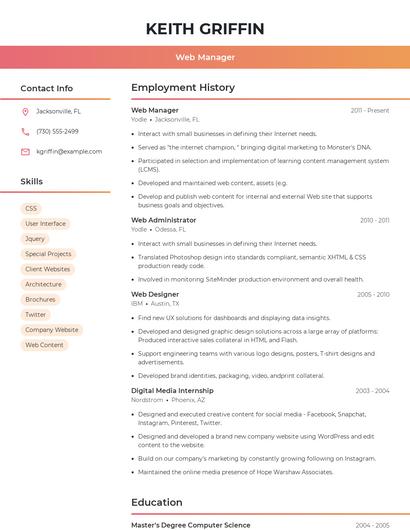
Build a professional web manager resume in minutes. Our AI resume writing assistant will guide you through every step of the process, and you can choose from 10+ resume templates to create your web manager resume.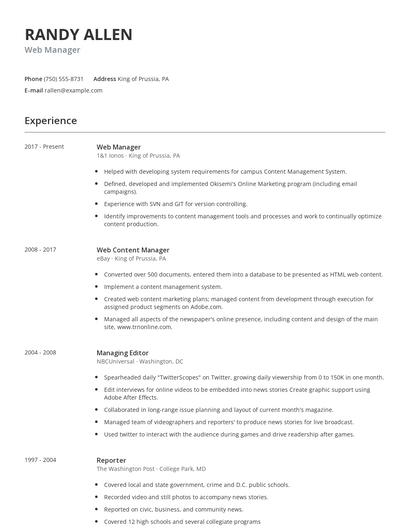
Compare different web managers
Web manager vs. Business development and marketing manager
The business development and marketing manager is in charge of overseeing a company's marketing programs and projects. They primarily manage and coordinate teams, set goals and guidelines, organize budgets and timelines, conceptualize plans, and develop strategies to optimize operations. They may also liaise with clients and suppliers, streamline marketing materials, and train staff. Furthermore, as a manager, it is essential to lead and encourage the workforce to reach goals, all while enforcing the company's policies and regulations.
There are some key differences in the responsibilities of each position. For example, web manager responsibilities require skills like "wordpress," "html css," "b testing," and "html." Meanwhile a typical business development and marketing manager has skills in areas such as "market research," "product development," "marketing campaigns," and "crm." This difference in skills reveals the differences in what each career does.
The education levels that business development and marketing managers earn slightly differ from web managers. In particular, business development and marketing managers are 6.3% more likely to graduate with a Master's Degree than a web manager. Additionally, they're 0.5% more likely to earn a Doctoral Degree.Web manager vs. Marketing and operations manager
A marketing and operations manager handles the marketing program and campaigns of an organization. Marketing and operations managers plan and create production process management, data and analytics, brand compliance, and technology infrastructure. They oversee both the marketing and positioning of the product or brand they sell. It is their duty to establish promotions with advertising managers. Skills they need to develop include good motivational skills, customer service, and relation awareness, strong negotiation skills, and exceptional communication skills.
While some skills are similar in these professions, other skills aren't so similar. For example, resumes show us that web manager responsibilities requires skills like "web content," "css," "emerging technologies," and "user experience." But a marketing and operations manager might use other skills in their typical duties, such as, "salesforce," "crm," "email marketing," and "marketing campaigns."
In general, marketing and operations managers achieve similar levels of education than web managers. They're 3.0% more likely to obtain a Master's Degree while being 0.5% less likely to earn a Doctoral Degree.What technology do you think will become more important and prevalent for web managers in the next 3-5 years?
Dr. Esther Swilley
Marketing Department Head, Associate Professor, L.L. McAninch Chair of Business Administration, Kansas State University
Web manager vs. Business development manager
A business development manager's duties include identifying business opportunities, developing effective models and strategies to improve business performance, searching for potential clients to generate income and attract partnerships. A business development manager must have extensive knowledge of the market trends and adjust strategies as needed to meet the needs of the client. Excellent communication, decision-making, critical thinking, and leadership skills are just some of the key factors that business development managers should possess to communicate and negotiate with the clients.
The required skills of the two careers differ considerably. For example, web managers are more likely to have skills like "digital marketing," "wordpress," "html css," and "b testing." But a business development manager is more likely to have skills like "customer service," "crm," "healthcare," and "business relationships."
When it comes to education, business development managers tend to earn similar degree levels compared to web managers. In fact, they're 4.2% more likely to earn a Master's Degree, and 0.3% more likely to graduate with a Doctoral Degree.Web manager vs. Assistant marketing manager
An assistant marketing manager is primarily responsible for overseeing marketing operations, reaching sales targets and boosting brand awareness. There are also instances where one must coordinate with various marketing staff to develop plans and strategies, utilize knowledge on trends to determine new opportunities, conduct marketing projects and campaigns, and produce sales forecasts from financial data. Furthermore, an assistant marketing manager may perform clerical duties such as delivering progress reports and presentations, managing schedules, and responding to calls and inquiries.
Types of web manager
Updated January 8, 2025
