- Business Statistics
- Startup Statistics
- Cloud Adoption Statistics
- Customer Loyalty Statistics
- Nonprofit Statistics
- Affiliate Marketing Statistics
- Cart Abandonment Rate Statistics
- Ridesharing Statistics
- Call Center Statistics
- eLearning statistics
- Customer Service Statistics
- Customer Experience statistics
- Entrepreneur Statistics
- Outsourcing Statistics
- Gross Revenue for Marketing and Advertising
- Sales Statistics
- MBA Statistics
- Average Small Business Revenue + Profit Margin
- How Much Do Employee Benefits Cost?
Research Summary. Entrepreneurs play a crucial role in shaping the U.S. economy. While the journey is filled with challenges and many startups do not succeed, those that do contribute significantly by creating jobs and addressing consumer needs. Here are some updated statistics on entrepreneurship in the U.S. as of 2026:
-
There are over 32 million entrepreneurs in the U.S. as of 2026.
-
60% of small business owners started their businesses themselves.
-
18% of startups fail within their first two years of operation.
-
The survival rate of new companies has remained relatively stable over the past 30 years.
-
65% of Americans view entrepreneurship as a favorable career choice.
For further insights, we have categorized the data into the following sections:
Funding | Demographics | Benefits | Challenges | Trends and Predictions
General Entrepreneurship Statistics
-
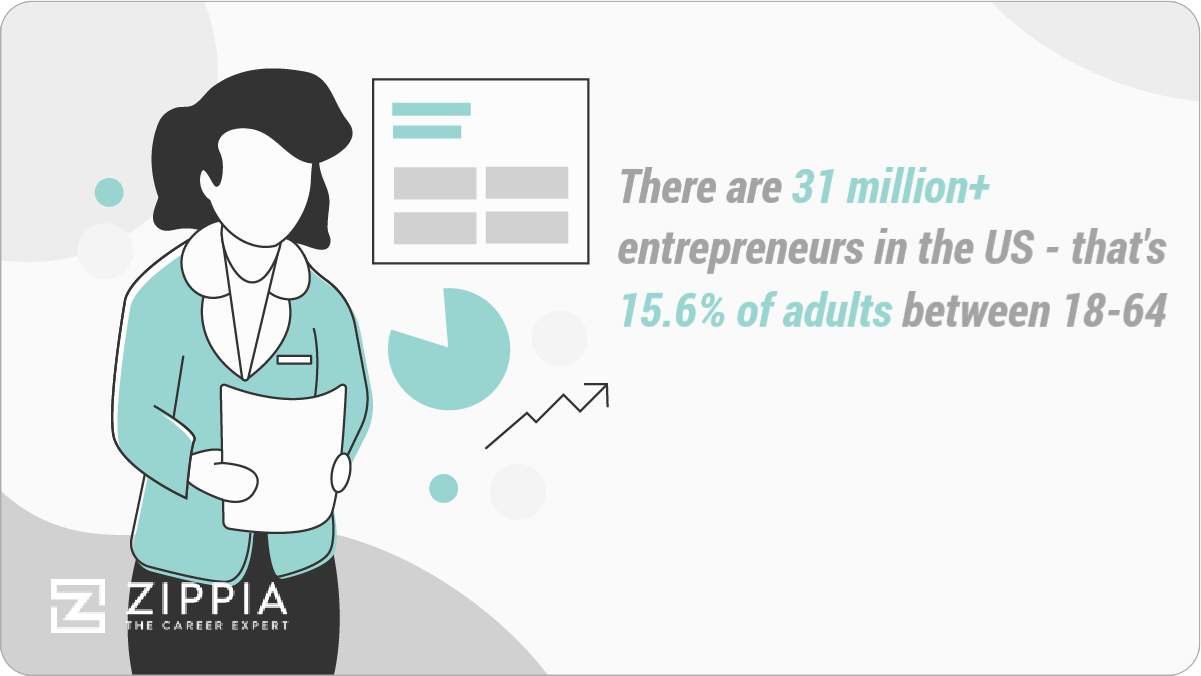
16% of U.S. adults between the ages of 18 and 64 are entrepreneurs.
This ranks among the highest globally, second only to Canada and Chile among the 31 high-income countries studied. (Uruguay ties with the U.S.)
Interestingly, many developing economies report even higher rates of entrepreneurship compared to the U.S.
-
Only 7% of entrepreneurs in the U.S. started a business out of necessity in 2022.
This low figure corresponds with the positive labor market conditions of that year, where few individuals found themselves without job opportunities.
Instead, most U.S. entrepreneurs are driven by the desire to pursue passions, be their own bosses, and meet local needs.
-
Finance, real estate, and business services accounted for 30% of U.S. startups in 2022.
This sector leads all industries, closely followed by wholesale and retail, which comprises 25% of startups.
Health, education, and social services represent 18%, while manufacturing and logistics account for 11%, agriculture and construction 8%, and information and communication technologies 6%.
Entrepreneur Funding Statistics
-
70% of surveyed entrepreneurs reported using personal funds to launch their businesses.
Among the remaining entrepreneurs, funding from financial institutions is rare:
-
29% utilized income from previous employment
-
15% gathered donations from friends and family
-
10% secured a bank loan
-
8% relied on cash advances from credit cards
-
4% received funds from investors
-
2% obtained grants
-
1% utilized crowdfunding
-
-
Approximately 75% of respondents indicated they did not seek external financing when starting their businesses.
They often relied on personal savings or funds from donations.
Many who did seek financing found support from banks or received assistance from family, with some accessing SBA loans.
-
The average startup cost is now around $120,000.
This figure can vary based on the nature of the business and its location, but it serves as a useful benchmark for entrepreneurs planning their capital needs.
While this amount might seem daunting, it’s relatively modest compared to the potential returns if the business thrives.
Entrepreneur Demographics
-
As of 2022, 67% of entrepreneurs identify as white or Caucasian.
12% are Black, and 10% are Hispanic/Latino. The remaining 11% are from various smaller racial and ethnic groups.
-
27% of individuals identifying as Black started businesses in 2022.
This is the highest rate among racial demographics, with Hispanics and Latinos at 18%, followed by whites at 14%.
-
35% of entrepreneurs operate family-owned or family-managed businesses.
In contrast, 60% of established businesses are family-owned, which includes both those that began as family operations and those that incorporated family as they expanded.
-
In 2022, 22% of 35- to 44-year-olds were in the process of starting or managing businesses that were less than three years old.
This demographic leads all age groups between 18 and 74 in entrepreneurship rates.
-
In 2022, 14% of women were starting or had recently started businesses, compared to 17% of men.
Notably, women own 48% of startups, while men own 45%.
Entrepreneurship Benefits
-
70% of surveyed individuals became entrepreneurs to be their own bosses and/or build something from the ground up.
-
In 2021, startups less than one year old accounted for 3.5 million jobs.
-
45% of small business owners report being generally satisfied with their lives.
Entrepreneurship Challenges
-
50% of new businesses fail within their first five years.
Of these, approximately 18% fail within two years, 60% do not survive past ten years, and 70% fail within 15 years.
While these statistics may seem daunting, they are more favorable than the often-cited but misleading statistic that claims half of new businesses fail within the first year.
-
In a recent study, 35% of startups failed due to insufficient funding.
While there are typically multiple factors leading to a startup’s demise, this is among the most prevalent. Other reasons include a lack of market need (30%), competition (22%), and flawed business models (18%).
-
Other failure causes encompassed legal issues, pricing challenges, poor team selection, timing issues, product quality concerns, investor disagreements, failed pivots, and burnout.
-
45% of entrepreneurs experience mental health challenges.
This compares to 30% of the general population facing similar issues.
Additionally, 25% of entrepreneurs report that their family members struggle with mental health, while only 18% of the general population does.
Entrepreneurship Trends and Predictions
-
The one-year survival rate for businesses opened in 2021 was 80%.
This rate shows that the one-year failure metrics for new entrepreneurs have remained stable over the last three decades.
-
Companies founded during the pandemic have shown resilience, with a survival rate of 76% in their first year.
This figure reflects the challenges faced during that period but also the adaptability of many startups.
-
The Bureau of Labor Statistics anticipates that there will be 11 million self-employed Americans by 2026.
This signifies a projected growth rate of 8.5% from 2016, surpassing the anticipated growth rate of 7.4% for all U.S. employees in the same timeframe.
Entrepreneurship FAQ
-
What percentage of startups are successful?
Only 10% of startups achieve long-term success. However, survival rates for startups in their first year are significantly higher, with 80% remaining operational within that timeframe. The primary challenge is maintaining momentum beyond the initial year.
-
What percentage of the population are entrepreneurs?
16% of the population are entrepreneurs. This encompasses adults aged 18 to 64 and reflects the growing cultural trend favoring startups in the U.S., with 65% of Americans perceiving entrepreneurship as an appealing career path.
-
What is the average salary of an entrepreneur?
The average salary of an entrepreneur is $76,000. This figure exceeds the overall average salary for U.S. workers, approximately $54,000.
-
How many new startups were there in 2022?
There were 919,000 new startups in 2022. This figure includes all businesses less than one year old during that period, marking a growth from 839,978 in 2021.
-
What percent of entrepreneurs went to college?
46% of entrepreneurs have a college degree. This indicates that over half of entrepreneurs do not possess a bachelor’s degree, including notable figures such as Mark Zuckerberg, Bill Gates, and Steve Jobs.
54% of entrepreneurs have an associate’s degree or have taken some college courses, while around 18% hold only a high school diploma and 20% possess a postgraduate degree.
Numerous entrepreneurs began their college education but chose to pursue their business aspirations early, either due to a compelling business idea or financial needs. Nevertheless, many entrepreneurs encourage young individuals to complete their degrees to have a backup plan should their ventures not succeed and to gain essential business knowledge.
-
How many millionaires are entrepreneurs?
90% of millionaires are entrepreneurs. Specifically, 90% of millionaires are self-made, meaning they did not inherit their wealth but generated it through businesses and investments. Among those worth $30 million or more, approximately 70% are self-made.
However, it’s important to note that many millionaires who inherited some wealth are still entrepreneurs, often utilizing their inheritances to launch businesses.
Ultimately, achieving financial success requires significant effort, whether through self-started companies or smart investments. Many millionaires reinvest their wealth into launching new ventures or supporting fellow entrepreneurs’ projects.
Business News Daily. “How Most Millionaires Got Rich.” Accessed on April 7, 2022.
-
How can I become an entrepreneur?
You can become an entrepreneur by starting your own business. This could be anything from selling handmade crafts to launching a tech startup. To succeed as an entrepreneur, you need energy, commitment, capital, and a clear understanding of your target market and their needs.
Entrepreneurship is not for the faint-hearted; even the simplest ventures come with their share of challenges. As the founder, you bear the brunt of responsibility for your business’s success and must take on various roles required to manage operations.
This demands persistence and hard work, along with business acumen. You must be capable of crafting a solid business plan for investors and ensuring that your product meets a genuine demand at a price customers are willing to pay. Additionally, effective marketing is essential to connect with potential buyers.
Conclusion
Entrepreneurship is a challenging yet rewarding path, as launching a business typically requires an investment of around $120,000 and comes with an 18% failure rate within the first two years. However, successful entrepreneurs can enjoy numerous benefits, including the potential for a higher income and the freedom to pursue their passions.
The average annual salary of an entrepreneur is now $76,000, surpassing the U.S. average salary of approximately $54,000. This financial success often accompanies the opportunity to create something meaningful, work on projects they are passionate about, and enjoy the independence of being their own boss.
Additionally, entrepreneurs can positively impact their families and communities, with 35% of entrepreneurs running family-owned businesses. Startups also contribute significantly to the economy, providing millions of jobs annually.
References
-
Babson. “2022/2023 United States Report: Global Entrepreneurship Monitor.” Accessed on October 7, 2021.
-
Score. “How Do Entrepreneurs Finance Their Startups?” Accessed on October 7, 2021.
-
Inc. “How Entrepreneurs Really Fund Their Business.” Accessed on October 7, 2021.
-
Cox Business. “Cox Business #SBWsurvey.” Accessed on October 7, 2021.
-
Statista. “Number of Jobs Created by Start-up Businesses That Were Less Than One Year Old in the United States From 1994 to 2020.” Accessed on October 7, 2021.
-
Guidant. “Small Business Trends: 2021.” Accessed on October 7, 2021.
-
Investopedia. “Top 6 Reasons New Businesses Fail.” Accessed on October 7, 2021.
-
CB Insights. “The Top 12 Reasons Startups Fail.” Accessed on October 7, 2021.
-
Forbes. “Why Entrepreneurs Need To Talk About Their Mental Health.” Accessed on October 7, 2021.
-
U.S. Bureau of Labor Statistics. “Table 7. Survival of Private Sector Establishments by Opening Year.” Accessed on October 7, 2021.
-
U.S. Bureau of Labor Statistics. “Small-Business Options: Occupational Outlook for Self-Employed Workers.” Accessed on October 7, 2021.
-
Zippia. “Average Entrepreneur Salary.” Accessed on October 7, 2021.
-
Zippia. “What is the Average Salary in the U.S.?” Accessed on October 7, 2021.
- Business Statistics
- Startup Statistics
- Cloud Adoption Statistics
- Customer Loyalty Statistics
- Nonprofit Statistics
- Affiliate Marketing Statistics
- Cart Abandonment Rate Statistics
- Ridesharing Statistics
- Call Center Statistics
- eLearning statistics
- Customer Service Statistics
- Customer Experience statistics
- Entrepreneur Statistics
- Outsourcing Statistics
- Gross Revenue for Marketing and Advertising
- Sales Statistics
- MBA Statistics
- Average Small Business Revenue + Profit Margin
- How Much Do Employee Benefits Cost?

Author

Chris Kolmar is a co-founder of Zippia and the editor-in-chief of the Zippia career advice blog. He has hired over 50 people in his career, been hired five times, and wants to help you land your next job. His research has been featured on the New York Times, Thrillist, VOX, The Atlantic, and a host of local news. More recently, he's been quoted on USA Today, BusinessInsider, and CNBC.