- Cover Letter Examples
- Cover Letter Examples
- Best Cover Letters
- Cover Letter For Internship
- General Cover Letter Templates
- Career Change Cover Letter
- Promotion Cover Letter
- College Student Cover Letter
- Entry Level Cover Letter
- Legal Cover Letter
- Creative Cover Letter
- Cover Letter For Government Job
- Cover Letter With No Experience
- Short Cover Letter Examples
- How To Send An Email Cover Letter
- How To Write A Cover Letter For A Job With No Experience In That Field
Find a Job You Really Want In
If you’re entering the job market in 2026, your cover letter plays a crucial role in your job search.
Your cover letter is a unique opportunity to differentiate yourself from other candidates applying for entry-level positions. Given the competitive nature of the job market, where many applicants may have similar resumes with limited experience, a well-crafted cover letter can make a significant impact.
Additionally, many candidates tend to make common mistakes in their cover letters. By tailoring your cover letter to the specific job you’re applying for, you can open doors that your resume alone might not.
Key Takeaways:
- Entry-level cover letters should be concise, ideally between 250 and 300 words, with a maximum of 400 words.
- Each cover letter should be specifically tailored for the position you seek.
- Clearly state the position you’re applying for, how you will meet the job’s responsibilities, and showcase your personality.
- Avoid generalizations in your opening; be specific and direct.
- Ensure your cover letter is easy to read, and quantify your accomplishments where possible.
- What Is an Entry-Level Cover Letter?
- How to Structure an Entry-Level Cover Letter
- Elements of an Entry-Level Cover Letter
- Common Mistakes in Entry-Level Cover Letters
- Entry-Level Cover Letter Tips
- Examples of Entry-Level Cover Letters
- Entry-Level Cover Letter FAQ
- Final Thoughts
- Sign Up For More Advice and Jobs
What Is an Entry-Level Cover Letter?
An entry-level cover letter is a document that expresses your interest and qualifications for a job classified as “entry-level.” These positions typically require minimal (or no) previous experience, making it challenging for job seekers to effectively summarize their qualifications.
Your cover letter, alongside your resume, forms the first impression that hiring managers or recruiters will have of you. Unlike your resume, it allows you to explain your interest in the role and how you plan to fulfill it.
The most effective cover letters lead to interview requests, so make sure to highlight your most impressive skills, experiences, and qualities. Even without formal experience, you likely have relevant background and skills that can prepare you for success in this role.
How to Structure an Entry-Level Cover Letter
Hiring managers typically spend about six seconds reviewing each cover letter. This means you need to capture their attention quickly, using around 250 words to highlight:
- The position you’re applying for
- Your approach to fulfilling the job’s responsibilities
- A glimpse of your personality
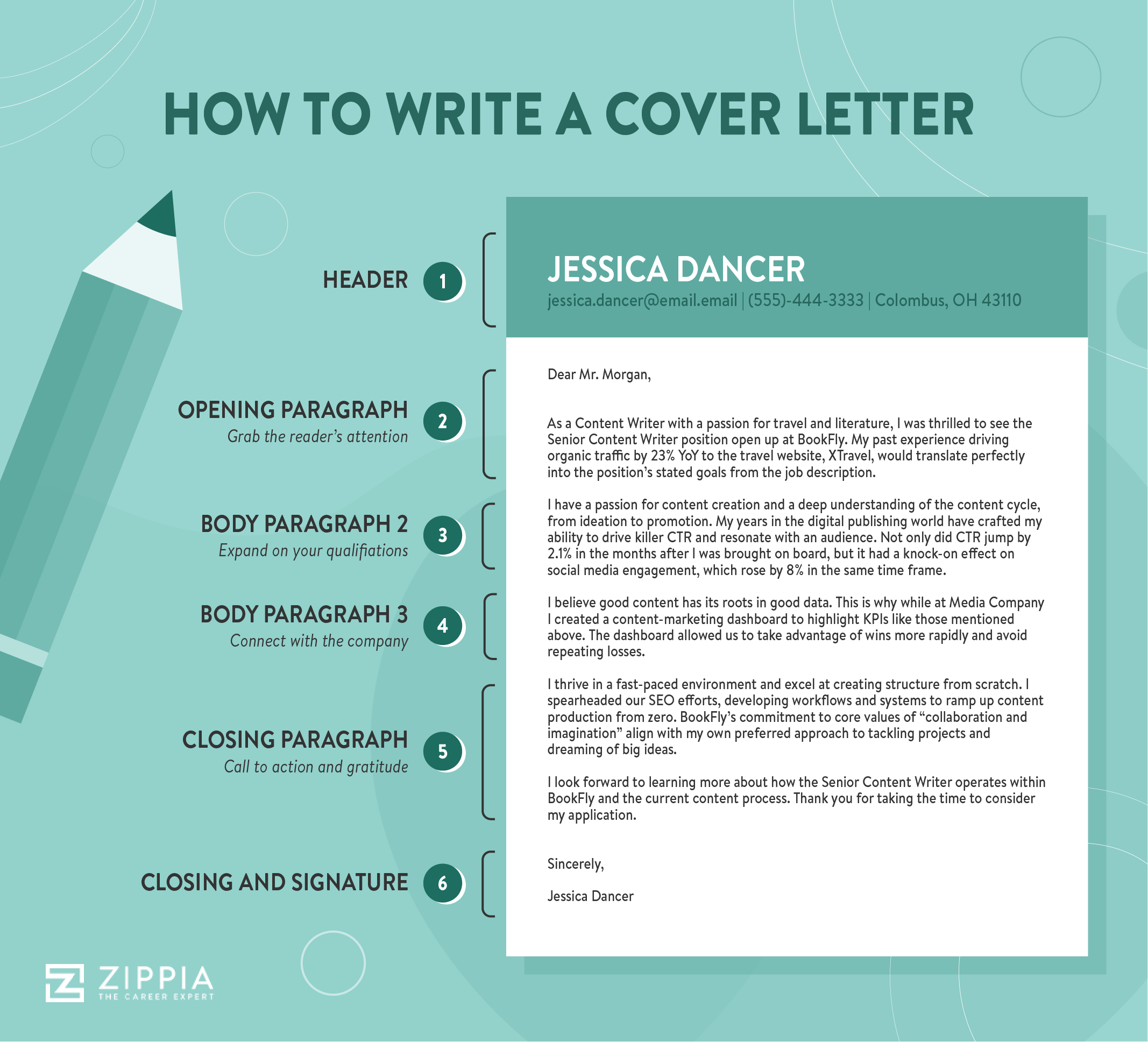
The structure of your cover letter should be as follows:
- Contact Information
- Salutation
- Body
- Closing and Signature
Elements of an Entry-Level Cover Letter
Contact Information
Ensure your contact information is accurate. Include your details at the top left corner, followed by a space and the date, then the salutation. Your contact information should include:
- Address
- City, State, Zip Code
- Phone Number
For the recipient’s contact information, include:
- Name
- Title
- Company
- Address
- City, State, Zip Code
If you’re sending your cover letter via email, place your contact information in your email signature and remove the recipient’s contact details.
For the subject line, keep it informative and concise, such as “Bilingual Creative Writer Application” or simply your name and the position title.
Salutations
Since hiring managers skim cover letters, avoid overly generic greetings. Instead, do your best to find the hiring manager’s name:
- No “Dear Sir or Madam” or “To Whom It May Concern” – these indicate a lack of effort in personalizing your letter.
- Use “Dear Mr./Ms. [Last Name]” for titles.
- If unsure of a person’s gender based on their name, use “Dear [Full Name].”
Employ either a comma or colon after the salutation; we recommend using commas.
Try to find the name of the person reading your letter by searching on the company website or reaching out to the human resources department if needed. If all else fails, “Dear Hiring Manager” is an acceptable fallback.
The Opening Sentence(s)
To stand out, avoid starting with generic phrases like “My name is [name] and I am applying for the [position] at [company].” Instead, capture their attention with a compelling opening.
Examples of Opening Sentence(s)
- Clearly state what position you are applying for
- Highlight how you will contribute to the role
- Convey your personality
Here are some examples:
-
“My passion for technology began when I built my first computer at age 12, and I am eager to apply that enthusiasm as a Junior IT Specialist at [Company].”
Why it works: This statement conveys enthusiasm for the role and demonstrates relevant personal experience in a relatable way.
-
“Inspired by my involvement in a community service project, I am excited to contribute my organizational skills as an Event Coordinator at [Company].”
Why it works: This example indicates a personal experience that relates to the job, highlighting the candidate’s skills and motivations.
-
“While volunteering at a local animal shelter, I discovered my passion for animal care and am excited to bring that dedication to the Veterinary Assistant position at [Company].”
Why it works: This shows the applicant’s commitment and relevant experience, positioning them as a candidate who cares about the role.
These examples illustrate that you don’t need formal work experience to create an engaging opening; your enthusiasm and personal experiences can be just as impactful.
The Cover Letter Body
A common mistake among entry-level candidates is submitting a cover letter that simply reiterates their resume. Think of your resume as providing the “who-what-where-when,” while your cover letter answers the “how and why.”
The goal of the body of your cover letter is to articulate why you are the best candidate for the position. Make sure to connect your experiences to the job requirements without listing them in a dry manner.
If the job description mentions the need for multitasking and meeting deadlines, reference your experience managing a part-time job while maintaining a strong GPA. If they seek detail-oriented candidates, discuss projects where you demonstrated this skill.
Include volunteer experiences, internships, relevant coursework, projects, leadership roles, and applicable skills that relate to the position you are pursuing.
Closing
In your closing, avoid excessive flattery or begging. Even if it’s your dream job, maintain a professional tone and frame it as a business opportunity.
A standard closing could be:
I would appreciate the opportunity to further discuss how my skills and ideas can benefit [Company].
Thank you for considering my application. I hope to hear from you soon.
Sincerely,
[Your Name]
If sending via email, include your email signature with contact details instead of a handwritten signature.
Common Mistakes in Entry-Level Cover Letters
Here’s a list of common pitfalls to avoid, as hiring managers often look for reasons to reject candidates:
- Avoid generic cover letters. Show employers you’re making an effort and personalize each letter.
- Don’t forget about the reader. Focus on how you can meet the company’s needs.
- Steer clear of jargon or complex vocabulary. Write clearly and naturally for readability.
- Be confident, not modest. This is your chance to showcase your strengths.
- Keep it concise. Ideally, your cover letter should be between 200-300 words. Remember, clarity is key.
Entry-Level Cover Letter Tips
With the basics covered, here are some additional tips for crafting an effective entry-level cover letter:
- Highlight universally important skills. Incorporate relevant skills from the job description and your strongest transferable skills, especially soft skills like communication and teamwork.
- Research the company. Understanding the company’s values and goals can help you align your cover letter with their culture.
- Emphasize education. For recent graduates, your educational achievements can help support your application. Mention relevant projects and coursework.
- Quantify accomplishments. Use measurable results to demonstrate your impact, such as “managed a team of five” or “increased sales by 20%.”
- Proofread. Review your cover letter for spelling and grammar errors, and consider having a friend review it as well.
Examples of Entry-Level Cover Letters
-
Example 1: Physical Letter
John Brown
123 Brook Ln.
Towne, MD
123-456-7890
john.brown@email.com08/24/2026
Ashley Smith
Senior Analyst
456 Technology Way
Landon, MDDear Ms. Smith,
As a senior sports management student at Roothers State College, I was thrilled to see your posting for equipment interns. Throughout my program, I have gained substantial experience working with athletes across various sports. I am one of only four students to successfully complete rotations in all three sports over four semesters.
I have maintained a 3.8 GPA while being actively involved in several campus recreational leagues, which has given me a unique perspective on the operations side of sports. I understand how to organize and manage equipment effectively due to my experiences.
It has always been my dream to work for a professional sports team, and the [Company] is an organization I deeply admire for its commitment to supporting young players and the local community. I believe my core values align well with those of your organization.
I am confident that I would be an ideal candidate for the equipment intern role, ready to assist coaches and manage inventories. I look forward to discussing the internship in more detail.
Best regards,
John Brown -
Example 2: Email
Subject Line: Amy Grant – Junior Copywriter Application
Dear Mr. Jones,
During a recent Job Fair, I had an enlightening conversation with ABC’s recruiter Doris Kelly regarding the Junior Copywriter positions available. As an English graduate, I was excited to learn more about ABC’s innovative content marketing strategy.
My academic background has equipped me with strong writing skills, evidenced by my completion of an award-winning 20,000-word thesis and several undergraduate research papers. I have also collaborated on marketing campaigns for departmental fundraising initiatives and served as a mentor at the university writing center.
Given that the Junior Copywriter role requires collaboration with product, design, and marketing teams, my background in teamwork and my commitment to meeting deadlines would be beneficial to your organization.
I am proficient in Microsoft Office and Google Suite, with a working knowledge of WordPress from managing my personal blog.
I appreciate your consideration for the Junior Copywriter position at ABC and look forward to further discussing my application.
Sincerely,
Beverly Brown
bbrown@uvm.com
555-654-3210
www.bevbrownwrites.com
Entry-Level Cover Letter FAQ
-
Do entry-level jobs require cover letters?
Yes, entry-level jobs typically require cover letters. A well-written cover letter is crucial for helping you stand out to potential employers and securing your first job after school.
Cover letters serve as a platform to illustrate how your achievements and experiences can be valuable in the position you’re pursuing.
-
What do you write in a cover letter if you have no experience?
Highlight soft skills you’ve developed through hobbies, coursework, or volunteer work. Soft skills are often more challenging to teach and are highly valued by employers.
Express your passion for learning new skills related to the job, as this trait is critical for entry-level positions.
-
Do employers read cover letters?
Yes, employers do read cover letters. This is particularly true if a cover letter is mandated as part of the application process.
While not every recruiter will read them, a significant portion considers them important in evaluating candidates.
-
How do you start an entry-level cover letter?
Begin your cover letter by enthusiastically expressing your interest in the role. Clearly state who you are, the position you are applying for, and how you discovered the job listing. Mention any connections you may have within the company.
Final Thoughts
Writing a cover letter when you have limited experience can be challenging. However, everyone possesses skills, passions, and stories of success. The key is translating those into a compelling half-page document that positions you as the ideal candidate.
By following these cover letter tips, you’ll increase your chances of receiving interview invitations from hiring managers and recruiters.
- Cover Letter Examples
- Cover Letter Examples
- Best Cover Letters
- Cover Letter For Internship
- General Cover Letter Templates
- Career Change Cover Letter
- Promotion Cover Letter
- College Student Cover Letter
- Entry Level Cover Letter
- Legal Cover Letter
- Creative Cover Letter
- Cover Letter For Government Job
- Cover Letter With No Experience
- Short Cover Letter Examples
- How To Send An Email Cover Letter
- How To Write A Cover Letter For A Job With No Experience In That Field

Author

David Luther was the Content Marketing Editor for the Zippia Advice blog. He developed partnerships with external reporting agencies in addition to generating original research and reporting for the Zippia Career Advice blog. David obtained his BA from UNC Chapel Hill.
Expert
Matt Warzel a President of a resume writing firm (MJW Careers, LLC) with 15+ years of recruitment, outplacement, career coaching and resume writing experience. Matt is also a Certified Professional Resume Writer (CPRW) and Certified Internet Recruiter (CIR) with a Bachelor of Science in Business Administration (Marketing Focus) from John Carroll University.