Find a Job You Really Want In
Childcare has long been recognized as a critical issue that impacts both families and the workforce. The need for accessible and affordable childcare remains a barrier for many families striving to engage fully in the labor market.
As of 2026, the average monthly cost of childcare for a single infant in a childcare center in the United States stands at approximately $1,230, totaling nearly $15,000 annually. This significant expense often outpaces the earnings of many workers, necessitating substantial financial sacrifices or outright precluding their ability to cover these costs without assistance.
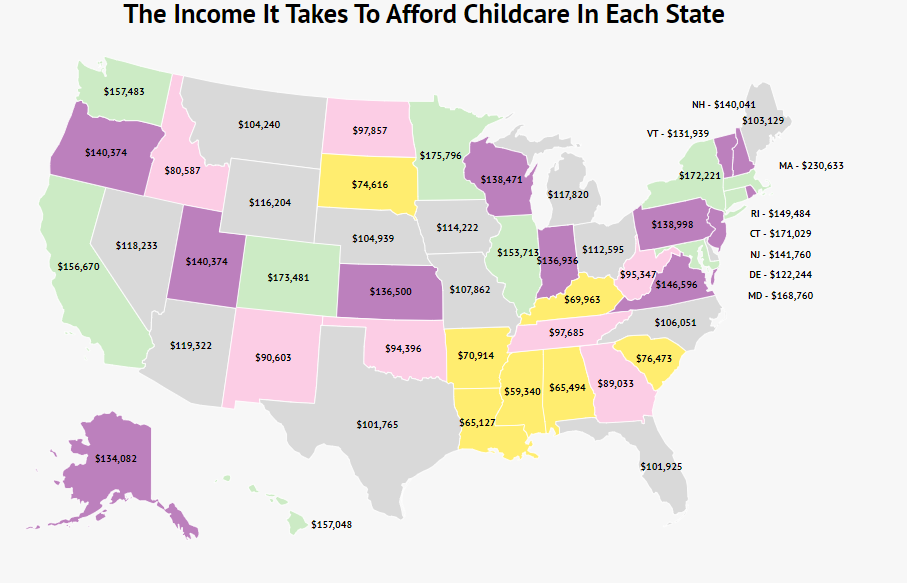
Our analysis reveals that no state’s median household income enables families to afford childcare without exceeding recommended financial limits. In fact, the average daycare costs across all states, when compared to median incomes, indicate that families are spending over 10% of their income on childcare—the threshold advised by the U.S. Government for affordability. Below, we outline the states with the highest and lowest incomes required to afford daycare.
10 States With the Highest Daycare Costs
- Massachusetts
- Minnesota
- Colorado
- New York
- Connecticut
- Maryland
- Washington
- Hawaii
- California
- Illinois
It comes as no surprise that many states with the highest daycare costs also rank among the priciest in terms of overall living expenses. All ten of these states require an income exceeding $150,000 to ensure that families spend less than 10% of their earnings on childcare.
10 States With the Lowest Daycare Costs
- Mississippi
- Louisiana
- Alabama
- Kentucky
- Arkansas
- South Dakota
- South Carolina
- Idaho
- Georgia
- New Mexico
While these ten states feature lower daycare costs, they typically also offer lower average earnings. For instance, even in Mississippi, where annual daycare costs are the lowest at $5,178, a household income of $59,340 is still required for affordability.
How We Determined This
Our analysis began by gathering the average cost of childcare for an infant in a childcare center, referencing data from Child Care Aware of America. We conducted independent research to establish costs for South Dakota, which was initially excluded from our dataset.
Following the guidance from the U.S. Department of Health and Human Services that daycare expenses should not exceed 10% of a household’s budget, we used this benchmark to determine affordability. We calculated the maximum necessary salary for each state, ensuring that average childcare costs remained below the 10% threshold. A flat rate of 14.6% was applied to account for taxes, social security, and Medicare contributions to estimate take-home pay.
The results indicate that in many states, families must earn significantly above the median household income to keep childcare costs manageable, evidencing the financial strain many workers experience.
It’s important to note that these figures reflect the average cost of childcare for one infant in a childcare center. Choosing a home daycare or budget-friendly options can lower costs, while premium locations or multiple children can escalate expenses.
Career Considerations
The unaffordability of childcare drives many parents, particularly women and low-to-middle-income earners, to exit the workforce rather than incur the high costs of care. However, even a brief interruption in employment can have lasting repercussions on future earnings. For single parents, the challenge is even more pronounced, as they often lack the option of sharing financial burdens with a partner.
Ultimately, childcare remains a complex, financial challenge for many working families, forcing them to make difficult decisions that can affect their short-term and long-term financial health.
How Much Childcare Costs in Each State—and Income Needed to Afford It
| State | Income Needed | Annual Cost-1 Kid | Annual Cost-2 Children |
|---|---|---|---|
| Alabama | $65,494 | $5,715 | $11,430 |
| Alaska | $134,082 | $11,700 | $23,400 |
| Arizona | $119,322 | $10,412 | $20,824 |
| Arkansas | $70,914 | $6,188 | $12,376 |
| California | $156,670 | $13,671 | $27,342 |
| Colorado | $173,481 | $15,138 | $30,276 |
| Connecticut | $171,029 | $14,924 | $29,848 |
| Delaware | $122,244 | $10,667 | $21,334 |
| Florida | $101,925 | $8,894 | $17,788 |
| Georgia | $89,033 | $7,769 | $15,538 |
| Hawaii | $157,048 | $13,704 | $27,408 |
| Idaho | $80,587 | $7,032 | $14,064 |
| Illinois | $153,713 | $13,413 | $26,826 |
| Indiana | $136,936 | $11,949 | $23,898 |
| Iowa | $114,222 | $9,967 | $19,934 |
| Kansas | $136,500 | $11,911 | $23,822 |
| Kentucky | $69,963 | $6,105 | $12,210 |
| Louisiana | $65,127 | $5,683 | $11,366 |
| Maine | $103,129 | $8,999 | $17,998 |
| Maryland | $168,760 | $14,726 | $29,452 |
| Massachusetts | $230,633 | $20,125 | $40,250 |
| Michigan | $117,820 | $10,281 | $20,562 |
| Minnesota | $175,796 | $15,340 | $30,680 |
| Mississippi | $59,340 | $5,178 | $10,356 |
| Missouri | $107,862 | $9,412 | $18,824 |
| Montana | $104,240 | $9,096 | $18,192 |
| Nebraska | $104,939 | $9,157 | $18,314 |
| Nevada | $118,233 | $10,317 | $20,634 |
| New Hampshire | $140,041 | $12,220 | $24,440 |
| New Jersey | $141,760 | $12,370 | $24,740 |
| New Mexico | $90,603 | $7,906 | $15,812 |
| New York | $172,221 | $15,028 | $30,056 |
| North Carolina | $106,051 | $9,254 | $18,508 |
| North Dakota | $97,857 | $8,539 | $17,078 |
| Ohio | $112,595 | $9,825 | $19,650 |
| Oklahoma | $94,396 | $8,237 | $16,474 |
| Oregon | $140,374 | $12,249 | $24,498 |
| Pennsylvania | $138,998 | $12,129 | $24,258 |
| Rhode Island | $149,484 | $13,044 | $26,088 |
| South Carolina | $76,473 | $6,673 | $13,346 |
| South Dakota | $74,616 | $6,511 | $13,022 |
| Tennessee | $97,685 | $8,524 | $17,048 |
| Texas | $101,765 | $8,880 | $17,760 |
| Utah | $140,374 | $12,249 | $24,498 |
| Vermont | $131,939 | $11,513 | $23,026 |
| Virginia | $146,596 | $12,792 | $25,584 |
| Washington | $157,483 | $13,742 | $27,484 |
| West Virginia | $95,347 | $8,320 | $16,640 |
| Wisconsin | $138,471 | $12,083 | $24,166 |
| Wyoming | $116,204 | $10,140 | $20,280 |

Author

Kathy is the head of content at Zippia with a knack for engaging audiences. Prior to joining Zippia, Kathy worked at Gateway Blend growing audiences across diverse brands. She graduated from Troy University with a degree in Social Science Education.