- HR Statistics
- Average Labor Cost Percent Of Sales
- Average Time to Reach Profitability At A Startup
- Office Space Per Employee
- Recruitment Statistics
- Employee Engagement Statistics
- Work-Life Balance Statistics
- BYOD Statistics
- Paternity Leave Statistics
- Onboarding Statistics
- Average Paid Maternity Leave In Us
- Average Cost Of A Bad Hire
- Employee Theft Statistics
- Paid Family Leave Statistics
- Cost Of Hiring Statistics
- Employee Turnover Statistics
- Average Cost Of Employer Sponsored Health Insurance Statistics
- Sexual Harassment In The Workplace Statistics
- HR Statistics
- PTO Statistics
- Social Media Recruitment Statistics
- Hiring Statistics
- Out Of Prison Employment Statistics
22 Must-Know Employee Engagement Statistics [2026]: Trends, Benefits, and More
Research Summary. In the United States, employee engagement continues to play a crucial role in driving productivity and profitability. Despite its importance in fostering a positive workforce and ensuring the ongoing success of the American economy, many employees still report feelings of disengagement at work. Our data analysis team has gathered significant statistics regarding employee engagement:
-
68% of the U.S. workforce is not engaged at work.
-
Companies with the highest levels of employee engagement are 21% more profitable than their peers.
-
Employees exhibiting high levels of engagement are 87% less likely to leave their employer voluntarily.
-
89% of human resources professionals agree that ongoing feedback and clear expectations are the best ways to enhance employee engagement.
-
69% of employees state they would work harder if they felt appreciated, and 37% consider recognition the most important factor for job satisfaction.
-
Employee disengagement can cost companies approximately $3,400 for every $10,000 an average disengaged employee earns annually.
-
Globally, only about 21% of the workforce is actively engaged at work.
For a deeper dive, we have categorized the data into the following sections:
The Cost of Disengaged Employees | Benefits of Employee Engagement | Reasons for Employee Engagement | Engagement and Retention | Trends
General Statistics on Employee Engagement
-
The majority of the U.S. workforce is not engaged at work.
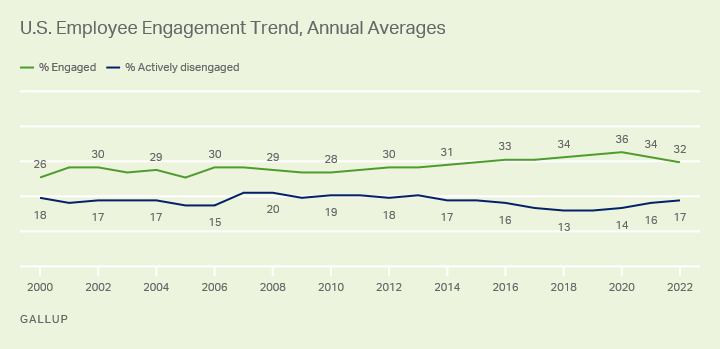
Currently, only 32% of employees are engaged, based on recent Gallup research. A 2023 survey revealed that 68% of Americans felt disengaged, with 14% actively disengaged.
-
36% of the U.S. workforce was engaged at work in 2020.
During the pandemic, employee engagement fluctuated significantly. In early 2020, engagement peaked at 38%, but plummeted to 31% shortly thereafter. Factors such as economic uncertainty and societal events impacted these engagement levels.
-
32% of employees are engaged at work in 2022.
Gallup reported a continuous decline in engagement rates from 2020 to 2021, extending into 2022.
Employee Engagement Statistics by the Cost of Disengaged Employees
-
On average, disengaged employees cost companies $3,400 for every $10,000 they earn annually.
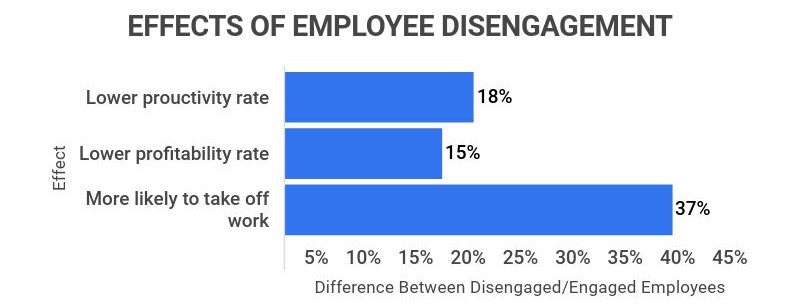
Disengaged employees are approximately 18% less productive and 15% less profitable than their engaged counterparts. Additionally, they are 37% more likely to take time off work.
-
For a company with 250 employees, low engagement can cost over $3 million per year.
With an average salary of $47,000, a firm with 250 employees could lose about $3,164,040 annually due to disengagement.
-
Complacent leadership is a leading reason for employee disengagement.
58% of American workers believe their company’s leadership is either inactive or uninvolved in fostering a positive culture. Only 9% feel that leadership is committed to cultural initiatives.
-
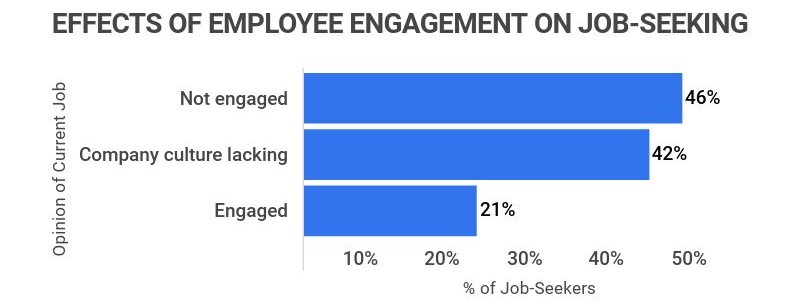
Employee disengagement increases turnover rates by nearly 50%.
A survey conducted by Achievers revealed that 52% of workers were actively seeking new jobs, with 46% feeling disengaged and 42% citing a lack of company culture as a concern.
Employee Engagement Statistics by Benefits
-
Engaged employees are 22% more productive than their disengaged counterparts.
Organizations with engaged employees report 22% higher productivity levels, according to research from Harvard Business Review.
-
Engaged employees are 21% more profitable than disengaged employees.
Top-tier engaged employees experience a 41% reduction in absenteeism and a 59% drop in turnover rates.
Employee Engagement Statistics: Reasons for Engagement at Work
-
Career advancement opportunities are crucial for job satisfaction, especially among younger workers.
47% of employees rate career advancement as essential for job satisfaction, with 89% of millennials prioritizing these opportunities.
-
Employees who feel heard are more likely to be engaged.
Employees who feel their voices are acknowledged are about 4.6 times more likely to be engaged and perform better.
Organizations emphasizing inclusivity and diversity tend to have more engaged employees.
-
89% of employees at companies with wellness programs report high engagement levels.
Most employees at wellness-focused companies believe their workplace is a great place to work compared to only 17% at companies lacking such initiatives.
-
HR experts emphasize the importance of consistent feedback for engagement.
89% of HR professionals agree that continuous feedback and recognition are key to fostering employee engagement.
Employee Engagement Statistics and Retention
-
Many U.S. workers would accept a pay cut for their ideal job.
Approximately 60% of employees are willing to earn less to work in a job they love, with many willing to forgo up to 50% of their salary.
-
Half of American workers would leave their current job for a better opportunity.
Studies indicate that nearly 50% of employees desire a career change, often citing employer-related issues as the main reason.
-
Engaged employees are significantly less likely to leave their jobs.
Engaged employees are 87% less likely to leave their jobs, highlighting the importance of engagement in retention strategies.
-
The ratio of engaged to disengaged employees is concerning.
For every actively disengaged employee, there are 2.2 engaged employees, marking the lowest ratio since 2016.
Employee Engagement Statistics: Trends
-
Organizations are increasingly prioritizing employee experience to boost engagement.
Post-pandemic, many businesses are focusing on career flexibility and employee well-being to enhance engagement, with 95% of IT executives reporting increased attentiveness to employee feedback.
-
Engagement levels fluctuated significantly during the pandemic.
Engagement dropped to historic lows in 2020 but is gradually recovering as companies adapt to new working environments.
Employee Engagement Statistics FAQ
-
What percentage of employees are engaged at work?
36% of employees in the United States are engaged at work. Recent surveys indicate that 68% of Americans are disengaged, with 14% actively disengaged.
-
How much more productive are engaged employees?
Engaged employees are significantly more productive. Organizations with engaged employees are 22% more productive, as noted by Harvard Business Review.
-
What makes an employee feel engaged at work?
Employee engagement is linked to job fulfillment and happiness. Employees who utilize their skills, trust leadership, and seek growth opportunities are more likely to feel engaged.
-
Do engaged employees stay at their jobs longer?
Yes, engaged employees tend to stay longer. Engaged employees are at least 44% more likely to remain with their current employer.
-
What does it mean to be an engaged employee compared to an actively disengaged employee?
Employee engagement can be categorized as follows:
-
Engaged employee. An engaged employee dedicates time and energy to their work, displaying enthusiasm and enjoyment in their daily tasks.
-
Disengaged employee. A disengaged employee meets minimum requirements but lacks passion and attachment to their company.
-
Actively disengaged employees. These employees have negative work experiences, often dragging down morale for colleagues.
-
Conclusion
Employee engagement remains vital for organizational success. Although many employees in the U.S. report challenges in staying engaged, businesses are increasingly prioritizing employee needs to enhance engagement, which in turn boosts productivity and profitability.
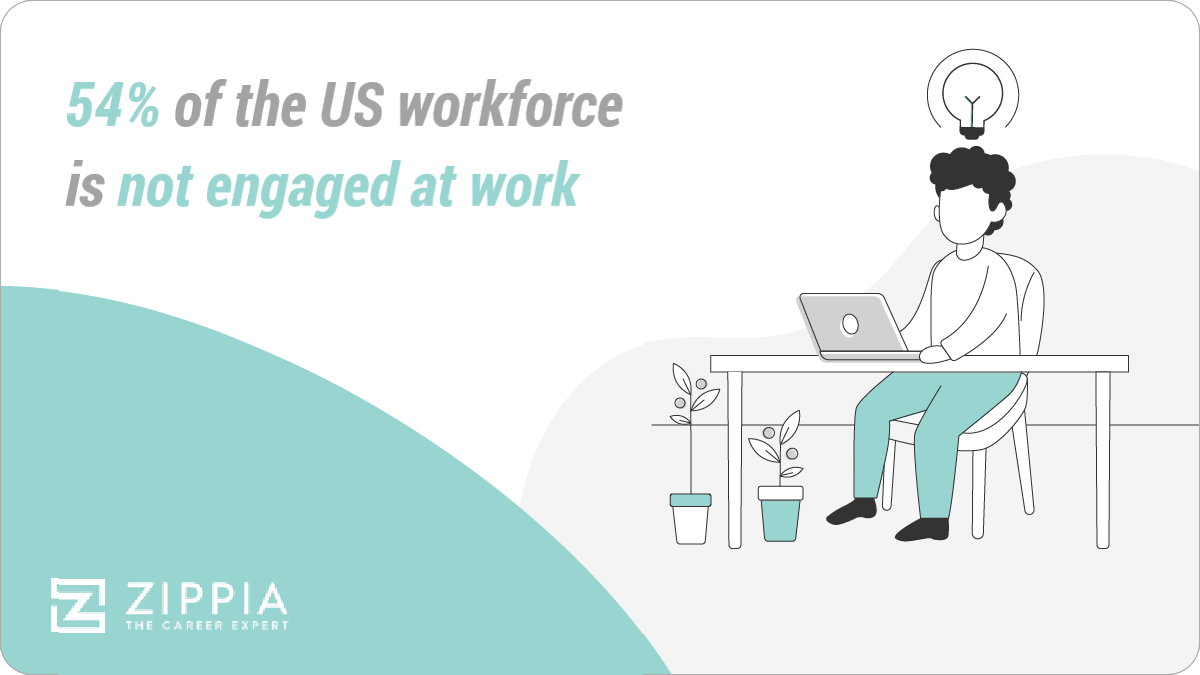
Currently, research indicates that 54% of the American workforce is disengaged at work, revealing significant gaps in business success that can lead to substantial financial losses.
While solutions and improvements are on the horizon, the commitment of HR professionals—89% are dedicated to providing consistent feedback—highlights a proactive approach to elevating employee engagement.
References
-
Gallup. “U.S. Employee Engagement Slump Continues.” Accessed on February 14, 2023.
-
Gallup. “State of the Global Workplace: 2022 Report.” Accessed on February 16, 2023.
-
The Society For Human Resource Management. “Employee Engagement Tech Key To Post-Pandemic Success.” Accessed on October 17, 2021.
-
Harvard Business Review. “Employee Engagement Does More Than Boost Productivity.” Accessed on October 14, 2021.
-
Forbes. “10 Timely Statistics About The Connection Between Employee Engagement And Wellness.” Accessed on October 14, 2021.
-
Culture Amp. “Increase Employee Engagement And Retention.” Accessed on October 17, 2021.
- HR Statistics
- Average Labor Cost Percent Of Sales
- Average Time to Reach Profitability At A Startup
- Office Space Per Employee
- Recruitment Statistics
- Employee Engagement Statistics
- Work-Life Balance Statistics
- BYOD Statistics
- Paternity Leave Statistics
- Onboarding Statistics
- Average Paid Maternity Leave In Us
- Average Cost Of A Bad Hire
- Employee Theft Statistics
- Paid Family Leave Statistics
- Cost Of Hiring Statistics
- Employee Turnover Statistics
- Average Cost Of Employer Sponsored Health Insurance Statistics
- Sexual Harassment In The Workplace Statistics
- HR Statistics
- PTO Statistics
- Social Media Recruitment Statistics
- Hiring Statistics
- Out Of Prison Employment Statistics

Author

Elsie is an experienced writer, reporter, and content creator. As a leader in her field, Elsie is best known for her work as a Reporter for The Southampton Press, but she can also be credited with contributions to Long Island Pulse Magazine and Hamptons Online. She holds a Bachelor of Arts degree in journalism from Stony Brook University and currently resides in Franklin, Tennessee.