- Industry Statistics
- Wedding Industry Statistics
- Yoga Industry Statistics
- Music Industry Statistics
- Landscaping Industry Statistics
- Bicycle Industry Statistics
- Coffee Industry Statistics
- Car Rental Industry Statistics
- Home Improvement Industry Statistics
- Insurance Industry Statistics
- Supplements Industry Statistics
- Golf Industry Statistics
- Fitness Industry Statistics
- US Media And Entertainment Industry Statistics
- Firearm Industry Statistics
- Financial Services Industry Statistics
- Health And Wellness Industry Statistics
- Trucking Industry Statistics
- Wine Industry Statistics
- Pet Industry Statistics
- Mobile App Industry Statistics
- Digital Marketing Industry Statistics
- Hotel Industry Statistics
- Retail Statistics
- Robotics Industry Statistics
- Jewelry Industry Statistics
- Appointment Scheduling statistics
- Restaurant Industry Statistics
- Food Delivery Statistics
- Food Truck Industry
- Fashion Industry
- Real Estate Industry
- US Film Industry
- US Beverage Industry
- USu202fFast Food Restaurants
- US Construction Industry
- US Book Industry
- Cosmetics Industry
- US Food Retail Industry
- US Pharmaceutical Industry
- US Healthcare Industry
- Airline Industry
- Automobile Industry
- Transportation Industry Statistics
- Event Industry Statistics
- Project Management Statistics
- Oil And Gas Industry Statistics
- Nursing Home Statistics
- Nursing Shortage Statistics
- Nursing Statistics
Book Industry Overview in 2026 – The U.S. book industry continues to play a pivotal role in education, entertainment, and cultural discourse. After comprehensive research, our data analysis team has compiled the following key insights:
-
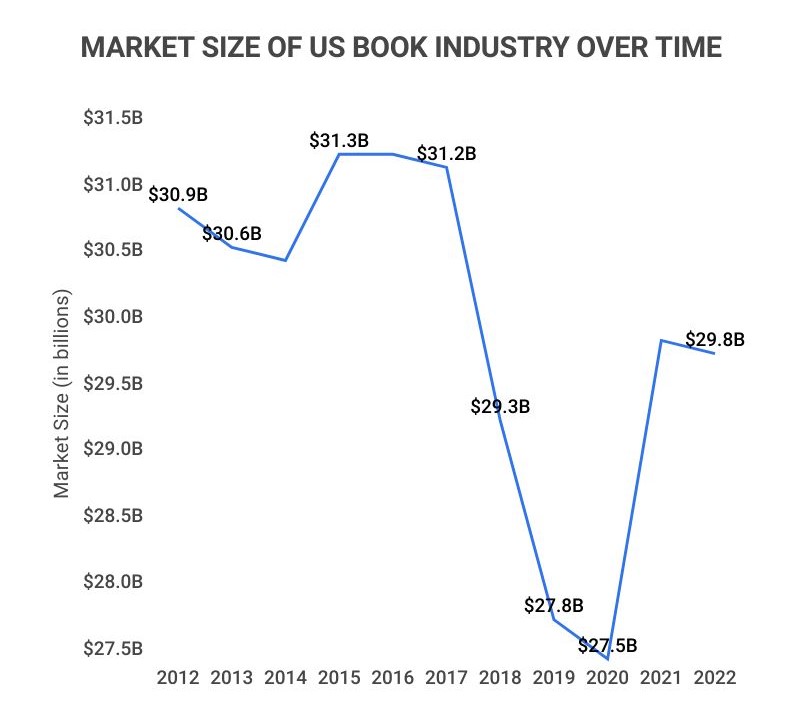
The U.S. book industry generated $29.8 billion in revenue in 2022.
-
Over 4 million new books, including both self-published and commercially published works, were released in 2022.
-
Romance novels emerged as the leading genre, with over 32 million print copies sold in 2022.
-
Approximately 1,700 independent bookselling businesses operate 4,100 stores across the U.S.
-
Total U.S. book sales reached 788.7 million units in 2022, reflecting a 4.5% decrease compared to 2021.
For a deeper dive into the data, explore our detailed sections on:
Print vs. eBook | Audiobook | Textbook | Trends
General U.S. Book Industry Statistics
While the volume of books published continues to climb, overall sales have plateaued. The book industry faces stiff competition from digital media and other entertainment forms. Here are the latest insights:
-
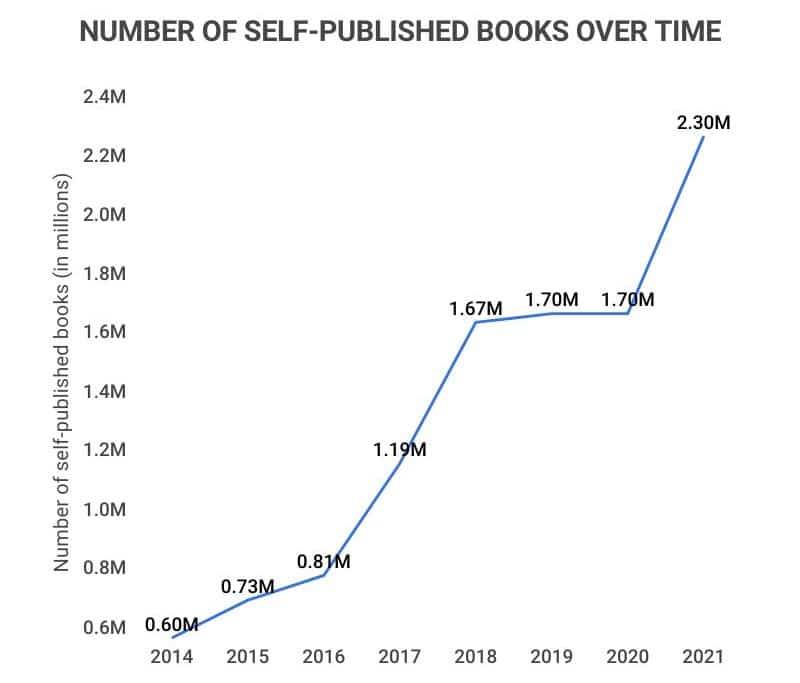
2.3 million new books were self-published in the U.S. in 2021.
This marks a significant increase of over 93% over the past five years and accounts for 57.5% of all new publications.
-
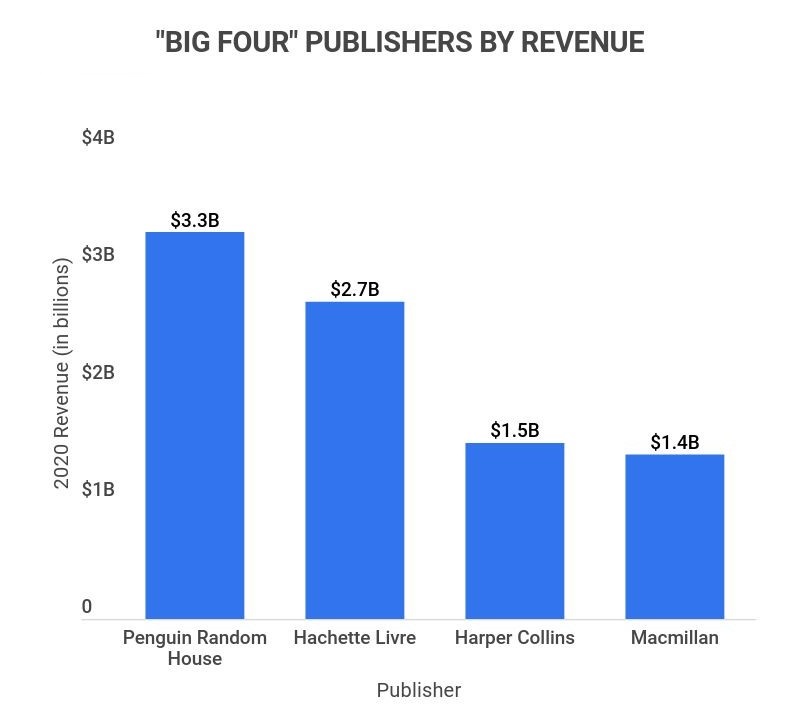
Penguin Random House remains the largest U.S. book publisher, with $3.3 billion in revenue (2019).
This publisher is one of the “Big Five,” alongside Hachette Book Group, HarperCollins, Simon & Schuster, and Macmillan.
-
As of 2022, the U.S. trade book publishing industry recorded $10.6 billion in net revenue.
This figure represents a decrease from $16.23 billion in 2019, although it shows a slight improvement from 2021, when revenues dropped below $10 billion.
-
The best-selling book of 2022 in the U.S. was ‘It Ends with Us’ by Colleen Hoover.
This title sold nearly 2.73 million copies, outperforming the runner-up, ‘Verity,’ also by Hoover, by over 730,000 copies.
-
68,670 individuals are employed in the Book Publishing industry, with 44,240 writers.
The workforce has seen a slight growth of 1.4% from 2016 to 2021.
-
Consumer book revenue increased by 6% in 2020, while PreK-12 revenue declined by 12.3%.
This trend highlights the demand for entertainment during lockdowns, contrasting sharply with the decline in educational material sales as schools transitioned to remote learning.
U.S. Book Industry Revenue Change by Category (2019-2020)
| Category | 2019-2020 Decline/Growth % | 2020 Revenue |
|---|---|---|
| Consumer | 6% | $16.67B |
| Higher Education | -5.70% | $3.1B |
| PreK-12 | -12.30% | $3.84B |
| Professional | -14.5% | $1.68B |
| University Presses | 2.90% | $0.39B |
Print vs. eBook Statistics
Despite the rapid technological advancements, eBook sales remain significantly lower than print. Here are the latest findings:
-
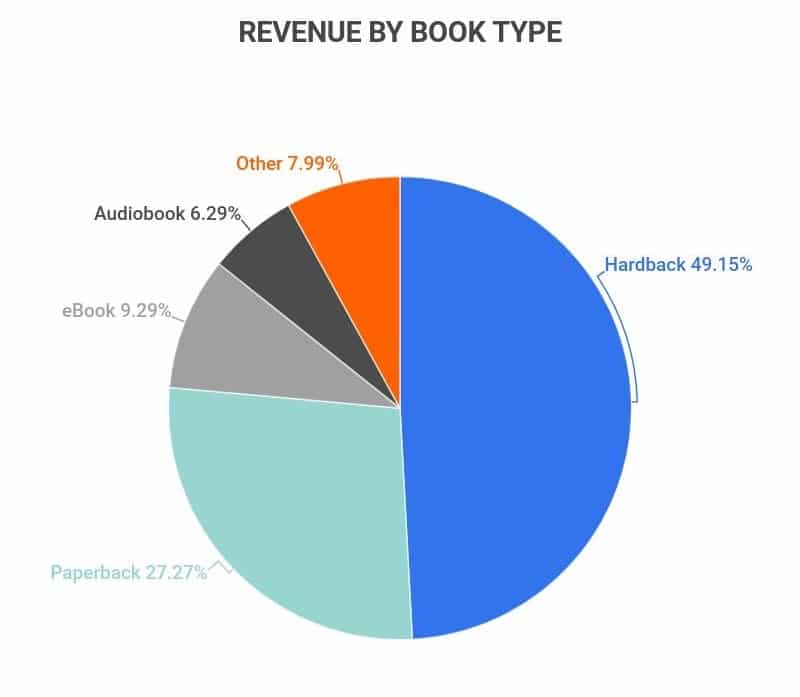
eBooks account for only 9% of total book industry revenue.
Last year, the book industry generated $26 billion, with print books contributing $22.6 billion compared to eBooks’ $2.04 billion.
-
eBook sales soared to 526 million units in 2022.
This marks a remarkable 175% increase since 2020, largely fueled by the pandemic and growing digital adoption.
-
Printed book sales reached 788.7 million units in 2022.
Although sales dipped from 2021 to 2022, the gap between printed books and eBooks is narrowing due to the rapid rise of digital formats.
Audiobook Statistics
Audiobooks have surged in popularity, emerging as the fastest-growing sector within the book industry. Key insights include:
-
74,000 audiobooks were published in 2022.
This figure represents a continued growth trend, despite a slight slowdown compared to earlier years.
-
U.S. audiobook revenue reached $1.81 billion in 2022.
This marks a 23% increase from the previous year, continuing a decade-long trend of robust growth.
-
Audible remains the leading platform for audiobooks.
The platform achieved sales of $940 million, growing at a rate of 24.5% and offering over 200,000 titles.
Textbook Statistics
Textbooks are a crucial component of the American educational landscape, though they often come with high costs. Here are the latest statistics:
-
In 2021, the textbook publishing industry generated $3.18 billion in revenue.
This reflects a significant decline from $7.93 billion in 2021, continuing a downward trend since 2015.
-
The average textbook price in the U.S. is $84.
This is a reduction from $110 in 2015, yet college students still spend an average of $1,240 on textbooks over four years.
-
Grades 4-6 exhibit the highest textbook usage in classrooms, exceeding 80%.
This usage positively correlates with student performance, as daily readers scored 6% higher on tests compared to those who read less frequently.
U.S. Book Industry Trends and Predictions
The book industry has demonstrated stable growth, particularly in eBooks and audiobooks. However, questions remain about sustainability and future trends. Here are some insights:
-
The U.S. publishing industry experienced a CAGR of 1% in 2021.
While this growth is minimal, it is expected to contribute an estimated $18.69 billion in industry income by 2025.
-
The digital publishing market is projected to grow at a CAGR of 6.4% from 2021 to 2028.
This growth is anticipated as digital formats continue to gain traction, increasing from $24.6 million in 2021 to $37.9 million by 2028.
-
eBook sales grew by 175% from 2020 to 2022.
This significant increase highlights the rapid adoption of digital reading formats compared to print.
-
Barnes & Noble’s sales declined by 22.3% in 2021.
The largest U.S. bookseller has faced a consistent reduction in sales, with a $382.4 million drop from 2020 to 2021.
U.S. Book Publishing Market Size Over Time
| Year | Market Size (In Billions) |
|---|---|
| 2022 | $29.8B |
| 2021 | $29.9B |
| 2020 | $27.5B |
| 2019 | $27.8B |
| 2018 | $29.3B |
| 2017 | $31.2B |
| 2016 | $31.3B |
| 2015 | $31.3B |
| 2014 | $30.5B |
| 2013 | $30.6B |
| 2012 | $30.9B |
U.S. Book Industry FAQ
-
How many books were published in 2022?
4 million new books were published in 2022. A significant portion of these were self-published, illustrating the expanding landscape of independent authorship. Reading all the books published in a single year would take over 2,000 years at an average of 4.5 hours per book!
-
How much is the U.S. book industry worth?
The U.S. book industry is valued at $29.8 billion. Notably, eBooks and audiobooks contribute only 9% and 10% to this figure, respectively, while print books dominate the market.
-
No, the book industry is not dying. Despite technological advancements leading some to believe otherwise, the book market remains robust. In fact, book sales have experienced a growth of approximately 1.4%, with print sales rising by 8.2%, while eBook and audiobook sales have surged over 12%.
More new books are being produced than ever, with 2.3 million self-published books recorded in 2021, reflecting a 93% increase over the last five years.
-
What is the growth rate of the book publishing industry?
The growth rate of the book publishing industry is estimated at -0.1% from 2022-2023.
This rate suggests a leveling off compared to other sectors within the industry, with the market expected to remain stable in 2023.
-
How many books are sold in the U.S. each year?
Approximately 700-900 million books are sold in the U.S. annually. The record was set in 2020 with 942 million units sold across eBook and print formats, although sales dipped to 788.7 million in 2022.
-
Is Amazon becoming a monopoly in the publishing world?
Yes, experts suggest that Amazon is nearing a monopoly status in the publishing sector. The company controls up to 80% of book distribution in the U.S., raising concerns over anti-competitive practices. In August 2020, a coalition of industry representatives expressed their worries to Congress, but no significant action ensued.
Conclusion
Despite misconceptions, the book industry has shown stable growth over the past five years and is projected to continue on this trajectory. For instance, self-published titles have surged by 93% in recent years.
Moreover, eBooks and audiobooks have witnessed remarkable growth, with sales rising by 12.6% and 12%, respectively. Although digital formats only account for 19% of the market currently, projections indicate a potential shift as the digital publishing sector is expected to grow at a CAGR of 6.4% through 2028.
Ultimately, the book industry is thriving, demonstrating resilience and adaptability in an evolving landscape.
References
-
Statista. “U.S. Book Industry – Statistics & Facts.” Accessed on June 28, 2023.
-
Berrett-Koehler Publishers. “The 10 Awful Truths about Book Publishing.” Accessed on June 28, 2023.
-
ProActive Writer. “Which Book Genre Is The Most Popular In 2021?” Accessed on June 28, 2023.
-
Publisher’s Weekly. “Ranking America’s Largest Publishers.” Accessed on June 28, 2023.
-
IBISWorld. “Book Publishing in the U.S. – Employment Statistics 2005–2027.” Accessed on June 28, 2023.
-
CNBC. “Physical Books Still Outsell eBooks — and Here’s Why.” Accessed on June 28, 2023.
-
Publishing Perspectives. “APA Cites 12-Percent 2020 U.S. Audiobook Revenue Growth.” Accessed on June 28, 2023.
-
Good E Reader. “Audiobook Trends and Statistics for 2020.” Accessed on June 28, 2023.
-
Education Data. “Average Cost of College Textbooks.” Accessed on June 28, 2023.
-
Academic Authors Association. “Textbook Usage in the United States: The Case of U.S. History.” Accessed on June 28, 2023.
-
MarketWatch. “Publishing Market Share, Growth 2021 Global Industry Size, CAGR of 1%, Future Trends, Growth Key Factors, Demand, Sales and Income, Manufacture Players, and Forecast 2025.” Accessed on June 28, 2023.
-
The Insight Partners. “Digital Publishing Market ($37.94Bn by 2028) Growth Forecast at 6.4% CAGR During 2021 to 2028 COVID Impact and Global Analysis by TheInsightPartners.com.” Accessed on June 28, 2023.
-
Businesswire. “Barnes & Noble Education Reports Fourth Quarter and Fiscal Year 2021 Financial Results.” Accessed on June 28, 2023.
-
Publishers Weekly. “A Year for the (Record) Books in Publishing.” Accessed on June 28, 2023.
- Industry Statistics
- Wedding Industry Statistics
- Yoga Industry Statistics
- Music Industry Statistics
- Landscaping Industry Statistics
- Bicycle Industry Statistics
- Coffee Industry Statistics
- Car Rental Industry Statistics
- Home Improvement Industry Statistics
- Insurance Industry Statistics
- Supplements Industry Statistics
- Golf Industry Statistics
- Fitness Industry Statistics
- US Media And Entertainment Industry Statistics
- Firearm Industry Statistics
- Financial Services Industry Statistics
- Health And Wellness Industry Statistics
- Trucking Industry Statistics
- Wine Industry Statistics
- Pet Industry Statistics
- Mobile App Industry Statistics
- Digital Marketing Industry Statistics
- Hotel Industry Statistics
- Retail Statistics
- Robotics Industry Statistics
- Jewelry Industry Statistics
- Appointment Scheduling statistics
- Restaurant Industry Statistics
- Food Delivery Statistics
- Food Truck Industry
- Fashion Industry
- Real Estate Industry
- US Film Industry
- US Beverage Industry
- USu202fFast Food Restaurants
- US Construction Industry
- US Book Industry
- Cosmetics Industry
- US Food Retail Industry
- US Pharmaceutical Industry
- US Healthcare Industry
- Airline Industry
- Automobile Industry
- Transportation Industry Statistics
- Event Industry Statistics
- Project Management Statistics
- Oil And Gas Industry Statistics
- Nursing Home Statistics
- Nursing Shortage Statistics
- Nursing Statistics

Author

Chris Kolmar is a co-founder of Zippia and the editor-in-chief of the Zippia career advice blog. He has hired over 50 people in his career, been hired five times, and wants to help you land your next job. His research has been featured on the New York Times, Thrillist, VOX, The Atlantic, and a host of local news. More recently, he's been quoted on USA Today, BusinessInsider, and CNBC.