What does an applications programmer do?

An application programmer is responsible for creating and designing computer systems and applications according to client specifications and business requirements. Application programmers run quality checks on the draft outputs to ensure its stability and efficiency for high-level performance. They also evaluate existing applications and recommend technical solutions to improve scalability. An application programmer must have excellent technical skills with a strong command of programming languages and system codes to determine the feasibility of applications and adjust features as needed.
Applications programmer responsibilities
Here are examples of responsibilities from real applications programmer resumes:
- Document all programming work accomplish and develop initial testing for debugging purposes.
- Develop different VBA macro tools to automate reporting and assure information accuracy, overlapping avoidance and management control.
- Transform the server from UNIX system to Linux system.
- Use XSL, HTML and CSS coding to present information from XML generate files to users.
- Create validation logic and change jQuery functions to manipulate and submit form data using AJAX server calls.
- Used AJAX to populate user interface controls such as drop down list and generate warning messages to enhance overall UI experience.
- Arrange meetings with customers to find the best transmission method (FTP, NDM etc .).
- Automate data migration using SSIS.
- Implement in system software via XML.
- Work on several payroll and tax applications.
- Write and maintain Linux shell scripts, crontab.
- Work in SDLC environment in both projects, AAPS and MMLD.
- Develop CSS to control the style and layout of multiple web pages.
- Create web service with PHP to test download file from server to the app.
- Develop UI to go along with this allowing some invoices to be email to customers.
Applications programmer skills and personality traits
We calculated that 9% of Applications Programmers are proficient in Java, C++, and Database. They’re also known for soft skills such as Troubleshooting skills, Detail oriented, and Analytical skills.
We break down the percentage of Applications Programmers that have these skills listed on their resume here:
- Java, 9%
Developed the Java Application for company transaction process using thread, serialization.
- C++, 8%
Design, code and test custom route accounting software using C, C++, Visual Basic, and PL/N programming languages.
- Database, 7%
Designed and implemented PL/SQL programs and database applications in an integrated, open-systems environment using relational database and client-server technology.
- JavaScript, 7%
Developed the front-end validations using JavaScript.
- HTML, 4%
Improved User Experience by merging Library page with Orders page and removing extraneous fields using HTML and CSS3.
- SQL Server, 4%
Administer SQL Server database security and database maintenance.
Most applications programmers use their skills in "java," "c++," and "database" to do their jobs. You can find more detail on essential applications programmer responsibilities here:
Troubleshooting skills. To carry out their duties, the most important skill for an applications programmer to have is troubleshooting skills. Their role and responsibilities require that "an important part of a programmer’s job is to check the code for errors and fix any they find." Applications programmers often use troubleshooting skills in their day-to-day job, as shown by this real resume: "involved in performance tuning, troubleshooting and bug fixing of pl/sql scripts while working closely with the ui developers. "
Detail oriented. Another essential skill to perform applications programmer duties is detail oriented. Applications programmers responsibilities require that "computer programmers must closely examine the code they write because a small mistake can affect the entire computer program." Applications programmers also use detail oriented in their role according to a real resume snippet: "involved in developing detail design document to implement the functional requirements in spring 3.0 framework using j2ee and java 1.7. "
Analytical skills. This is an important skill for applications programmers to perform their duties. For an example of how applications programmer responsibilities depend on this skill, consider that "computer programmers must understand complex instructions in order to create computer code." This excerpt from a resume also shows how vital it is to everyday roles and responsibilities of an applications programmer: "designed java beans and wrote hibernate mapping files and data access object (dao) to connect services with database. ".
The three companies that hire the most applications programmers are:
- Bank of America26 applications programmers jobs
- Black Knight13 applications programmers jobs
- RMS Management
13 applications programmers jobs
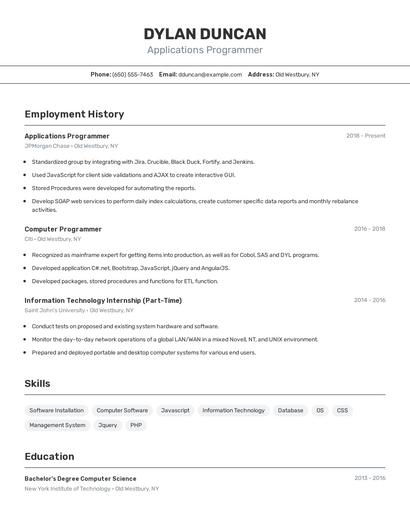
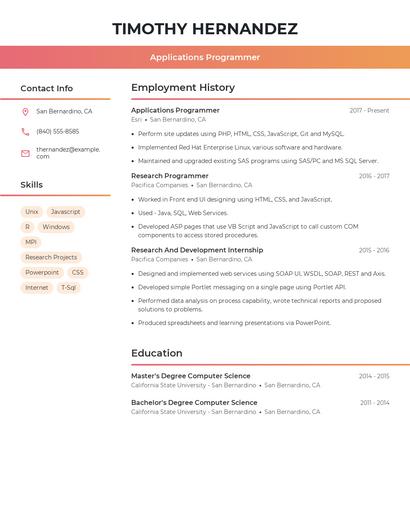
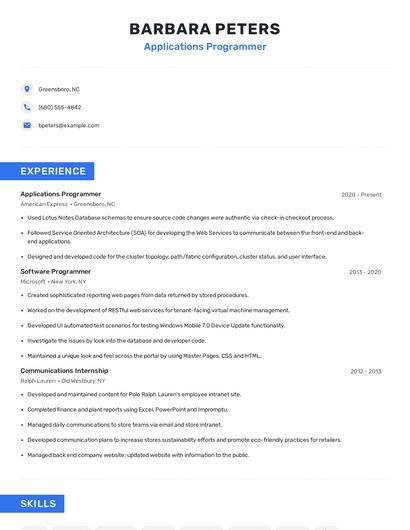
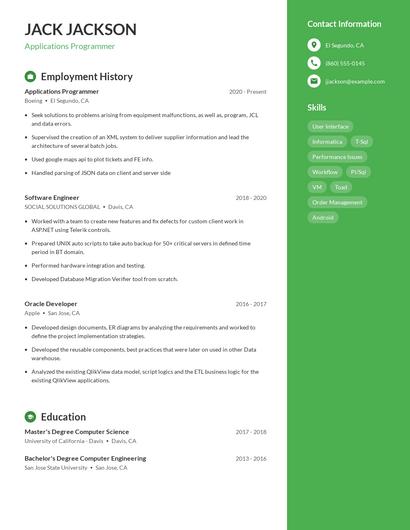
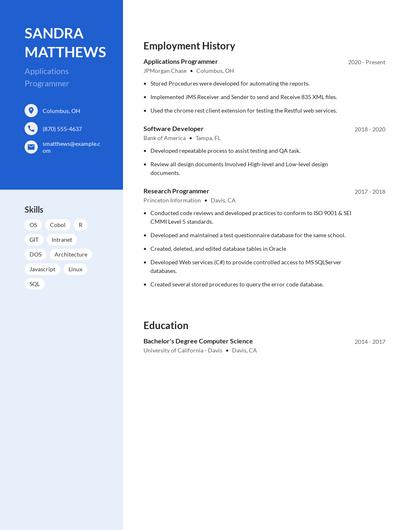
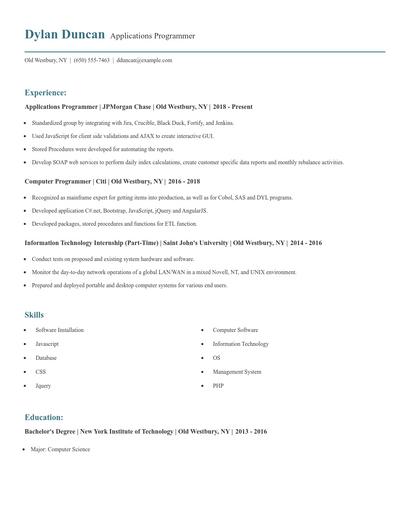
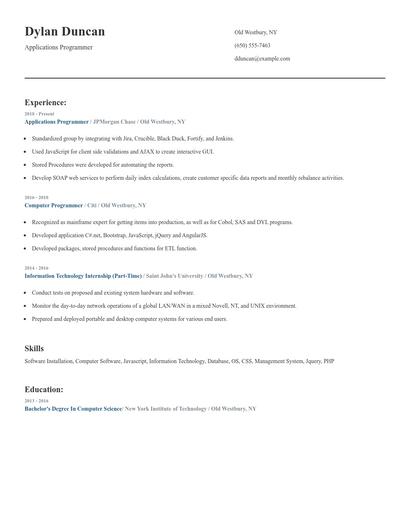
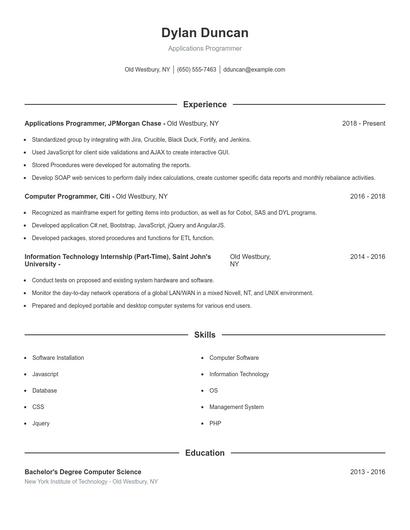
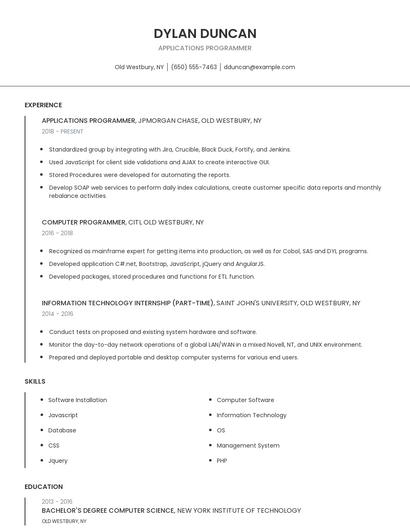
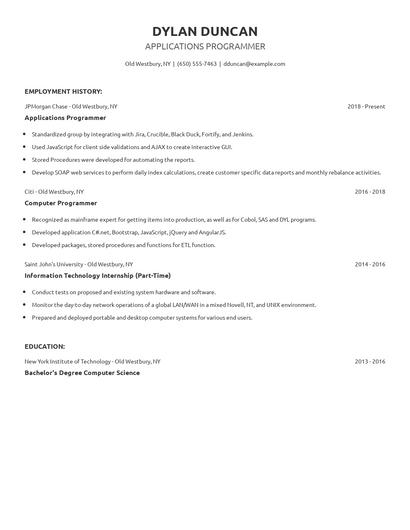
Choose from 10+ customizable applications programmer resume templates
Build a professional applications programmer resume in minutes. Our AI resume writing assistant will guide you through every step of the process, and you can choose from 10+ resume templates to create your applications programmer resume.

Compare different applications programmers
Applications programmer vs. Java/j2ee developer
Java developers are in charge of the design, development, and management of Java-based applications. Whereas, J2EE or Java 2 Platform Enterprise Edition developers are responsible for developing web and software enterprise-internet level applications. Both developers utilize the Java programming language, but the first one develops desktop-based applications while the later develop enterprise-related applications. Java developers have many roles and responsibilities, and they vary based on the applications that they develop and design.
While similarities exist, there are also some differences between applications programmers and java/j2ee developer. For instance, applications programmer responsibilities require skills such as "c++," "c #," "php," and "strong analytical." Whereas a java/j2ee developer is skilled in "user interface," "xml," "maven," and "log4j." This is part of what separates the two careers.
Java/j2ee developers earn the highest salaries when working in the finance industry, with an average yearly salary of $100,301. On the other hand, applications programmers are paid more in the finance industry with an average salary of $99,211.The education levels that java/j2ee developers earn slightly differ from applications programmers. In particular, java/j2ee developers are 4.7% more likely to graduate with a Master's Degree than an applications programmer. Additionally, they're 0.3% less likely to earn a Doctoral Degree.Applications programmer vs. Software developer
A software developer is responsible for designing application systems to support the user and business' needs. Duties of a software developer include testing software codes, performing diagnostic programs and troubleshooting, interpreting system data and establishing efficient parameters, and ensuring the compatibility of the systems. A software developer must have an excellent knowledge of computer programs and programming languages to understand its complexities, especially on detecting system defects and malfunctions. A software developer must have strong attention to detail, communication, and decision-making skills to coordinate with the team and also work independently under minimal supervision.
While some skills are similar in these professions, other skills aren't so similar. For example, resumes show us that applications programmer responsibilities requires skills like "c #," "sql server," "mvc," and "windows." But a software developer might use other skills in their typical duties, such as, "python," "software development," "git," and "api."
On average, software developers earn a higher salary than applications programmers. Some industries support higher salaries in each profession. Interestingly enough, software developers earn the most pay in the finance industry with an average salary of $96,138. Whereas applications programmers have higher pay in the finance industry, with an average salary of $99,211.software developers earn higher levels of education than applications programmers in general. They're 5.6% more likely to graduate with a Master's Degree and 0.3% more likely to earn a Doctoral Degree.What technology do you think will become more important and prevalent for applications programmers in the next 3-5 years?
Frank McCown Ph.D.
Associate Professor, Harding University
Applications programmer vs. Developer
Developers are usually system or application developers in a company who work on specific projects related to networks or applications from conception to implementation. They attend planning sessions to ensure that the program is feasible. They are responsible for designing the system through coding and basic user interface design. They also work on troubleshooting any challenges that may be met at the testing stage of the program's development. They solve challenges and ensure that minimal problems will arise upon publishing the system or application. They also manage the evaluation to ensure that the program's goals are accomplished and that the end-users are satisfied with the results.
There are many key differences between these two careers, including some of the skills required to perform responsibilities within each role. For example, an applications programmer is likely to be skilled in "c #," "database," "windows," and "development life," while a typical developer is skilled in "python," "api," "git," and "aws."
Developers earn the highest salary when working in the finance industry, where they receive an average salary of $104,286. Comparatively, applications programmers have the highest earning potential in the finance industry, with an average salary of $99,211.developers typically earn higher educational levels compared to applications programmers. Specifically, they're 5.1% more likely to graduate with a Master's Degree, and 0.3% more likely to earn a Doctoral Degree.Applications programmer vs. Software engineer
A software engineer is a computer science professional who is responsible for the development of information systems, designing and building computer systems software and applications software. They often prefer to call themselves as a software developer or computer programmer. They have substantial knowledge of programming languages, software development, and computer operating systems, and other technologies. They use these to turn a plan into a final output. They can create a design, test, and develop software based on the needs of their clients.
Types of applications programmer
Updated January 8, 2025
