What does an assistant scientist do?
Assistant research scientists are research team members who carry out different tasks in research. The research scientists help plan and do experiments, record and analyze data, and demonstrate research procedures. They perform fieldwork like sample collection and write research reports, papers, summaries, and reviews. Also, they present the results of their research to other research staff and their seniors. The scientists need to develop skills in research and attention to detail.
Assistant scientist responsibilities
Here are examples of responsibilities from real assistant scientist resumes:
- Manage laboratory inspections and maintenance programs in compliance with GLP regulations.
- Develop and manage third party claim investigations and contractor remedial oversight for various insurance companies.
- Prepare biological samples, reagents, stock and working standards and QC samples.
- Develop ELISA and SEAP assays for quantification of HIV proteins.
- Involve in and bring project from start to FDA acceptance to commercial introduction.
- Perform ELISA, RIA, and EIA screening of monoclonal antibodies for specific antigens.
- Maintain laboratory safety logs and compliance with OSHA, EHSA, FDA, ASTM and QS9000 standards.
- Develop and validate HPLC methods for dissolution.
- Co-developed suspension and solution formulations for GLP toxicology studies.
- Fill pharmaceutical blisters, prepare standards and sample solvents/reagents, processed/analyze HPLC results.
- Perform urine & blood screening/confirmatory analysis using solid and liquid phase extraction techniques.
- Develop extraction processes for naturally-occurring cholesterol-lowering compounds.
- Conduct test method training for Jr. Scientists or newly hire scientists.
- Prepare DNA/RNA samples for genotyping and expression.
- Perform metabolic profiling experiments, data processing and project reporting.
Assistant scientist skills and personality traits
We calculated that 9% of Assistant Scientists are proficient in Laboratory Equipment, Data Analysis, and Laboratory Procedures.
We break down the percentage of Assistant Scientists that have these skills listed on their resume here:
- Laboratory Equipment, 9%
Operated & monitored various laboratory equipment (daily maintenance, calibration, validation and basic troubleshooting).
- Data Analysis, 6%
Developed and tested new methodologies for large data set exploratory data analysis and visualization.
- Laboratory Procedures, 6%
Supervised lab personnel, developed laboratory procedures, maintained equipment and supplies.
- Sample Preparation, 5%
Performed simple sample preparation and analysis procedures to quantitatively measure pharmaceutical compounds in a variety of biological matrices.
- Cell Culture, 4%
Maintain responsibility for conducting experiments, monitoring cell culture parameters, and lab book accuracy.
- Method Development, 4%
Conducted method development/validation of chemically unstable compounds via acid hydrolysis.
Most assistant scientists use their skills in "laboratory equipment," "data analysis," and "laboratory procedures" to do their jobs. You can find more detail on essential assistant scientist responsibilities here:
Communication skills. One of the key soft skills for an assistant scientist to have is communication skills. You can see how this relates to what assistant scientists do because "medical scientists must be able to explain their research in nontechnical ways." Additionally, an assistant scientist resume shows how assistant scientists use communication skills: "design, experiments, data analysis, reports and other communications conform to relevant global standards. "
Observation skills. Many assistant scientist duties rely on observation skills. "medical scientists conduct experiments that require monitoring samples and other health-related data.," so an assistant scientist will need this skill often in their role. This resume example is just one of many ways assistant scientist responsibilities rely on observation skills: "participated in fda audit of program which resulted in zero fda 483 observation. "
The three companies that hire the most assistant scientists are:
- Eurofins12 assistant scientists jobs
- University of Florida10 assistant scientists jobs
- RGA Environmental, A Terracon Company7 assistant scientists jobs
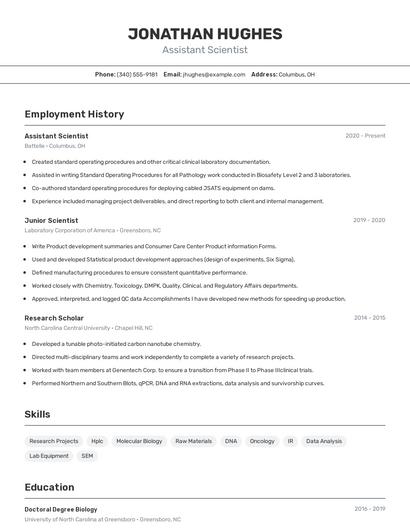
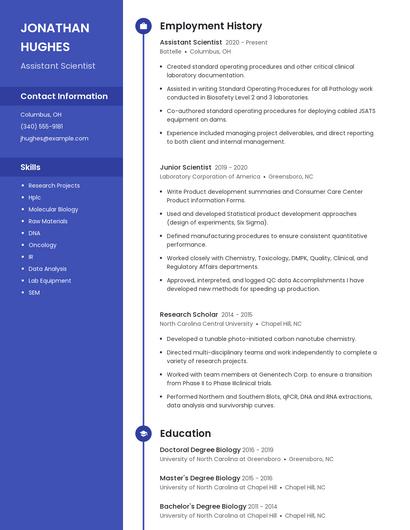
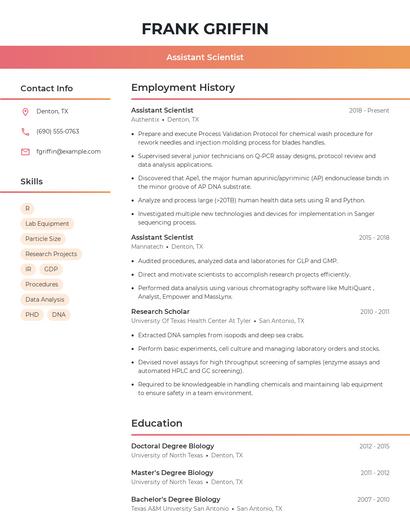
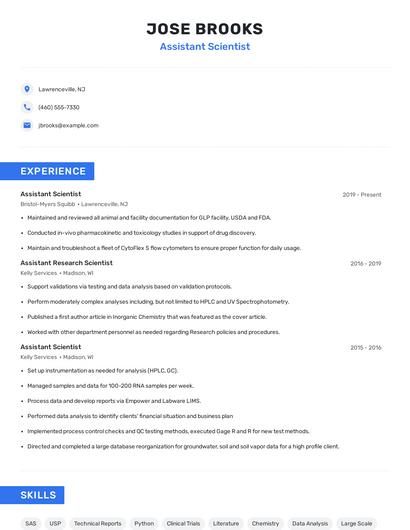
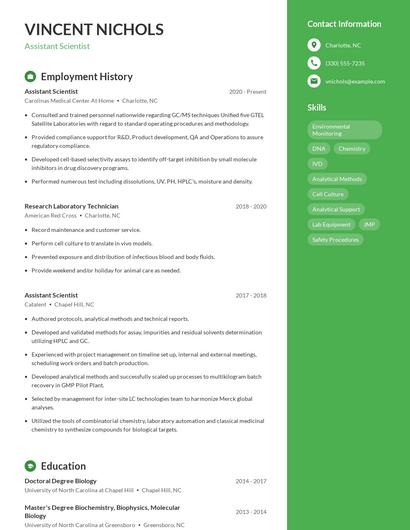
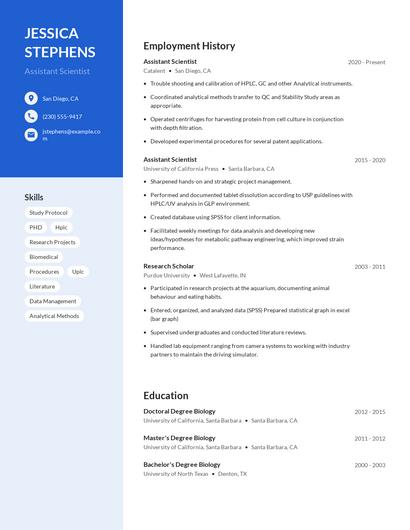
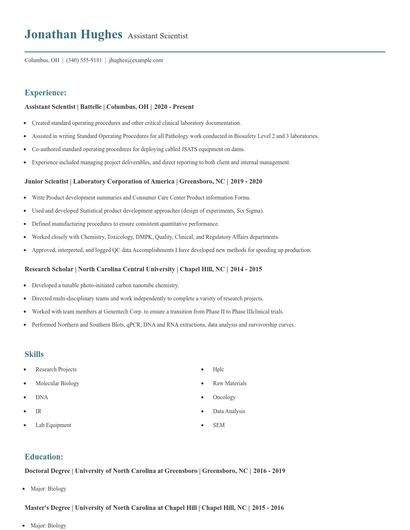
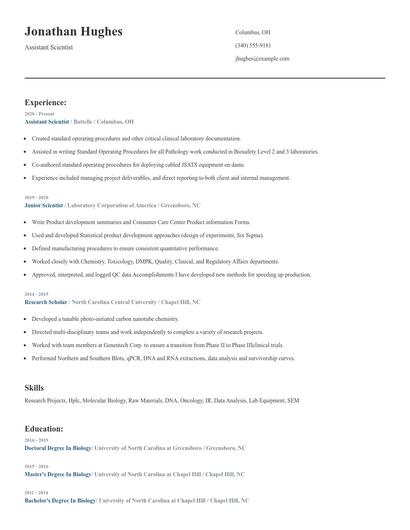
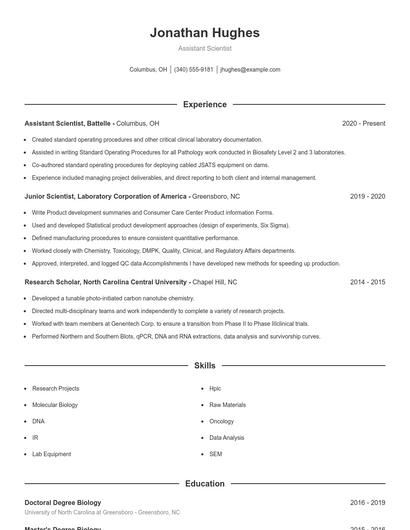
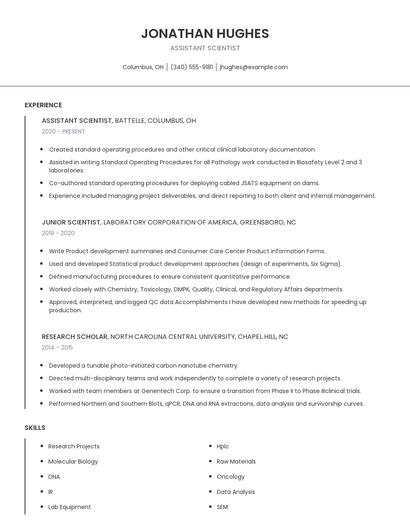
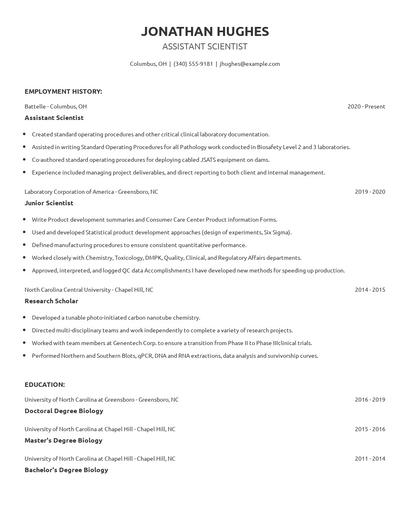
Choose from 10+ customizable assistant scientist resume templates
Build a professional assistant scientist resume in minutes. Our AI resume writing assistant will guide you through every step of the process, and you can choose from 10+ resume templates to create your assistant scientist resume.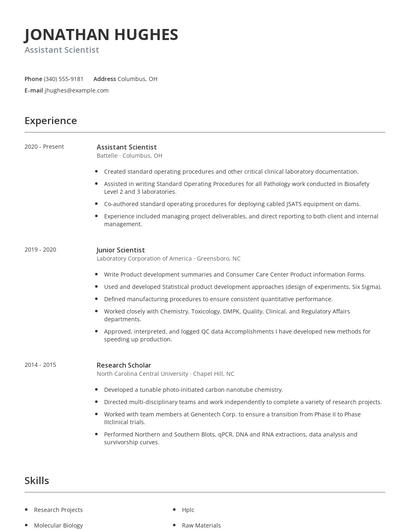
Compare different assistant scientists
Assistant scientist vs. Quality control analyst
Quality assurance representatives are professionals who are responsible for ensuring the quality of units produced or manufactured is following the standards set by the industry. These representatives supervise the entire production process to identify erroneous methods or tools being used by workers and observing produced for visible defects. They are required to perform various tests to check for the durability of the product and other desirable characteristics. Quality assurance representatives must also collaborate with the manufacturing engineer to implement quality control programs and preparing training manuals and quality guidelines.
There are some key differences in the responsibilities of each position. For example, assistant scientist responsibilities require skills like "laboratory equipment," "laboratory procedures," "sample preparation," and "cell culture." Meanwhile a typical quality control analyst has skills in areas such as "lab equipment," "microbiology," "test methods," and "qc testing." This difference in skills reveals the differences in what each career does.
Quality control analysts earn the highest salaries when working in the manufacturing industry, with an average yearly salary of $62,870. On the other hand, assistant scientists are paid more in the manufacturing industry with an average salary of $82,362.On average, quality control analysts reach similar levels of education than assistant scientists. Quality control analysts are 1.5% less likely to earn a Master's Degree and 6.1% less likely to graduate with a Doctoral Degree.Assistant scientist vs. Research and development chemist
A research and development chemist primarily works at laboratories to conduct extensive tests and experiments aiming to develop new products and technologies. Although the extent of their duties may vary, it typically revolves around conducting research and studies, observing chemical reactions, maintaining records and databases, collaborating with fellow experts, and identifying the strengths and weaknesses of existing components or mixtures. They can find employment in different areas, such as manufacturing companies, private laboratories, government agencies, and even education.
Each career also uses different skills, according to real assistant scientist resumes. While assistant scientist responsibilities can utilize skills like "laboratory procedures," "sample preparation," "cell culture," and "analytical techniques," research and development chemists use skills like "synthesis," "d chemist," "technical support," and "gmp."
Research and development chemists may earn a lower salary than assistant scientists, but research and development chemists earn the most pay in the health care industry with an average salary of $82,941. On the other hand, assistant scientists receive higher pay in the manufacturing industry, where they earn an average salary of $82,362.research and development chemists earn similar levels of education than assistant scientists in general. They're 3.9% more likely to graduate with a Master's Degree and 6.1% less likely to earn a Doctoral Degree.What technology do you think will become more important and prevalent for assistant scientists in the next 3-5 years?
Dr. Betsy Smith
Assistant Professor of Chemistry, Elmira College
Assistant scientist vs. Laboratory analyst
A Laboratory Analyst helps conduct experiments, run laboratory tests, and analyze results. They compile and record data for the documentation needed for testing and report preparation.
There are many key differences between these two careers, including some of the skills required to perform responsibilities within each role. For example, an assistant scientist is likely to be skilled in "laboratory equipment," "cell culture," "analytical techniques," and "data collection," while a typical laboratory analyst is skilled in "test methods," "lab equipment," "gmp," and "math."
Laboratory analysts earn the best pay in the pharmaceutical industry, where they command an average salary of $47,806. Assistant scientists earn the highest pay from the manufacturing industry, with an average salary of $82,362.Most laboratory analysts achieve a similar degree level compared to assistant scientists. For example, they're 4.5% less likely to graduate with a Master's Degree, and 6.6% less likely to earn a Doctoral Degree.Assistant scientist vs. Research laboratory technician
Research laboratory technicians play a vital role in scientific laboratories. They perform varied duties and responsibilities, which include setting up, operating, and maintaining the laboratory equipment, assisting in laboratory-based research activities such as sampling, testing, and analyzing results, and providing technical support to the laboratory team members. In addition, they are expected to support the development and advancement of science and modern medicine. Other typical duties of research laboratory technicians include preparing samples and specimens, keeping abreast with current technical developments, and ensuring strict compliance with safety procedures.
Types of assistant scientist
Updated January 8, 2025
