What does an associate principal scientist do?
Associate Principal Scientists are responsible for directing the operations of scientific research.They work with cross-functional teams in elaborating technical specifications, and they provide training and mentorship to staff. An associate principal scientist maintains clients' and projects' confidentiality and learns proactively to keep abreast of technological advancements.Other duties may include resolving conflicts within and between departments, monitoring project timeline and performance, supervising laboratory work, and ensuring accurate scientific report documentation.
Associate principal scientist responsibilities
Here are examples of responsibilities from real associate principal scientist resumes:
- Develop strategies for the CMC teams to achieve global regulatory compliance.
- Manage transfer of processes to CMO's and oversee GMP manufacturing when technology not available in house.
- Manage technology transfer for clinical API supply delivery.
- Manage stability coordination activities for market drug products in accordance to company and ICH guidelines.
- Perform analytical method development and GMP method validations.
- Assess CROs for conducting studies cost-effectively with high quality.
- Profile various bone biomarkers in rodent sera and tissue using ex-vivo assays.
- Analyze products and monitor reactions using NMR, HPLC, GC and LC/MS.
- Collaborate with CROs for delivery of intermediates.
- Implement innovative scientific solutions in collaboration with medicinal chemistry partners.
- Resolve chemistry issues on carbon-nitrogen couplings through catalysis screening in collaboration with catalysis group in process chemistry
- Develop, validate and implement robust methods for pharmacokinetic, immunogenicity (ADA) and immunodepletion ELISAs, and cell based-bioassays.
- Initiate DNA synthesis and bioassays for anti-sense oligonucleotide screening.
- Conduct genotyping and phenotyping of models as required.
- Identify opportunities and develop and support on-line and at-line process NIR and IR monitoring and control methodologies for aluminum coating operations.
Associate principal scientist skills and personality traits
We calculated that 10% of Associate Principal Scientists are proficient in Data Analysis, Chemistry, and Project Management.
We break down the percentage of Associate Principal Scientists that have these skills listed on their resume here:
- Data Analysis, 10%
Process oversight includes maintaining cell lines, preparing protocols, compound preparation, data analysis, report creation and laboratory maintenance.
- Chemistry, 9%
Implemented innovative scientific solutions in collaboration with medicinal chemistry partners.
- Project Management, 4%
General project management and representation on mid-level Product Development team/s for high-profile oral combination drug products.
- Clinical Trials, 4%
Design mechanistic studies to evaluate immune modulation and therapeutic response in phase 1, 2 and 3 clinical trials.
- GMP, 4%
Phase II: The optimized procedure from kilo lab was transferred to pilot plant under GMP guidelines.
- Sops, 3%
Write SOPs, project proposals and study reports, supervise research associates and junior scientists in performing experiments and career development.
Common skills that an associate principal scientist uses to do their job include "data analysis," "chemistry," and "project management." You can find details on the most important associate principal scientist responsibilities below.
Communication skills. The most essential soft skill for an associate principal scientist to carry out their responsibilities is communication skills. This skill is important for the role because "medical scientists must be able to explain their research in nontechnical ways." Additionally, an associate principal scientist resume shows how their duties depend on communication skills: "participated in method transfers of new products with akzo nobel served as qc representative on employee communication committee"
Observation skills. Another soft skill that's essential for fulfilling associate principal scientist duties is observation skills. The role rewards competence in this skill because "medical scientists conduct experiments that require monitoring samples and other health-related data." According to an associate principal scientist resume, here's how associate principal scientists can utilize observation skills in their job responsibilities: "coordinated and performed commercial release testing of marketed product at manufacturing site in qc environment to address fda audit observations"
The three companies that hire the most associate principal scientists are:
- Organon489 associate principal scientists jobs
- Merck204 associate principal scientists jobs
- Takeda Pharmaceuticals U.S.A., Inc.28 associate principal scientists jobs
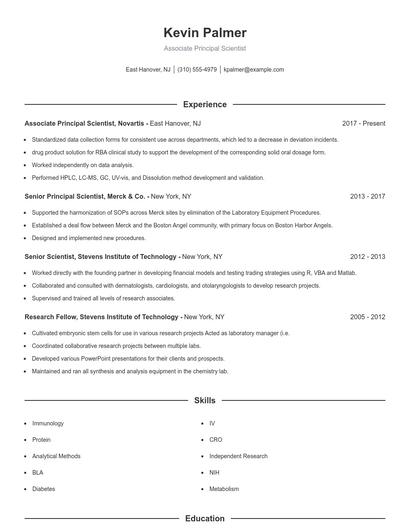
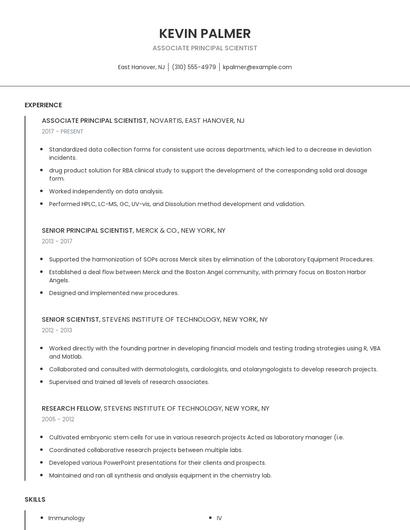
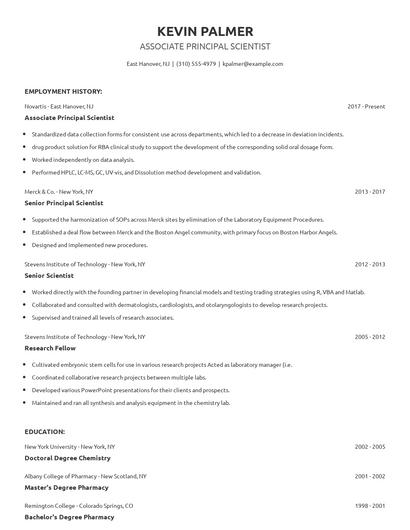
Choose from 10+ customizable associate principal scientist resume templates
Build a professional associate principal scientist resume in minutes. Our AI resume writing assistant will guide you through every step of the process, and you can choose from 10+ resume templates to create your associate principal scientist resume.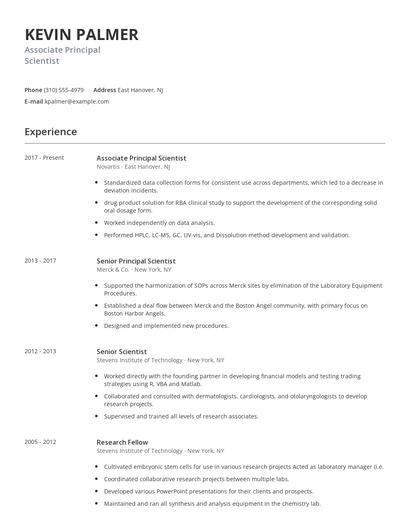
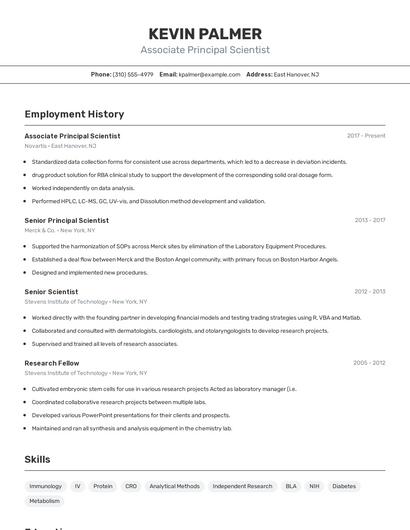


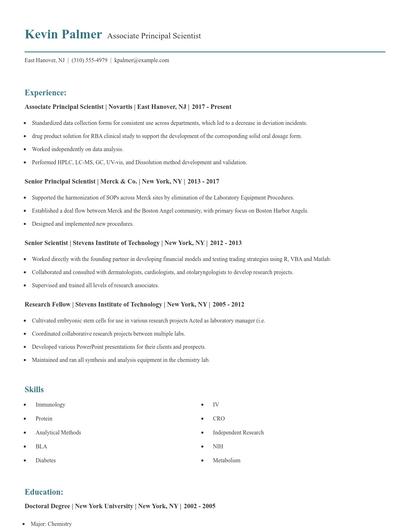
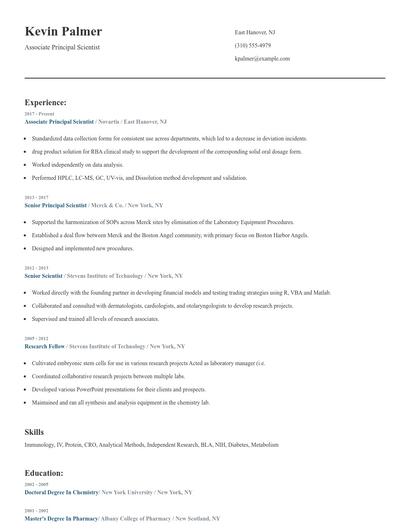
Compare different associate principal scientists
Associate principal scientist vs. Fellow
A fellow's responsibility will depend on the organization or industry where one belongs. However, most of the time, a fellow's duty will revolve around conducting research and analysis, presiding discussions and attending dialogues, handle lectures while complying with the guidelines or tasks set by supervisors, and assist in various projects and activities. Furthermore, a fellow must adhere to the institution or organization's policies and regulations at all times, meet all the requirements and outputs involved, and coordinate with every person in the workforce.
While similarities exist, there are also some differences between associate principal scientists and fellow. For instance, associate principal scientist responsibilities require skills such as "chemistry," "project management," "clinical trials," and "gmp." Whereas a fellow is skilled in "patients," "professional development," "veterans," and "mathematics." This is part of what separates the two careers.
Fellows earn the highest salaries when working in the professional industry, with an average yearly salary of $67,978. On the other hand, associate principal scientists are paid more in the government industry with an average salary of $114,135.fellows tend to reach similar levels of education than associate principal scientists. In fact, fellows are 0.1% less likely to graduate with a Master's Degree and 11.9% less likely to have a Doctoral Degree.Associate principal scientist vs. Researcher
A researcher is responsible for collating, organizing, and verifying necessary information for a specific subject. Researchers' duties include analyzing data, gathering and comparing resources, ensuring facts, sharing findings with the whole research team, adhering to required methodologies, performing fieldwork as needed, and keeping critical information confidential. Researchers must be knowledgeable about the current market trends and align findings with the research goals. A researcher must show strong communication skills, as well as strong attention to detail and time-management skills to meet deadlines under minimal supervision.
In addition to the difference in salary, there are some other key differences worth noting. For example, associate principal scientist responsibilities are more likely to require skills like "project management," "clinical trials," "gmp," and "sops." Meanwhile, a researcher has duties that require skills in areas such as "python," "lab equipment," "c++," and "data collection." These differences highlight just how different the day-to-day in each role looks.
In general, researchers achieve similar levels of education than associate principal scientists. They're 3.0% less likely to obtain a Master's Degree while being 11.9% less likely to earn a Doctoral Degree.What technology do you think will become more important and prevalent for associate principal scientists in the next 3-5 years?
Scott Johnson
Professor and Director, University of Maine
Associate principal scientist vs. Chemist
Chemists are generally responsible for observing and investigating chemical substances to create new and safe compounds essential for practical applications. They are often grouped depending on a particular area of specialization to focus and understand the complexities of the matter. A chemist usually takes time performing research and conducting experiments to test and further improve the quality and usage of a specific chemical substance. Chemists are expected to write on their observations and findings to establish scientific results.
Some important key differences between the two careers include a few of the skills necessary to fulfill the responsibilities of each. Some examples from associate principal scientist resumes include skills like "project management," "clinical trials," "sops," and "clinical development," whereas a chemist is more likely to list skills in "lab equipment," "test results," "sample preparation," and "uv/vis. "
Chemists earn the highest salary when working in the manufacturing industry, where they receive an average salary of $75,495. Comparatively, associate principal scientists have the highest earning potential in the government industry, with an average salary of $114,135.When it comes to education, chemists tend to earn lower degree levels compared to associate principal scientists. In fact, they're 5.7% less likely to earn a Master's Degree, and 23.1% less likely to graduate with a Doctoral Degree.Associate principal scientist vs. Research chemist
A research chemist specializes in conducting studies and experiments to develop new products. Their duties primarily focus on conducting research and assessments, gathering and analyzing chemical samples, developing ideas, conducting tests to study chemical reactions, maintaining records of all procedures, and utilizing previous studies. Their research findings can be used to create new medicines, enhance existing products, and lead to innovations. When it comes to employment, a research chemist may work for pharmaceutical companies, private laboratories, government agencies, and learning institutions.
Types of associate principal scientist
Updated January 8, 2025
