What does an associate technical analyst do?
An Associate Technical Analyst works at a company's information technology department where they are in charge of performing support tasks to accomplish project goals. They usually work under the directives of a senior technical analyst. Their responsibilities often include conducting research and analyses, reviewing technical reports, gathering and analyzing data from different departments, and developing strategies to optimize operations. In some companies, they are responsible for communicating with clients to answer inquiries, troubleshoot issues, and promptly and professionally resolve problems, ensuring client satisfaction.
Associate technical analyst responsibilities
Here are examples of responsibilities from real associate technical analyst resumes:
- Manage CRM database ensuring issues and client contacts are accurately document.
- Contract by client to improve the sales force's ability to target customers effectively by optimizing its existing prescription information database.
- Develop multiple EDI maps to accurately process mission-critical financial transactions worth billions of dollars on a daily basis.
- Establish EDI trading partnerships that eliminate manual ordering and ensure on time ordering and delivery of raw materials and components.
Associate technical analyst skills and personality traits
We calculated that 10% of Associate Technical Analysts are proficient in Java, Business Processes, and Data Analysis. They’re also known for soft skills such as Analytical skills, Communication skills, and Creativity.
We break down the percentage of Associate Technical Analysts that have these skills listed on their resume here:
- Java, 10%
Developed and designed the automation testing framework using Java, JavaScript, SQL and Oracle Application Testing Suite for OFSAA.
- Business Processes, 9%
Involved in creating the business processes for the operations of Fusion Middleware suite of products.
- Data Analysis, 8%
Performed Data Analysis using SQL for data mapping exercises during Countrywide-BOA integration for First Mortgage and HELOC Servicing Data.
- CRM, 6%
Managed CRM database ensuring issues and client contacts are accurately documented.
- Data Integrity, 6%
Eliminated possible company impact to liability and exposure of data integrity.
- Customer Support, 5%
Live Customer Support Experience o Interacts with customers and responds to live calls in a high-pressure environment.
Most associate technical analysts use their skills in "java," "business processes," and "data analysis" to do their jobs. You can find more detail on essential associate technical analyst responsibilities here:
Analytical skills. To carry out their duties, the most important skill for an associate technical analyst to have is analytical skills. Their role and responsibilities require that "analysts must interpret complex information from various sources and decide the best way to move forward on a project." Associate technical analysts often use analytical skills in their day-to-day job, as shown by this real resume: "worked with database administrators on numerous aspects of database creation, maintenance, and efficiency modeling. "
Communication skills. Another soft skill that's essential for fulfilling associate technical analyst duties is communication skills. The role rewards competence in this skill because "analysts work as a go-between with management and the it department and must explain complex issues in a way that both will understand." According to an associate technical analyst resume, here's how associate technical analysts can utilize communication skills in their job responsibilities: "utilized remote consoles to provide telecommunications and desktop technical support. "
Creativity. Another skill that relates to the job responsibilities of associate technical analysts is creativity. This skill is critical to many everyday associate technical analyst duties, as "because analysts are tasked with finding innovative solutions to computer problems, an ability to “think outside the box” is important." This example from a resume shows how this skill is used: "implemented an inventory tracking system using sharepoint 2010 to track and maintain inventory records. "
The three companies that hire the most associate technical analysts are:
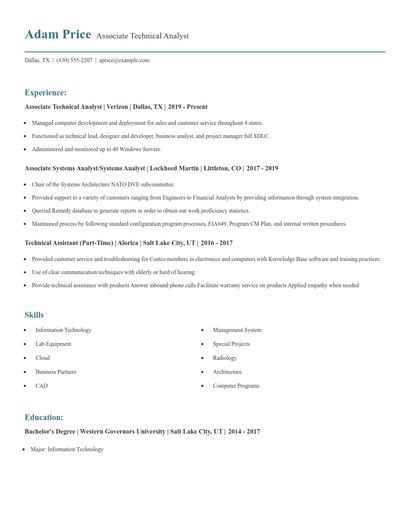
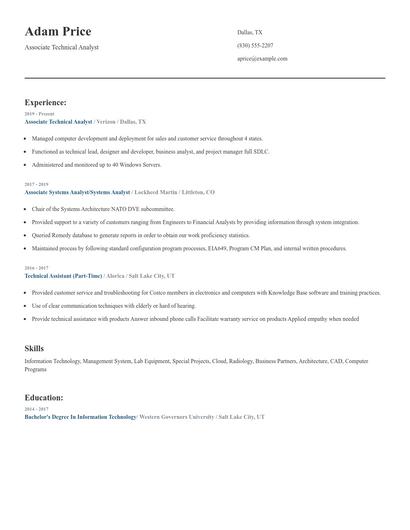
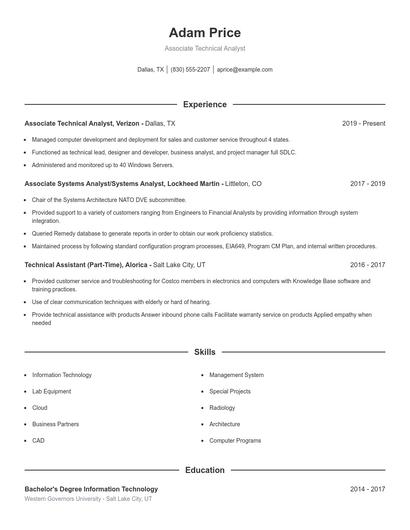
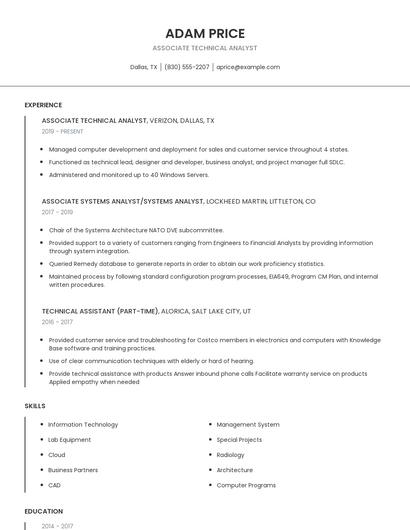
Choose from 10+ customizable associate technical analyst resume templates
Build a professional associate technical analyst resume in minutes. Our AI resume writing assistant will guide you through every step of the process, and you can choose from 10+ resume templates to create your associate technical analyst resume.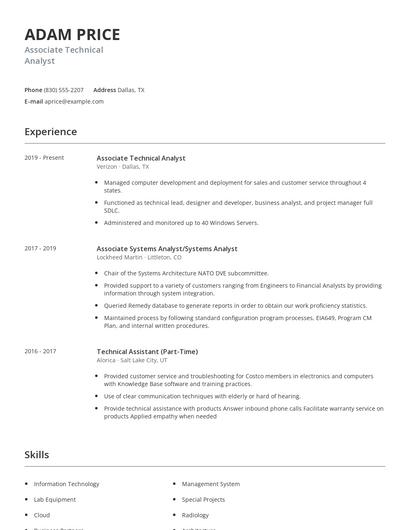



Compare different associate technical analysts
Associate technical analyst vs. Analyst lead
The duties of an analyst lead depend on one's line of work or industry of employment. Typically, their responsibilities revolve around performing research and analysis, coordinating with different departments to gather leads and data, reviewing findings, and producing reports and presentations for the stakeholders and other higher-ranking officials. Through the results, an analyst lead can provide advice, devise strategies for business optimization, spearhead the development of processes, identify strengths and weaknesses, and offer recommendations on areas in need of improvement. All of this is done while in adherence to the company's vision and mission.
These skill sets are where the common ground ends though. The responsibilities of an associate technical analyst are more likely to require skills like "business processes," "business operations," "crm," and "data integrity." On the other hand, a job as an analyst lead requires skills like "analytics," "project management," "customer service," and "excellent interpersonal." As you can see, what employees do in each career varies considerably.
Analyst leads earn the highest salaries when working in the finance industry, with an average yearly salary of $110,488. On the other hand, associate technical analysts are paid more in the finance industry with an average salary of $91,189.On average, analyst leads reach similar levels of education than associate technical analysts. Analyst leads are 4.5% more likely to earn a Master's Degree and 1.2% more likely to graduate with a Doctoral Degree.Associate technical analyst vs. Staff analyst
Staff Analysts are employees who oversee the activities related to the employees. They monitor the performance of the employees and assess whether particular employees suit the role they have. They also assess the current roles in the company to see if those roles are really needed. Staff Analysts ensure that the manpower allocation in the company is efficient. They analyze staff-related data to check whether there are more areas for improvement. Staff Analysts may also be assigned to come up with projects related to improving productivity.
In addition to the difference in salary, there are some other key differences worth noting. For example, associate technical analyst responsibilities are more likely to require skills like "java," "business operations," "crm," and "data integrity." Meanwhile, a staff analyst has duties that require skills in areas such as "project management," "technical support," "windows," and "sql." These differences highlight just how different the day-to-day in each role looks.
Staff analysts may earn a higher salary than associate technical analysts, but staff analysts earn the most pay in the technology industry with an average salary of $107,444. On the other hand, associate technical analysts receive higher pay in the finance industry, where they earn an average salary of $91,189.staff analysts earn similar levels of education than associate technical analysts in general. They're 2.1% more likely to graduate with a Master's Degree and 1.2% more likely to earn a Doctoral Degree.What technology do you think will become more important and prevalent for associate technical analysts in the next 3-5 years?
Babak Beheshti Ph.D.
Dean, Professor, New York Institute of Technology
-We will be witnessing a more widespread commercial deployment of 5G in 2020. With the implementation of the Standalone 5G devices based on the 3gpp release 16, we should be seeing the more robust mobile broadband deployment of 5G, wider availability of 5G smartphones, and a push towards an all 5G Network in select urban areas around the world.
-Significant growth in AI-based technologies, from face recognition and voice recognition to business intelligence and market predictions. As machines and deep learning algorithms get integrated into many applications, many industries will undergo substantial changes. AI systems will continue to interact with our phones; cars will interpret and analyze their surroundings and intelligently drive themselves. Online vendors will monitor our browsing habits, and Google decides what kind of search results to give us, based on who it thinks we are.
Associate technical analyst vs. Support analyst
The role of support analysts is to resolve problems with hardware, computer programs, and peripherals. They may focus on a particular aspect of the information technology (IT) department or give technical support to end-users. They mainly detect issues with IT equipment and software and devise solutions to resolve these issues. Also, they are responsible for answering queries from users, preparing service records, and handling escalations. Support analysts also support the company's IT operations and best practices by creating and distributing relevant IT documents.
The required skills of the two careers differ considerably. For example, associate technical analysts are more likely to have skills like "business processes," "data analysis," "business operations," and "crm." But a support analyst is more likely to have skills like "customer service," "technical support," "patients," and "issue resolution."
Support analysts earn the best pay in the finance industry, where they command an average salary of $93,871. Associate technical analysts earn the highest pay from the finance industry, with an average salary of $91,189.Most support analysts achieve a similar degree level compared to associate technical analysts. For example, they're 4.5% less likely to graduate with a Master's Degree, and 0.5% less likely to earn a Doctoral Degree.Associate technical analyst vs. Quality analyst
Pumpers are individuals who take responsibility for setting the pumping system controls for product maximization. Their job requires them to set density, concentration, rate, and pressure. They do the operation and maintenance of the auxiliary equipment pumping oil. It is their duty to set the wells so they will function based on the production schedules and switch the oil flow between tanks. They even install the pumping systems.
Types of associate technical analyst
Updated January 8, 2025
