What does an automation analyst do?
An automation analyst is an information technology expert specializing in developing quality control procedures for systems and software. Their responsibilities typically include developing test structures to ensure the quality and efficiency of systems, generating codes and scripts, assessing existing programs to identify its strengths and weaknesses, implementing solutions in problem areas, and developing new programs. Furthermore, an automation analyst must manage teams, all while implementing the company's data security policies and the establishment's regulations for a smooth and efficient workflow.
Automation analyst responsibilities
Here are examples of responsibilities from real automation analyst resumes:
- Work with UFT and ALM to create, manage and execute test sets.
- Manage design, correction, and modification of the installations monitor in Citect-SCADA software (HMI).
- Involve in using data driven tests to validate API calls in large J2EE n-tier architectures.
- Involve in the web services testing for the UI.
- Utilize JIRA to report software issues and monitor their resolution status.
- Interact with the UAT team to solve issues relate to the defects.
- Analyze and develop automated technical solutions for the IBM mainframe and Unix platforms.
- Enhance existing test cases using Java programming features and Junit as well as TestNG annotations.
- Update task, report bugs, report defects with clear description to developers using JIRA.
- Complete RDS review for all new API orders and track orders in order tracker via SharePoint.
- Used Jenkins for continuous integration and run the scripts number of times by giving specific time in configuration settings.
- Prepare proposal requests for automate systems and support all phases including development, integration and UAT of the project life cycle.
- Test and implement applications build using Java.
- Analyze potential automation scripts and automate test scripts using QTP automation.
- Possess thorough technical and operational knowledge within the QA area of responsibility.
Automation analyst skills and personality traits
We calculated that 11% of Automation Analysts are proficient in Java, Macro, and Business Process.
We break down the percentage of Automation Analysts that have these skills listed on their resume here:
- Java, 11%
Involved in setup and Configuration of testing environment with Eclipse, TestNG, Selenium WebDriver and Selenium Java client driver.
- Macro, 7%
Analyzed manual processing procedures and wrote several macros and scripts creating significant efficiency gains.
- Business Process, 6%
Test Automation team supports in converting the manual Business Process Testing Components to automated Components across different applications of Sprint.
- C #, 6%
Prepared weekly status report which include project name and PAC # with the detail information.
- UI, 4%
Developed Jenkins build job for Selenium BDD automated tests for the UI, Acceptance and Regression tests.
- QA, 3%
Debugged/Reviewed framework for automation to enhance the efficiency of Automated QA projects.
"java," "macro," and "business process" are among the most common skills that automation analysts use at work. You can find even more automation analyst responsibilities below, including:
The three companies that hire the most automation analysts are:
- BMO Capital Markets110 automation analysts jobs
- Grant Thornton28 automation analysts jobs
- R1 RCM13 automation analysts jobs
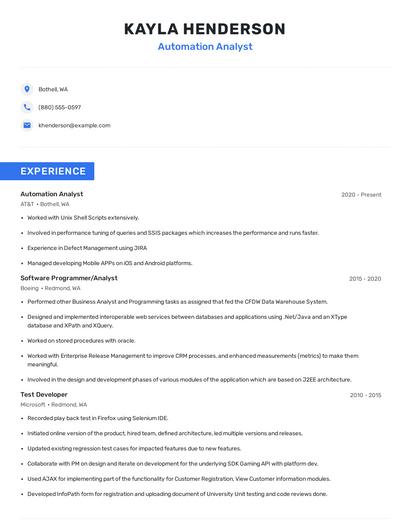
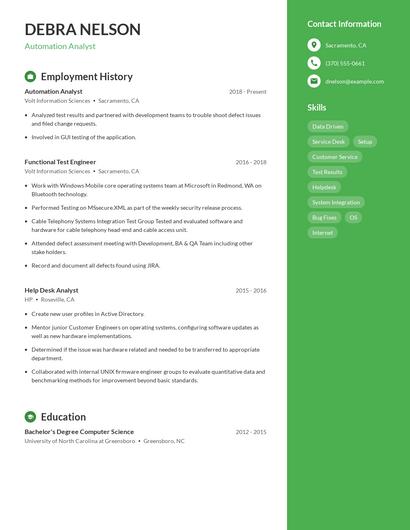
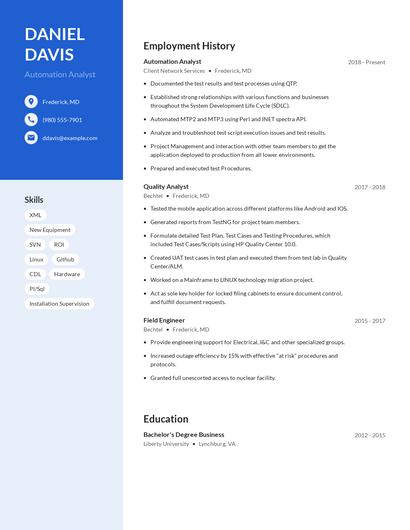
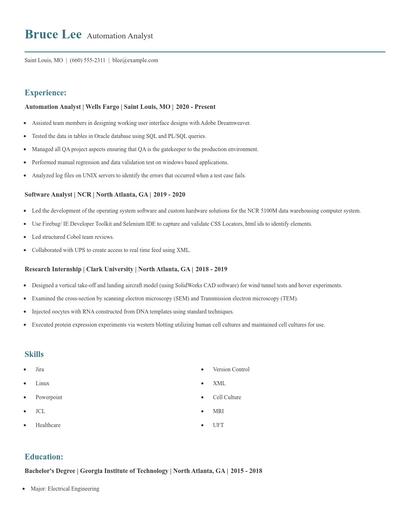
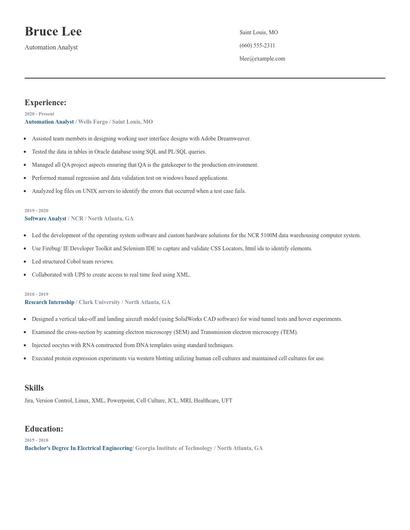
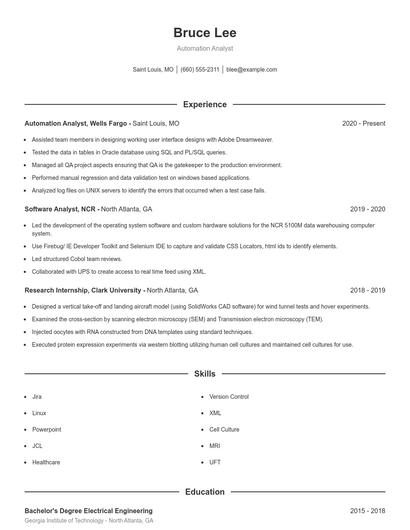
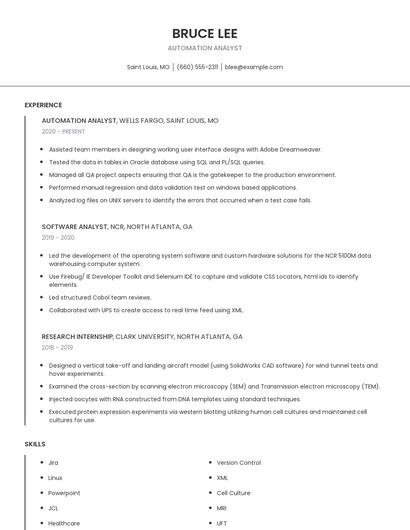
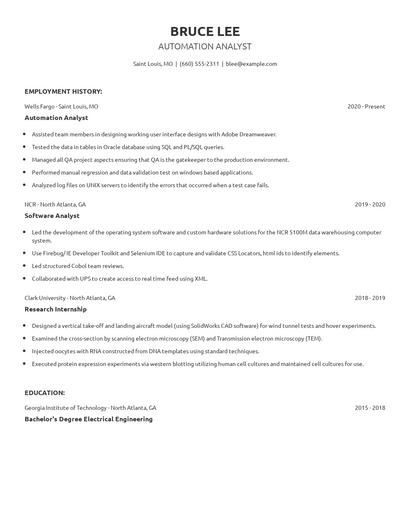
Choose from 10+ customizable automation analyst resume templates
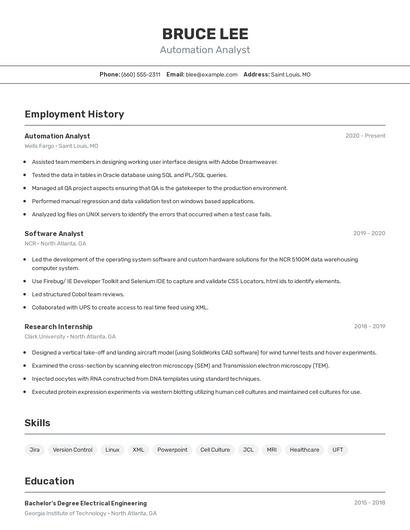
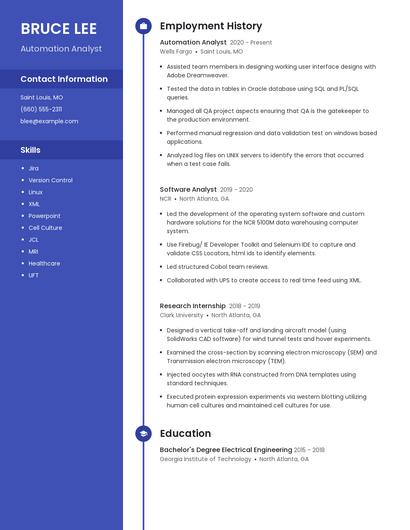
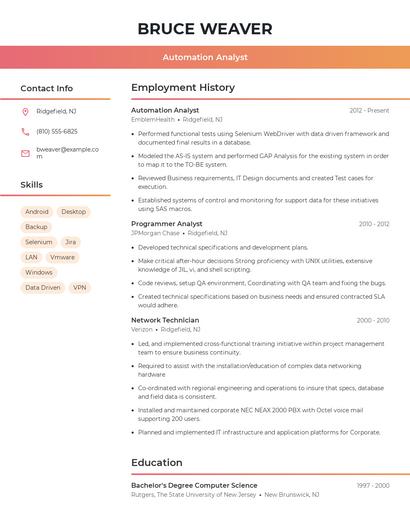
Build a professional automation analyst resume in minutes. Our AI resume writing assistant will guide you through every step of the process, and you can choose from 10+ resume templates to create your automation analyst resume.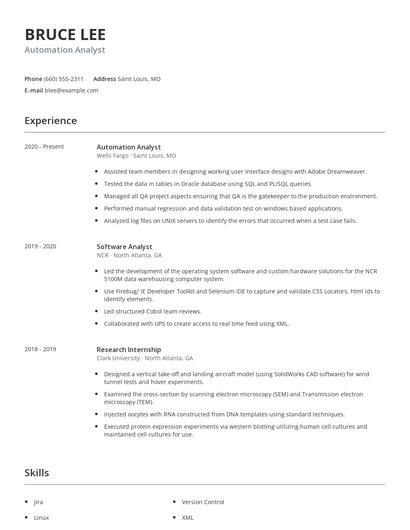
Compare different automation analysts
Automation analyst vs. Quality assurance engineer
A Quality Assurance Engineer's role is to oversee the overall production and ensure that the product is cost-efficient and aligns with the company's standards. The responsibility mainly revolves around conducting activities that examine and scrutinize the condition of a product or service to identify issues and come up with possible solutions to resolve the issue or attain stronger customer satisfaction. Furthermore, the Quality Assurance Engineer must also ensure that the product adheres to the government regulations and market guidelines.
While similarities exist, there are also some differences between automation analysts and quality assurance engineer. For instance, automation analyst responsibilities require skills such as "macro," "business process," "email marketing," and "qa." Whereas a quality assurance engineer is skilled in "python," "scrum," "c++," and "test scripts." This is part of what separates the two careers.
Quality assurance engineers tend to make the most money working in the technology industry, where they earn an average salary of $100,740. In contrast, automation analysts make the biggest average salary, $79,647, in the technology industry.On average, quality assurance engineers reach similar levels of education than automation analysts. Quality assurance engineers are 2.2% more likely to earn a Master's Degree and 0.4% more likely to graduate with a Doctoral Degree.Automation analyst vs. Software tester
The responsibility of software testers involves the quality assurance of software development and deployment. Software testers conduct manual and automated tests to make sure that the software is developed for its purpose. They remove the issues and bugs within a product before deployment to users. Their responsibilities include software and systems analysis, risk mitigation, and software-related issue prevention. They should have skills in automation, programming, social networking, logical thinking, and mobile and web technology.
In addition to the difference in salary, there are some other key differences worth noting. For example, automation analyst responsibilities are more likely to require skills like "macro," "business process," "email marketing," and "technical support." Meanwhile, a software tester has duties that require skills in areas such as "test scripts," "scrum," "web application," and "c++." These differences highlight just how different the day-to-day in each role looks.
Software testers earn a higher average salary than automation analysts. But software testers earn the highest pay in the technology industry, with an average salary of $85,662. Additionally, automation analysts earn the highest salaries in the technology with average pay of $79,647 annually.In general, software testers achieve similar levels of education than automation analysts. They're 0.8% less likely to obtain a Master's Degree while being 0.4% more likely to earn a Doctoral Degree.What technology do you think will become more important and prevalent for automation analysts in the next 3-5 years?
Erik Johnson Ph.D.
Assistant Professor of Economics, Carthage College
Automation analyst vs. Quality assurance consultant
A quality assurance consultant specializes in recommending and optimizing quality-control procedures ensuring efficiency and smooth workflow. They typically conduct research and analysis to identify the strengths and weaknesses of current quality control operations, implement solutions on problem areas, review policies and regulations, and coordinate with other staff to gather necessary data, analyzing them to find new opportunities for improvement. Furthermore, as a quality assurance consultant, it is essential to recommend solutions in adherence to the company's policies and regulations, including its mission and vision.
Some important key differences between the two careers include a few of the skills necessary to fulfill the responsibilities of each. Some examples from automation analyst resumes include skills like "macro," "ui," "email marketing," and "javascript," whereas a quality assurance consultant is more likely to list skills in "test scripts," "selenium webdriver," "status reports," and "scrum. "
Quality assurance consultants earn the highest salary when working in the finance industry, where they receive an average salary of $98,723. Comparatively, automation analysts have the highest earning potential in the technology industry, with an average salary of $79,647.quality assurance consultants typically earn higher educational levels compared to automation analysts. Specifically, they're 5.9% more likely to graduate with a Master's Degree, and 1.2% more likely to earn a Doctoral Degree.Automation analyst vs. Senior quality assurance analyst/lead
A senior quality assurance analyst/lead organizes and manages a lot of quality assurance testing procedures before the release of a product or service to the public. This is considered a skilled profession requiring prior quality assurance experience and industry-specific skills or certifications. The duties and responsibilities of senior quality assurance analysts/leads depend on the specific project or industry in which they are working. The job requires core skills such as strong interpersonal communication skills, a keen eye for details, and excellent time and project management skills. Also, the education requirements to qualify for the position vary depending on the industry.
Types of automation analyst
Updated January 8, 2025
