What does a branch coordinator do?
Branch Coordinators are employees assigned to act as the main point of contact between the branch and the company's head office. They are assigned to the branch and would usually work on administrative activities. Branch coordinators inform their head office counterparts on what is happening in the branch. They update the head office on activities, challenges, and any other happening that may need to be escalated to higher management. Branch coordinators also send the head office requests for materials, supplies, and other resources that the branch may need. They may also be assigned to help in the performance assessments of employees in the branch.
Branch coordinator responsibilities
Here are examples of responsibilities from real branch coordinator resumes:
- Accomplish inspections of the ATM's and coordinate their maintenance.
- Manage IDT roster and participate in interdisciplinary team meetings.
- Provide assistance to patients seeking medical equipment needs including oxygen, c-pap, and other durable medical equipment.
- Communicate and interact with management, external and internal patients, customers and referral sources in an appropriate and professional manner.
- Order and audit weekly cash shipments, as well as servicing ATM.
- Update inventory reports, perform audits of close appeals cases and assist with performance coaching within SharePoint applications.
Branch coordinator skills and personality traits
We calculated that 61% of Branch Coordinators are proficient in Patients, Data Entry, and Reception Services. They’re also known for soft skills such as Communication skills, Compassion, and Interpersonal skills.
We break down the percentage of Branch Coordinators that have these skills listed on their resume here:
- Patients, 61%
Communicated and interacted with management, external and internal patients, customers and referral sources in an appropriate and professional manner.
- Data Entry, 21%
Reviewed and verified all new hire documentation and credentials including interviewing, reference verification, data entry, orientation and training.
- Reception Services, 6%
Provide reception services as first point of contact including telephone reception and in-person.
- Customer Service, 2%
Provided excellent customer service via distributing incoming calls and welcoming all clients.
- E-Verify, 2%
Process I-9 documents E-Verify through Department of Homeland Security.
- Operational Procedures, 1%
Ensured compliance with internal controls, operational procedures, and risk management policies to mitigate risk and loss.
"patients," "data entry," and "reception services" are among the most common skills that branch coordinators use at work. You can find even more branch coordinator responsibilities below, including:
Communication skills. The most essential soft skill for a branch coordinator to carry out their responsibilities is communication skills. This skill is important for the role because "social and human service assistants talk with clients about the challenges in their lives and assist them in getting help." Additionally, a branch coordinator resume shows how their duties depend on communication skills: "provided customer service by answering calls and directing phone communication. "
Compassion. Another essential skill to perform branch coordinator duties is compassion. Branch coordinators responsibilities require that "social and human service assistants often work with people who are in stressful and difficult situations." Branch coordinators also use compassion in their role according to a real resume snippet: "interact effectively and compassionately with patients, families, visitors and staff. "
Interpersonal skills. Another skill that relates to the job responsibilities of branch coordinators is interpersonal skills. This skill is critical to many everyday branch coordinator duties, as "social and human service assistants must make their clients feel comfortable discussing sensitive issues." This example from a resume shows how this skill is used: "demonstrated excellent organizational, interpersonal, written and verbal communication skills with clients, supervisor, and command leadership. "
Organizational skills. For certain branch coordinator responsibilities to be completed, the job requires competence in "organizational skills." The day-to-day duties of a branch coordinator rely on this skill, as "social and human service assistants must often complete lots of paperwork and work with many different clients." For example, this snippet was taken directly from a resume about how this skill applies to what branch coordinators do: "investigate and resolve customer inquiries and complaints strong organizational skills through good time management. "
Problem-solving skills. A commonly-found skill in branch coordinator job descriptions, "problem-solving skills" is essential to what branch coordinators do. Branch coordinator responsibilities rely on this skill because "social and human service assistants help clients find solutions to their problems." You can also see how branch coordinator duties rely on problem-solving skills in this resume example: "assist patients with questions regarding billing issues and provide resolutions. "
Time-management skills. Another skill commonly found on branch coordinator job descriptions is "time-management skills." It can come up quite often in branch coordinator duties, since "social and human service assistants often work with many clients." Here's an example from a resume of how this skill fits into day-to-day branch coordinator responsibilities: "implemented policies and procedures regarding delivery schedules resulting in a 97% - 99% deliveries successfully accomplished on time. "
The three companies that hire the most branch coordinators are:
- Grandbridge Real Estate Capital42 branch coordinators jobs
- Sherwin-Williams19 branch coordinators jobs
- Stanley Black & Decker16 branch coordinators jobs
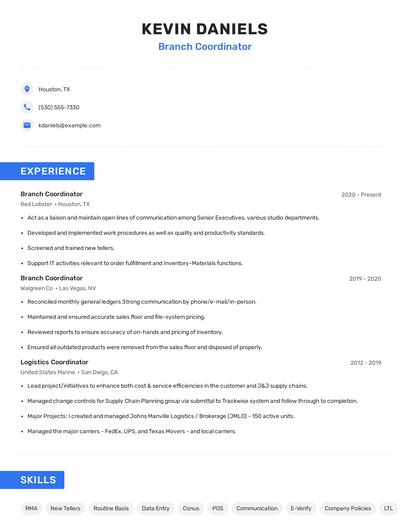
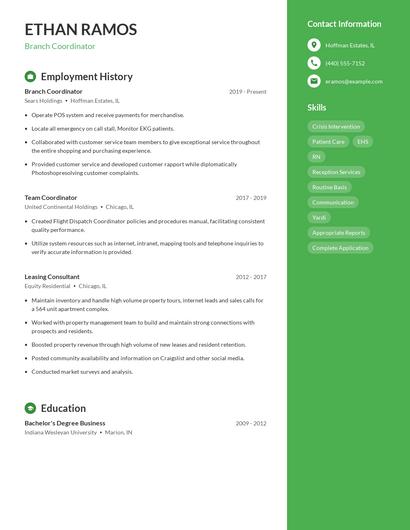
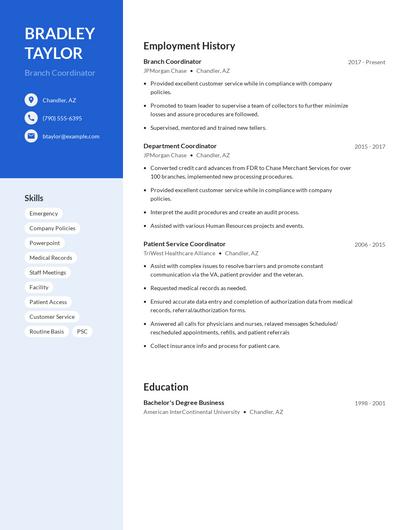
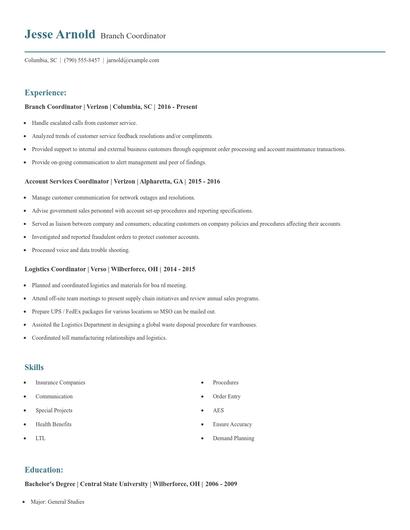
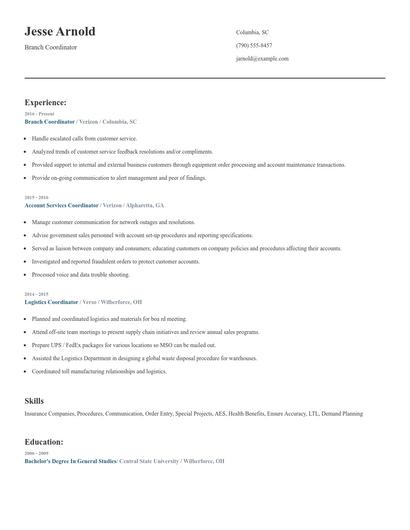
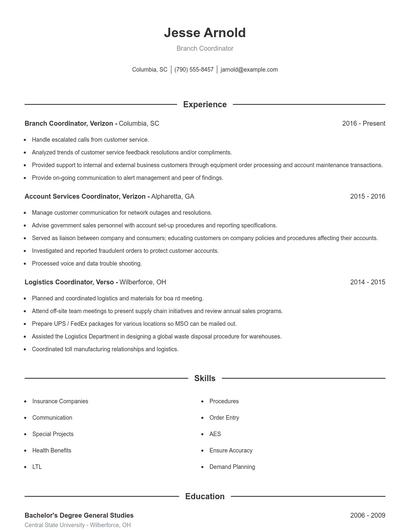
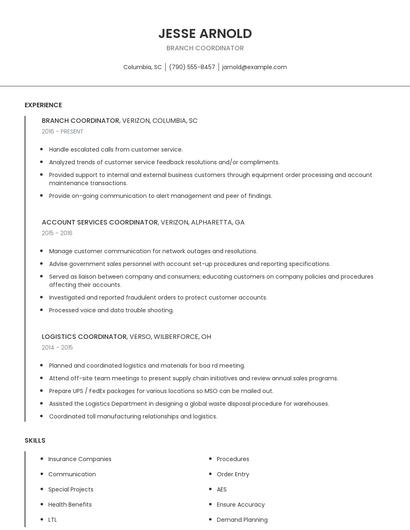
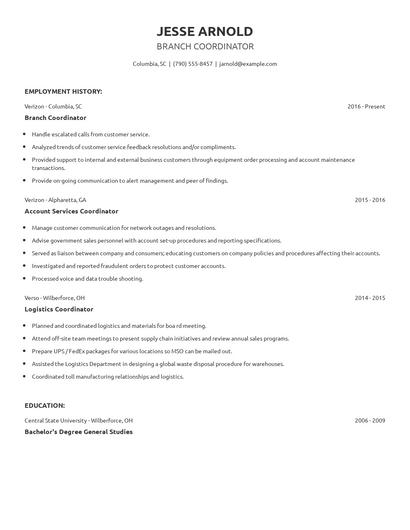
Choose from 10+ customizable branch coordinator resume templates
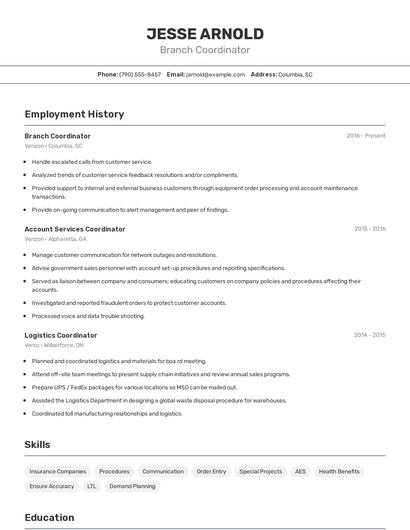
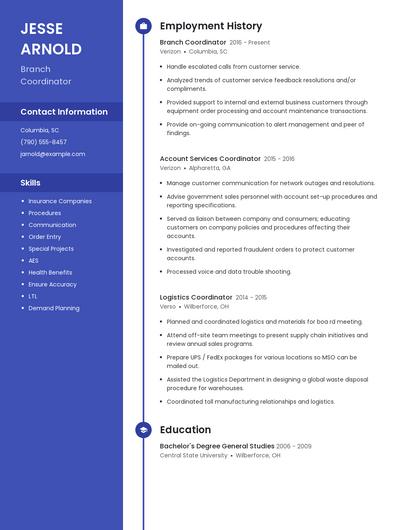
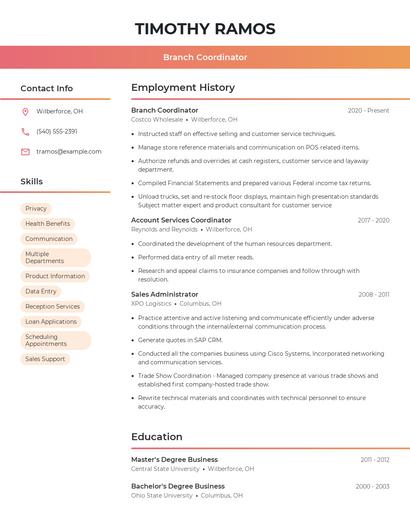
Build a professional branch coordinator resume in minutes. Our AI resume writing assistant will guide you through every step of the process, and you can choose from 10+ resume templates to create your branch coordinator resume.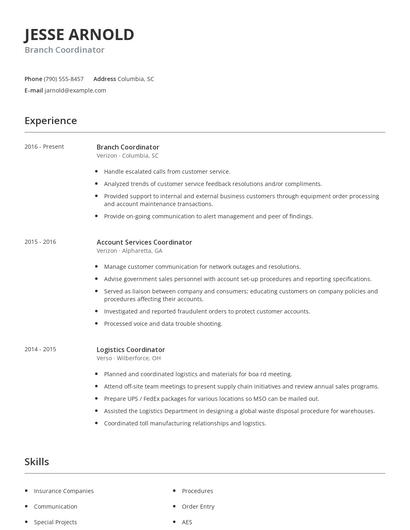
Compare different branch coordinators
Branch coordinator vs. Office manager
Office managers oversee the entire workplace. They maintain office processes and services to ensure that everything is running well. They manage office supplies by managing inventory and procurement procedures. They also device filing systems, create needed and relevant office policies, and ensure that all the policies are being followed. As a way to make sure that the office is in top shape, office managers supervise most of the logistical aspects inside the office. They also provide support to both management teams and the rest of the employees. They often act as the bridge between the two and would sometimes even assist in the training of new employees.
There are some key differences in the responsibilities of each position. For example, branch coordinator responsibilities require skills like "dot," "data entry," "reception services," and "telephone reception." Meanwhile a typical office manager has skills in areas such as "financial statements," "office operations," "office management," and "accounts receivables." This difference in skills reveals the differences in what each career does.
Office managers earn the highest salaries when working in the construction industry, with an average yearly salary of $53,450. On the other hand, branch coordinators are paid more in the real estate industry with an average salary of $45,902.The education levels that office managers earn slightly differ from branch coordinators. In particular, office managers are 1.3% less likely to graduate with a Master's Degree than a branch coordinator. Additionally, they're 0.4% less likely to earn a Doctoral Degree.Branch coordinator vs. Customer service supervisor
A customer service supervisor is responsible for directing the staff in providing the best services to the customers. Customer service supervisors' duties include evaluating the performance of the service staff, implementing strategic procedures to improve operations, developing promotional offers and products to increase the business' revenues, keeping documents of operation records, and assisting with customer's inquiries and complaints. A customer service supervisor must have exceptional leadership and decision-making skills to lead the service staff with daily operations.
Each career also uses different skills, according to real branch coordinator resumes. While branch coordinator responsibilities can utilize skills like "patients," "dot," "data entry," and "reception services," customer service supervisors use skills like "strong customer service," "customer care," "payroll," and "customer complaints."
Customer service supervisors earn a higher average salary than branch coordinators. But customer service supervisors earn the highest pay in the finance industry, with an average salary of $38,952. Additionally, branch coordinators earn the highest salaries in the real estate with average pay of $45,902 annually.customer service supervisors earn similar levels of education than branch coordinators in general. They're 1.8% less likely to graduate with a Master's Degree and 0.4% less likely to earn a Doctoral Degree.Branch coordinator vs. Branch supervisor
A senior administrative coordinator is primarily in charge of overseeing all administrative operations within a company or an organization. Their responsibilities typically revolve around assessing the performance of junior staff and assisting them when necessary, reporting to supervisors or directors, and devising strategies on how to improve the line of communication among all departments. Moreover, a senior administrative coordinator may perform clerical tasks such as preparing progress reports, managing schedules, and maintaining records of all transactions. As a senior, it is also vital to implement the company's policies and regulations, recommending new ones if deemed necessary.
Some important key differences between the two careers include a few of the skills necessary to fulfill the responsibilities of each. Some examples from branch coordinator resumes include skills like "patients," "dot," "data entry," and "reception services," whereas a branch supervisor is more likely to list skills in "security procedures," "security measures," "state laws," and "bank products. "
When it comes to education, branch supervisors tend to earn similar degree levels compared to branch coordinators. In fact, they're 1.1% less likely to earn a Master's Degree, and 0.4% less likely to graduate with a Doctoral Degree.Branch coordinator vs. Senior administrative coordinator
Types of branch coordinator
Updated January 8, 2025
