What does a classroom instructor do?
Classroom instructor responsibilities
Here are examples of responsibilities from real classroom instructor resumes:
- Manage and supervise evening ESL classes to adults ages 18 and over.
- Introduce the distance learning monthly training program, create content, produce PowerPoint programs, videos, and manage support.
- Utilize training in medical English to facilitate preparation of study and achieve require educational standards necessary to successfully complete course.
- Organize and lead other learning activities pertaining to mathematics and reading.
- Meet with parents along with BCBA to discuss IEP goals and progress reports.
- Utilize multiple teaching methods including PowerPoint presentations, discussions, video, and audio to maximize students learning.
- Train in CPR, first aid and early childhood development skills through company training both written and videos.
- Serve the educational community in after school enrichment programs for fields of science, technology, engineering, and mathematics.
- Communicate regularly to parents/clinical staff to ensure IEP goals meet and needs are being addressed in a timely and professional manner.
- Develop and instruct specialized courses and laboratory sessions for funeral directors in human anatomy and biology and conduct private tutoring sessions.
- Supervise students in classrooms, halls, cafeterias, gymnasiums, and on field trips.
Classroom instructor skills and personality traits
We calculated that 11% of Classroom Instructors are proficient in Kids, Math, and ESL. They’re also known for soft skills such as Physical stamina, Communication skills, and Patience.
We break down the percentage of Classroom Instructors that have these skills listed on their resume here:
- Kids, 11%
Increased program efficiency by developing games to keep kids interested and engaged.
- Math, 11%
Developed, promoted & implemented individualized math & reading curriculum.
- ESL, 8%
Work with Director of Education, ESL and Lab Instructors in developing training programs.
- Help Support, 7%
Develop and facilitate parent classes to help support and develop parents' abilities to assist their students with school curriculum.
- Course Curriculum, 7%
Developed course curriculum, facilitated classroom learning, evaluated and graded students.
- GED, 7%
Prepared high functioning consumers for the GED testing with special accommodations with one successful completion.
Most classroom instructors use their skills in "kids," "math," and "esl" to do their jobs. You can find more detail on essential classroom instructor responsibilities here:
Physical stamina. One of the key soft skills for a classroom instructor to have is physical stamina. You can see how this relates to what classroom instructors do because "working with kindergarten- and elementary-age students can be tiring." Additionally, a classroom instructor resume shows how classroom instructors use physical stamina: "formulated daily lesson plans, evaluated student performances on written, verbal and physical development skill sets. "
Communication skills. Another soft skill that's essential for fulfilling classroom instructor duties is communication skills. The role rewards competence in this skill because "teachers need to discuss students’ needs with parents and administrators." According to a classroom instructor resume, here's how classroom instructors can utilize communication skills in their job responsibilities: "reviewed english language client communications and wrote a new hire orientation manual for english speaking foreign staff. "
Patience. classroom instructors are also known for patience, which are critical to their duties. You can see how this skill relates to classroom instructor responsibilities, because "kindergarten and elementary school teachers must respond with patience when students struggle with material." A classroom instructor resume example shows how patience is used in the workplace: "embodied and honored the instructor s code of ethics of professionalism, patience, rapport, respect, and admission. "
Resourcefulness. classroom instructor responsibilities often require "resourcefulness." The duties that rely on this skill are shown by the fact that "kindergarten and elementary school teachers must be able to get students engaged in learning." This resume example shows what classroom instructors do with resourcefulness on a typical day: "showed resourcefulness and teaching effectiveness in meeting the needs of students with limited english language proficiency as well as learning disabilities. "
The three companies that hire the most classroom instructors are:
- Jo-Ann Stores3 classroom instructors jobs
- Genesee Community College2 classroom instructors jobs
- Manhattan School of Music
2 classroom instructors jobs
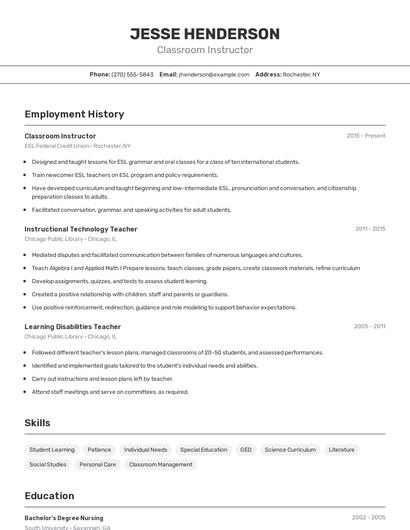
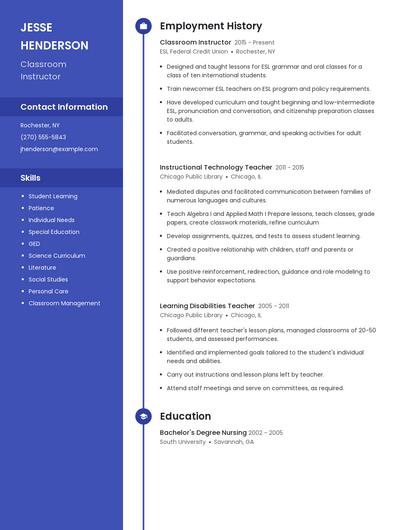
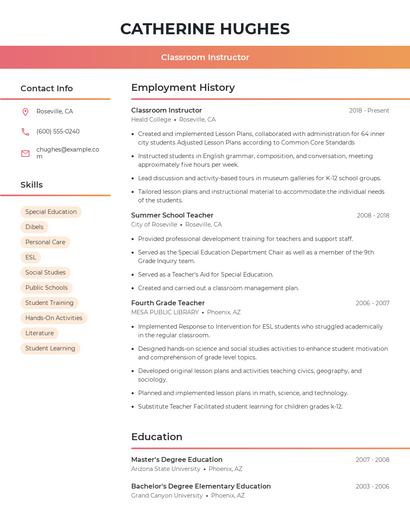
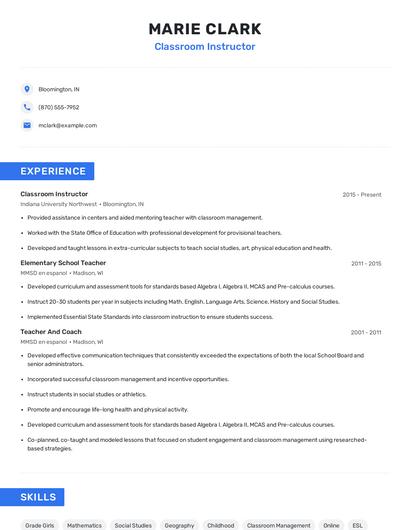
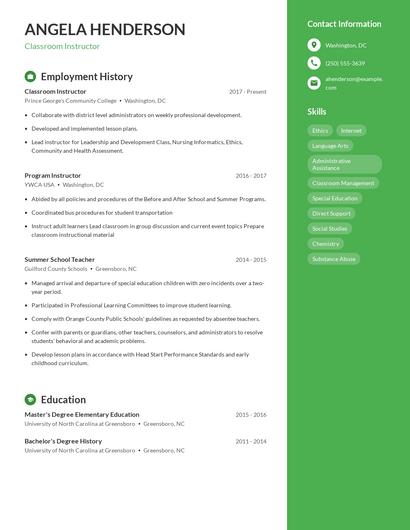
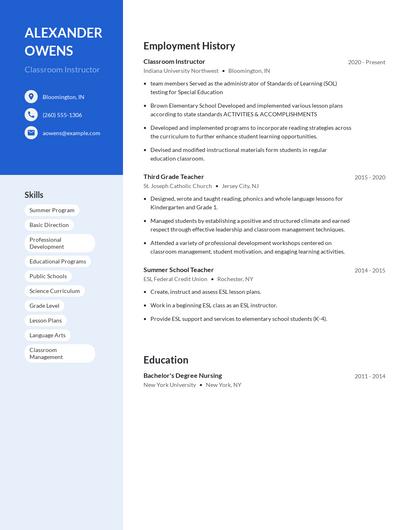
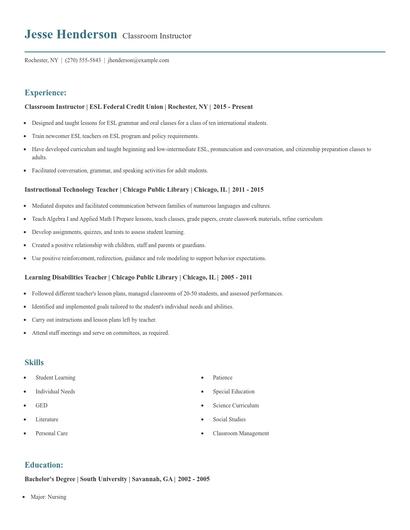
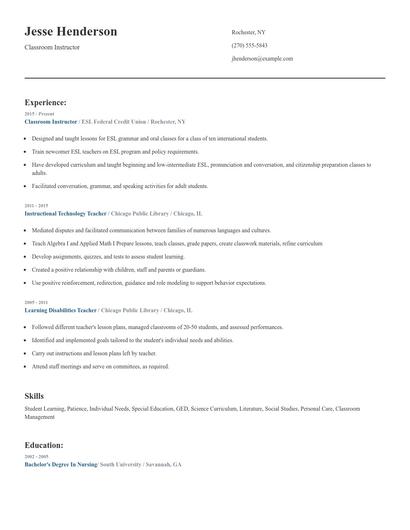
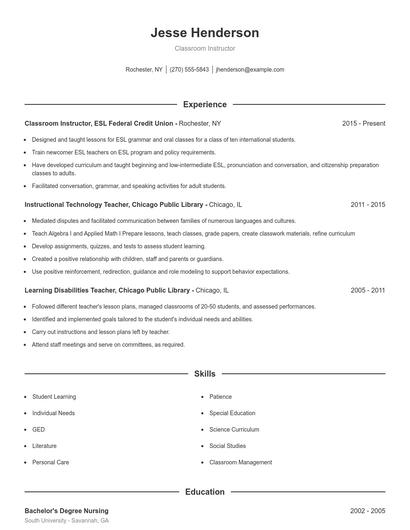
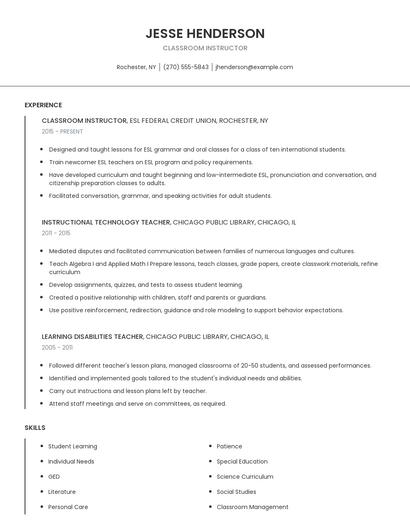
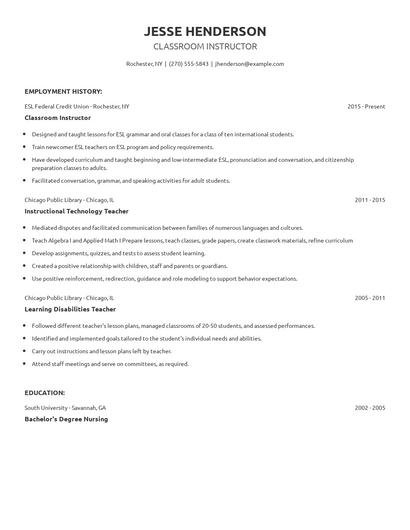
Choose from 10+ customizable classroom instructor resume templates
Build a professional classroom instructor resume in minutes. Our AI resume writing assistant will guide you through every step of the process, and you can choose from 10+ resume templates to create your classroom instructor resume.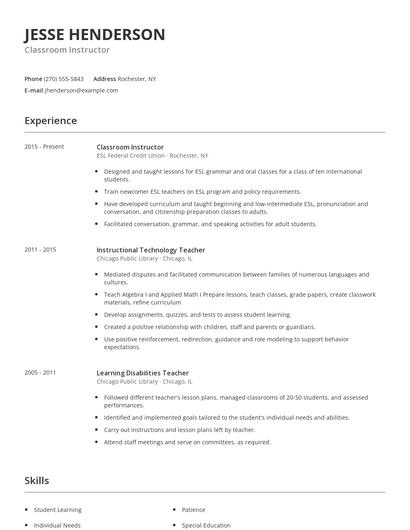
Compare different classroom instructors
Classroom instructor vs. Reading teacher
Reactor Engineers are responsible for designing and developing nuclear reactor programs. Their duties include presenting design reviews, overseeing operations of the reactor core, conducting nuclear material tracking and new fuel receipt, facilitating control room, and producing document safety analysis. They are responsible for setting technical specifications, participate in the peer review process, implement programmatic strategies, and undertake emergency response and mitigation initiatives. Reactor Engineers also help in facilitating projects between external and internal engineering companies.
While similarities exist, there are also some differences between classroom instructors and reading teacher. For instance, classroom instructor responsibilities require skills such as "kids," "help support," "course curriculum," and "ged." Whereas a reading teacher is skilled in "mentoring students," "learning process," "intervention program," and "state standards." This is part of what separates the two careers.
Reading teachers tend to make the most money working in the education industry, where they earn an average salary of $51,003. In contrast, classroom instructors make the biggest average salary, $49,363, in the education industry.The education levels that reading teachers earn slightly differ from classroom instructors. In particular, reading teachers are 9.2% more likely to graduate with a Master's Degree than a classroom instructor. Additionally, they're 0.1% more likely to earn a Doctoral Degree.Classroom instructor vs. Teacher
Being a teacher is one of the most passionate professions, among others. Teachers educate, motivate, and guide every generation of learners to prepare them for the real world. Every teacher is unique and has their own teaching styles and methods depending on the subject they teach and the age of their students. Oftentimes they also function as a parent, counselor, coach, friend, and even a lawmaker. There is essentially no limit to the roles a teacher portrays.
While some skills are similar in these professions, other skills aren't so similar. For example, resumes show us that classroom instructor responsibilities requires skills like "help support," "course curriculum," "ged," and "ethics." But a teacher might use other skills in their typical duties, such as, "handle scheduling," "geography," "whiteboards," and "pre-k."
Teachers may earn a higher salary than classroom instructors, but teachers earn the most pay in the education industry with an average salary of $49,700. On the other hand, classroom instructors receive higher pay in the education industry, where they earn an average salary of $49,363.In general, teachers achieve similar levels of education than classroom instructors. They're 2.3% less likely to obtain a Master's Degree while being 0.1% less likely to earn a Doctoral Degree.What technology do you think will become more important and prevalent for classroom instructors in the next 3-5 years?
Dr. Diana Jones
Chair, Department of Kinesiology, Anderson University
Classroom instructor vs. Certified teacher
A certified teacher is responsible for designing lesson plans and activities for the students by following the curriculum and the students' learning needs. Certified teachers manage the coordination of the students within the classroom setting, observe their behaviors, and identify their areas of improvement by determining every student's strengths and weaknesses. They also evaluate the students' performance and progress by conducting assessments and facilitating engaging activities that would not only help the students develop their mental skills but their social connections as well.
The required skills of the two careers differ considerably. For example, classroom instructors are more likely to have skills like "help support," "course curriculum," "ged," and "literature." But a certified teacher is more likely to have skills like "childhood," "applied behavior analysis," "reading comprehension," and "learning process."
Certified teachers make a very good living in the government industry with an average annual salary of $51,100. On the other hand, classroom instructors are paid the highest salary in the education industry, with average annual pay of $49,363.certified teachers typically earn similar educational levels compared to classroom instructors. Specifically, they're 2.3% more likely to graduate with a Master's Degree, and 0.8% more likely to earn a Doctoral Degree.Classroom instructor vs. High school teacher
High school teachers play an essential role in preparing students for college or life following graduation. They typically teach students from the ninth to 12th grades. They plan and develop lessons, evaluate their students' strengths, weaknesses and abilities, and grade their exams and assignments. Other duties include working with individual students to challenge and improve their abilities, developing and implementing classroom rules, and overseeing students outside the classroom. Some of them also take on additional tasks, such as advising academic clubs or coaching sports teams.
Even though a few skill sets overlap between classroom instructors and high school teachers, there are some differences that are important to note. For one, a classroom instructor might have more use for skills like "kids," "help support," "course curriculum," and "ged." Meanwhile, some responsibilities of high school teachers require skills like "culinary," "english language," "learning process," and "gpa. "
In general, high school teachers earn the most working in the professional industry, with an average salary of $51,028. The highest-paying industry for a classroom instructor is the education industry.In general, high school teachers hold similar degree levels compared to classroom instructors. High school teachers are 2.3% more likely to earn their Master's Degree and 0.6% more likely to graduate with a Doctoral Degree.Types of classroom instructor
Updated January 8, 2025
