What does a clerk specialist do?
A Clerk Specialist is an information clerk that people can refer to when they have inquiries. Businesses place the Clerk Specialist under the umbrella of a receptionist and are often highly knowledgeable of company policies, provide solutions to problems, and handle customer complaints. A Clerk Specialist's main requirements are strong interpersonal communication skills and a high tolerance when under pressure.
Clerk specialist responsibilities
Here are examples of responsibilities from real clerk specialist resumes:
- Manage orthopedic accounts regarding payment posting through IDX medical systems.
- Assist in preliminary budget, preparation; prepare departmental payroll, statistical data and reports.
- Check visitation/meeting rooms for cleanliness; print daily visitation/meeting room schedules; and escort parents/attendees to visitation/meeting rooms.
- Answer phones with the ability to provide accurate information and education on the communicability and disease process of tuberculosis.
Clerk specialist skills and personality traits
We calculated that 18% of Clerks Specialist are proficient in Data Entry, Office Equipment, and Customer Service. They’re also known for soft skills such as Customer-service skills, Detail oriented, and Organizational skills.
We break down the percentage of Clerks Specialist that have these skills listed on their resume here:
- Data Entry, 18%
Consulted and coordinated assignments with computerized data entry services.
- Office Equipment, 15%
Developed relationship with outside vendors and contractors for office equipment.
- Customer Service, 13%
Provided daily support as the agency's only bilingual English/Spanish customer service representative.
- Front Desk, 5%
Staff front desk: Answer phone calls; pull records.
- Payroll, 5%
Assisted in preliminary budget, preparation; prepared departmental payroll, statistical data and reports.
- Computer System, 5%
FloridaVerified that information in the computer system was up-to-date and accurate.
Common skills that a clerk specialist uses to do their job include "data entry," "office equipment," and "customer service." You can find details on the most important clerk specialist responsibilities below.
Customer-service skills. To carry out their duties, the most important skill for a clerk specialist to have is customer-service skills. Their role and responsibilities require that "general office clerks often provide general information to company staff, customers, or the public." Clerks specialist often use customer-service skills in their day-to-day job, as shown by this real resume: "process request for replacement bic card assisted eligibility workers with the data entry of retro-active medical application for their customers. "
Detail oriented. Many clerk specialist duties rely on detail oriented. "general office clerks perform many clerical tasks that require attention to detail, such as preparing bills.," so a clerk specialist will need this skill often in their role. This resume example is just one of many ways clerk specialist responsibilities rely on detail oriented: "detailed orientated data processing of correspondence and applications. "
Organizational skills. Another skill that relates to the job responsibilities of clerks specialist is organizational skills. This skill is critical to many everyday clerk specialist duties, as "general office clerks file and retrieve records." This example from a resume shows how this skill is used: "demonstrated outstanding organizational strengths to manage and coordinate travel arrangements and accommodations for director. "
The three companies that hire the most clerk specialists are:
- Iowa Department of Transportation3 clerks specialist jobs
- Miriam Hospital2 clerks specialist jobs
- Robert Half1 clerks specialist jobs
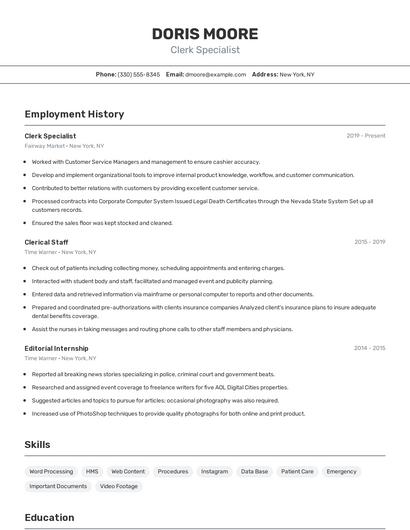
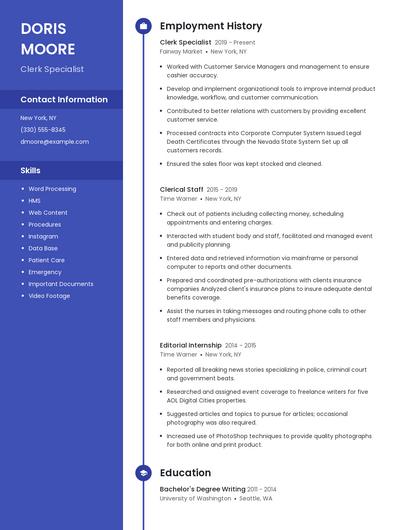
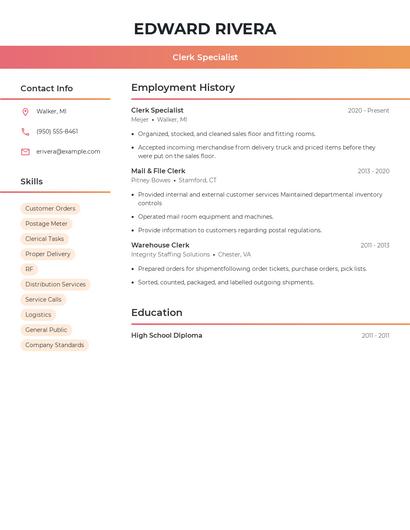
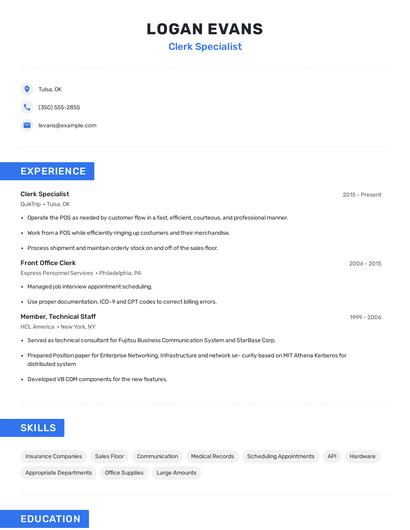
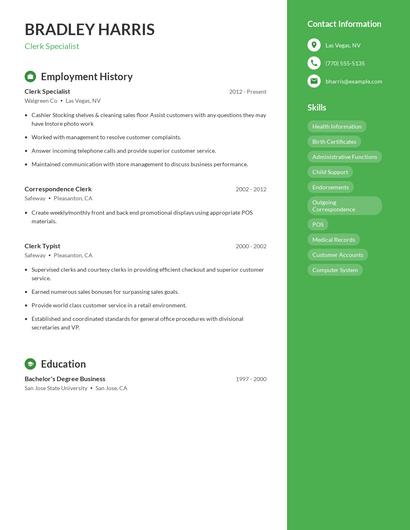
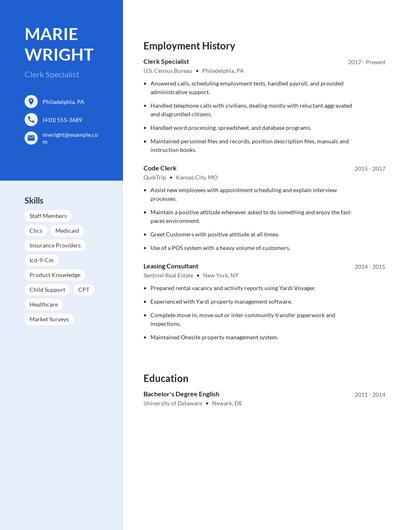
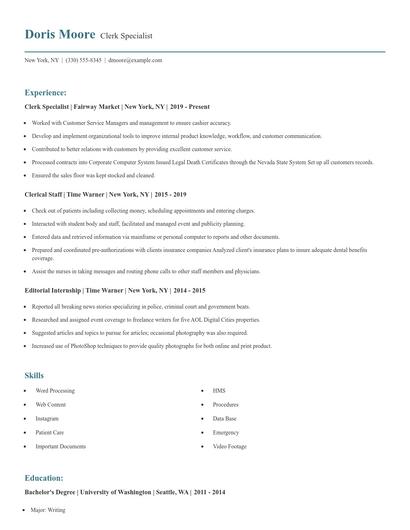
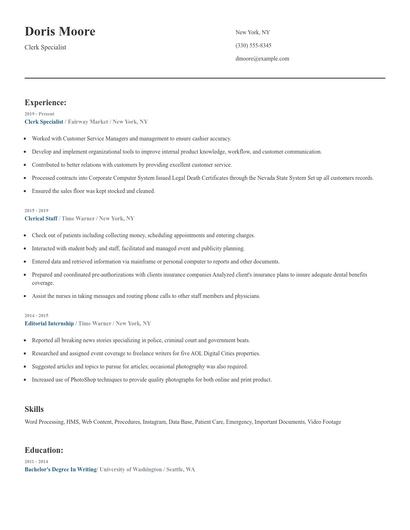
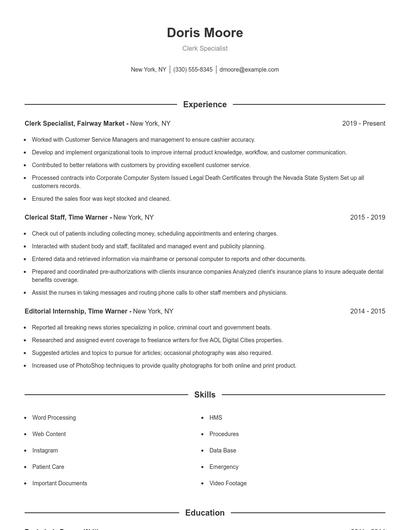
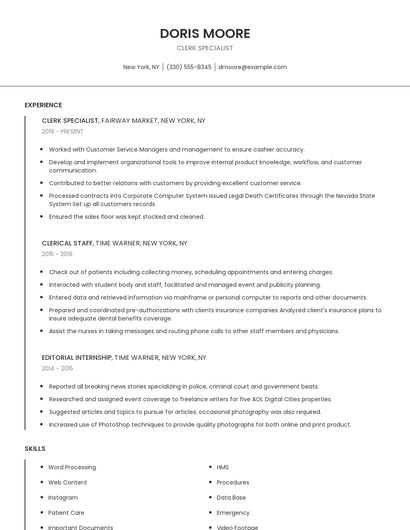
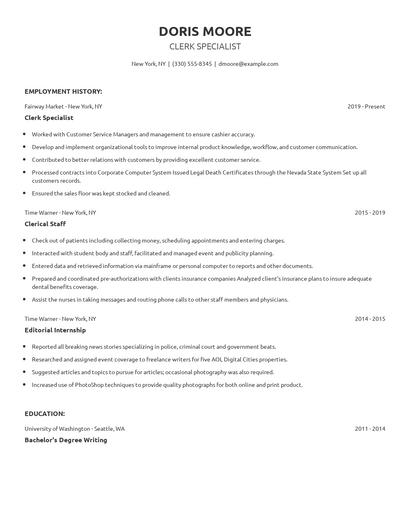
Choose from 10+ customizable clerk specialist resume templates
Build a professional clerk specialist resume in minutes. Our AI resume writing assistant will guide you through every step of the process, and you can choose from 10+ resume templates to create your clerk specialist resume.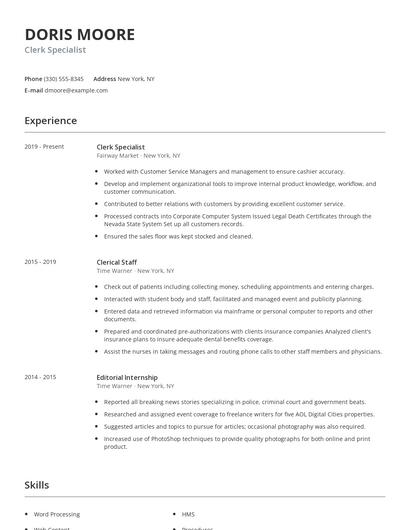
Compare different clerks specialist
Clerk specialist vs. Operations clerk
An operations clerk is responsible for performing administrative and clerical duties, ensuring smooth business operations. Operations clerks often handle customer service, respond to customers' inquiries and concerns, and direct guests to appropriate departments. They also manage data entry tasks, update customers or employees' information to the database, create business reports, identify potential clients through cold calls and e-mails, sort and file documents, and monitor inventories. An operations clerk must have excellent time-management and organizational skills to follow office procedures and meet deadlines.
There are some key differences in the responsibilities of each position. For example, clerk specialist responsibilities require skills like "data entry," "front desk," "child support," and "purchase orders." Meanwhile a typical operations clerk has skills in areas such as "data entry functions," "provide clerical support," "quality standards," and "financial data." This difference in skills reveals the differences in what each career does.
Operations clerks tend to make the most money working in the manufacturing industry, where they earn an average salary of $34,803. In contrast, clerks specialist make the biggest average salary, $38,591, in the energy industry.The education levels that operations clerks earn slightly differ from clerks specialist. In particular, operations clerks are 1.1% less likely to graduate with a Master's Degree than a clerk specialist. Additionally, they're 0.2% more likely to earn a Doctoral Degree.Clerk specialist vs. Support clerk
A support clerk is primarily in charge of performing administrative support tasks in an office, making the daily workflow easier. Their responsibilities typically include preparing and processing documentation, answering and forwarding calls, handling correspondence, disseminating and organizing files, and running errands as needed. They may also update databases, maintaining records of all transactions. Furthermore, as a support clerk, it is essential to maintain an active communication line with staff, coordinating to ensure efficient and smooth workplace operations.
In addition to the difference in salary, there are some other key differences worth noting. For example, clerk specialist responsibilities are more likely to require skills like "payroll," "purchase orders," "proofread," and "dmv." Meanwhile, a support clerk has duties that require skills in areas such as "patients," "clerical support," "medical terminology," and "patient care." These differences highlight just how different the day-to-day in each role looks.
On average, support clerks earn a higher salary than clerks specialist. Some industries support higher salaries in each profession. Interestingly enough, support clerks earn the most pay in the government industry with an average salary of $35,567. Whereas clerks specialist have higher pay in the energy industry, with an average salary of $38,591.support clerks earn similar levels of education than clerks specialist in general. They're 0.8% less likely to graduate with a Master's Degree and 0.2% more likely to earn a Doctoral Degree.Clerk specialist vs. Records clerk
A records clerk is responsible for performing clerical and administrative duties, filing important documents, and keeping the company's files safe. Records clerks sort papers accurately and provide the files only to authorized personnel. They categorize records efficiently and dispose of unnecessary files, following correct procedures of the organization. A records clerk maintains a records database for easy tracking and retrieving of files. A records clerk must have excellent organizational and time-management skills, especially when compiling documents that are urgently needed.
There are many key differences between these two careers, including some of the skills required to perform responsibilities within each role. For example, a clerk specialist is likely to be skilled in "payroll," "child support," "purchase orders," and "proofread," while a typical records clerk is skilled in "digital database," "management system," "patient charts," and "clerical support."
Records clerks earn the highest salary when working in the government industry, where they receive an average salary of $34,460. Comparatively, clerks specialist have the highest earning potential in the energy industry, with an average salary of $38,591.When it comes to education, records clerks tend to earn similar degree levels compared to clerks specialist. In fact, they're 0.2% less likely to earn a Master's Degree, and 0.4% less likely to graduate with a Doctoral Degree.Clerk specialist vs. Claims clerk
Claims clerks review the forms and documents for insurance claims to check for missing information and attachments. The data they obtain is entered into their database for safekeeping and quick retrieval. They should know the answers to their clients' questions about the regulations, policies, and procedures covered by their insurance policy. These clerks prepare documents that their agents use to present to their clients. When working for this position, a person must have the ability to communicate well and be familiar with computer applications.
Types of clerk specialist
Updated January 8, 2025
