What does a community aide do?
Community aide responsibilities
Here are examples of responsibilities from real community aide resumes:
- Assist in managing inventory for student and staff culinary and scholastic supplies.
- Provide relationship-base treatment plans to patients that involves high quality acute psychiatric evaluations, crisis stabilization, and intensive short-term treatment.
- Collaborate with community health councils and other community agencies to provide programs that enhance community awareness of health and safety.
Community aide skills and personality traits
We calculated that 24% of Community Aides are proficient in Developmental Disabilities, CPR, and Autism. They’re also known for soft skills such as Compassion, Time-management skills, and Communication skills.
We break down the percentage of Community Aides that have these skills listed on their resume here:
- Developmental Disabilities, 24%
Assisted consumers with developmental disabilities with daily aspects of life.
- CPR, 22%
Performed CPR successfully established a security perimeter and maintained security of the scene until Albuquerque Police and Medical personnel arrived.
- Autism, 7%
Support and teach an individual with Autism to improve social and work skills
- Behavior Management, 6%
Applied behavior management as care planned - Completed incident reports, accident reports, and grievance reports per policy.
- Community Resources, 5%
Develop relationships with community resources and service providers.
- Front Desk, 4%
Assist in front desk coverage.
Most community aides use their skills in "developmental disabilities," "cpr," and "autism" to do their jobs. You can find more detail on essential community aide responsibilities here:
Compassion. One of the key soft skills for a community aide to have is compassion. You can see how this relates to what community aides do because "social and human service assistants often work with people who are in stressful and difficult situations." Additionally, a community aide resume shows how community aides use compassion: "follow clear protocol according to each clients needs and have proven to be reliable, dependable, and true compassion. "
Time-management skills. Another essential skill to perform community aide duties is time-management skills. Community aides responsibilities require that "social and human service assistants often work with many clients." Community aides also use time-management skills in their role according to a real resume snippet: "insured all plans were turned in on time and that case managers complied with state regulations for billing. "
Communication skills. Another skill that relates to the job responsibilities of community aides is communication skills. This skill is critical to many everyday community aide duties, as "social and human service assistants talk with clients about the challenges in their lives and assist them in getting help." This example from a resume shows how this skill is used: "maintained communication with division of developmental disabilities case manager, families, day care & health care professionals. "
Organizational skills. community aide responsibilities often require "organizational skills." The duties that rely on this skill are shown by the fact that "social and human service assistants must often complete lots of paperwork and work with many different clients." This resume example shows what community aides do with organizational skills on a typical day: "assisted students with physical disabilities develop strong organizational skills, complete homework assignments, and maintain dean's list-level grades. "
Problem-solving skills. Another common skill required for community aide responsibilities is "problem-solving skills." This skill comes up in the duties of community aides all the time, as "social and human service assistants help clients find solutions to their problems." An excerpt from a real community aide resume shows how this skill is central to what a community aide does: "promoted positive environment for non-traditional students and their children and facilitated conflict resolution between residents. "
Interpersonal skills. Lastly, "interpersonal skills" is an important element of what a community aide does. Community aide responsibilities require this skill because "social and human service assistants must make their clients feel comfortable discussing sensitive issues." This resume example highlights how community aide duties rely on this skill: "gained effective interpersonal and customer service skills while assisting more than 8 patients an hour. "
The three companies that hire the most community aides are:
- City of Baltimore7 community aides jobs
- Trinity Health5 community aides jobs
- UPMC2 community aides jobs
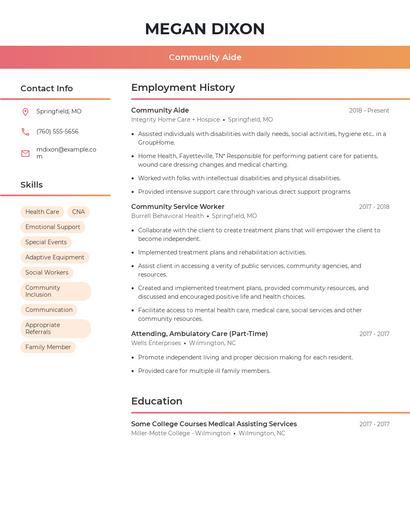
Choose from 10+ customizable community aide resume templates
Build a professional community aide resume in minutes. Our AI resume writing assistant will guide you through every step of the process, and you can choose from 10+ resume templates to create your community aide resume.




Compare different community aides
Community aide vs. Human services worker
A human services worker provides various services that will improve their clients' lives. These include evaluating the needs of their clients, creating the right treatment plan, and executing the plan. As a human services worker, you will regularly provide clients emotional support and maintain a good relationship with them. You need to make sure they feel comfortable talking about their problems with you. Additionally, you will also coordinate with other service providers and assist clients with researching different types of assistance and eligibility requirements.
These skill sets are where the common ground ends though. The responsibilities of a community aide are more likely to require skills like "autism," "behavior management," "front desk," and "direct support." On the other hand, a job as a human services worker requires skills like "criminal justice," "client orientation," "social work," and "patients." As you can see, what employees do in each career varies considerably.
Human services workers tend to make the most money working in the education industry, where they earn an average salary of $28,528. In contrast, community aides make the biggest average salary, $28,124, in the professional industry.On average, human services workers reach similar levels of education than community aides. Human services workers are 1.1% more likely to earn a Master's Degree and 0.1% less likely to graduate with a Doctoral Degree.Community aide vs. Residential program worker
A residential counselor is responsible for guiding and providing the residents with their basic needs and other resources to support them in their daily living. Residential counselors' duties include maintaining the safety of the community by enforcing safety guidelines and procedures for the residents' compliance, organizing productive and engaging community activities, updating the residents of any changes and policies in the community, and resolving conflicts by counseling and understanding each resident's differences. A residential counselor must have excellent communication and decision-making skills to ensure the development of residents in a living facility.
Each career also uses different skills, according to real community aide resumes. While community aide responsibilities can utilize skills like "autism," "front desk," "direct support," and "early intervention," residential program workers use skills like "patients," "motor vehicle," "mental health," and "adaptive."
Residential program workers may earn a higher salary than community aides, but residential program workers earn the most pay in the health care industry with an average salary of $28,780. On the other hand, community aides receive higher pay in the professional industry, where they earn an average salary of $28,124.Average education levels between the two professions vary. Residential program workers tend to reach similar levels of education than community aides. In fact, they're 4.7% less likely to graduate with a Master's Degree and 0.1% more likely to earn a Doctoral Degree.Community aide vs. Residential instructor
The required skills of the two careers differ considerably. For example, community aides are more likely to have skills like "cpr," "community resources," "front desk," and "early intervention." But a residential instructor is more likely to have skills like "data collection," "direct supervision," "role model," and "behavioral health issues."
Residential instructors earn the best pay in the education industry, where they command an average salary of $31,699. Community aides earn the highest pay from the professional industry, with an average salary of $28,124.residential instructors typically earn similar educational levels compared to community aides. Specifically, they're 2.8% less likely to graduate with a Master's Degree, and 0.3% less likely to earn a Doctoral Degree.Community aide vs. Residential counselor
Types of community aide
Updated January 8, 2025
