What does a computer systems manager do?
Computer systems manager responsibilities
Here are examples of responsibilities from real computer systems manager resumes:
- Manage a multi-vendor UNIX environment (HP/SUN).
- Develop, manage and perform maintenance on SharePoint web applications with a concentrate focus on physical, information and personnel security.
- Help train employees to troubleshoot network problems.
- Maintain all phases of personal computer and UNIX workstation hardware and software.
- Configure and maintain routing protocol such as OSPF, OSPFv3, and BGP routers and switches.
- Save client $150K by streamlining process for maintaining HVAC assets and warranty information for more than 2400 locations.
- Support field construction: feasibility studies, surveillances, and solves field design problems of piping and HVAC system design.
- Install and configure workstations, and update support reference materials.
- Deploy, configure, and maintain all computer forensic workstations in accordance with federal security regulations and accept standards.
- Added/Remove all software/hardware; provide internet TCP/IP proxy server address for internet usage to customers; upgrade internet security patches
- Administer corporate databases and operating systems and provide application support in a manufacturing environment running large scale ERP and CMMS software.
- Convert an antiquate telephone and messaging system to a VoIP communications system, increasing accessibility and responsiveness to clients and customers.
- Provide PC/Mac technical support for students and faculty of the college.
- Train and certify on Unisys voice over IP and data networking software.
- Convert an antiquate telephone and messaging system to a VoIP communications system, increasing accessibility and responsiveness to clients and customers.
Computer systems manager skills and personality traits
We calculated that 25% of Computer Systems Managers are proficient in Computer System, FDA, and Software Development. They’re also known for soft skills such as Business skills, Leadership skills, and Organizational skills.
We break down the percentage of Computer Systems Managers that have these skills listed on their resume here:
- Computer System, 25%
Provided consultation/advice to staff in other departments to assure that the computer systems represented the maximum quality and reliability.
- FDA, 10%
Worked on all FDA and Regulatory comments in order to bring system up to acceptable standards.
- Software Development, 8%
Facilitated communication between designers, architects, and senior executives to identify requirements for custom design software development.
- ISO, 7%
Supported global HA & ISO inspections and internal audits with a focus on compliance of IS related quality systems.
- Customer Service, 5%
Ensured staff's proficiency in computer operations greatly enhancing customer service and increasing overall sales volume.
- Linux, 4%
Maintain 15+ servers and 50+ workstations running Linux, OS X, and Microsoft Windows.
"computer system," "fda," and "software development" are among the most common skills that computer systems managers use at work. You can find even more computer systems manager responsibilities below, including:
Business skills. To carry out their duties, the most important skill for a computer systems manager to have is business skills. Their role and responsibilities require that "it managers must develop and implement strategic plans to reach the goals of their organizations." Computer systems managers often use business skills in their day-to-day job, as shown by this real resume: "partner with local / corporate qa and other business functions to develop, implement, and maintain quality systems. "
Leadership skills. Another essential skill to perform computer systems manager duties is leadership skills. Computer systems managers responsibilities require that "it managers must lead and motivate it teams or departments so that workers are efficient and effective." Computer systems managers also use leadership skills in their role according to a real resume snippet: "provided it leadership and managerial oversight for business processes, projects, and application support in a multi-food-product plant environment. "
Organizational skills. Another skill that relates to the job responsibilities of computer systems managers is organizational skills. This skill is critical to many everyday computer systems manager duties, as "some it managers must coordinate the work of several different it departments to make the organization run efficiently." This example from a resume shows how this skill is used: "managed client user accounts and organizational client device accounts and performed other system/network administration and helpdesk duties. "
Analytical skills. For certain computer systems manager responsibilities to be completed, the job requires competence in "analytical skills." The day-to-day duties of a computer systems manager rely on this skill, as "it managers must analyze problems and consider and select the best ways to solve them." For example, this snippet was taken directly from a resume about how this skill applies to what computer systems managers do: "perform system planning and management of laboratory computer networks used for data collection and analysis. "
Communication skills. A commonly-found skill in computer systems manager job descriptions, "communication skills" is essential to what computer systems managers do. Computer systems manager responsibilities rely on this skill because "it managers must explain their work to top executives and give clear instructions to their subordinates." You can also see how computer systems manager duties rely on communication skills in this resume example: "acted as leader of emergency communications project to oversee high-level program plan for upgrade of nyc 911 & communications systems. "
The three companies that hire the most computer systems managers are:
- Northrop Grumman21 computer systems managers jobs
- U.S. Bank4 computer systems managers jobs
- Bristol-Myers Squibb2 computer systems managers jobs
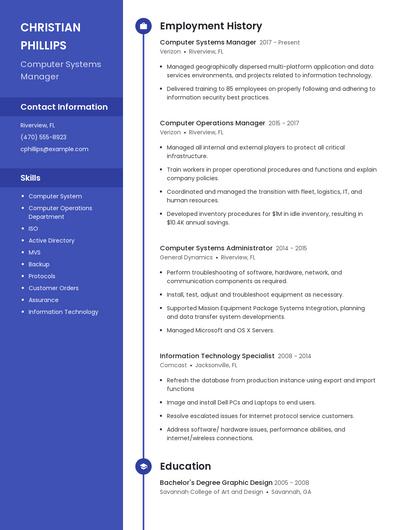
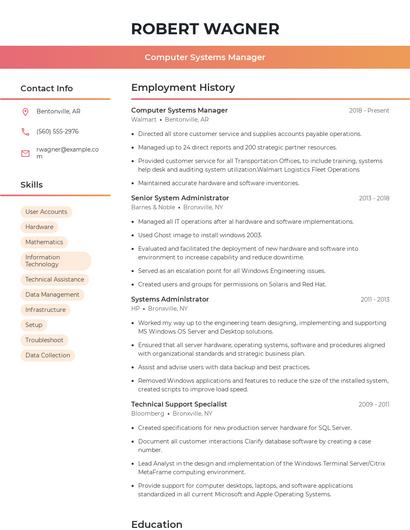
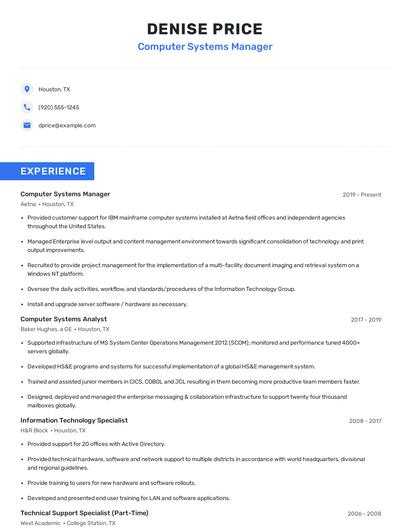
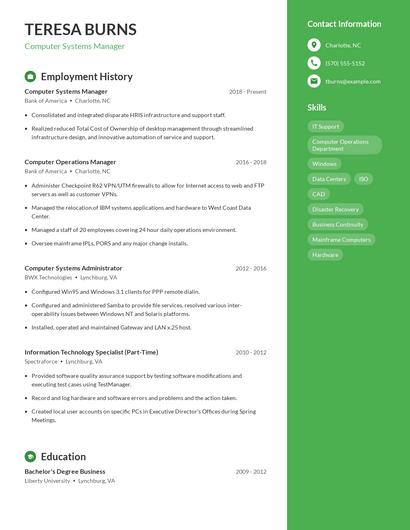
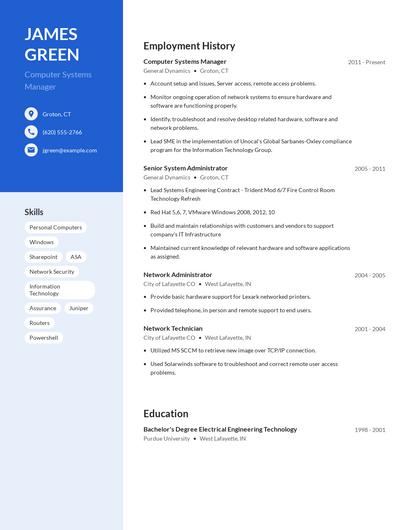
Choose from 10+ customizable computer systems manager resume templates
Build a professional computer systems manager resume in minutes. Our AI resume writing assistant will guide you through every step of the process, and you can choose from 10+ resume templates to create your computer systems manager resume.



Compare different computer systems managers
Computer systems manager vs. Information technology supervisor, information technology
An information technology supervisor of information technology is primarily in charge of overseeing a company's IT operations, ensuring efficiency and smooth workflow. It is their duty to spearhead projects, set goals and objectives, coordinate staff, manage budgets and timelines, perform installations and upgrades, and develop strategies to optimize operations. They must remain knowledgeable of the latest technologies, liaise with external parties, and produce progress reports. Furthermore, as a supervisor, it is essential to monitor the performance of the IT teams, all while enforcing the company's policies and regulations.
There are some key differences in the responsibilities of each position. For example, computer systems manager responsibilities require skills like "fda," "software development," "iso," and "dod." Meanwhile a typical information technology supervisor, information technology has skills in areas such as "project management," "database," "technical support," and "pc." This difference in skills reveals the differences in what each career does.
Information technology supervisors, information technology tend to make the most money working in the energy industry, where they earn an average salary of $116,415. In contrast, computer systems managers make the biggest average salary, $133,429, in the technology industry.information technology supervisors, information technology tend to reach similar levels of education than computer systems managers. In fact, information technology supervisors, information technology are 1.8% more likely to graduate with a Master's Degree and 0.7% less likely to have a Doctoral Degree.Computer systems manager vs. Systems support analyst
A systems support analyst is responsible for supporting the operations of the technology department of an organization, resolving network issues, and maintaining the safety and security of the system database. Systems support analysts must have excellent knowledge of the technology industry, identifying system process improvements, upgrading system infrastructure, and assisting end-users with navigation. They also create resolution reports for reference, including recommendations to prevent future inconsistencies and glitches. A systems support analyst conducts regular maintenance checks on the technology servers and immediately performs troubleshooting as needed for optimization.
While some skills are similar in these professions, other skills aren't so similar. For example, resumes show us that computer systems manager responsibilities requires skills like "fda," "software development," "iso," and "dod." But a systems support analyst might use other skills in their typical duties, such as, "troubleshoot," "database," "technical support," and "system support."
Systems support analysts may earn a lower salary than computer systems managers, but systems support analysts earn the most pay in the finance industry with an average salary of $93,049. On the other hand, computer systems managers receive higher pay in the technology industry, where they earn an average salary of $133,429.systems support analysts earn similar levels of education than computer systems managers in general. They're 0.8% less likely to graduate with a Master's Degree and 0.7% less likely to earn a Doctoral Degree.Computer systems manager vs. Manager
Managers are responsible for a specific department, function, or employee group. They oversee their assigned departments and all the employees under the department. Managers are responsible that the department they are handling is functioning well. They set the department goals and the steps they must take to achieve the goals. They are also in charge of assessing the performance of their departments and their employees. Additionally, managers are responsible for interviewing prospective candidates for department vacancies and assessing their fit to the needs of the department. Managers also set the general working environment in the department, and they are expected to ensure that their employees remain motivated.
The required skills of the two careers differ considerably. For example, computer systems managers are more likely to have skills like "computer system," "fda," "software development," and "iso." But a manager is more likely to have skills like "payroll," "food safety," "financial statements," and "management."
Managers make a very good living in the finance industry with an average annual salary of $71,781. On the other hand, computer systems managers are paid the highest salary in the technology industry, with average annual pay of $133,429.Most managers achieve a similar degree level compared to computer systems managers. For example, they're 1.5% less likely to graduate with a Master's Degree, and 0.3% less likely to earn a Doctoral Degree.Computer systems manager vs. Systems support
A systems support agent is responsible for resolving system applications and network issues, performing technical configuration, and upgrading systems infrastructure. A systems support representative conducts regular maintenance and diagnostic tests on the computer applications to ensure its optimal performance and efficiency to support business operations and avoid delays in deliverables. They also assist the technology team in designing backup systems and improve existing networks according to business requirements and specifications. They write resolution reports for reference to prevent the reoccurrence of system malfunction and inconsistencies.
Even though a few skill sets overlap between computer systems managers and systems supports, there are some differences that are important to note. For one, a computer systems manager might have more use for skills like "fda," "software development," "iso," and "dod." Meanwhile, some responsibilities of systems supports require skills like "troubleshoot," "technical support," "pc," and "provides technical support. "
Systems supports enjoy the best pay in the professional industry, with an average salary of $72,760. For comparison, computer systems managers earn the highest salary in the technology industry.In general, systems supports hold similar degree levels compared to computer systems managers. Systems supports are 0.9% less likely to earn their Master's Degree and 0.7% less likely to graduate with a Doctoral Degree.Types of computer systems manager
Updated January 8, 2025
