What does a configuration technician do?
Configuration technicians are in charge of the installation, testing, and troubleshooting of operating systems and software. The technicians assess computer networks and make an analysis of security measures for the correct functioning. They take responsibility for the daily maintenance of the systems to prevent interruptions. Their tasks may include research of new systems as well as recommendations on network solutions to meet client needs. Skills in computer hardware, troubleshooting, computer system, and customer service are necessary for this job.
Configuration technician responsibilities
Here are examples of responsibilities from real configuration technician resumes:
- Coordinate and manage a large-scale VOIP phone system conversion project for high-profile corporate customer.
- Create OS and software images for a wide variety of laptop hardware.
- Work with various servers, PCs, notebooks, mobile devices and peripherals.
- Install OS, updates, applications, images and other software to customer standards and requests as required.
- Configure and install components into customers PCs.
- Configure troubleshoot and support network device and printers.
- Test newly configure computers for appropriate functionality and troubleshoot for any errors find.
- Complete inventory of IBM laptops and input information in appropriate database upon repair.
- Configure POS machines and peripherals according to specifications and report issues with equipment where appropriate.
- Enter specific information into appropriate POS equipment, per order speculations, and specific terminal entry methodology.
- Complete inventory of IBM laptops and accurately and efficiently input necessary data into designated database before repair.
- Champion the selection and ultimate use of Java and object-orient design and programming on a web-base financial inventory management system.
- Provision of token ring and Ethernet connectivity for networking equipment and installation of that equipment.
Configuration technician skills and personality traits
We calculated that 10% of Configuration Technicians are proficient in Troubleshoot, Computer System, and Customer Service. They’re also known for soft skills such as Customer-service skills, Listening skills, and Problem-solving skills.
We break down the percentage of Configuration Technicians that have these skills listed on their resume here:
- Troubleshoot, 10%
Tested newly configured computers for appropriate functionality and troubleshoot for any errors found.
- Computer System, 10%
Performed custom configuration of computer systems from servers to laptops, printers and associated peripherals to customers requirements per ISO specifications.
- Customer Service, 8%
Provided support and training for dealer partners and customer service representatives for newly implemented wireless products, policies/procedures and technologies.
- Technical Support, 5%
Provided technical support to customers on the operational or maintenance aspects of installed equipment.
- Desktop Support, 5%
Performed desktop support for GE, including change out and setup of new hardware and software.
- Customer Orders, 4%
Communicate issues concerning customer orders to the area Help Desk or Team Leader.
"troubleshoot," "computer system," and "customer service" are among the most common skills that configuration technicians use at work. You can find even more configuration technician responsibilities below, including:
Customer-service skills. One of the key soft skills for a configuration technician to have is customer-service skills. You can see how this relates to what configuration technicians do because "computer support specialists must be patient and sympathetic." Additionally, a configuration technician resume shows how configuration technicians use customer-service skills: "configured and installed components into customers pcs. "
Listening skills. Many configuration technician duties rely on listening skills. "support workers must be able to understand the problems that their customers are describing and know when to ask questions to clarify the situation.," so a configuration technician will need this skill often in their role. This resume example is just one of many ways configuration technician responsibilities rely on listening skills: "communicated with customer service representatives regarding alternate methods of order fulfillment when our stock was insufficient. "
Problem-solving skills. Another skill that relates to the job responsibilities of configuration technicians is problem-solving skills. This skill is critical to many everyday configuration technician duties, as "support workers must identify both simple and complex computer problems, analyze them, and solve them." This example from a resume shows how this skill is used: "identified and resolved network connectivity issues assembled branded system units including dell, ibm, compaq and hp per manufacturer specifications. "
Speaking skills. For certain configuration technician responsibilities to be completed, the job requires competence in "speaking skills." The day-to-day duties of a configuration technician rely on this skill, as "support workers must describe the solutions to computer problems in a way that a nontechnical person can understand." For example, this snippet was taken directly from a resume about how this skill applies to what configuration technicians do: "identified and addressed existing and potential hardware/software issues and created proactive upgrades and enhancements for optimal results. "
Writing skills. Another crucial skill for a configuration technician to carry out their responsibilities is "writing skills." A big part of what configuration technicians relies on this skill, since "strong writing skills are useful for preparing instructions and email responses for employees and customers, as well as for real-time web chat interactions." How this skill relates to configuration technician duties can be seen in an example from a configuration technician resume snippet: "assisted in writing training materials and problem resolution fixes. "
The three companies that hire the most configuration technicians are:
- ProMedica Toledo Hospital11 configuration technicians jobs
- ILC Dover6 configuration technicians jobs
- Ryder System4 configuration technicians jobs
Choose from 10+ customizable configuration technician resume templates
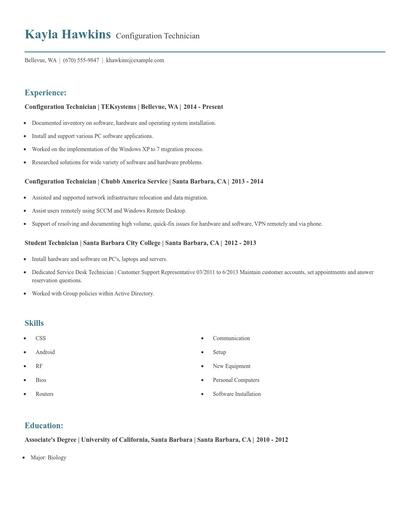
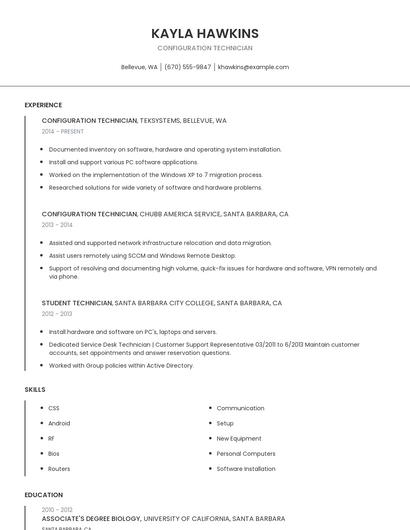
Build a professional configuration technician resume in minutes. Our AI resume writing assistant will guide you through every step of the process, and you can choose from 10+ resume templates to create your configuration technician resume.





Compare different configuration technicians
Configuration technician vs. Technician support tier
A technician support tier focuses on providing technical support to clients or employees within a company. Typically working in a team setting, a technician support tier addresses technical problems and troubleshoots to identify the root of the issues and perform necessary corrective measures or repairs. Their responsibilities also revolve around responding to inquiries, answering calls and correspondence, conducting regular maintenance of systems and networks, maintaining records of all transactions, and supporting software and networks. Furthermore, it is essential to coordinate with all team members while adhering to the company's policies and regulations.
These skill sets are where the common ground ends though. The responsibilities of a configuration technician are more likely to require skills like "troubleshoot," "customer orders," "configuration management," and "computer equipment." On the other hand, a job as a technician support tier requires skills like "lan wan," "phone calls," "cisco ios," and "tier ii." As you can see, what employees do in each career varies considerably.
Technician support tiers tend to make the most money working in the technology industry, where they earn an average salary of $62,098. In contrast, configuration technicians make the biggest average salary, $36,974, in the technology industry.technician support tiers tend to reach similar levels of education than configuration technicians. In fact, technician support tiers are 0.9% less likely to graduate with a Master's Degree and 0.1% more likely to have a Doctoral Degree.Configuration technician vs. Technical support technician
Technical support technicians are skilled professionals who resolve computer or information technology-related concerns. They may do installations, repairs, or maintenance activities of various applications or computer hardware. They are sometimes assigned specific issues or concerns to resolve so that they will not be bombarded with various issues. This means that they can now specialize in a specific family of concerns. Technical support technicians may provide on-site support, going directly to the person who needs help and doing what needs to be done or troubleshoot the problem in person. They may also be offsite and would usually be manning helpdesk hotlines. Offsite technical support technicians walk the caller through the steps they should do to fix the issues. As such, when a technical support technician is offsite, they are expected to be good communicators and will be able to provide clear instructions.
While some skills are similar in these professions, other skills aren't so similar. For example, resumes show us that configuration technician responsibilities requires skills like "troubleshoot," "customer orders," "configuration management," and "computer equipment." But a technical support technician might use other skills in their typical duties, such as, "patients," "customer support," "inbound calls," and "android."
Technical support technicians earn a higher average salary than configuration technicians. But technical support technicians earn the highest pay in the finance industry, with an average salary of $52,365. Additionally, configuration technicians earn the highest salaries in the technology with average pay of $36,974 annually.technical support technicians earn similar levels of education than configuration technicians in general. They're 0.2% more likely to graduate with a Master's Degree and 0.1% more likely to earn a Doctoral Degree.What technology do you think will become more important and prevalent for configuration technicians in the next 3-5 years?
Ming Chow
Associate Teaching Professor, Tufts University
References:
1. cybersecurity
2. cybersecurity
Configuration technician vs. Senior support technician
A senior support technician is an individual specializing in diagnosing and resolving information technology (IT)-related problems in an organization, including virus issues, forgotten passwords, and software updates. The job requires knowledge about the installation, configuration, and testing of computer hardware and software. Possessing excellent customer service, listening, and problem-solving skills is also vital to qualify for the position. The job's education requirements include an associate or bachelor's degree in computer science, business, information technology, or a related field.
Some important key differences between the two careers include a few of the skills necessary to fulfill the responsibilities of each. Some examples from configuration technician resumes include skills like "desktop support," "customer orders," "configuration management," and "computer equipment," whereas a senior support technician is more likely to list skills in "desk support," "phone calls," "sharepoint," and "citrix. "
Senior support technicians earn the best pay in the technology industry, where they command an average salary of $75,924. Configuration technicians earn the highest pay from the technology industry, with an average salary of $36,974.senior support technicians typically earn similar educational levels compared to configuration technicians. Specifically, they're 1.4% more likely to graduate with a Master's Degree, and 0.1% more likely to earn a Doctoral Degree.Configuration technician vs. Information technology/support technician
An information technology (IT) support technician is an individual who is responsible for providing support and troubleshoots software and hardware problems faced by customers. As for larger organizations that have their own IT department, technicians must work together internally with their IT staff members. IT support technicians are involved in inspecting and resolving minor local area network and wireless network issues, which include TCP/IP, DHCP, and VPN. They are also required to obtain an associate's degree in computer science or related field.
Types of configuration technician
Updated January 8, 2025
