What does a director of clinical education do?
The clinical education directors are responsible for creating the clinical schedules, determining instructors for students, and organizing rotations together with initiating partnership agreements. They evaluate students' cases and gather clinical response records, serving as internship coordinators. Also, they instruct many care clinical programs online or in-person as well as coordinate with many facilities. Additionally, they give input in making strategic decisions, assist in budget development, and help solve escalated complaints. Qualities that the position requires include several clinical experiences, a strong inclination to teach, and exceptional organizational skills.
Director of clinical education responsibilities
Here are examples of responsibilities from real director of clinical education resumes:
- Manage care for all residents, ICF and SNF.
- Obtain CPR instructor certification, to ensure staff can be train in house efficiently and effectively.
- Develop clinical partner sites for rehabilitation internship and maintain clinical site database, training and contracts for all site.
- Revise the diabetes education program to incorporate evidence-base practice.
- Develop a telephonic triage system to provide clinical support to oncology patients nationally.
- Provide oversight for development and implementation of comprehensive company- wide clinical quality management program.
- Provide patients with behavior modification counseling, nutritional education and exercise regimens that promotes weight loss and create lifestyle changes.
- Evaluate, recruit, and maintain a quality stable staff to meet the level of acuity of the LTC.
- Coordinate interdisciplinary efforts with AHEC personnel.
Director of clinical education skills and personality traits
We calculated that 10% of Directors Of Clinical Education are proficient in Patients, Patient Care, and Clinical Practice. They’re also known for soft skills such as Analytical skills, Detail oriented, and Interpersonal skills.
We break down the percentage of Directors Of Clinical Education that have these skills listed on their resume here:
- Patients, 10%
Provided care management for MediCal patients in the community focusing on preventing hospitalizations and multiple emergency room visits.
- Patient Care, 8%
Provided orientation and continuing education providing inpatient and outpatient care for veterans.
- Clinical Practice, 7%
Stayed abreast of CMS and organ donation regulatory standards and made recommendations for improvements of clinical practice.
- Oversight, 6%
Provided oversight for development and implementation of comprehensive company- wide clinical quality management program.
- Professional Development, 6%
Planned and facilitate all staff education and training programs for professional development.
- Infection Control, 4%
Serve as infection control coordinator and adhere to infection control policy and provide immunizations.
Most directors of clinical education use their skills in "patients," "patient care," and "clinical practice" to do their jobs. You can find more detail on essential director of clinical education responsibilities here:
Analytical skills. The most essential soft skill for a director of clinical education to carry out their responsibilities is analytical skills. This skill is important for the role because "medical and health services managers review and evaluate healthcare metrics for ways to improve efficiency and meet goals." Additionally, a director of clinical education resume shows how their duties depend on analytical skills: "analyzed data results to determine and implement quality improvement initiatives other duties. "
Detail oriented. Many director of clinical education duties rely on detail oriented. "medical and health services managers must pay attention to detail," so a director of clinical education will need this skill often in their role. This resume example is just one of many ways director of clinical education responsibilities rely on detail oriented: "detailed planning and informative training to staff and health community members regarding disease management. "
Technical skills. director of clinical education responsibilities often require "technical skills." The duties that rely on this skill are shown by the fact that "medical and health services managers must stay up to date with advances in healthcare technology, such as the coding and electronic health record (ehr) systems their facility adopts." This resume example shows what directors of clinical education do with technical skills on a typical day: "provide consultation and technical assistance to health professionals on a variety of health care issues. "
Communication skills. Another common skill required for director of clinical education responsibilities is "communication skills." This skill comes up in the duties of directors of clinical education all the time, as "medical and health services managers must convey information to their staff, other healthcare workers, and, sometimes, patients and insurance agents." An excerpt from a real director of clinical education resume shows how this skill is central to what a director of clinical education does: "assist program director in arranging and providing regular communication links between theory and clinical faculty. "
Leadership skills. Lastly, "leadership skills" is an important element of what a director of clinical education does. Director of clinical education responsibilities require this skill because "medical and health services managers hire, train, and direct staff." This resume example highlights how director of clinical education duties rely on this skill: "develop leadership skills and performance improvement toward quality patient care. "
The three companies that hire the most director of clinical educations are:
- Boehringer Ingelheim11 directors of clinical education jobs
- Touchstone Communities9 directors of clinical education jobs
- Diversicare3 directors of clinical education jobs
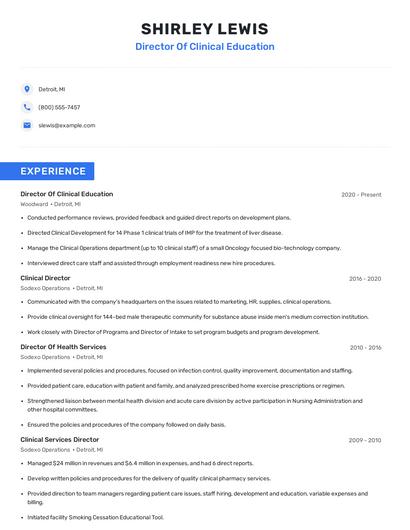
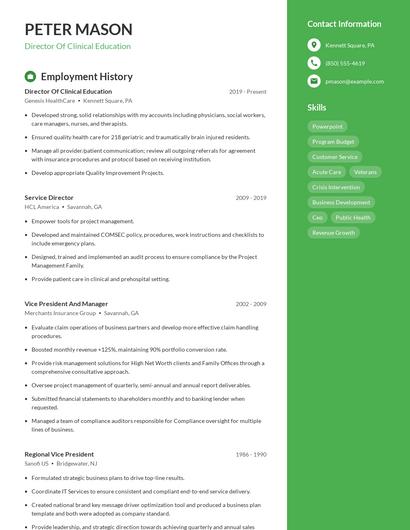
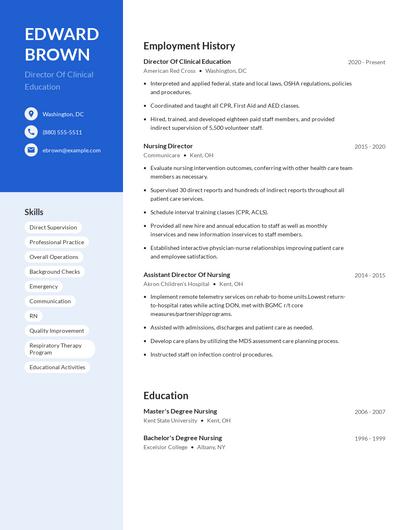
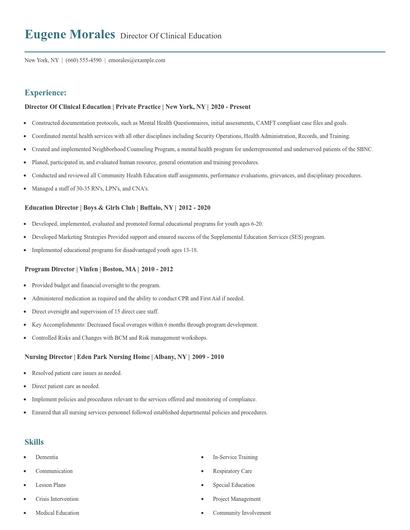
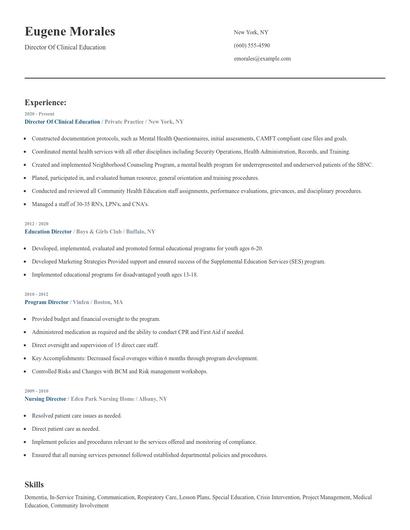
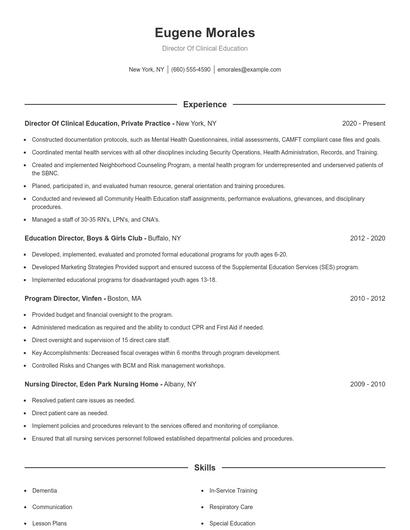
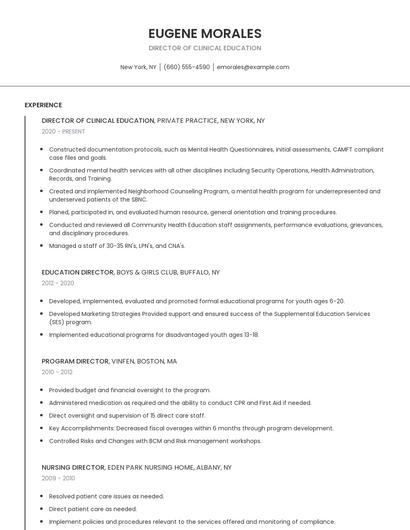
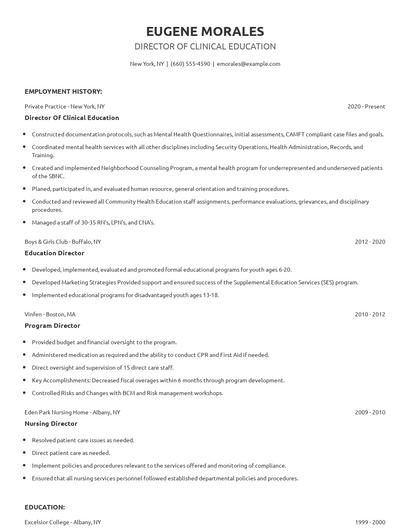
Choose from 10+ customizable director of clinical education resume templates
Build a professional director of clinical education resume in minutes. Our AI resume writing assistant will guide you through every step of the process, and you can choose from 10+ resume templates to create your director of clinical education resume.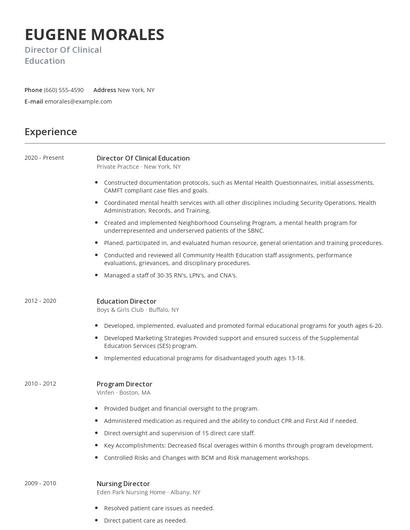
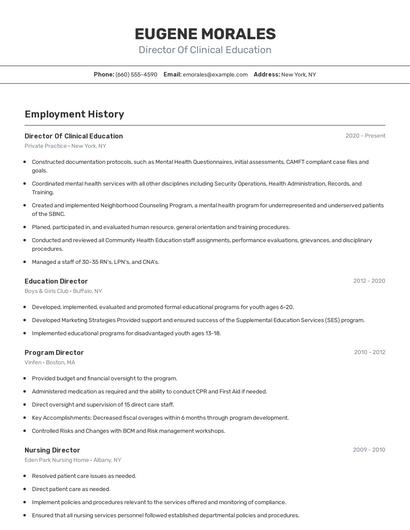
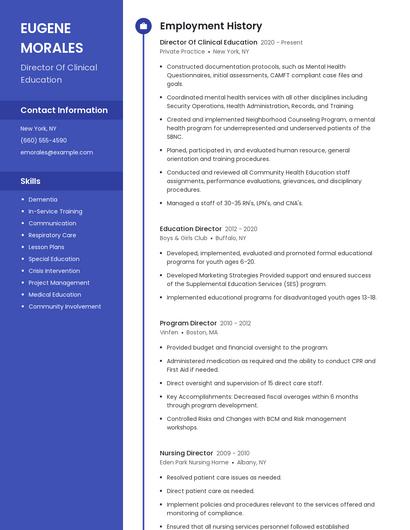
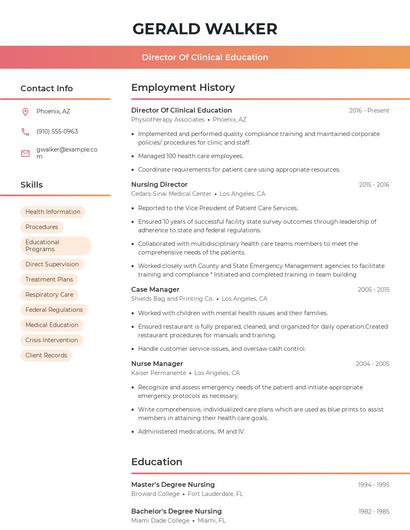
Compare different directors of clinical education
Director of clinical education vs. Pharmacist manager
A pharmacist manager is responsible for monitoring the daily operations of a pharmacy, ensuring that all pharmacy personnel provides the right medication to the customers based on the prescription. Pharmacist managers assist in advising the customers for the instructions of their medications, including its dosage and instructions of intake. They manage the inventory and keep safe and clean storage for the products at all times. A pharmacist manager must have a comprehensive knowledge of the medical industry, as well as excellent communication skills, especially in responding to the customers' concerns and inquiries.
While similarities exist, there are also some differences between directors of clinical education and pharmacist manager. For instance, director of clinical education responsibilities require skills such as "clinical practice," "oversight," "professional development," and "infection control." Whereas a pharmacist manager is skilled in "customer service," "compassion," "inventory management," and "federal laws." This is part of what separates the two careers.
Pharmacist managers tend to make the most money working in the health care industry, where they earn an average salary of $100,580. In contrast, directors of clinical education make the biggest average salary, $79,606, in the health care industry.pharmacist managers tend to reach lower levels of education than directors of clinical education. In fact, pharmacist managers are 14.5% less likely to graduate with a Master's Degree and 24.8% more likely to have a Doctoral Degree.Director of clinical education vs. Nurse manager
The primary role of nurse managers is to supervise the nursing staff in a clinical or hospital setting. They are the ones who are in charge of patient care, setting work schedules, and making budgetary and management decisions. They are also responsible for making personnel decisions, coordinating meetings, and creating safe environments that promote patient engagement and aid the healthcare team's work. Their role is vital in promoting a culture in which team members contribute to professional growth and patient outcomes.
Each career also uses different skills, according to real director of clinical education resumes. While director of clinical education responsibilities can utilize skills like "patient care," "clinical practice," "curriculum development," and "bls," nurse managers use skills like "customer service," "performance improvement," "surgery," and "quality patient care."
On average, nurse managers earn a lower salary than directors of clinical education. Some industries support higher salaries in each profession. Interestingly enough, nurse managers earn the most pay in the health care industry with an average salary of $90,775. Whereas directors of clinical education have higher pay in the health care industry, with an average salary of $79,606.nurse managers earn lower levels of education than directors of clinical education in general. They're 6.2% less likely to graduate with a Master's Degree and 24.8% less likely to earn a Doctoral Degree.Director of clinical education vs. Patient care manager
Patient care managers are executives who are in charge of supervising a clinical team. The managers take responsibility for directing patient care within an organization. Also called health care managers, they protect every patient's safety and health in a clinical setting. They interact with the healthcare team members to maintain open communication. It is also part of their duties to supervise the daily operations in the clinical care units. Managing clinical budgets and maintaining quality health services are also their responsibilities.
The required skills of the two careers differ considerably. For example, directors of clinical education are more likely to have skills like "patient care," "clinical practice," "oversight," and "professional development." But a patient care manager is more likely to have skills like "quality care," "social work," "community resources," and "substance abuse."
Patient care managers make a very good living in the health care industry with an average annual salary of $54,278. On the other hand, directors of clinical education are paid the highest salary in the health care industry, with average annual pay of $79,606.When it comes to education, patient care managers tend to earn similar degree levels compared to directors of clinical education. In fact, they're 4.6% less likely to earn a Master's Degree, and 5.4% less likely to graduate with a Doctoral Degree.Director of clinical education vs. Practice manager
A practice manager is responsible for supervising daily operations, especially on the side of the medical industry. Practice managers monitor staffing needs, train new employees, and evaluate the employees' productivity and performance. They also enforce strict guidelines and procedures, ensuring that the processes adhere to the legal standards and regulatory requirements. Practice managers also maintain budget goals, creating cost estimates and expense reports. A practice manager must have strong communication, analytical, and critical-thinking skills, as well as comprehensive knowledge of the medical industry practices.
Types of director of clinical education
Updated January 8, 2025
