What does a director of information technology security do?
A director of information technology security is responsible for managing and maintaining the safety and security of the information systems of an organization and ensuring that the servers provide the highest support to maximize the staff's productivity and efficiency. Directors of information technology security handle the budget and resource allocation for technical solutions development and improving networks' infrastructure. They also evaluate technology recommendations that would generate more opportunities for revenues, profit growth, and business partnerships.
Director of information technology security responsibilities
Here are examples of responsibilities from real director of information technology security resumes:
- Manage systems and implement security patches maintenance of all company computer systems, windows and Linux.
- Assemble and evaluate proper documentation requirements and manage SDLC to support pre-production.
- Manage cloud transition and operations of several key technologies responsible for portal and administrative computing.
- Manage the conversion to a hybrid NAS/disk/tape CommVault base backup environment resulting in decreasing backup windows and improving recovery objectives.
- Include ITIL service management, financial system, formal service desk and trouble-ticket systems, networks, and servers.
- Provide SOX audit testing of general security controls to ensure regulatory compliance for critical applications.
- Review the SOX control wording and design? appropriate test plans.
- Apply knowledge of HIPAA regulations, security and information technology to ensure current vendor contracts are current and correctly interpret.
- Maintain information security compliance with HIPAA regulations.
- Champion ITIL implementation to improve process maturity and efficiency.
- Establish technical architecture plan consistent with application and business goals and objectives.
- Develop security architecture and policy in adherence to regulations and best practice.
- Strengthen security posture by applying security defense mechanisms to both cloud infrastructure and mobile platforms.
- Develop and implement leading-edge security policies, security awareness and training activities, governance, and risk strategies.
- Develop and implement policy, and associate governance, risk and control framework to enable effectively management of risk.
Director of information technology security skills and personality traits
We calculated that 8% of Directors Of Information Technology Security are proficient in NIST, Risk Management, and Risk Assessments. They’re also known for soft skills such as Detail oriented, Ingenuity, and Problem-solving skills.
We break down the percentage of Directors Of Information Technology Security that have these skills listed on their resume here:
- NIST, 8%
Developed and implemented security controls based on ISO 27000, SOC I Type II, and NIST guidelines.
- Risk Management, 7%
Lead the evolution of Supplier Risk Management by introducing supplier inherent risk aligned to contract material terms and focused assessment criteria.
- Risk Assessments, 5%
Perform risk assessments and assess security capabilities of new businesses and acquisitions.
- Architecture, 5%
Provided leadership for Planning and coordinating technical security architecture, design and development teams.
- Cloud, 5%
Led an Enterprise Information Security Program protecting Internal Network Security and Customer Corporate Cloud based Applications with no successful compromises.
- Project Management, 5%
Provided electronic project management and quality improvement tools yielding productivity improvements for IT, maintenance, lab, and nursing departments.
Most directors of information technology security use their skills in "nist," "risk management," and "risk assessments" to do their jobs. You can find more detail on essential director of information technology security responsibilities here:
Detail oriented. One of the key soft skills for a director of information technology security to have is detail oriented. You can see how this relates to what directors of information technology security do because "because cyberattacks can be difficult to detect, information security analysts must pay careful attention to computer systems and watch for minor changes in performance." Additionally, a director of information technology security resume shows how directors of information technology security use detail oriented: "protected vulnerable networks following detailed risk assessments. "
Ingenuity. Another soft skill that's essential for fulfilling director of information technology security duties is ingenuity. The role rewards competence in this skill because "information security analysts must anticipate information security risks and implement new ways to protect their organizations’ computer systems and networks." According to a director of information technology security resume, here's how directors of information technology security can utilize ingenuity in their job responsibilities: "provide expertise and ingenuity to the risk and information security management tasks. "
Problem-solving skills. This is an important skill for directors of information technology security to perform their duties. For an example of how director of information technology security responsibilities depend on this skill, consider that "information security analysts must respond to security alerts and uncover and fix flaws in computer systems and networks." This excerpt from a resume also shows how vital it is to everyday roles and responsibilities of a director of information technology security: "automated governance framework in archer grc solution. ".
Analytical skills. director of information technology security responsibilities often require "analytical skills." The duties that rely on this skill are shown by the fact that "information security analysts must carefully study computer systems and networks and assess risks to determine how security policies and protocols can be improved." This resume example shows what directors of information technology security do with analytical skills on a typical day: "designed new security solution for database encryption and network segregation. "
The three companies that hire the most director of information technology securitys are:
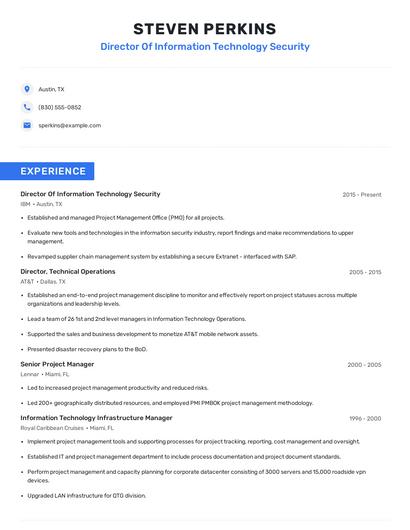
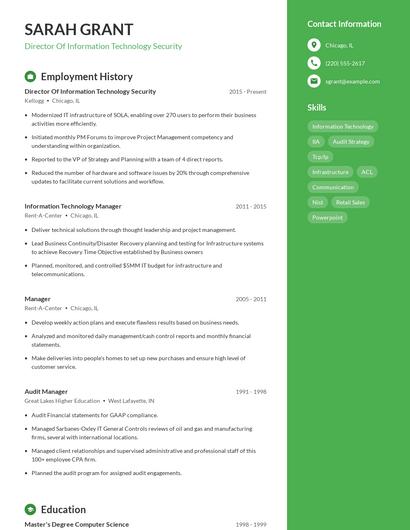
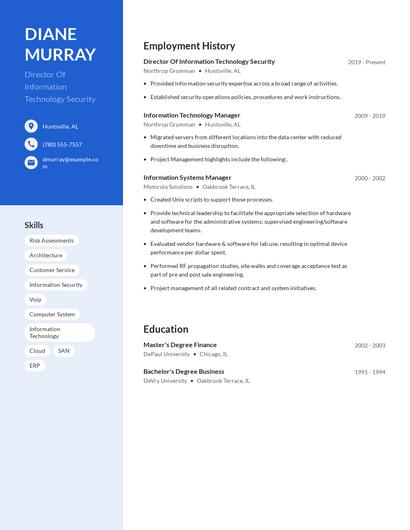
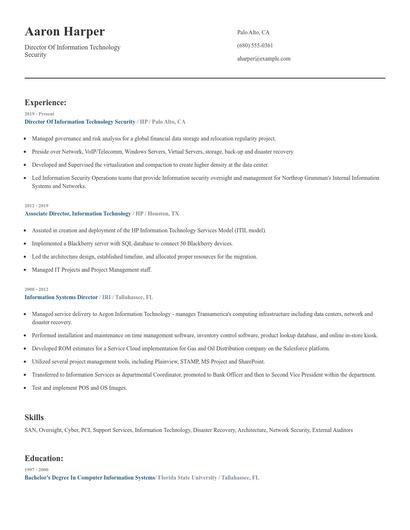
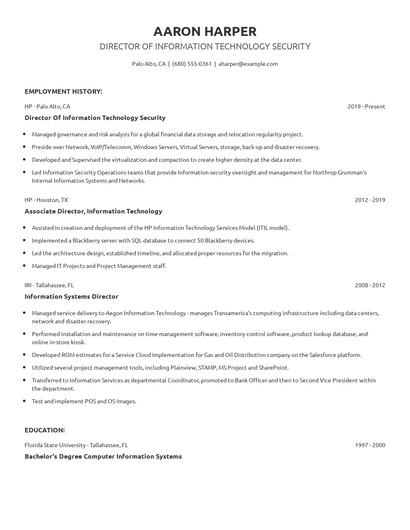
Choose from 10+ customizable director of information technology security resume templates
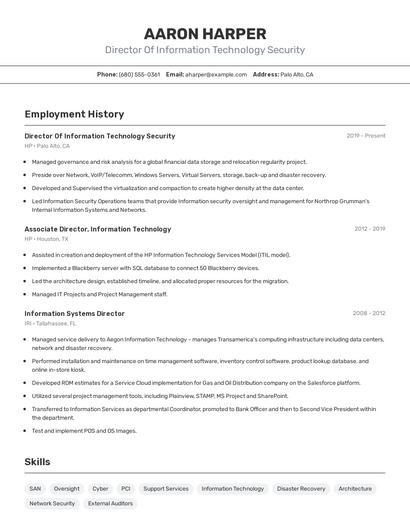
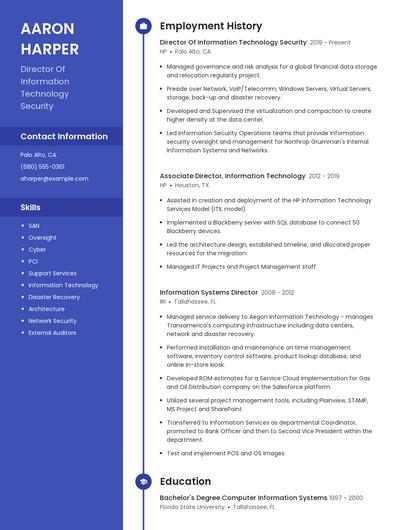
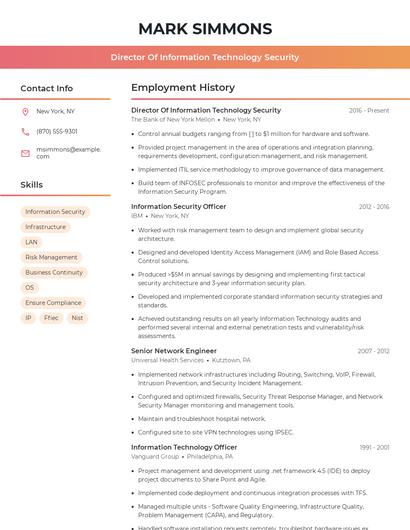
Build a professional director of information technology security resume in minutes. Our AI resume writing assistant will guide you through every step of the process, and you can choose from 10+ resume templates to create your director of information technology security resume.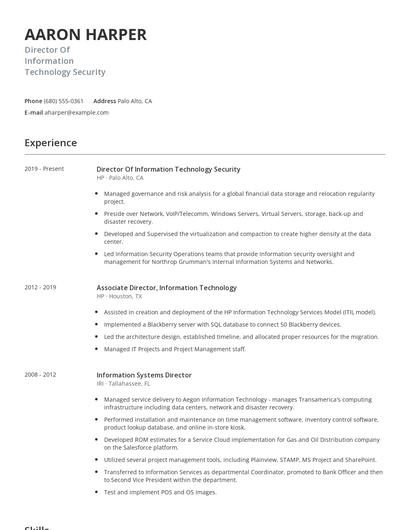



Compare different directors of information technology security
Director of information technology security vs. Director, technical operations
A director of technical operations is in charge of spearheading the efforts in optimizing business operations. Their responsibilities revolve around performing research and analysis to determine the best operational practices, setting goals and objectives, allocating budgets, coordinating different departments, and evaluating the performance of technicians and engineers. Furthermore, as a director, it is essential to serve as a driving force that leads and encourages the workforce to meet goals and new heights, all while implementing the company's policies and regulations.
These skill sets are where the common ground ends though. The responsibilities of a director of information technology security are more likely to require skills like "nist," "risk management," "risk assessments," and "access management." On the other hand, a job as a director, technical operations requires skills like "service delivery," "vendor management," "r," and "level agreements." As you can see, what employees do in each career varies considerably.
Directors, technical operations really shine in the technology industry with an average salary of $143,691. Comparatively, directors of information technology security tend to make the most money in the retail industry with an average salary of $132,872.On average, directors, technical operations reach similar levels of education than directors of information technology security. Directors, technical operations are 2.4% less likely to earn a Master's Degree and 1.1% less likely to graduate with a Doctoral Degree.Director of information technology security vs. Vice president, technology
A vice president of technology is in charge of overseeing all technological operations in a company while managing the workforce involved, ensuring efficiency and smooth workflow. Typically, it is their responsibility to establish goals and objectives, devising strategies to enforce them. They also spearhead the development of new systems and tools that boost workforce productivity, coordinate with analysts and specialists, and resolve any issues and concerns. Furthermore, as a vice president, it is essential to implement the company's policies and regulations, creating new ones as needed.
In addition to the difference in salary, there are some other key differences worth noting. For example, director of information technology security responsibilities are more likely to require skills like "nist," "risk assessments," "access management," and "incident response." Meanwhile, a vice president, technology has duties that require skills in areas such as "analytics," "java," "portfolio," and "software development." These differences highlight just how different the day-to-day in each role looks.
Vice presidents, technology may earn a higher salary than directors of information technology security, but vice presidents, technology earn the most pay in the technology industry with an average salary of $156,843. On the other hand, directors of information technology security receive higher pay in the retail industry, where they earn an average salary of $132,872.vice presidents, technology earn similar levels of education than directors of information technology security in general. They're 0.1% more likely to graduate with a Master's Degree and 1.1% more likely to earn a Doctoral Degree.Director of information technology security vs. Information systems director
An Information Systems Director spearheads and oversees a business establishment's information systems, ensuring everything runs smoothly and efficiently. They set goals and guidelines, establish protocols and timelines, liaise with external business partners such as vendors and suppliers, manage staff, and develop strategies to optimize operations. As an Information Systems Director, it is essential to lead and encourage staff to reach performance and service goals, all while implementing the company's policies and regulations.
Some important key differences between the two careers include a few of the skills necessary to fulfill the responsibilities of each. Some examples from director of information technology security resumes include skills like "nist," "risk management," "risk assessments," and "architecture," whereas an information systems director is more likely to list skills in "customer service," "windows server," "sql server," and "data warehouse. "
Information systems directors make a very good living in the manufacturing industry with an average annual salary of $125,492. On the other hand, directors of information technology security are paid the highest salary in the retail industry, with average annual pay of $132,872.information systems directors typically earn similar educational levels compared to directors of information technology security. Specifically, they're 2.2% less likely to graduate with a Master's Degree, and 0.8% less likely to earn a Doctoral Degree.Director of information technology security vs. Director, network operations
As a network operations director, you will be responsible for overseeing the availability and overall performance of a company's network. You will perform varied tasks that include analyzing the network and recommending changes or upgrades, ensuring compliance to best practices, promoting continuous information operations, and overseeing other technical resources. A network operations director is expected to provide expertise in networking and operating system and project management. You are responsible for managing all vendor-related support contracts for software, hardware, and connectivity.
Types of director of information technology security
Updated January 8, 2025
