What does a director of placement do?
Director of placement responsibilities
Here are examples of responsibilities from real director of placement resumes:
- Manage domestic and international travel arrangements including transportation, lodging, and logistics for individuals and groups utilizing travel management systems.
- Assist an alumni population of several thousand with career development and assistance.
- Network for students and alumni concerning career opportunities and employment trend.
- Manage domestic and international travel arrangements including transportation, lodging, and logistics for individuals and groups utilizing travel management systems.
- Participate and assist with planning group tours, orientations, PAC meetings and graduations.
Director of placement skills and personality traits
We calculated that 29% of Directors Of Placement are proficient in Client Relationships, Permanent Placement, and Student Placement. They’re also known for soft skills such as Computer skills, Problem-solving skills, and Organizational skills.
We break down the percentage of Directors Of Placement that have these skills listed on their resume here:
- Client Relationships, 29%
Developed and cultivated client relationships by designing a personalized solution for family needs.
- Permanent Placement, 10%
Coordinated all placement functions including internships, cooperative education, and part-time and permanent placement.
- Student Placement, 8%
Networked with business community and professional organizations in support of student placement.
- Career Services, 5%
Administered the department budget and provided supervisions and evaluation to Career Services Assistant.
- Career Fairs, 4%
Sponsored and initiate on-campus recruiting and coordinate career fairs.
- Career Development, 4%
Developed, managed, and implemented a comprehensive career development and placement system for information technology graduates.
"client relationships," "permanent placement," and "student placement" are among the most common skills that directors of placement use at work. You can find even more director of placement responsibilities below, including:
Computer skills. The most essential soft skill for a director of placement to carry out their responsibilities is computer skills. This skill is important for the role because "postsecondary education administrators need to be comfortable working with computers so they can use software to manage student and school records." Additionally, a director of placement resume shows how their duties depend on computer skills: "created student job placement department for court reporting and computer training programs resulting in 100% placement within one year. "
Problem-solving skills. Another soft skill that's essential for fulfilling director of placement duties is problem-solving skills. The role rewards competence in this skill because "administrators need to react calmly when a difficult situation arises and develop creative solutions." According to a director of placement resume, here's how directors of placement can utilize problem-solving skills in their job responsibilities: "operate as career services rep or employer relationship developer in priority or difficultsituations as conflict resolution. "
Organizational skills. This is an important skill for directors of placement to perform their duties. For an example of how director of placement responsibilities depend on this skill, consider that "administrators need to be organized so they can manage records, prioritize tasks, and coordinate activities with their staff." This excerpt from a resume also shows how vital it is to everyday roles and responsibilities of a director of placement: "served as staff liaison to board-appointed chairmen of organizational viability committee and strategic planning committee. ".
The three companies that hire the most director of placements are:
- Robert Half14 directors of placement jobs
- MAS Medical Staffing3 directors of placement jobs
- Aspirus2 directors of placement jobs
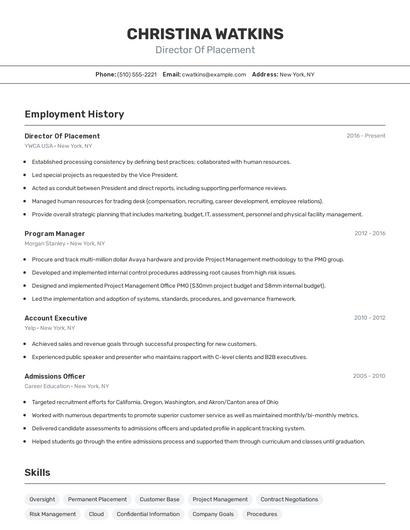
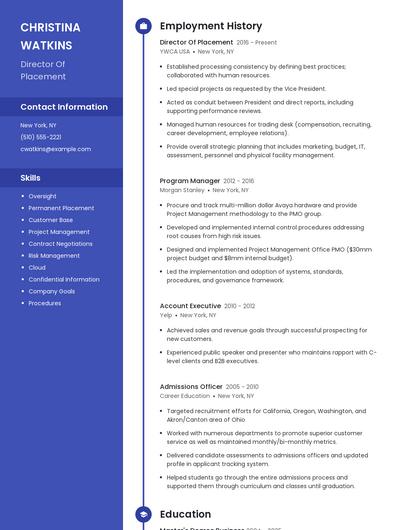
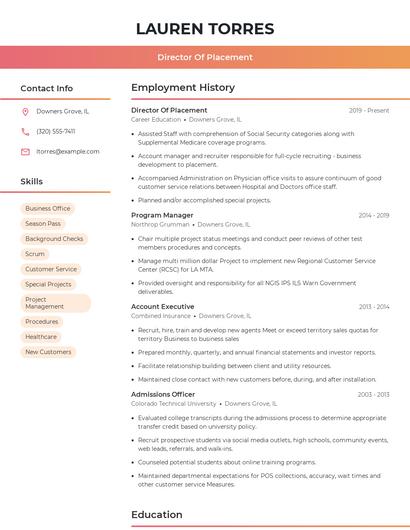
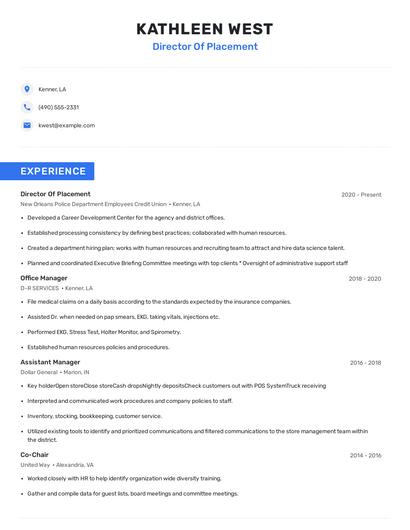
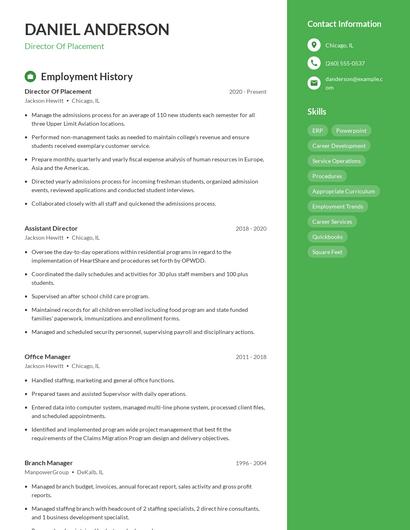
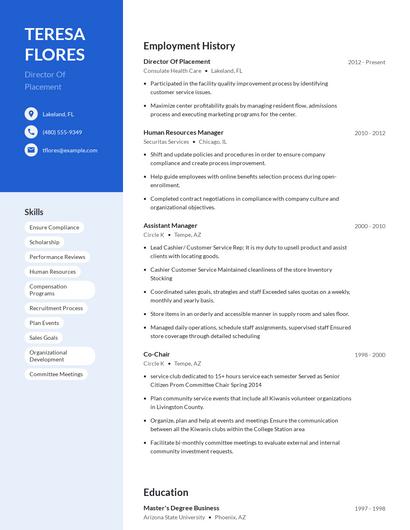
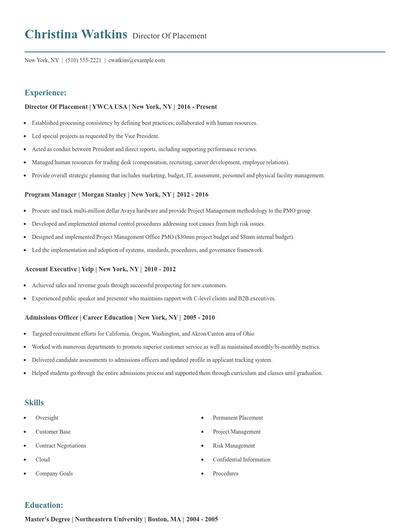
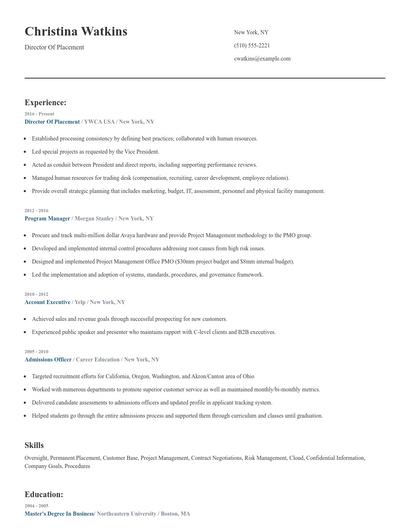
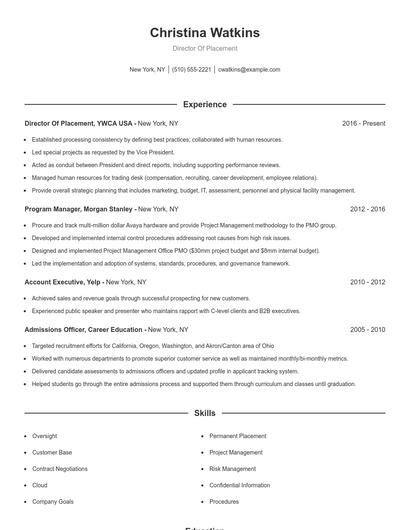
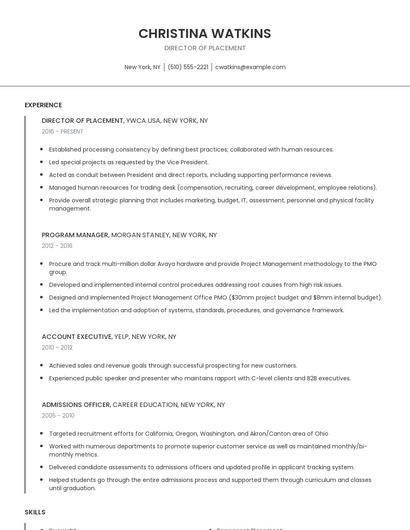
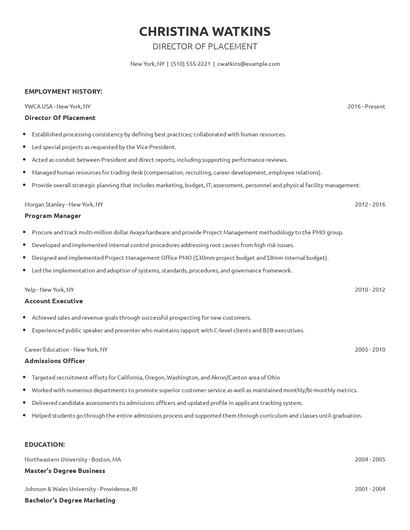
Choose from 10+ customizable director of placement resume templates
Build a professional director of placement resume in minutes. Our AI resume writing assistant will guide you through every step of the process, and you can choose from 10+ resume templates to create your director of placement resume.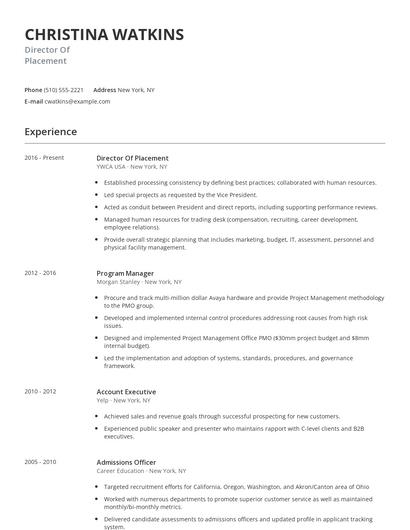
Compare different directors of placement
Director of placement vs. Co-chair
A co-chair is responsible for supporting the duties and responsibilities under the supervision of a chair. Co-chairs help with the implementation of effective plans and programs that would benefit the organization. They handle fundraising events, marketing campaigns for promotional programs, audit reports, and evaluating the committee's suggestions and recommendations for its success. A co-chair must have excellent communication and leadership skills and critical-thinking on developing strategies to supervise meetings and events alongside the chair.
While similarities exist, there are also some differences between directors of placement and co-chair. For instance, director of placement responsibilities require skills such as "client relationships," "permanent placement," "student placement," and "career services." Whereas a co-chair is skilled in "community outreach," "alumni," "plan events," and "facebook." This is part of what separates the two careers.
On average, co-chairs reach lower levels of education than directors of placement. Co-chairs are 5.4% less likely to earn a Master's Degree and 0.0% less likely to graduate with a Doctoral Degree.Director of placement vs. Registrar
A registrar's role is to process and maintain accurate records within an institution or establishment. They are the main point of communication to obtain various kinds of information. In schools, a registrar is in charge of keeping a student or educator's academic, personal, and financial records. They also have the task of arranging a student's course and class schedules. Furthermore, a registrar may also have other administrative tasks such as responding to calls and other forms of correspondence, producing reports, and process requirements.
While some skills are similar in these professions, other skills aren't so similar. For example, resumes show us that director of placement responsibilities requires skills like "client relationships," "permanent placement," "student placement," and "career services." But a registrar might use other skills in their typical duties, such as, "patients," "customer service," "medical terminology," and "patient registration."
On average, registrars earn a lower salary than directors of placement. Some industries support higher salaries in each profession. Interestingly enough, registrars earn the most pay in the health care industry with an average salary of $36,641. Whereas directors of placement have higher pay in the construction industry, with an average salary of $104,175.Average education levels between the two professions vary. Registrars tend to reach lower levels of education than directors of placement. In fact, they're 12.1% less likely to graduate with a Master's Degree and 0.0% less likely to earn a Doctoral Degree.Director of placement vs. Committee chairperson
A committee chairperson or chair is a presiding officer in an organization who is responsible for leading committee meetings and establishing agendas for the committee members to tackle. Committee chairpersons must provide strong leadership to the organization while reminding committee members about their purpose, mission, and strategic direction. In terms of confidentiality, committee chairpersons must keep business meetings confidential and they must be willing to address committee members who fail to protect confidentiality. They must also report the committee's findings to the organization's board of directors.
There are many key differences between these two careers, including some of the skills required to perform responsibilities within each role. For example, a director of placement is likely to be skilled in "client relationships," "permanent placement," "student placement," and "career services," while a typical committee chairperson is skilled in "committee chair," "financial statements," "community outreach," and "alumni."
Most committee chairpeople achieve a similar degree level compared to directors of placement. For example, they're 4.8% less likely to graduate with a Master's Degree, and 0.4% less likely to earn a Doctoral Degree.Director of placement vs. Student dean
A Student Dean is focused on responding to students' needs at a college or university. They plan and direct university activities related to student services and campus life.
Types of director of placement
Updated January 8, 2025
