What does a director/operations manager do?
A director/operations manager spearheads and oversees the operations of an organization. They primarily set goals and guidelines, establish roadmaps and timelines, participate in recruitment procedures, and implement policies and regulations, developing new ones as necessary. They monitor operations, pointing out issues and concerns should there be any. They also have the responsibility to make decisions, negotiate and finalize deals with external parties, and build strong relationships with business partners. Moreover, a director/operations manager encourages and leads employees towards the organization's short and long-term goals while promoting industry and company standards.
Director/operations manager responsibilities
Here are examples of responsibilities from real director/operations manager resumes:
- Lead high-profile ERP implementation team and ISO 9001:2000 team, ensuring seamless technology and standards integration and conducting internal ISO audits.
- Finance and billing accountability across Medicaid, manage care commercial insurance, insurance verification, contract management, and benefits administration.
- Generate reports for divisional managers, and participate in reviews to ensure standards of safety and ISO compliance have been meet.
- Coordinate equipment vendors, oversight of training, procedures, facility testing and transitional operation.
- Submit bi-weekly timekeeping to corporate and follow up once payroll are received with resolutions to payroll relate problems.
- Develop and implement learning strategies for educating staff to utilize a new windows base system for executive management approval.
- Administer personnel and operational demands, from hiring and on-air talent contract negotiations to programming/promotion budget oversight and sales/marketing strategy.
- Design company website, PowerPoint presentation, brochure, profile, machinery list & factory production capacity information for marketing purposes.
- Design and engineer station sortation layout to maximize productivity and to integrate new home delivery process in station during holiday season.
Director/operations manager skills and personality traits
We calculated that 13% of Director/Operations Managers are proficient in Customer Service, Financial Statements, and Payroll. They’re also known for soft skills such as Communication skills, Leadership skills, and Management skills.
We break down the percentage of Director/Operations Managers that have these skills listed on their resume here:
- Customer Service, 13%
Planned and implemented financial, operational and customer service synergies between the properties to maximize profitability for the investors.
- Financial Statements, 9%
Reviewed financial statements and data and utilized financial data to improve profitability.
- Payroll, 8%
Submitted bi-weekly timekeeping to corporate and followed up once payroll was received with resolutions to payroll related problems.
- Safety Program, 8%
Administered preventative maintenance programs, implemented safety program and staffed quality control studies.
- ISO, 7%
Establish Engineering Procedures for ISO certification.
- Logistics, 4%
Developed an all-inclusive logistics solution for outbound material domestically and abroad to curtail wasteful spending and enforce timing and efficiency.
Most director/operations managers use their skills in "customer service," "financial statements," and "payroll" to do their jobs. You can find more detail on essential director/operations manager responsibilities here:
Communication skills. The most essential soft skill for a director/operations manager to carry out their responsibilities is communication skills. This skill is important for the role because "top executives must be able to convey information clearly and persuasively." Additionally, a director/operations manager resume shows how their duties depend on communication skills: "improved customer/client relations by managing to customer needs and open communication. "
Leadership skills. Another essential skill to perform director/operations manager duties is leadership skills. Director/operations managers responsibilities require that "top executives must be able to shape and direct an organization by coordinating policies, people, and resources." Director/operations managers also use leadership skills in their role according to a real resume snippet: "conduct daily administrative duties with payroll, scheduling, leadership/mentoring, coaching/corrective counseling. "
Problem-solving skills. For certain director/operations manager responsibilities to be completed, the job requires competence in "problem-solving skills." The day-to-day duties of a director/operations manager rely on this skill, as "top executives need to identify and resolve issues within an organization." For example, this snippet was taken directly from a resume about how this skill applies to what director/operations managers do: "worked daily on employee and customer relations along with conflict resolution along with operational risk priorities. "
Time-management skills. Another crucial skill for a director/operations manager to carry out their responsibilities is "time-management skills." A big part of what director/operations managers relies on this skill, since "top executives do many tasks concurrently to ensure that their work gets done and that the organization meets its goals." How this skill relates to director/operations manager duties can be seen in an example from a director/operations manager resume snippet: "identify product development and sourcing opportunities for private label products, create project implementation timelines and drive projects through completion. "
The three companies that hire the most director/operations managers are:
- Goodwin Recruiting4 director/operations managers jobs
- Morgan Stanley2 director/operations managers jobs
- RCM Technologies2 director/operations managers jobs
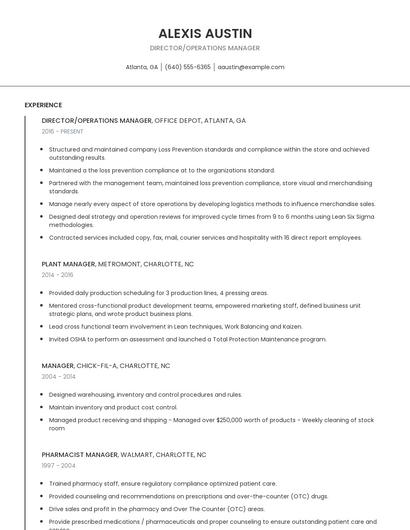
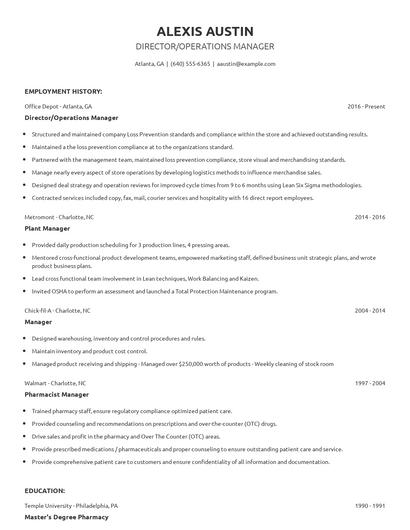
Choose from 10+ customizable director/operations manager resume templates
Build a professional director/operations manager resume in minutes. Our AI resume writing assistant will guide you through every step of the process, and you can choose from 10+ resume templates to create your director/operations manager resume.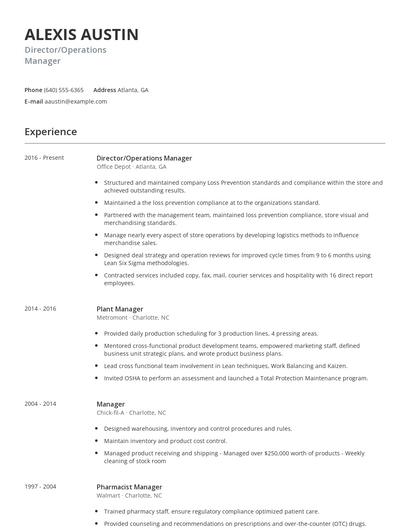
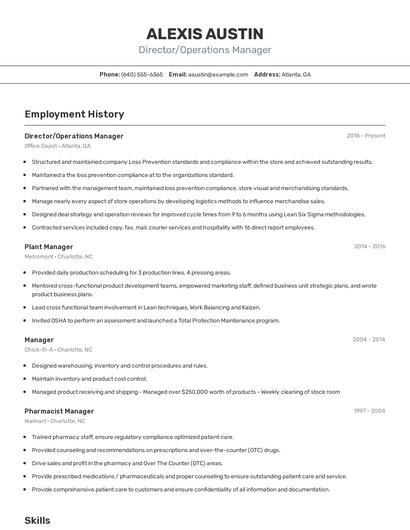


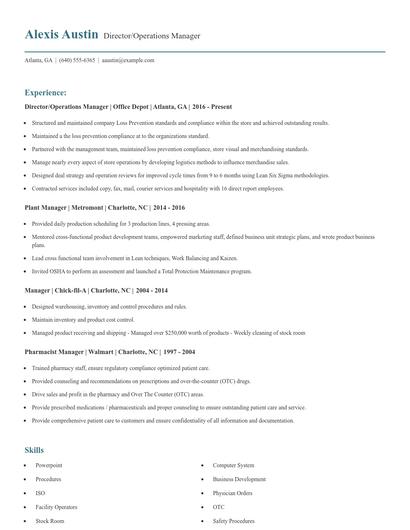
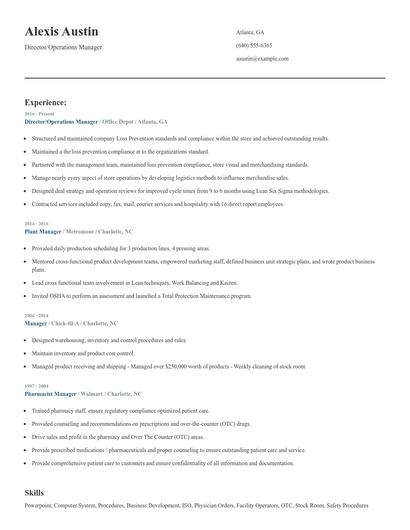

Compare different director/operations managers
Director/operations manager vs. Area director
Area directors oversee the operations of the company in a particular area. They manage the company's presence in their assigned area. Area directors come up with strategies so that their area meets company goals. They manage the company's performance in their area, from sales to marketing to finance to human resources. Area directors are expected to have in-depth knowledge of the situation and the context in the area they handle. They should be able to identify strengths and areas for improvement in their area. As such, they would be able to capitalize on their strengths and address their areas for improvement. Overall, area directors are responsible for the fulfillment of the company's vision in their area.
While similarities exist, there are also some differences between director/operations managers and area director. For instance, director/operations manager responsibilities require skills such as "financial statements," "safety program," "iso," and "logistics." Whereas a area director is skilled in "patients," "home health," "compassion," and "brand marketing." This is part of what separates the two careers.
Area directors tend to make the most money working in the health care industry, where they earn an average salary of $110,804. In contrast, director/operations managers make the biggest average salary, $102,669, in the professional industry.On average, area directors reach similar levels of education than director/operations managers. Area directors are 3.9% more likely to earn a Master's Degree and 0.5% more likely to graduate with a Doctoral Degree.Director/operations manager vs. Operations vice president
The responsibilities of an operations vice president will revolve around overseeing business operations and ensuring workforce and workflow efficiency through evaluations and providing strategic plans that would drive the company to meet its vision and mission. An operations vice president, in adherence to the company policies and regulations, also has the power to hire and train employees, even to execute disciplinary actions such as termination or suspension when necessary. Furthermore, an operations vice president also has discretion in reviewing and approving reports and requirements in various aspects such as budgeting and new policies.
In addition to the difference in salary, there are some other key differences worth noting. For example, director/operations manager responsibilities are more likely to require skills like "safety program," "a/p," "pos," and "front desk." Meanwhile, an operations vice president has duties that require skills in areas such as "project management," "risk management," "strategic plan," and "regulatory compliance." These differences highlight just how different the day-to-day in each role looks.
On average, operations vice presidents earn a higher salary than director/operations managers. Some industries support higher salaries in each profession. Interestingly enough, operations vice presidents earn the most pay in the hospitality industry with an average salary of $167,073. Whereas director/operations managers have higher pay in the professional industry, with an average salary of $102,669.operations vice presidents earn similar levels of education than director/operations managers in general. They're 3.4% more likely to graduate with a Master's Degree and 0.5% more likely to earn a Doctoral Degree.What technology do you think will become more important and prevalent for director/operations managers in the next 3-5 years?
Eric Olsen
Professor, Industrial Technology and Packaging, Orfalea College of Business
Director/operations manager vs. General manager of operations
General managers of operations are employed to oversee the overall operations of businesses. Their responsibilities include the improvement of the efficiency of the operations and overall management. They coordinate the primary performance goals for direct reporting functions and set the strategies for the organization. It is their responsibility to communicate strategy as well as results to employees. They also engage with the corporate officers in the strategic planning and development of the organization or enterprise.
The required skills of the two careers differ considerably. For example, director/operations managers are more likely to have skills like "safety program," "a/p," "hvac," and "facebook." But a general manager of operations is more likely to have skills like "develop team," "personnel processes," "loss prevention," and "performance management."
When it comes to education, general managers of operations tend to earn similar degree levels compared to director/operations managers. In fact, they're 1.0% less likely to earn a Master's Degree, and 0.4% less likely to graduate with a Doctoral Degree.Director/operations manager vs. Operations director
Operations directors oversee all company operations. They have the power to set the direction, change the course of the organization, and reform strategies to ensure efficiency in how the company operates. Operations directors manage business operations effectively by constantly analyzing company data and by anticipating any challenge that may come their way. As such, they make sound business decisions and recommendations that will help strengthen the organization. Operations directors oversee finances, quality control, and even human resources. They ensure that all aspects of the business are considered in making business operations decisions.
Types of director/operations manager
Updated January 8, 2025
