What does an employment training specialist do?
Employment training specialist responsibilities
Here are examples of responsibilities from real employment training specialist resumes:
- Manage payroll, benefits and insurance administration.
- Demonstrate employability competencies on verbal and written communication, coping and decision making skills.
- Research and recommend various organizations and resources to communicate company opportunities to minorities, veterans and individuals with disabilities.
- Maintain reports and changes of consumer cases and on a weekly basis email updates to DARS counselors.
- Provide job placement assistance for people with disabilities under the PWI grant, DVR and insurance companies.
Employment training specialist skills and personality traits
We calculated that 18% of Employment Training Specialists are proficient in Developmental Disabilities, Employment Training, and Support Services. They’re also known for soft skills such as Creativity, Instructional skills, and Analytical skills.
We break down the percentage of Employment Training Specialists that have these skills listed on their resume here:
- Developmental Disabilities, 18%
Advocated for individuals with developmental disabilities, providing support, supervision, and guidance towards personal achievement and employment.
- Employment Training, 10%
Established and fostered relationships with area businesses to sell progressive employment training programs.
- Support Services, 8%
Provide job placement and retention support services to vocational trainees and community residents seeking employment.
- Competitive Employment, 7%
Trained and motivated physically and mentally challenged clients to become self-sufficient, by aiding them in obtaining and maintaining competitive employment.
- Autism, 5%
Support Individuals with Behavioral Needs and Autism, teaching daily living skills, vocational skills, and providing informal music therapy.
- Data Entry, 5%
Facilitate orientations and data entry.
Common skills that an employment training specialist uses to do their job include "developmental disabilities," "employment training," and "support services." You can find details on the most important employment training specialist responsibilities below.
Creativity. One of the key soft skills for an employment training specialist to have is creativity. You can see how this relates to what employment training specialists do because "specialists should be resourceful when developing training materials." Additionally, an employment training specialist resume shows how employment training specialists use creativity: "developed, initiated and enhanced creative approaches to job training for individuals with developmental disabilities"
Instructional skills. Another essential skill to perform employment training specialist duties is instructional skills. Employment training specialists responsibilities require that "training and development specialists deliver employee training programs." Employment training specialists also use instructional skills in their role according to a real resume snippet: "deliver instruction on career development and assisted all students with academic inquiries and instructional assistance when needed. "
Analytical skills. employment training specialists are also known for analytical skills, which are critical to their duties. You can see how this skill relates to employment training specialist responsibilities, because "training and development specialists must evaluate training programs, methods, and materials and choose those that best fit each situation." An employment training specialist resume example shows how analytical skills is used in the workplace: "completed supporting paperwork and data entry accurately capturing client's information activities. "
Communication skills. For certain employment training specialist responsibilities to be completed, the job requires competence in "communication skills." The day-to-day duties of an employment training specialist rely on this skill, as "training and development specialists must convey information clearly and facilitate learning to diverse audiences." For example, this snippet was taken directly from a resume about how this skill applies to what employment training specialists do: "maintained on going communication with employer, treatment teams, vesid, omrdd and families while providing extended support services. "
The three companies that hire the most employment training specialists are:
- Devereux Arizona6 employment training specialists jobs
- Helen Keller International5 employment training specialists jobs
- Goodwill of Orange County2 employment training specialists jobs
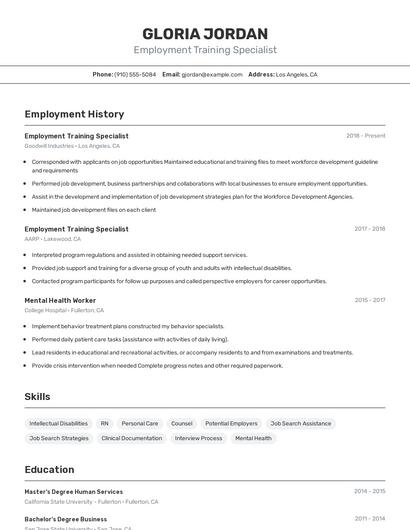
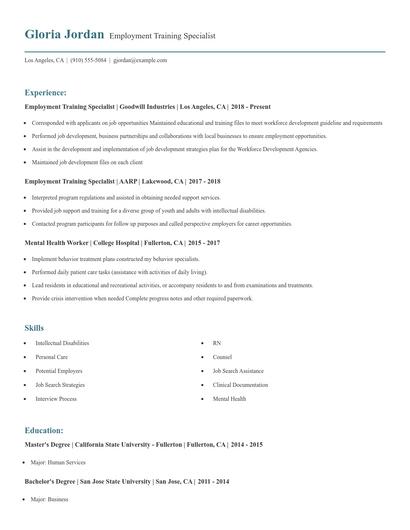
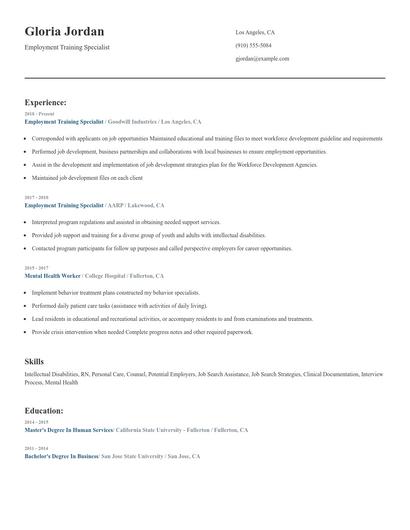
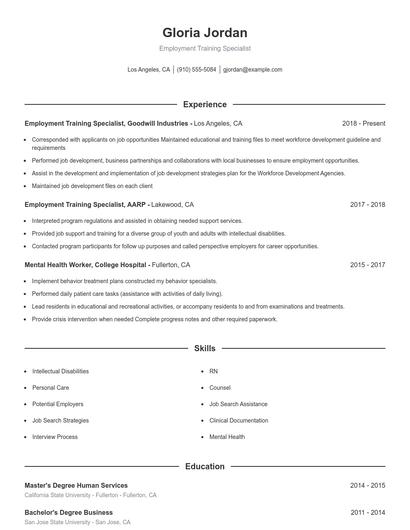
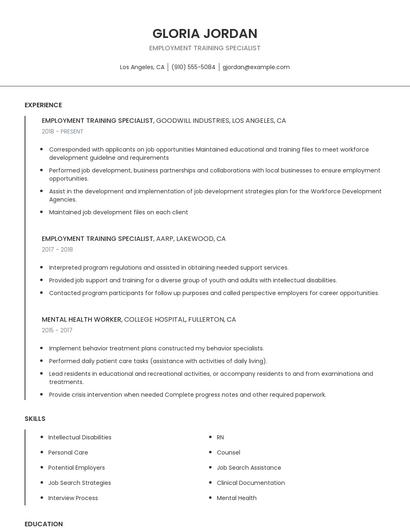
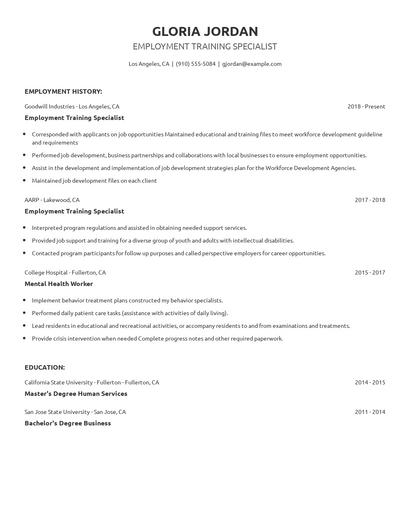
Choose from 10+ customizable employment training specialist resume templates
Build a professional employment training specialist resume in minutes. Our AI resume writing assistant will guide you through every step of the process, and you can choose from 10+ resume templates to create your employment training specialist resume.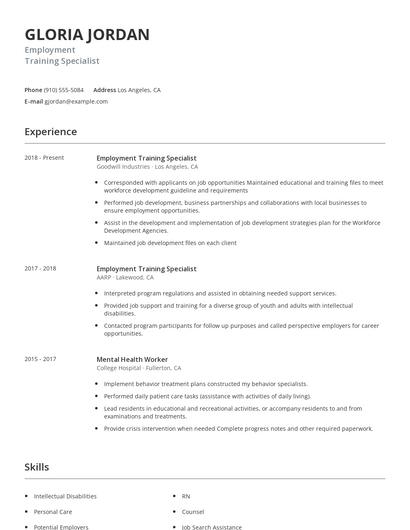


Compare different employment training specialists
Employment training specialist vs. Facilitator
A facilitator is responsible for assisting a group event or program, ensuring that the participants coordinate well. Facilitators also monitor that the objectives of the event are smoothly delivered and organized. An effective facilitator requires having strong communication and leadership skills to manage the participants' concerns and inquiries, including active participation in group discussions and designing engaging activities and processes. Facilitators also assist with planning and finalizing the timetable and setting the specific house rules and regulations for everyone's compliance.
While similarities exist, there are also some differences between employment training specialists and facilitator. For instance, employment training specialist responsibilities require skills such as "employment training," "support services," "competitive employment," and "autism." Whereas a facilitator is skilled in "patients," "customer service," "facilitators," and "classroom management." This is part of what separates the two careers.
Facilitators really shine in the manufacturing industry with an average salary of $45,516. Comparatively, employment training specialists tend to make the most money in the government industry with an average salary of $37,122.facilitators tend to reach similar levels of education than employment training specialists. In fact, facilitators are 4.9% more likely to graduate with a Master's Degree and 1.2% more likely to have a Doctoral Degree.Employment training specialist vs. Trainer
A trainer is responsible for instilling knowledge and process techniques for a specific business role. Duties of a trainer include facilitating engaging classes, identifying areas of improvement and opportunities for the learner, evaluating skills and attending to the learner's challenges, organizing training materials and scheduling training sessions, and submitting timely reports to the management on progress. Trainers are required to have excellent public communication skills and extensive product knowledge to provide effective learning methodologies and maintain strategic project management.
While some skills are similar in these professions, other skills aren't so similar. For example, resumes show us that employment training specialist responsibilities requires skills like "employment training," "support services," "competitive employment," and "autism." But a trainer might use other skills in their typical duties, such as, "pet," "leadership," "bonds," and "training sessions."
On average, trainers earn a higher salary than employment training specialists. Some industries support higher salaries in each profession. Interestingly enough, trainers earn the most pay in the technology industry with an average salary of $51,822. Whereas employment training specialists have higher pay in the government industry, with an average salary of $37,122.In general, trainers achieve similar levels of education than employment training specialists. They're 0.9% less likely to obtain a Master's Degree while being 1.2% more likely to earn a Doctoral Degree.What technology do you think will become more important and prevalent for employment training specialists in the next 3-5 years?
Dr. Phil Gardner Ph.D.
Director, Michigan State University
Automation - in animal care and food processing to lower demand for human labor because there are shortages.
Employment training specialist vs. Corporate trainer
A corporate trainer is someone who essentially works as a teacher in a corporate setting. Daily duties include training employees with new company systems, skills, and strategies. They monitor the engagement levels and performance of the training participants. Also, they collaborate with project stakeholders to create training content and design. Corporate trainers must have high interpersonal skills to connect with trainers easily and to get them to participate actively in the training sessions. Preferred candidates for the job are those with a bachelor's degree in human resources or those with relevant job experience in the same field.
The required skills of the two careers differ considerably. For example, employment training specialists are more likely to have skills like "developmental disabilities," "employment training," "support services," and "competitive employment." But a corporate trainer is more likely to have skills like "customer service," "training sessions," "training materials," and "corporate training."
Corporate trainers make a very good living in the health care industry with an average annual salary of $58,663. On the other hand, employment training specialists are paid the highest salary in the government industry, with average annual pay of $37,122.When it comes to education, corporate trainers tend to earn similar degree levels compared to employment training specialists. In fact, they're 1.4% less likely to earn a Master's Degree, and 0.5% less likely to graduate with a Doctoral Degree.Employment training specialist vs. Training officer
As a Training Officer, you will be responsible for organizing training for different types of staff in an organization. You will do this by first identifying the needs of both individuals and the company as a whole, either through staff appraisal or meetings with managers. Also, you will have the responsibility to not only organize but assess, design, and deliver the training programs to people.
Types of employment training specialist
Updated January 8, 2025
