What does a health data analyst do?
A health data analyst is responsible for delivering high-quality medical services by managing healthcare data and conducting data analysis to provide recommendations on how to improve health operations. Health data analysts should have excellent knowledge of data processing procedures, especially on creating analytical reports to identify opportunities that would increase reliability and efficiency. They also perform related administrative duties, such as storing patients' information, ensuring the adequacy of supplies, and pulling up information from the system as the management requires.
Health data analyst responsibilities
Here are examples of responsibilities from real health data analyst resumes:
- Manage the success for the adoption of the EMR into the health center.
- Manage weapon system project websites via SharePoint, including troubleshooting technical issues and developing guidelines for public/private information and user permissions.
- Work on Monahrq and CMS Medicare quality contract.
- Oversee paper and multiple EMR systems data extractions.
- Follow up on all third party claims and report results to CMS.
- Create statistical reports on key performance measures, and create PowerPoint presentations.
- Lead physician training and technical support activities on the use of EHR systems.
- Develop models using SAS in a UNIX environment to assess and score patient risk.
- Evaluate program compliance to ensure clients are receiving clinical services according to the Medicaid policy.
- Design, develop, and implement physician profiling (utilization, financial, and clinical).
- Present documentation on key elements of HIPAA compliance to ensure the development teams are on track.
- Serve as the single point-of-contact and account manager for external clients including Medicare, Medicaid, and commercial clients.
- Ensure the SAS programs work routinely well, add more functions as needed, and improve their functions' efficiency.
- Prepare powerful scientific PowerPoint presentations.
- Problem-Solve extraction issues and test issue-specific solutions to proprietary database software.
Health data analyst skills and personality traits
We calculated that 9% of Health Data Analysts are proficient in Tableau, Public Health, and Data Collection. They’re also known for soft skills such as Interpersonal skills, Problem-solving skills, and Time-management skills.
We break down the percentage of Health Data Analysts that have these skills listed on their resume here:
- Tableau, 9%
Analyzed Medicare claims, Health facts data and visualized the findings using tableau dashboards and storyboards.
- Public Health, 6%
Provided database support to academic researchers, biostatisticians, physicians, and other public health researchers.
- Data Collection, 6%
Provided oversight/and or training to clinical staff involved in data collection activities to maintain data quality.
- Patients, 5%
Preformed all necessary functions to obtain an electronic record database and assisted patients with obtaining medical records.
- Data Management, 5%
Developed rules and methodologies for effective data management.
- Visualization, 5%
Perform descriptive analysis, data visualization and statistical significance analysis for global student surveys * Write and present reports on analyses results
Most health data analysts use their skills in "tableau," "public health," and "data collection" to do their jobs. You can find more detail on essential health data analyst responsibilities here:
Interpersonal skills. The most essential soft skill for a health data analyst to carry out their responsibilities is interpersonal skills. This skill is important for the role because "management analysts work with managers and other employees of the organizations for which they provide consulting services." Additionally, a health data analyst resume shows how their duties depend on interpersonal skills: "applied interpersonal, analytical and computer skills to troubleshoot incoming problems and disbursed cases to the appropriate information systems team members. "
Problem-solving skills. Another essential skill to perform health data analyst duties is problem-solving skills. Health data analysts responsibilities require that "management analysts must be able to think creatively to solve clients’ problems." Health data analysts also use problem-solving skills in their role according to a real resume snippet: "problem-solved extraction issues and test issue-specific solutions to proprietary database software. "
Time-management skills. Another skill that relates to the job responsibilities of health data analysts is time-management skills. This skill is critical to many everyday health data analyst duties, as "management analysts often work under tight deadlines and must use their time efficiently to complete projects on schedule." This example from a resume shows how this skill is used: "designated patient care team; managing and exceeding aggressive deadlines. "
Analytical skills. A big part of what health data analysts do relies on "analytical skills." You can see how essential it is to health data analyst responsibilities because "management analysts must be able to interpret information and use their findings to make proposals." Here's an example of how this skill is used from a resume that represents typical health data analyst tasks: "download and analyze claims data for a variety of reports including cost, utilization, and trend reporting. "
Communication skills. Another crucial skill for a health data analyst to carry out their responsibilities is "communication skills." A big part of what health data analysts relies on this skill, since "management analysts must be able to convey information clearly in both writing and speaking." How this skill relates to health data analyst duties can be seen in an example from a health data analyst resume snippet: "developed health-related training materials and provided staff communication regarding healthcare related issues. "
The three companies that hire the most health data analysts are:
- Abt Associates5 health data analysts jobs
- GBMC Healthcare4 health data analysts jobs
- Mount Sinai Health System4 health data analysts jobs
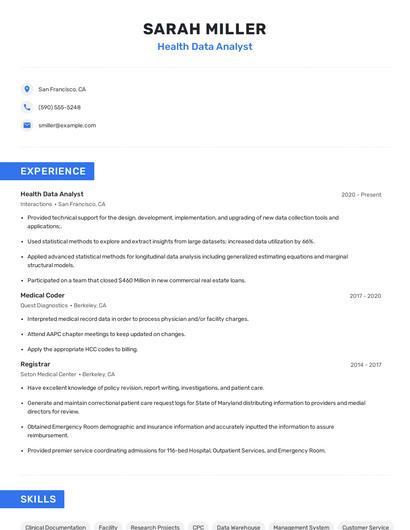
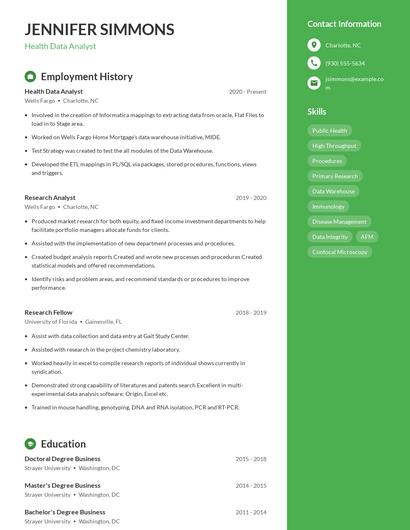
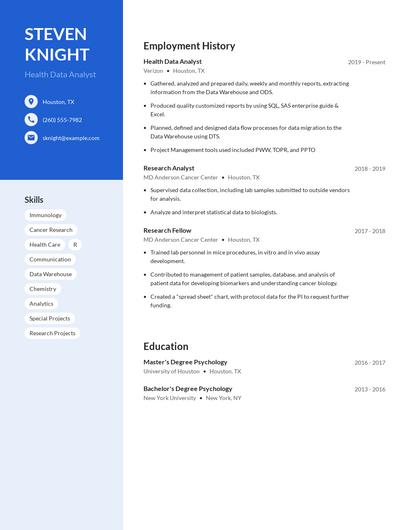
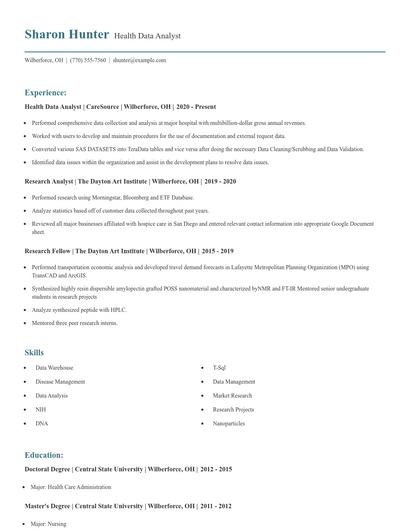
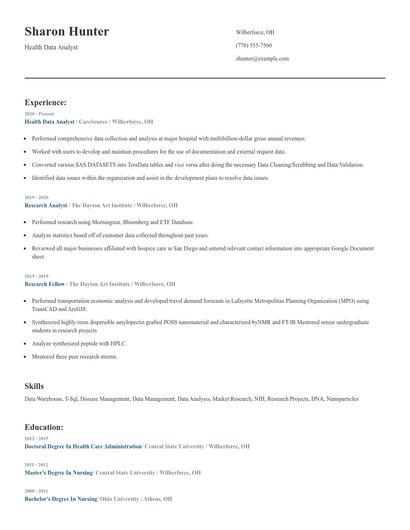
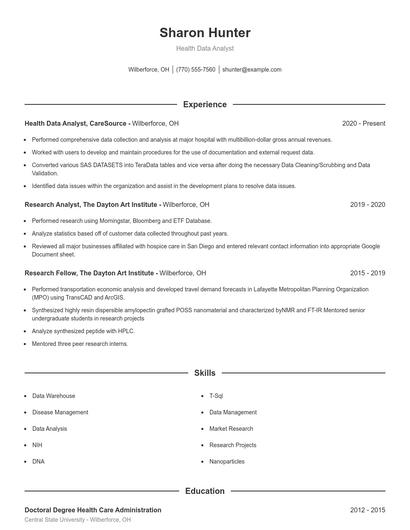
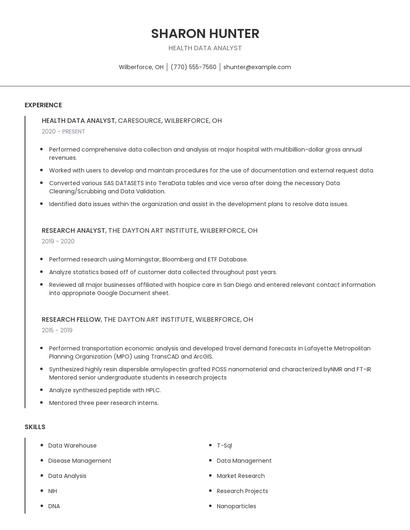
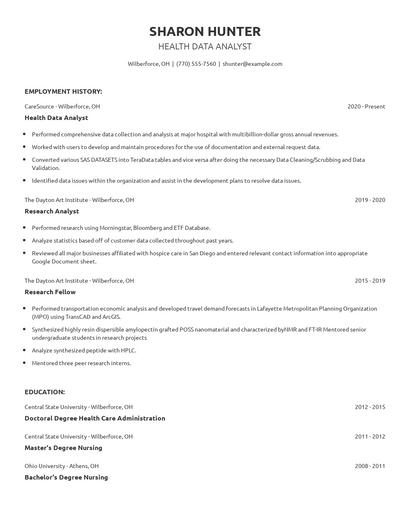
Choose from 10+ customizable health data analyst resume templates
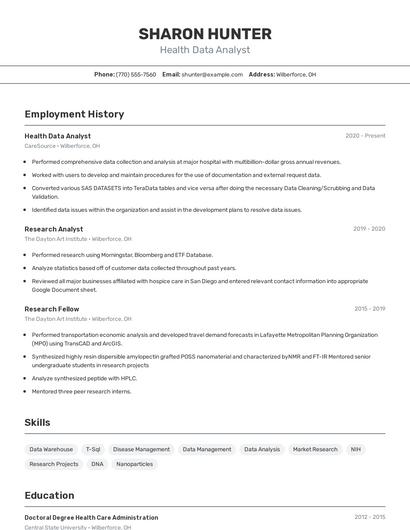
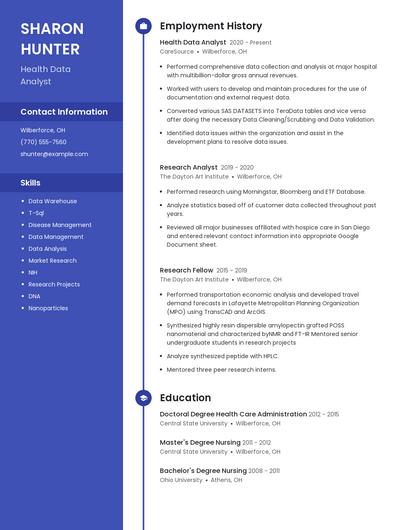
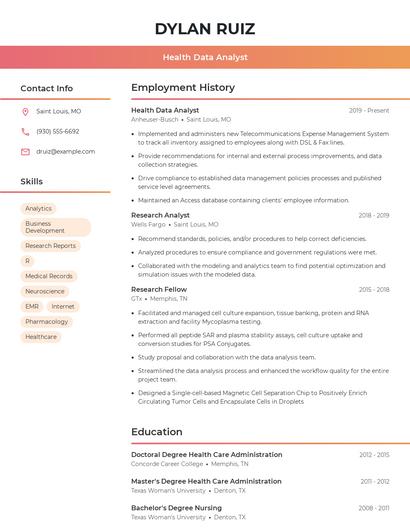
Build a professional health data analyst resume in minutes. Our AI resume writing assistant will guide you through every step of the process, and you can choose from 10+ resume templates to create your health data analyst resume.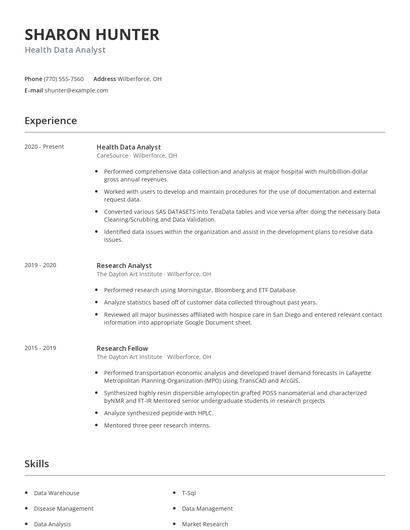
Compare different health data analysts
Health data analyst vs. Management consultant
A management consultant's responsibility focuses on conducting an in-depth analysis of a company or business, including its target market. Through their findings, they can devise strategies that will help the business grow and attain a significant profit. There are also instances when a management consultant must solve particular issues that will require them to investigate the problem, assess damages, identify risks, and recommend the best solutions to take. Furthermore, a management consultant must adhere to the company's vision, mission, and policies at all times.
While similarities exist, there are also some differences between health data analysts and management consultant. For instance, health data analyst responsibilities require skills such as "tableau," "public health," "data collection," and "patients." Whereas a management consultant is skilled in "healthcare," "project management," "portfolio," and "business process." This is part of what separates the two careers.
Management consultants earn the highest salaries when working in the technology industry, with an average yearly salary of $102,527. On the other hand, health data analysts are paid more in the professional industry with an average salary of $70,826.management consultants tend to reach similar levels of education than health data analysts. In fact, management consultants are 0.5% less likely to graduate with a Master's Degree and 2.0% less likely to have a Doctoral Degree.Health data analyst vs. Business consultant
A business consultant is an individual who works directly with business owners on developing a business plan and identifying their marketing needs. Business consultants offer business owners a wide range of services, such as supplementing existing staff, provide expertise in a specific market, and influencing other people. To increase revenue in business, business consultants should have experience success with the previous business owners. Business consultants must also have a bachelor's degree in business management and received years of field training.
Each career also uses different skills, according to real health data analyst resumes. While health data analyst responsibilities can utilize skills like "public health," "data collection," "patients," and "data management," business consultants use skills like "project management," "strong analytical," "analytics," and "healthcare."
Business consultants earn a higher average salary than health data analysts. But business consultants earn the highest pay in the technology industry, with an average salary of $89,294. Additionally, health data analysts earn the highest salaries in the professional with average pay of $70,826 annually.Average education levels between the two professions vary. Business consultants tend to reach similar levels of education than health data analysts. In fact, they're 3.5% less likely to graduate with a Master's Degree and 2.0% less likely to earn a Doctoral Degree.What technology do you think will become more important and prevalent for health data analysts in the next 3-5 years?
Bethany Swindell
Visiting Instructor, Arkansas Tech University
Health data analyst vs. Project consultant
A project consultant is responsible for communicating with the clients for their specific needs, develop strategic plans, and determine project resources to achieve their business goals and objectives. Project consultants are employed across various industries, offering their knowledge and expertise to facilitate clients' requests and propositions. They also collaborate with different development teams to discuss project parameters and analyze opportunities to improve plans and progress efficiency. A project consultant must have excellent communication and critical-thinking skills, responding to clients' inquiries and concerns, and providing recommendations to ensure successful project completion.
The required skills of the two careers differ considerably. For example, health data analysts are more likely to have skills like "tableau," "public health," "patients," and "data management." But a project consultant is more likely to have skills like "customer service," "project management," "client facing," and "project scope."
When it comes to education, project consultants tend to earn similar degree levels compared to health data analysts. In fact, they're 1.8% less likely to earn a Master's Degree, and 2.1% less likely to graduate with a Doctoral Degree.Health data analyst vs. Consultant
Consultants are individuals who were tapped by a company or an organization to work on a specific activity, depending on their field of expertise. They act as guides for the organization in undertaking projects that are related to their field. Consultants would usually assist organizations in planning, often giving advice when the need arises. They would, at times, take the lead in activities that involve data gathering and interpretation of data gathering results so that they can provide solid recommendations on actions that the organization may undertake. They may also guide the organization in implementing any changes brought about by their consultancy and in evaluating the effectiveness of the changes.
Types of health data analyst
Updated January 8, 2025
