What does a health unit supervisor do?
A health unit supervisor handles both the administrative and executive tasks in a health care unit. They coordinate all that takes place in one or more patient care units in health care facilities. The unit supervisor plans and oversees administrative operations. They also supervise other personnel or staff in the unit or ward. They may also be responsible for the generation of schedules for teams in the unit. They will be required to communicate with other members of the administrative team.
Health unit supervisor responsibilities
Here are examples of responsibilities from real health unit supervisor resumes:
- Engage, educate and empower participants to access community base resources in or- der to achieve rehabilitation and recovery.
- Facilitate administrative, advocacy, customer service and technical support to uninsure and under-insure patients, and their families.
- Engage, educate and empower participants to access community base resources in or- der to achieve rehabilitation and recovery.
- Coordinate with clinical managers regarding: CMS, CDPH, TJC, and ACHC survey preparation process and on-site surveys.
- Assist in respiratory fit-testing program, strongly contributing to prevention of tuberculosis and other airborne diseases.
Health unit supervisor skills and personality traits
We calculated that 21% of Health Unit Supervisors are proficient in Patients, Social Work, and Patient Care. They’re also known for soft skills such as Analytical skills, Communication skills, and Detail oriented.
We break down the percentage of Health Unit Supervisors that have these skills listed on their resume here:
- Patients, 21%
Provided telephonic patient education and case management of patients with cardiovascular Disease and CAD risk factors.
- Social Work, 13%
Provided comprehensive social work case management services to 20-25 clients in the Home Health Dept.
- Patient Care, 11%
Established and maintained sound working relationships with personnel of the medical center and the community agencies involved in patient care.
- CPR, 6%
Conducted numerous non-profit/marketing presentations including CPR and First Aid certification classes for local businesses.
- Substance Abuse, 5%
Planned and facilitated unit focus group sessions, newcomer's orientations as well as substance abuse and suicide prevention briefings.
- Clinical Supervision, 4%
Provided clinical supervision, coaching for clinical and ancillary staff.
Most health unit supervisors use their skills in "patients," "social work," and "patient care" to do their jobs. You can find more detail on essential health unit supervisor responsibilities here:
Analytical skills. The most essential soft skill for a health unit supervisor to carry out their responsibilities is analytical skills. This skill is important for the role because "medical and health services managers review and evaluate healthcare metrics for ways to improve efficiency and meet goals." Additionally, a health unit supervisor resume shows how their duties depend on analytical skills: "provided clinical supervision for casacs and social workers including training, case analysis, case management, and treatment planning. "
Communication skills. Another essential skill to perform health unit supervisor duties is communication skills. Health unit supervisors responsibilities require that "medical and health services managers must convey information to their staff, other healthcare workers, and, sometimes, patients and insurance agents." Health unit supervisors also use communication skills in their role according to a real resume snippet: "integrate client families into care management planning and communication for cooperative decision-making. "
Detail oriented. This is an important skill for health unit supervisors to perform their duties. For an example of how health unit supervisor responsibilities depend on this skill, consider that "medical and health services managers must pay attention to detail." This excerpt from a resume also shows how vital it is to everyday roles and responsibilities of a health unit supervisor: "trained and oriented new mental health counselors. ".
Leadership skills. For certain health unit supervisor responsibilities to be completed, the job requires competence in "leadership skills." The day-to-day duties of a health unit supervisor rely on this skill, as "medical and health services managers hire, train, and direct staff." For example, this snippet was taken directly from a resume about how this skill applies to what health unit supervisors do: "take a leadership role in crisis intervention in the living environment. "
Technical skills. Another crucial skill for a health unit supervisor to carry out their responsibilities is "technical skills." A big part of what health unit supervisors relies on this skill, since "medical and health services managers must stay up to date with advances in healthcare technology, such as the coding and electronic health record (ehr) systems their facility adopts." How this skill relates to health unit supervisor duties can be seen in an example from a health unit supervisor resume snippet: "facilitated administrative, advocacy, customer service and technical support to uninsured and under-insured patients, and their families. "
The three companies that hire the most health unit supervisors are:
- UPMC6 health unit supervisors jobs
- Advanced Recovery Systems5 health unit supervisors jobs
- The Center for Health Care Services3 health unit supervisors jobs
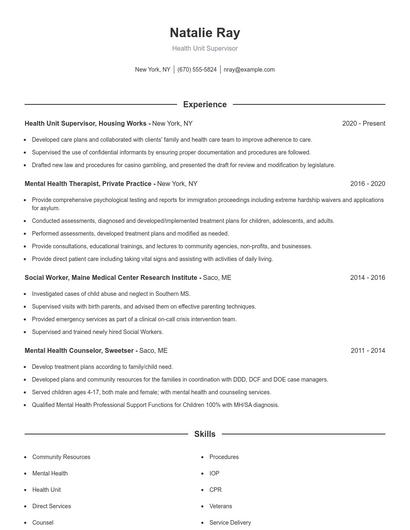
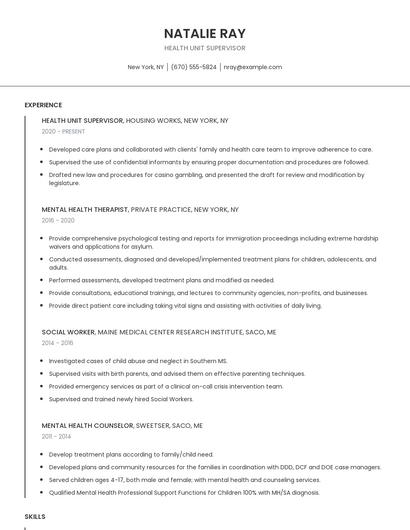
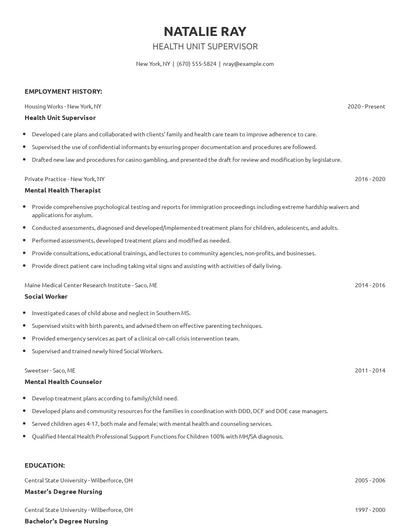
Choose from 10+ customizable health unit supervisor resume templates
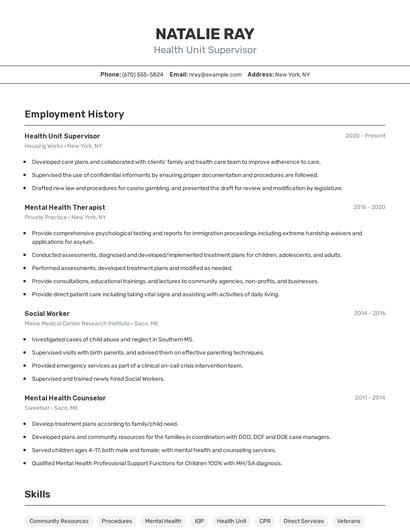
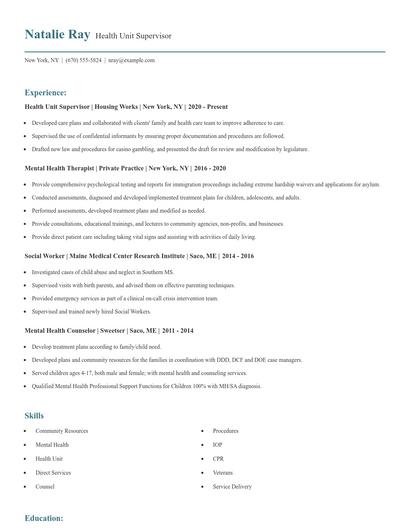
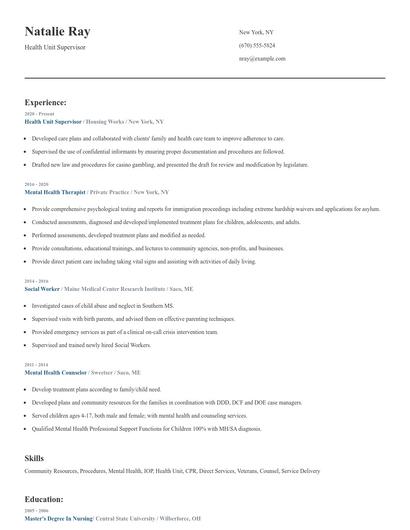
Build a professional health unit supervisor resume in minutes. Our AI resume writing assistant will guide you through every step of the process, and you can choose from 10+ resume templates to create your health unit supervisor resume.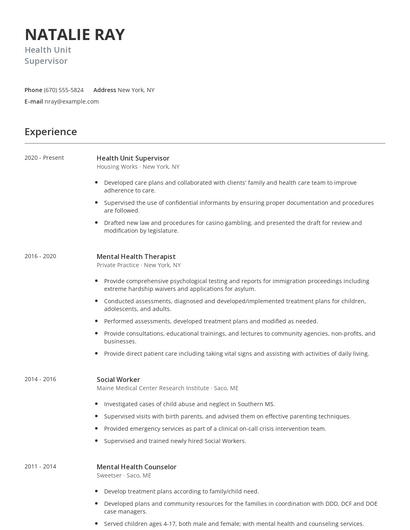


Compare different health unit supervisors
Health unit supervisor vs. Nursing director
A nursing director's role is to oversee and evaluate all nurse staff in a hospital or organization, ensuring their efficiency at providing care towards patients. A nursing director's responsibilities mainly revolve around administrative tasks such as coordinating with physicians and other consultants, producing reports, conducting assessments, managing the budget and expenditures, and resolving issues. Furthermore, a nursing director must keep and maintain accurate records, ensuring all procedures adhere to the highest health standards and aligns with the hospital's policies and regulations.
While similarities exist, there are also some differences between health unit supervisors and nursing director. For instance, health unit supervisor responsibilities require skills such as "social work," "patient care," "substance abuse," and "clinical supervision." Whereas a nursing director is skilled in "term care," "home health," "resident care," and "infection control." This is part of what separates the two careers.
Nursing directors tend to reach lower levels of education than health unit supervisors. In fact, nursing directors are 10.0% less likely to graduate with a Master's Degree and 0.2% less likely to have a Doctoral Degree.Health unit supervisor vs. Clinical director
A clinical director is a managing professional who manages the work of healthcare providers to ensure quality patient care is achieved. Clinical directors are responsible for organizational tasks such as adjusting staff schedules, explaining insurance benefits to the patients, and managing financial reports. They can work either in small clinics with a smaller workforce or larger hospitals with multiple departments. Clinical directors may also assist in the hiring process of healthcare providers and should establish a positive work environment.
While some skills are similar in these professions, other skills aren't so similar. For example, resumes show us that health unit supervisor responsibilities requires skills like "cpr," "public health," "mental illness," and "health programs." But a clinical director might use other skills in their typical duties, such as, "physical therapy," "clinical operations," "quality improvement," and "autism."
In general, clinical directors achieve higher levels of education than health unit supervisors. They're 11.8% more likely to obtain a Master's Degree while being 0.2% more likely to earn a Doctoral Degree.Health unit supervisor vs. Practice manager
A practice manager is responsible for supervising daily operations, especially on the side of the medical industry. Practice managers monitor staffing needs, train new employees, and evaluate the employees' productivity and performance. They also enforce strict guidelines and procedures, ensuring that the processes adhere to the legal standards and regulatory requirements. Practice managers also maintain budget goals, creating cost estimates and expense reports. A practice manager must have strong communication, analytical, and critical-thinking skills, as well as comprehensive knowledge of the medical industry practices.
Some important key differences between the two careers include a few of the skills necessary to fulfill the responsibilities of each. Some examples from health unit supervisor resumes include skills like "social work," "cpr," "substance abuse," and "clinical supervision," whereas a practice manager is more likely to list skills in "customer service," "pet," "practice management," and "payroll. "
When it comes to education, practice managers tend to earn lower degree levels compared to health unit supervisors. In fact, they're 7.1% less likely to earn a Master's Degree, and 0.2% less likely to graduate with a Doctoral Degree.Health unit supervisor vs. Assistant director of nursing
An assistant director of nursing is responsible for administering quality care services for patients, supervising nursing activities, and ensuring the patients' comfort under the supervision of the director of nursing. Assistant directors of nursing assist with nursing staff training, distributing shift schedules, developing comprehensive nursing care plans, handling expense reports, identifying areas of improvement with the staff performance, and securing patients' medical charts for reference. An assistant director of nursing must have excellent communication and organizational skills, especially in handling patients' medical needs.
Types of health unit supervisor
Updated January 8, 2025
