What does an information systems coordinator do?
The responsibilities of an information system coordinator are well-defined. They troubleshoot, analyze, monitor, and manage various network infrastructure and server operations. They must ensure that all network facilities including Microsoft Exchange, SQL servers, and a host of other hardware and software systems function at optimal levels.
Information systems coordinator responsibilities
Here are examples of responsibilities from real information systems coordinator resumes:
- Track and manage all devices using consolidate memorandum receipts and SharePoint while conducting quarterly eyes on verification of all items.
- Print payroll and accounts payable checks and run them through the check signature machine.
- Develop the computerized accounting system for payroll, general ledger, account receivable and payable.
- Assign control numbers, schedule changes base on CMS due dates, problem logs, and report results.
- Implement a site collaboration process utilizing Microsoft SharePoint.
- Institute and document ISO requirements throughout the organization.
- Authore ISO relate material process documents for management.
- Update and maintain company intranet and publicly view company website.
- Promote from a desktop support specialist role into a more prominent project manager position ensuring proper system functionality.
- Ensure all critical actions are coordinated and properly execute to provide a cohesive approach to integrate logistics support requirements.
- Identify, prioritize and resolve report problems including data, account administration, desktop hardware/software, including application issues.
- Provide project management and leadership skills to senior management for successful application implementation and transition to enterprise application, Cerner.
- Track and manage all devices using consolidate memorandum receipts and SharePoint while conducting quarterly eyes on verification of all items.
- Repair and/or replace motherboards, Ethernet cards and any other parts that may need to be replace to maintain server operation.
- Implement and manage all organizational security measures, cryptographic equipment and DoD communications security (COMSEC) keying material.
Information systems coordinator skills and personality traits
We calculated that 11% of Information Systems Coordinators are proficient in Data Entry, Computer System, and Technical Support. They’re also known for soft skills such as Problem-solving skills, Analytical skills, and Communication skills.
We break down the percentage of Information Systems Coordinators that have these skills listed on their resume here:
- Data Entry, 11%
Supervised four Data Entry Coordinators.
- Computer System, 6%
Analyzed user requirements, procedures and problems to automate processing and improve existing computer systems and customization for COTS software products.
- Technical Support, 6%
Served as a Non-Commissioned Officer/Primary Technical Lead responsible for providing technical support and training to over 3000 users /students.
- LIS, 5%
Maintained proper interfacing between machines/analyzers, LIS, and the hospital information system.
- SQL, 5%
Supervised deployment of clinical assessment application and SQL database to support field operations.
- Epic, 3%
Assisted in the building, validating and implementation of EPIC Blood Administration Module simultaneously with SoftBank.
"data entry," "computer system," and "technical support" are among the most common skills that information systems coordinators use at work. You can find even more information systems coordinator responsibilities below, including:
Problem-solving skills. To carry out their duties, the most important skill for an information systems coordinator to have is problem-solving skills. Their role and responsibilities require that "administrators must quickly resolve problems that arise with computer networks." Information systems coordinators often use problem-solving skills in their day-to-day job, as shown by this real resume: "coordinate with the hris team to identify long term solutions for data auditing. "
Analytical skills. Another essential skill to perform information systems coordinator duties is analytical skills. Information systems coordinators responsibilities require that "administrators need to evaluate networks and systems to make sure that they perform reliably and to anticipate new requirements as customers’ needs change." Information systems coordinators also use analytical skills in their role according to a real resume snippet: "provided data analysis and reports for management team. "
Communication skills. Another skill that relates to the job responsibilities of information systems coordinators is communication skills. This skill is critical to many everyday information systems coordinator duties, as "administrators must describe problems and their solutions to non-it workers." This example from a resume shows how this skill is used: "maintained communication with lis vendors. "
The three companies that hire the most information systems coordinators are:
- Lamar Advertising12 information systems coordinators jobs
- Olathe Health4 information systems coordinators jobs
- ManTech3 information systems coordinators jobs
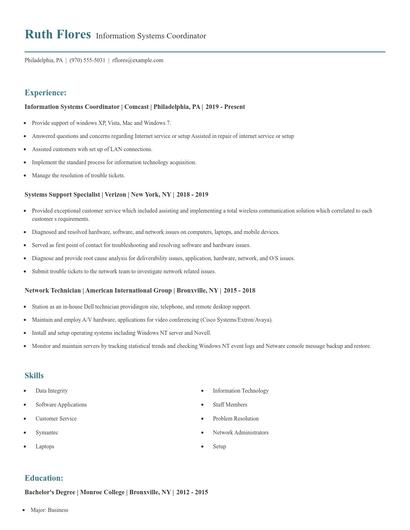
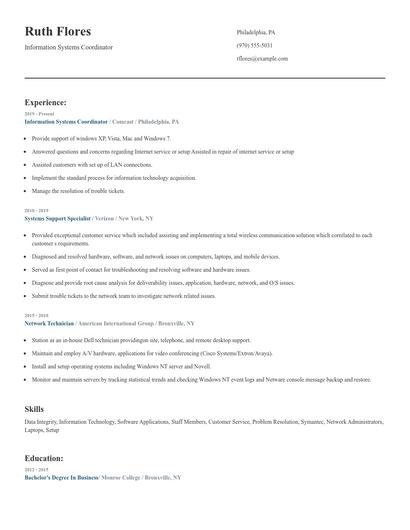
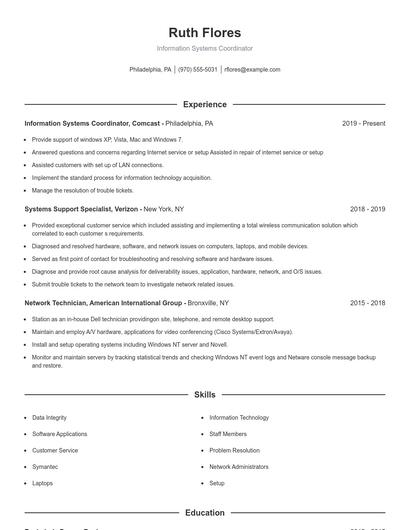
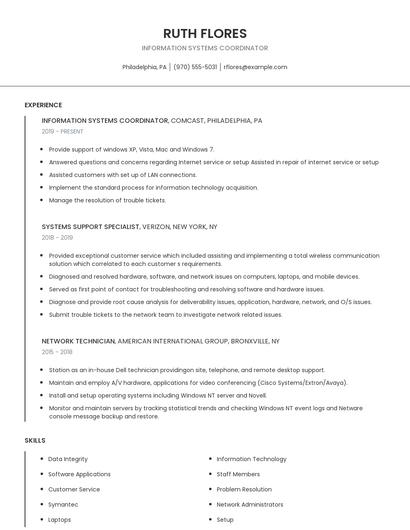
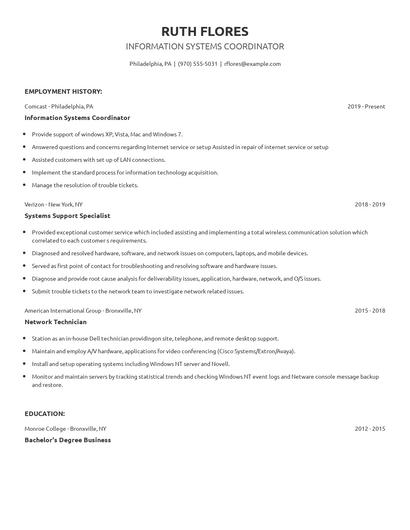
Choose from 10+ customizable information systems coordinator resume templates
Build a professional information systems coordinator resume in minutes. Our AI resume writing assistant will guide you through every step of the process, and you can choose from 10+ resume templates to create your information systems coordinator resume.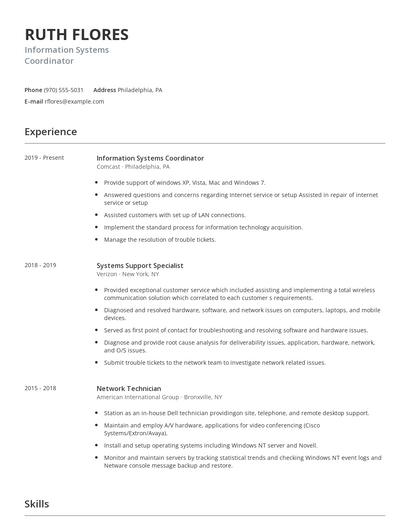
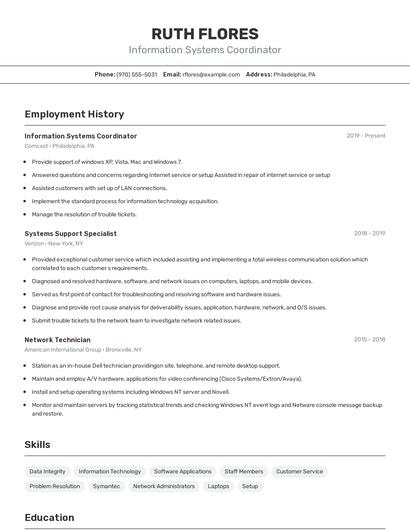


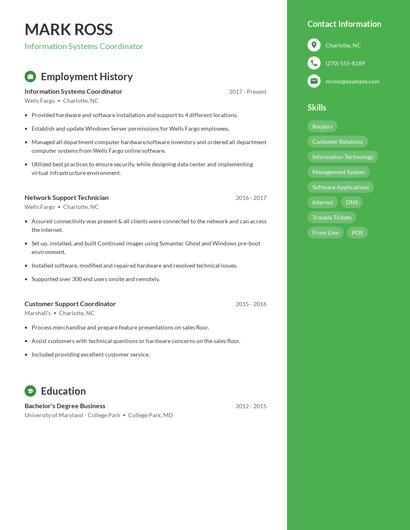
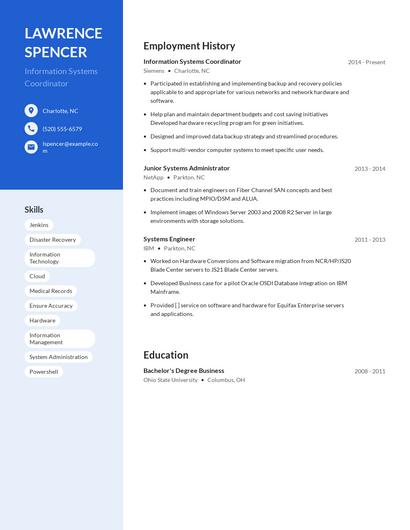
Compare different information systems coordinators
Information systems coordinator vs. Systems integration engineer
A systems integration engineer is responsible for evaluating the efficiency and performance of the control systems to support business operations and requirements. Systems integration engineers develop technical solutions from business initiatives that would maximize a team's productivity and increase target performance. They also handle the upgrades of network infrastructure and system configuration and resolve technical failures as soon as they arise. A systems integration engineer must have excellent communication and technical skills, especially in providing recommendations to improve the network's capability and prevent downtimes.
There are some key differences in the responsibilities of each position. For example, information systems coordinator responsibilities require skills like "data entry," "computer system," "lis," and "sql." Meanwhile a typical systems integration engineer has skills in areas such as "python," "architecture," "system integration," and "c++." This difference in skills reveals the differences in what each career does.
Systems integration engineers earn the highest salaries when working in the professional industry, with an average yearly salary of $105,674. On the other hand, information systems coordinators are paid more in the energy industry with an average salary of $82,073.On average, systems integration engineers reach higher levels of education than information systems coordinators. Systems integration engineers are 5.9% more likely to earn a Master's Degree and 0.0% more likely to graduate with a Doctoral Degree.Information systems coordinator vs. Systems analyst
A systems analyst is responsible for monitoring the effectiveness of technology systems and analyzing its efficiency for business operations and clients' needs. Systems analysts create specific modifications to operating systems and help design solutions and processes. Other tasks include managing the system's workflow, diagnosing and detecting malfunctions, performing troubleshooting, and assisting clients' with their concerns. A systems analyst must have excellent command with programming languages and the knowledge with the technology industry to understand systems' complexities and processes.
Each career also uses different skills, according to real information systems coordinator resumes. While information systems coordinator responsibilities can utilize skills like "data entry," "lis," "sql," and "epic," systems analysts use skills like "customer service," "project management," "troubleshoot," and "java."
Systems analysts may earn a higher salary than information systems coordinators, but systems analysts earn the most pay in the finance industry with an average salary of $86,904. On the other hand, information systems coordinators receive higher pay in the energy industry, where they earn an average salary of $82,073.Average education levels between the two professions vary. Systems analysts tend to reach similar levels of education than information systems coordinators. In fact, they're 3.4% more likely to graduate with a Master's Degree and 0.0% less likely to earn a Doctoral Degree.What technology do you think will become more important and prevalent for information systems coordinators in the next 3-5 years?
Babak Beheshti Ph.D.
Dean, Professor, New York Institute of Technology
-We will be witnessing a more widespread commercial deployment of 5G in 2020. With the implementation of the Standalone 5G devices based on the 3gpp release 16, we should be seeing the more robust mobile broadband deployment of 5G, wider availability of 5G smartphones, and a push towards an all 5G Network in select urban areas around the world.
-Significant growth in AI-based technologies, from face recognition and voice recognition to business intelligence and market predictions. As machines and deep learning algorithms get integrated into many applications, many industries will undergo substantial changes. AI systems will continue to interact with our phones; cars will interpret and analyze their surroundings and intelligently drive themselves. Online vendors will monitor our browsing habits, and Google decides what kind of search results to give us, based on who it thinks we are.
Information systems coordinator vs. Systems support
A systems support agent is responsible for resolving system applications and network issues, performing technical configuration, and upgrading systems infrastructure. A systems support representative conducts regular maintenance and diagnostic tests on the computer applications to ensure its optimal performance and efficiency to support business operations and avoid delays in deliverables. They also assist the technology team in designing backup systems and improve existing networks according to business requirements and specifications. They write resolution reports for reference to prevent the reoccurrence of system malfunction and inconsistencies.
There are many key differences between these two careers, including some of the skills required to perform responsibilities within each role. For example, an information systems coordinator is likely to be skilled in "data entry," "lis," "sql," and "epic," while a typical systems support is skilled in "customer service," "troubleshoot," "pc," and "provides technical support."
Systems supports earn the best pay in the professional industry, where they command an average salary of $72,760. Information systems coordinators earn the highest pay from the energy industry, with an average salary of $82,073.When it comes to education, systems supports tend to earn similar degree levels compared to information systems coordinators. In fact, they're 2.6% less likely to earn a Master's Degree, and 0.6% less likely to graduate with a Doctoral Degree.Information systems coordinator vs. Systems manager
A systems manager is responsible for monitoring the operations of the information technology department, evaluating staff performance, developing strategic procedures to maximize productivity, and identifying business opportunities that would generate more revenues and profitability for the company. Systems managers inspect company networks to ensure the efficiency of the technology systems, conducting regular diagnostic tests, and installing upgrades to boost optimization. A systems manager must have excellent knowledge of the technology industry, as well as a strong command in programming languages and system codes to maintain the security of the company's database.
Even though a few skill sets overlap between information systems coordinators and systems managers, there are some differences that are important to note. For one, an information systems coordinator might have more use for skills like "technical support," "lis," "sql," and "epic." Meanwhile, some responsibilities of systems managers require skills like "customer service," "project management," "patients," and "client facing. "
Systems managers enjoy the best pay in the technology industry, with an average salary of $116,351. For comparison, information systems coordinators earn the highest salary in the energy industry.The average resume of systems managers showed that they earn similar levels of education compared to information systems coordinators. So much so that theyacirc;euro;trade;re 2.3% more likely to earn a Master's Degree and less likely to earn a Doctoral Degree by 0.1%.Types of information systems coordinator
Updated January 8, 2025
