Explore jobs
Find specific jobs
Explore careers
Explore professions
Best companies
Explore companies
What is an instructional designer and how to become one

An instructional designer creates effective and engaging learning experiences for a variety of industries. They analyze learners' needs, design solutions, and develop materials that help them achieve their goals. This requires expertise in learning theory, content development, and technology tools. Instructional designers work with subject matter experts and stakeholders to create training that meets objectives. They use e-learning modules, job aids, simulations, and videos. Instructional designers ensure learners acquire the knowledge to succeed.
What general advice would you give to an instructional designer?
Abby Guido
Assistant Professor, Tyler School of Art and Architecture, Temple University
Every job I have ever received in my career has been through someone else I know. I share this with students to help them see the value in relationships. I always remember the students that took the time to write a handwritten thank-you note. And I think of them when I get an email asking if I know any students are looking for work.
Avg. Salary $57,534
Avg. Salary $59,228
Growth rate 7%
Growth rate 0.3%
American Indian and Alaska Native 0.75%
Asian 5.53%
Black or African American 9.89%
Hispanic or Latino 17.21%
Unknown 4.26%
White 62.35%
Genderfemale 58.19%
male 41.81%
Age - 44American Indian and Alaska Native 3.00%
Asian 7.00%
Black or African American 14.00%
Hispanic or Latino 19.00%
White 57.00%
Genderfemale 47.00%
male 53.00%
Age - 44Stress level is manageable
7.1 - high
Complexity level is challenging
7 - challenging
Work life balance is poor
6.4 - fair
What are the pros and cons of being an instructional designer?
Pros
Opportunity to develop creative and engaging learning experiences
Flexibility in designing courses and materials
Opportunity to work remotely or freelance
Competitive salary and benefits
High demand for instructional designers in many industries
Cons
Tight deadlines and time constraints on projects
Heavy workload and pressure to produce quality materials quickly
Potential for repetitive work when designing similar courses or materials
Difficulty in measuring the effectiveness of instruction or learning outcomes
Dependence on technology, which can be frustrating when it malfunctions or requires updates
Instructional designer career paths
Key steps to become an instructional designer
Explore instructional designer education requirements
Start to develop specific instructional designer skills
Skills Percentages Instructional Design 8.61% Subject Matter Experts 7.42% Project Management 4.19% PowerPoint 3.79% ELearning 3.65% Complete relevant instructional designer training and internships
Accountants spend an average of 1-3 months on post-employment, on-the-job training. New instructional designers learn the skills and techniques required for their job and employer during this time. The chart below shows how long it takes to gain competency as an instructional designer based on U.S. Bureau of Labor Statistics data and data from real instructional designer resumes.Research instructional designer duties and responsibilities
- Design instructor lead, virtual, and SCORM compliant web base training for a 300 seat inbound customer care department.
- Manage project development including facilitating all stages of the ADDIE process from analysis to evaluation.
- Develop PowerPoint presentations to support instructor lead courses and other training documentation including job aids, and business process procedures.
- Design and development of eLearning and instructor lead courses in a wide area of subjects including leadership development and innovation curriculum.
Prepare your instructional designer resume
When your background is strong enough, you can start writing your instructional designer resume.
You can use Zippia's AI resume builder to make the resume writing process easier while also making sure that you include key information that hiring managers expect to see on an instructional designer resume. You'll find resume tips and examples of skills, responsibilities, and summaries, all provided by Zippi, your career sidekick.
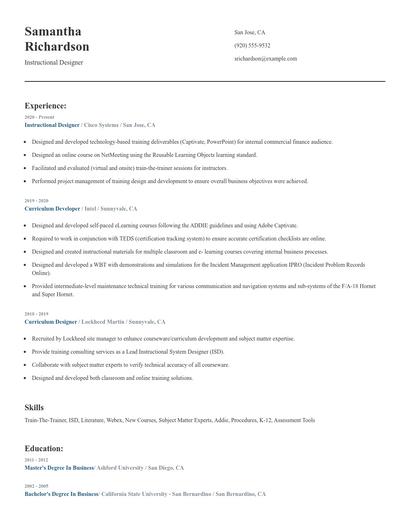
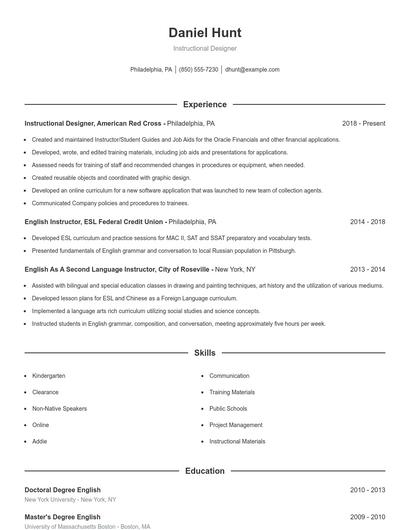
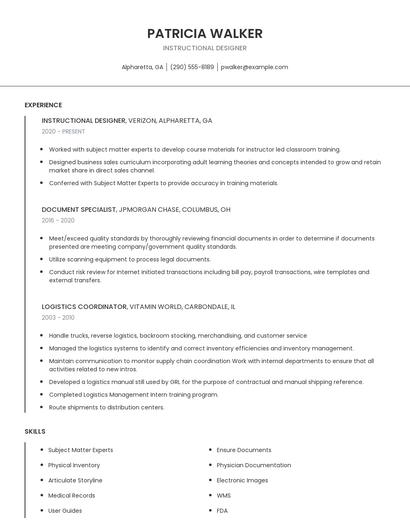
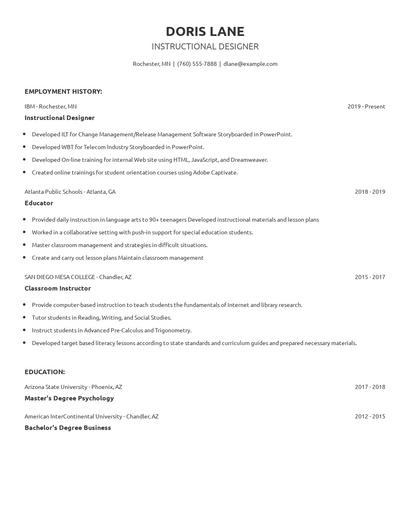
Choose from 10+ customizable instructional designer resume templates
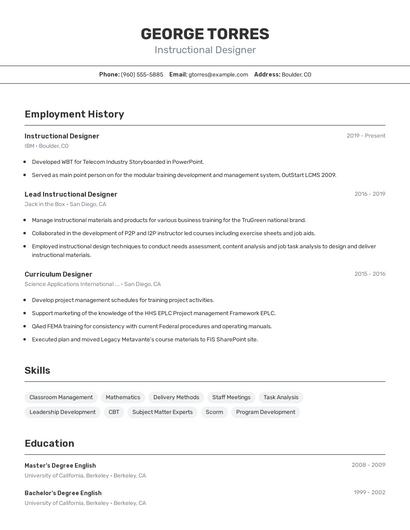
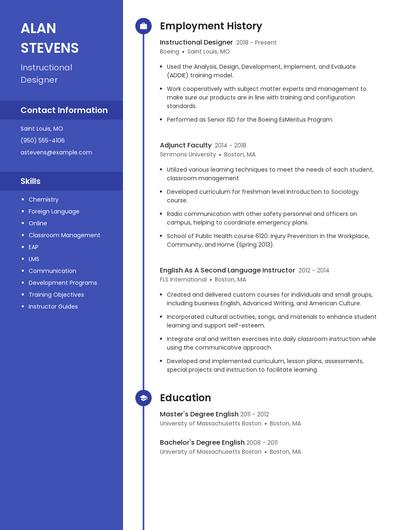
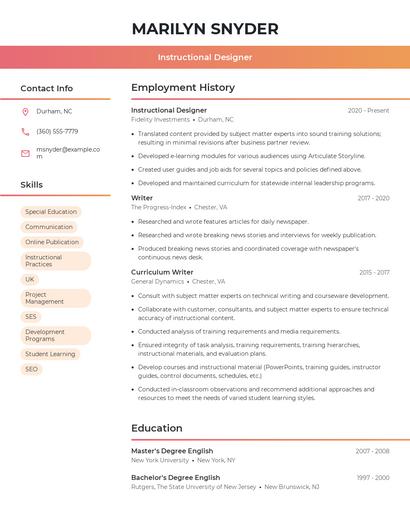
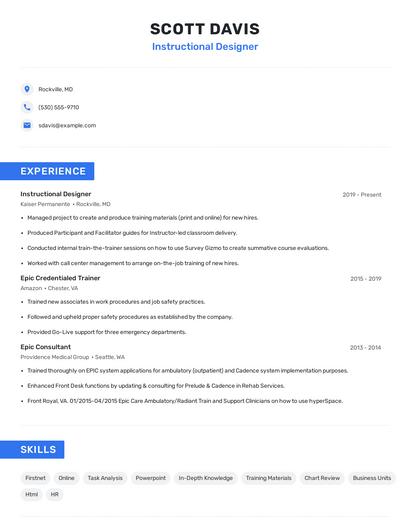
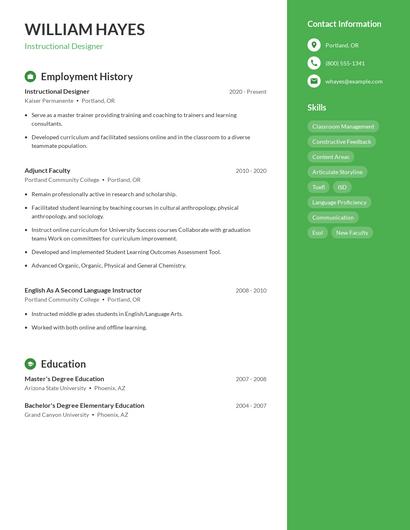
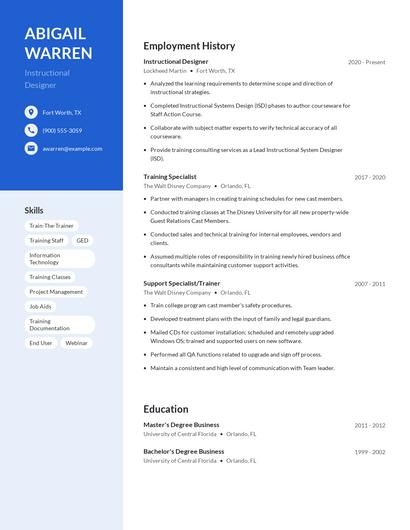
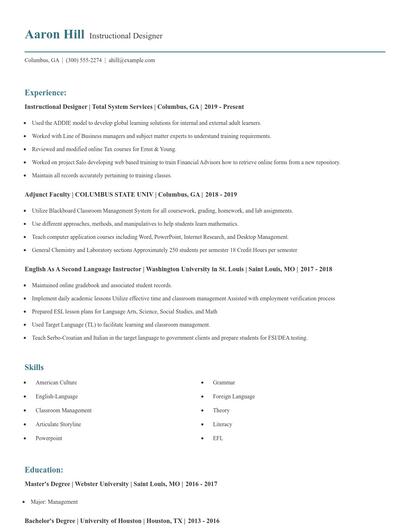
Build a professional instructional designer resume in minutes. Browse through our resume examples to identify the best way to word your resume. Then choose from 10+ resume templates to create your instructional designer resume.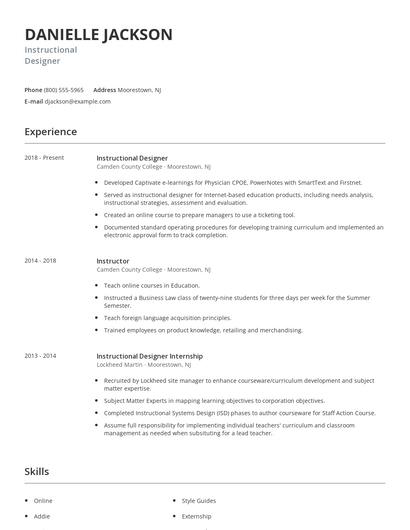
Apply for instructional designer jobs
Now it's time to start searching for an instructional designer job. Consider the tips below for a successful job search:
- Browse job boards for relevant postings
- Consult your professional network
- Reach out to companies you're interested in working for directly
- Watch out for job scams
How did you land your first instructional designer job
Pete Blair
Instructional Designer
thermometer outside our dining room and observed a temperature of minus twenty
eight. That did it! In spite of my love for my job as an BM Instructor in Endicott, New
York I went into my manager’s office bright and early Monday morning and told him that
I was interested in the next job opening south of the Mason Dixon Line! In July a job in
Raleigh, North Carolina opened, I applied and was accepted. However the job turned
out to be a pipe dream of the Raleigh manager who hired me. Regardless of where I
looked, I encountered the fact that what I thought I was supposed to do was the actually
the responsibility of someone in a different department. The wen on for almost a year
and was probably the most disappointing year I spent at IBM.
During that year the guy who had been my manager in Endicott also transferred to
Raleigh and was now the manager of a course development department. That
department was in the same building as mine. I had had enough! I walked into his
office pleading for a transfer to his department. IBM had just announced a new modem
designed to work over voice grade lines and he needed someone to write the computer
based training for that product. I transferred that began my career as an instructional
designer.
For the next twenty years I developed my courses for many IBM products developed at
the Research Triangle Park facility in North Carolina. In 1986 I participated in a twelve-
week special program developed by IBM and Georgia State University to prepare us to
develop computer based training in the new world of the personal computer. During
that program, we had speakers from the outside world telling us about the world of
instructional design outside of IBM. It was during that twelve week program that I
decided to go into the training design and development business for myself. But I also
decided I needed to gain experience in what I had just learned in the twelve-week
program. Five years later, I retired on October 31 st and Pete Blair and Associates gave
birth and I started on what has been the next 33 years of work as a freelance
instructional designer. With each assignment, and reading many instructional design
related books beginning clear back to 1971, I have learned even more.
Average instructional designer salary
The average instructional designer salary in the United States is $57,534 per year or $28 per hour. Instructional designer salaries range between $41,000 and $79,000 per year.
What am I worth?

How do instructional designers rate their job?
Instructional designer reviews

First of all, i'll say that i like the routine. I have had amazing health benefits because of waking up early and go to school because i live quite far. In the school, i like the working mechanism and how everyone is committed and dedicated for the job. The most important thing i like is that how i am able to make my place in the room of young, enthusiast children who see me as their mentor. I love being the change maker and i's always love to be a professional learning specialist because this is what angels would do.
Instructional designer FAQs
Search for instructional designer jobs
Instructional designer jobs by state
- Instructional designer jobs in Alaska
- Instructional designer jobs in Alabama
- Instructional designer jobs in Arkansas
- Instructional designer jobs in Arizona
- Instructional designer jobs in California
- Instructional designer jobs in Colorado
- Instructional designer jobs in Connecticut
- Instructional designer jobs in District of Columbia
- Instructional designer jobs in Delaware
- Instructional designer jobs in Florida
- Instructional designer jobs in Georgia
- Instructional designer jobs in Hawaii
- Instructional designer jobs in Iowa
- Instructional designer jobs in Idaho
- Instructional designer jobs in Illinois
- Instructional designer jobs in Indiana
- Instructional designer jobs in Kansas
- Instructional designer jobs in Kentucky
- Instructional designer jobs in Louisiana
- Instructional designer jobs in Massachusetts
- Instructional designer jobs in Maryland
- Instructional designer jobs in Maine
- Instructional designer jobs in Michigan
- Instructional designer jobs in Minnesota
- Instructional designer jobs in Missouri
- Instructional designer jobs in Mississippi
- Instructional designer jobs in Montana
- Instructional designer jobs in North Carolina
- Instructional designer jobs in North Dakota
- Instructional designer jobs in Nebraska
- Instructional designer jobs in New Hampshire
- Instructional designer jobs in New Jersey
- Instructional designer jobs in New Mexico
- Instructional designer jobs in Nevada
- Instructional designer jobs in New York
- Instructional designer jobs in Ohio
- Instructional designer jobs in Oklahoma
- Instructional designer jobs in Oregon
- Instructional designer jobs in Pennsylvania
- Instructional designer jobs in Puerto Rico
- Instructional designer jobs in Rhode Island
- Instructional designer jobs in South Carolina
- Instructional designer jobs in South Dakota
- Instructional designer jobs in Tennessee
- Instructional designer jobs in Texas
- Instructional designer jobs in Utah
- Instructional designer jobs in Virginia
- Instructional designer jobs in Vermont
- Instructional designer jobs in Washington
- Instructional designer jobs in Wisconsin
- Instructional designer jobs in West Virginia
- Instructional designer jobs in Wyoming
Updated January 8, 2025
