What does an integration analyst do?
An integration analyst's role is to analyze the needs of different company departments and provide them with the necessary solutions and systems for development and improvement. Their responsibilities revolve around spearheading system integrations, implementing software and application optimizations, providing written instructions or training for employees on how to operate new systems, and monitoring progress. They are also responsible for addressing any inquiries or concerns, resolving them promptly and efficiently. Furthermore, it is essential to perform clerical tasks such as producing progress reports and presentations, all while implementing the company's policies and regulations.
Integration analyst responsibilities
Here are examples of responsibilities from real integration analyst resumes:
- Work with SharePoint site to maintain, modify and manage the documents and the templates.
- Attain knowledge of ICD-9, CPT and HCPCS codes and benefit configuration as elements of the claims processing.
- Develop Linux shell scripts to perform automate task using Cron.
- Diagnose and troubleshoot special issues as it pertains to the IDMS system.
- Establish communication between systems through connectivity methods such as TCP/IP and FTP.
- Construct Java classes that invoke legacy COBOL code on the mainframe via MQ.
- Work with monthly and quarterly ASES reports which are upload through their FTP.
- Create project plan for migrating to Linux OS, improving client resource commitments.
- Design and write CVS export functionality for select data screens and HTML reports.
- Develop extraction, transformation and load procedures (PL/SQL, Java) between systems.
- Audit EDI processes to ensure all customer metrics are being meet and SLA scores maintain.
- Utilize SharePoint and SalesForce for tracking work requests, change requests, and document sharing.
- Analyze HIPAA EDI transactions in X12 responses and of 837 and 835 and look for defects.
- Attend internal meetings, as requested, to provide subject matter expertise on the NextGen software.
- Lead ERP (PeopleSoft) system administrator, delivering technical solutions to business needs and audit requirements.
Integration analyst skills and personality traits
We calculated that 19% of Integration Analysts are proficient in Healthcare, Data Analysis, and Project Management. They’re also known for soft skills such as Creativity, Analytical skills, and Communication skills.
We break down the percentage of Integration Analysts that have these skills listed on their resume here:
- Healthcare, 19%
Modified and updated ADT interface for GE HealthCare CPN (fetal monitoring).
- Data Analysis, 5%
Performed research and statistical data analysis.
- Project Management, 5%
Provided input to estimates for project management and change management activities through analysis of requirements effort, resources, and technology.
- Customer Service, 4%
Develop more efficient methodology with management to resolve pricing issue and render better customer service to members and clubs.
- CPT, 4%
Attained knowledge of ICD-9, CPT and HCPCS codes and benefit configuration as elements of the claims processing.
- HL7, 4%
Hired to develop new interface products and standardize existing HL7 integration processes for company wide expansion initiative.
Most integration analysts use their skills in "healthcare," "data analysis," and "project management" to do their jobs. You can find more detail on essential integration analyst responsibilities here:
Creativity. To carry out their duties, the most important skill for an integration analyst to have is creativity. Their role and responsibilities require that "because analysts are tasked with finding innovative solutions to computer problems, an ability to “think outside the box” is important." Integration analysts often use creativity in their day-to-day job, as shown by this real resume: "conducted pc inventory in all hospitals and specialty offices utilizing dbmotion hie agent/clinical viewer. "
Analytical skills. Another essential skill to perform integration analyst duties is analytical skills. Integration analysts responsibilities require that "analysts must interpret complex information from various sources and decide the best way to move forward on a project." Integration analysts also use analytical skills in their role according to a real resume snippet: "analyzed hl7 messaging inbound to the integration engine from hospital information systems and outbound to the applications that use them. "
Communication skills. This is an important skill for integration analysts to perform their duties. For an example of how integration analyst responsibilities depend on this skill, consider that "analysts work as a go-between with management and the it department and must explain complex issues in a way that both will understand." This excerpt from a resume also shows how vital it is to everyday roles and responsibilities of an integration analyst: "review hca regs communications, applicable cms transmittals, and local coverage decisions (lcd). ".
The three companies that hire the most integration analysts are:
- Deloitte118 integration analysts jobs
- Meta55 integration analysts jobs
- Guidehouse51 integration analysts jobs
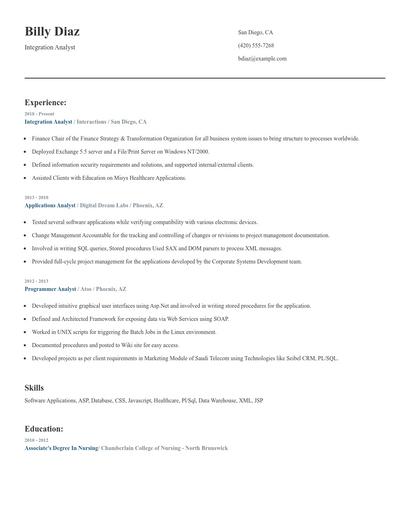
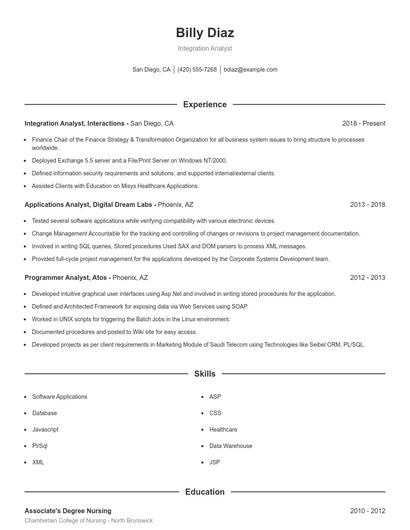
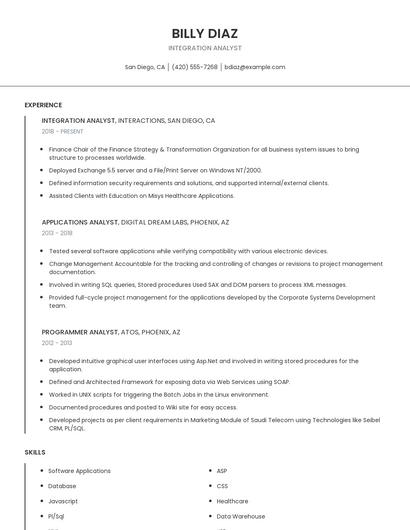
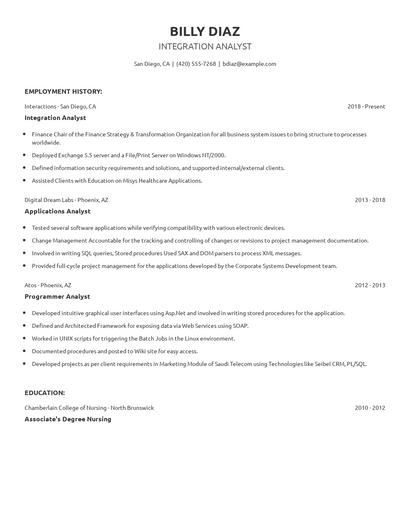
Choose from 10+ customizable integration analyst resume templates
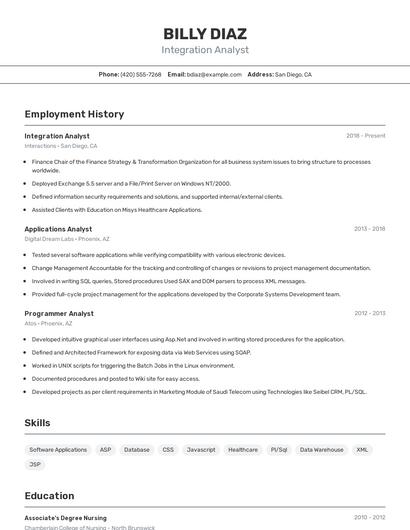
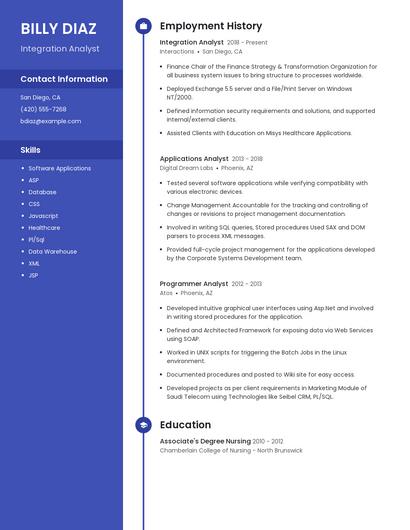
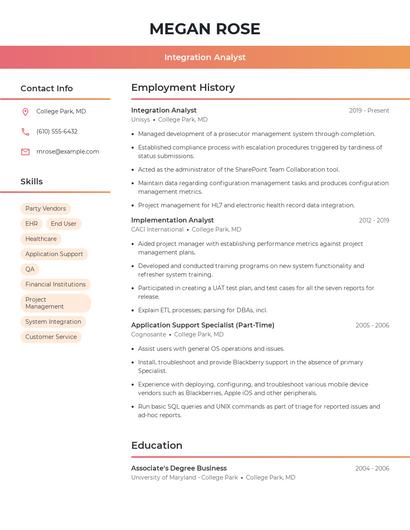
Build a professional integration analyst resume in minutes. Our AI resume writing assistant will guide you through every step of the process, and you can choose from 10+ resume templates to create your integration analyst resume.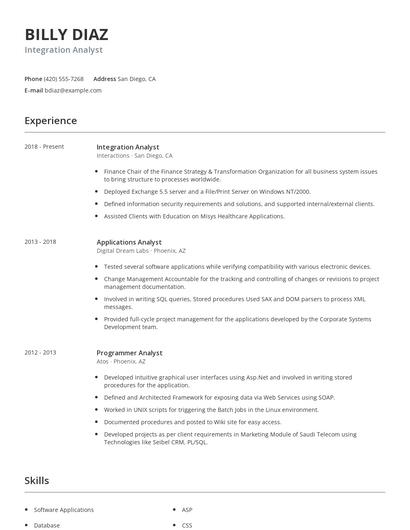
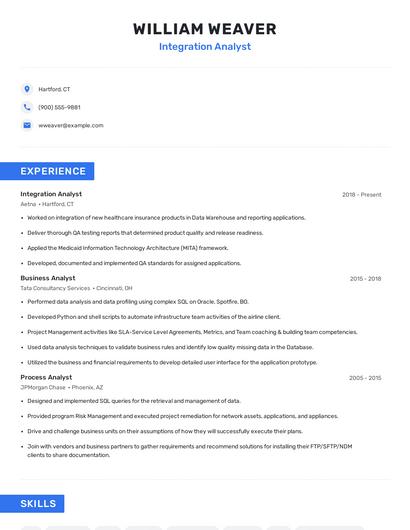
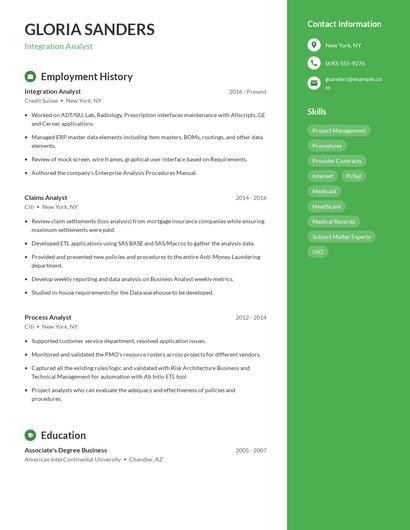
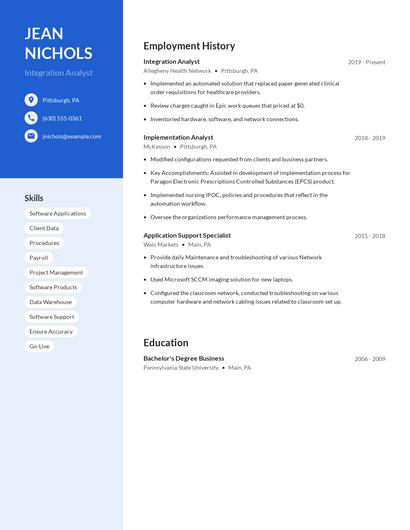
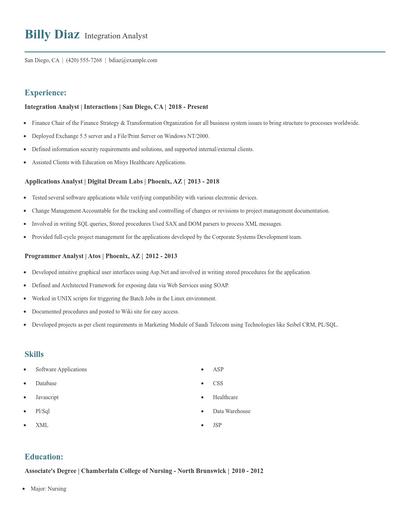
Compare different integration analysts
Integration analyst vs. Analyst lead
The duties of an analyst lead depend on one's line of work or industry of employment. Typically, their responsibilities revolve around performing research and analysis, coordinating with different departments to gather leads and data, reviewing findings, and producing reports and presentations for the stakeholders and other higher-ranking officials. Through the results, an analyst lead can provide advice, devise strategies for business optimization, spearhead the development of processes, identify strengths and weaknesses, and offer recommendations on areas in need of improvement. All of this is done while in adherence to the company's vision and mission.
While similarities exist, there are also some differences between integration analysts and analyst lead. For instance, integration analyst responsibilities require skills such as "healthcare," "cpt," "hl7," and "cerner." Whereas a analyst lead is skilled in "analytics," "excellent interpersonal," "powerpoint," and "cloud security." This is part of what separates the two careers.
Analyst leads really shine in the finance industry with an average salary of $110,488. Comparatively, integration analysts tend to make the most money in the retail industry with an average salary of $99,316.analyst leads tend to reach similar levels of education than integration analysts. In fact, analyst leads are 0.8% more likely to graduate with a Master's Degree and 0.8% more likely to have a Doctoral Degree.Integration analyst vs. Analyst
Analysts are employees or individual contributors with a vast experience in a particular field that help the organization address challenges. They help the organization improve processes, policies, and other operations protocol by studying the current processes in place and determining the effectiveness of those processes. They also research industry trends and data to make sound inferences and recommendations on what the company should do to improve their numbers. Analysts recommend business solutions and often help the organization roll out these solutions. They ensure that the proposed action plans are effective and produce the desired results.
In addition to the difference in salary, there are some other key differences worth noting. For example, integration analyst responsibilities are more likely to require skills like "healthcare," "hl7," "cerner," and "queues." Meanwhile, an analyst has duties that require skills in areas such as "digital transformation," "data entry," "excellent interpersonal," and "work ethic." These differences highlight just how different the day-to-day in each role looks.
Analysts earn a lower average salary than integration analysts. But analysts earn the highest pay in the technology industry, with an average salary of $79,330. Additionally, integration analysts earn the highest salaries in the retail with average pay of $99,316 annually.In general, analysts achieve similar levels of education than integration analysts. They're 4.5% less likely to obtain a Master's Degree while being 0.8% more likely to earn a Doctoral Degree.What technology do you think will become more important and prevalent for integration analysts in the next 3-5 years?
Erik Johnson Ph.D.
Assistant Professor of Economics, Carthage College
Integration analyst vs. Technical analyst
A technical analyst is responsible for analyzing technical information and aligning it to the business strategies and procedures in meeting project goals. Technical analysts monitor technical system errors and provide immediate resolutions to ensure an efficient and smooth flow of operations. They comply with the business requirements and clients' specifications to facilitate the technical team with the best techniques to get the job done. A technical analyst should have excellent critical-thinking and communication skills, as well as having a broad knowledge of the technology industry and disciplines.
Some important key differences between the two careers include a few of the skills necessary to fulfill the responsibilities of each. Some examples from integration analyst resumes include skills like "healthcare," "project management," "cpt," and "hl7," whereas a technical analyst is more likely to list skills in "digital transformation," "c #," "desktop," and "patients. "
Technical analysts make a very good living in the retail industry with an average annual salary of $88,568. On the other hand, integration analysts are paid the highest salary in the retail industry, with average annual pay of $99,316.When it comes to education, technical analysts tend to earn lower degree levels compared to integration analysts. In fact, they're 5.3% less likely to earn a Master's Degree, and 0.0% less likely to graduate with a Doctoral Degree.Integration analyst vs. Application support analyst
An application support analyst is responsible for responding to and resolving customer issues about smartphone or computer applications. They do a variety of applications ranging from banking software and mobile games, and they usually deal with a great number of clients daily. It is also their task to report to a next level member of staff, such as an information technology (IT) manager or a senior systems analyst. Moreover, they spend their time working in an office setting and can be employed by software companies, game developers, technology creators, and other types of organizations.
Types of integration analyst
Updated January 8, 2025
