What does a labour relations manager do?
Also called labor relations negotiators, labor relations managers enforce and maintain the labor relations policies, procedures, and programs of an organization. The managers ensure satisfactory relations between management and labor. They interpret the collective bargaining agreements. It is their job to resolve complaints, strikes, and disputes. They work hand in hand with arbitrators and mediators in determining new labor agreement conditions. Skills necessary for this position include leadership, communication, management, and customer service.
Labour relations manager responsibilities
Here are examples of responsibilities from real labour relations manager resumes:
- Reduce absenteeism by managing an aggressive absence control program for FMLA usage.
- Lead the development and implementation of an improve full administrative process, absence controls, and tracking log for FMLA.
- Manage all unemployment claims and appeals resulting in a reduction of the maximum experience rate to the minimum contribution rate.
- Manage all aspects of employee relations including mediation and investigations as required.
- Manage alumni programs and data systems including implementing new data tracking system and creating data privacy policy.
- Counsele all levels of management regarding matters relate to the NLRA, RLA, ADA, FMLA and FLSA.
- Provide program oversight and technical advice and guidance to other employees regarding EEO policies, processes, procedures, and systems.
- Prepare and present advisory bench arbitration cases, prepare for conventional arbitration of union employee/employer disputes of policies and disciplinary actions.
- Ensure EEO compliance as well as adherence to state and federal laws in all employment matters.
- Oversee daily office operations for staff including payroll information.
- Design and implement extensive litigation tracking and management system.
- Represent management's position in disciplinary appeals and bargaining and non-bargaining grievances and arbitrations.
- Assist others with necessary financial systems access and processes to facilitate interaction with payroll system.
- Provide guidance and direction for issue resolution and improve employee performance including conducting mediation sessions.
- Facilitate resolution of ongoing reclassification dispute with part-time bargaining unit, saving substantial litigation and back-pay costs.
Labour relations manager skills and personality traits
We calculated that 12% of Labour Relations Managers are proficient in Human Resources, Collective Bargaining Agreements, and Arbitration. They’re also known for soft skills such as Listening skills, Writing skills, and Detail oriented.
We break down the percentage of Labour Relations Managers that have these skills listed on their resume here:
- Human Resources, 12%
Collaborated as an internal consultant to Operations Management, Human Resources, establishing consensus on all matters pertaining to labor management.
- Collective Bargaining Agreements, 7%
Manage all activities related to labor relations, including the interpretation and application of collective bargaining agreements.
- Arbitration, 5%
Lead all corporate efforts relative to dispute resolution including preparation for and defense of issues appealed to binding arbitration.
- CRM, 5%
Initiated and generated individualized donor reports using Salesforce CRM.
- Collective Bargaining, 5%
Participate in collective bargaining activities - contract administration, grievance responses, negotiation preparation, strike contingency planning, risk assessments.
- PowerPoint, 4%
Participated in public speaking events, including PowerPoint presentations to promote the Conservancy.
Common skills that a labour relations manager uses to do their job include "human resources," "collective bargaining agreements," and "arbitration." You can find details on the most important labour relations manager responsibilities below.
Listening skills. The most essential soft skill for a labour relations manager to carry out their responsibilities is listening skills. This skill is important for the role because "listening skills are essential for labor relations specialists." Additionally, a labour relations manager resume shows how their duties depend on listening skills: "communicated, tracked and reported on all dealer (customer) issues identified by the performance management, website support. "
Writing skills. Another soft skill that's essential for fulfilling labour relations manager duties is writing skills. The role rewards competence in this skill because "all labor relations specialists need strong writing skills to be effective at their job." According to a labour relations manager resume, here's how labour relations managers can utilize writing skills in their job responsibilities: "directed and trained labor relations representatives responsible for responding to grievances and writing arbitration briefs. "
Detail oriented. labour relations managers are also known for detail oriented, which are critical to their duties. You can see how this skill relates to labour relations manager responsibilities, because "specialists must be detail oriented when evaluating labor laws and maintaining records of an employee grievance." A labour relations manager resume example shows how detail oriented is used in the workplace: "managed human resources operations for the call center; recruited, oriented, trained, coached, and disciplined personnel. "
Interpersonal skills. A big part of what labour relations managers do relies on "interpersonal skills." You can see how essential it is to labour relations manager responsibilities because "interpersonal skills are essential for labor relations specialists." Here's an example of how this skill is used from a resume that represents typical labour relations manager tasks: "facilitated communication workshops/training programs to increase awareness and appreciation of varying styles eliminating interpersonal conflict and increasing employee productivity. "
The three companies that hire the most labour relations managers are:
- Deloitte22 labour relations managers jobs
- Ferguson Enterprises5 labour relations managers jobs
- Raytheon Technologies4 labour relations managers jobs
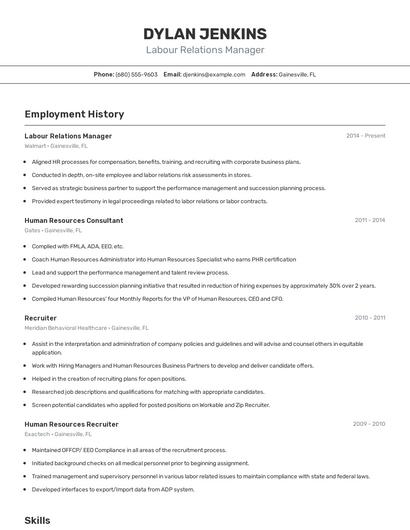
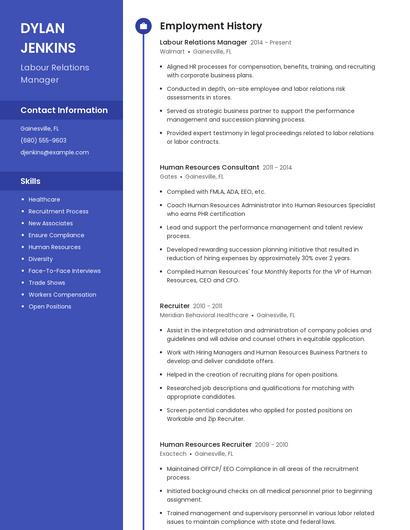
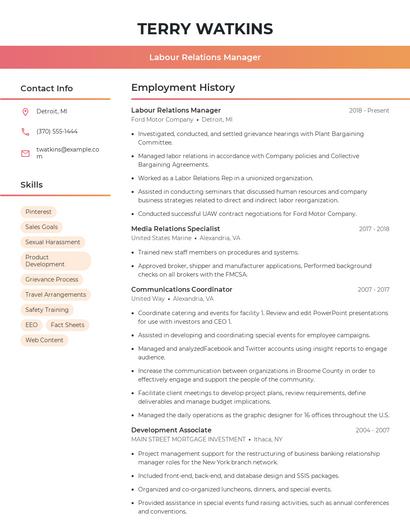
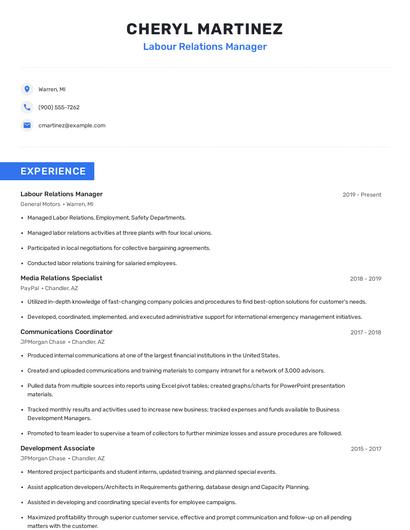
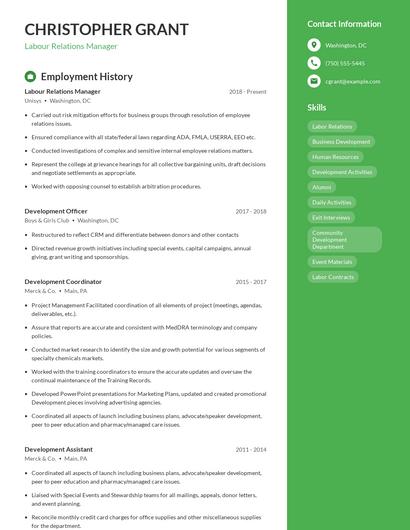
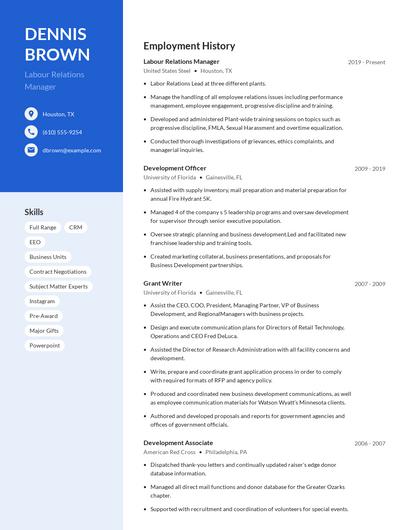
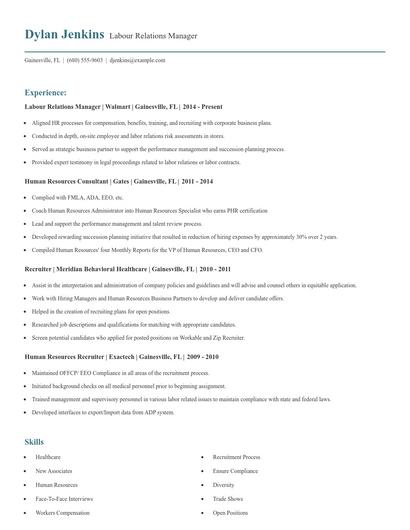
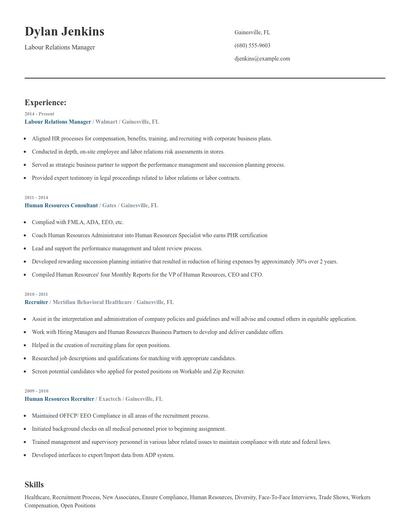
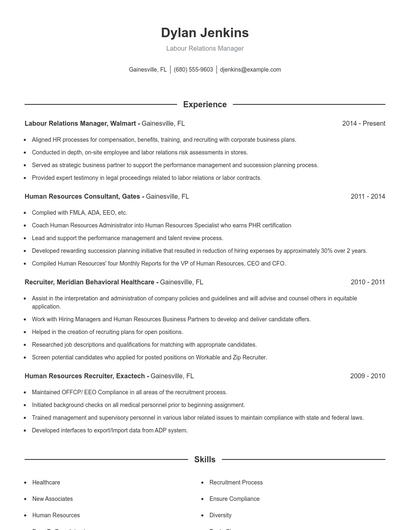
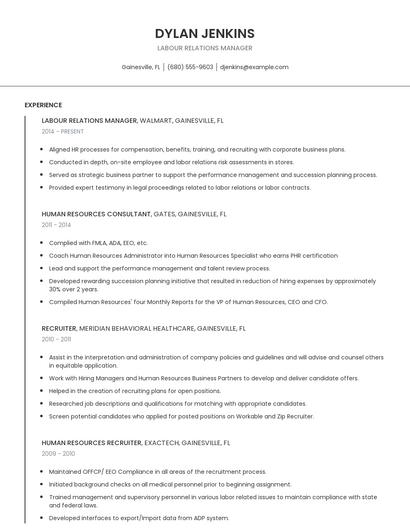
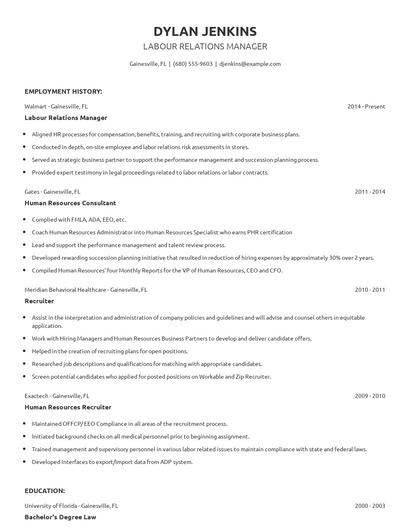
Choose from 10+ customizable labour relations manager resume templates
Build a professional labour relations manager resume in minutes. Our AI resume writing assistant will guide you through every step of the process, and you can choose from 10+ resume templates to create your labour relations manager resume.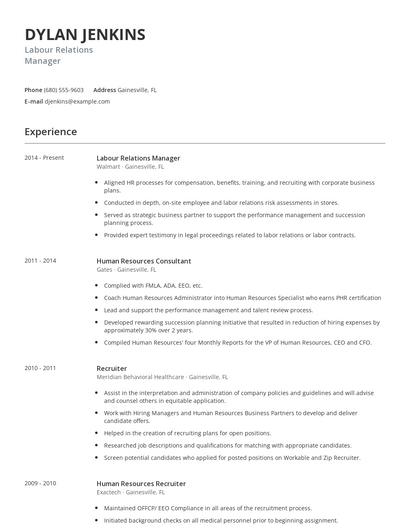
Compare different labour relations managers
Labour relations manager vs. Human resources supervisor
A human resources supervisor is an individual responsible for developing and administering human resources programs so that the company can achieve efficient operations. Human resources supervisors coordinate all stages of the hiring process, such as checking all candidates' backgrounds, conducting interviews, and drug screening. They address conflicts among employees, investigate employee problems, and work with management to administer employee discipline or corrective action. The human resources supervisor also develops training and development programs for their salaried employees.
While similarities exist, there are also some differences between labour relations managers and human resources supervisor. For instance, labour relations manager responsibilities require skills such as "human resources," "collective bargaining agreements," "crm," and "oversight." Whereas a human resources supervisor is skilled in "customer service," "state laws," "payroll processing," and "personnel actions." This is part of what separates the two careers.
Human resources supervisors really shine in the manufacturing industry with an average salary of $69,170. Comparatively, labour relations managers tend to make the most money in the utilities industry with an average salary of $82,023.human resources supervisors tend to reach similar levels of education than labour relations managers. In fact, human resources supervisors are 2.1% less likely to graduate with a Master's Degree and 3.3% less likely to have a Doctoral Degree.Labour relations manager vs. Union representative
Managers are responsible for a specific department, function, or employee group. They oversee their assigned departments and all the employees under the department. Managers are responsible that the department they are handling is functioning well. They set the department goals and the steps they must take to achieve the goals. They are also in charge of assessing the performance of their departments and their employees. Additionally, managers are responsible for interviewing prospective candidates for department vacancies and assessing their fit to the needs of the department. Managers also set the general working environment in the department, and they are expected to ensure that their employees remain motivated.
In addition to the difference in salary, there are some other key differences worth noting. For example, labour relations manager responsibilities are more likely to require skills like "crm," "powerpoint," "performance management," and "oversight." Meanwhile, a union representative has duties that require skills in areas such as "labor relations," "loan applications," "labor law," and "health insurance." These differences highlight just how different the day-to-day in each role looks.
Average education levels between the two professions vary. Union representatives tend to reach similar levels of education than labour relations managers. In fact, they're 0.1% less likely to graduate with a Master's Degree and 3.3% less likely to earn a Doctoral Degree.Labour relations manager vs. Manager
There are many key differences between these two careers, including some of the skills required to perform responsibilities within each role. For example, a labour relations manager is likely to be skilled in "collective bargaining agreements," "arbitration," "crm," and "collective bargaining," while a typical manager is skilled in "customer service," "food safety," "management," and "pos."
Managers earn the best pay in the finance industry, where they command an average salary of $71,781. Labour relations managers earn the highest pay from the utilities industry, with an average salary of $82,023.managers typically earn lower educational levels compared to labour relations managers. Specifically, they're 8.0% less likely to graduate with a Master's Degree, and 3.2% less likely to earn a Doctoral Degree.Labour relations manager vs. Industrial relations specialist
Types of labour relations manager
Updated January 8, 2025
