What does a nutritional services aide do?
A Nutritional Services Aide assists nutritionists and healthcare professionals in identifying and assessing the nutritional needs of clients. Your responsibilities include:
Helping to come up with menus that cater to different dietary categories with consideration to medical conditions present.
Preparing and delivering food to clients in places such as nursing homes.
Reviewing doctor charts to input doctor restricted the planning.
Interact with the clients to determine the effective meal plans and take notes of changes to be made.
Health response the client has to the prepared diet.
Nutritional services aide responsibilities
Here are examples of responsibilities from real nutritional services aide resumes:
- Demonstrate exceptional customer service and interact effectively with physicians, patients, visitors and staff.
- Analyze and accurately verify computer generate orders and determine which items to place on patients' trays for delivery.
- Maintain an excellent standard of cleanliness and ensure that quality standards are meet.
- Guarantee the kitchen meets both rigid hospital standards and industry standards regarding cleanliness and sanitary guidelines.
- Input children diet and cost via POS system.
Nutritional services aide skills and personality traits
We calculated that 23% of Nutritional Services Aides are proficient in Patients, Dishes, and Food Preparation. They’re also known for soft skills such as Listening skills, Dexterity, and Physical strength.
We break down the percentage of Nutritional Services Aides that have these skills listed on their resume here:
- Patients, 23%
Analyzed and accurately verified computer generated orders and determined which items to place on patients' trays for delivery.
- Dishes, 10%
Turn off coffee and clean pots in dish machine Begin washing pans; begin washing dishes as they are ready.
- Food Preparation, 9%
Maintain a highly sanitary environment through daily cleaning of all food preparation/stations.
- Food Service, 8%
Worked directly in the food service program and was able to gain valuable knowledge about food service in the clinical setting.
- Patient Care, 6%
Documented patient care records accurately.
- Meal Service, 4%
Prepare, portions, and stores food for all meal services.
Most nutritional services aides use their skills in "patients," "dishes," and "food preparation" to do their jobs. You can find more detail on essential nutritional services aide responsibilities here:
The three companies that hire the most nutritional services aides are:
- Encompass Health103 nutritional services aides jobs
- Fairview Health Services28 nutritional services aides jobs
- Trinity Health16 nutritional services aides jobs
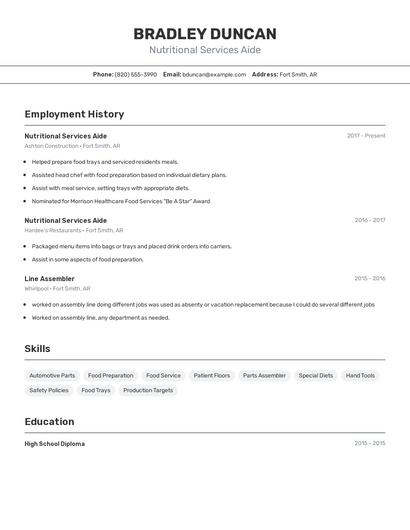
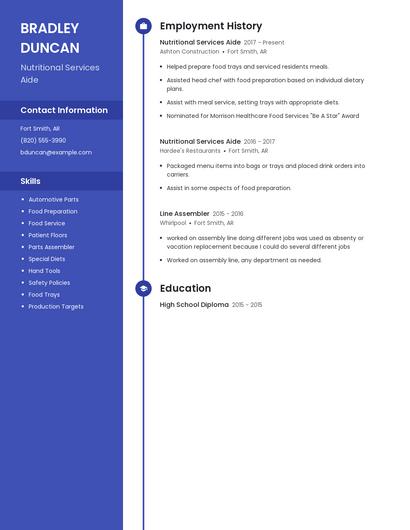
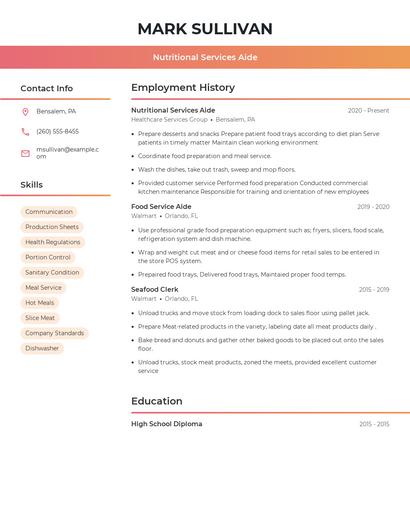
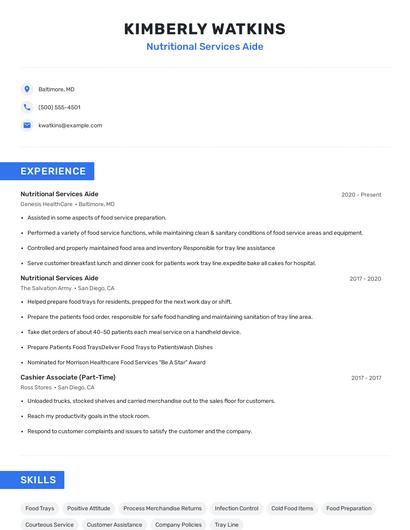
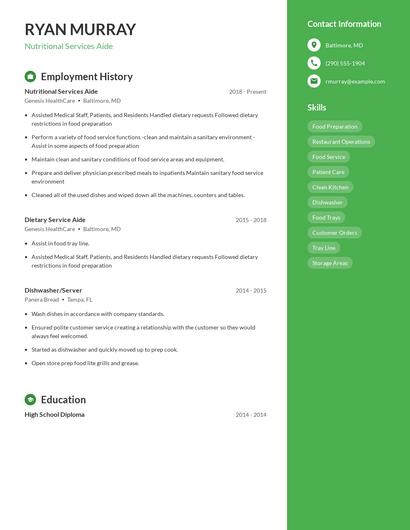
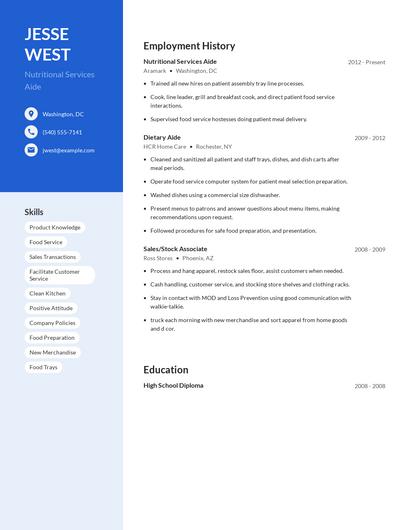
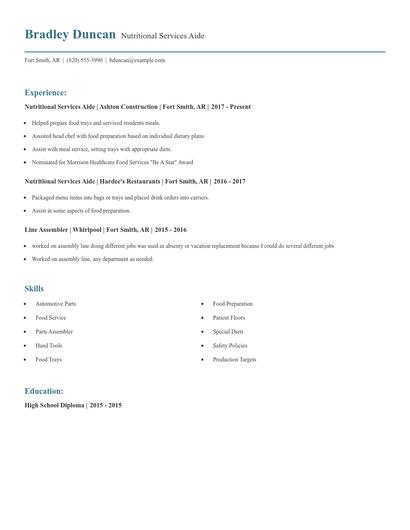
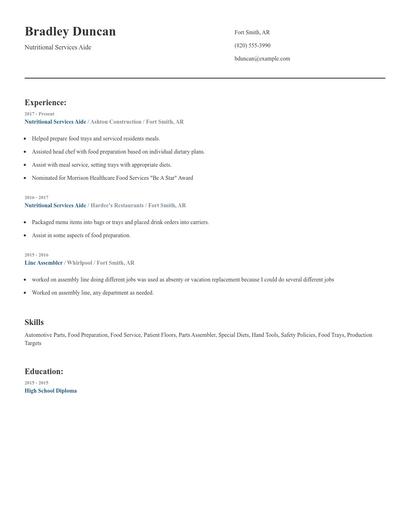
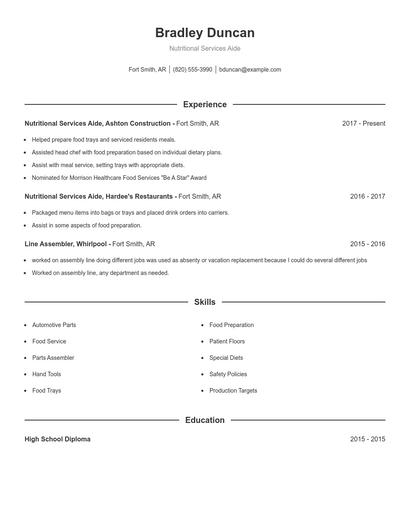
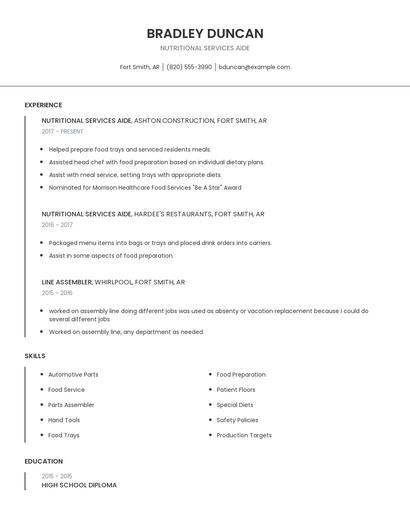
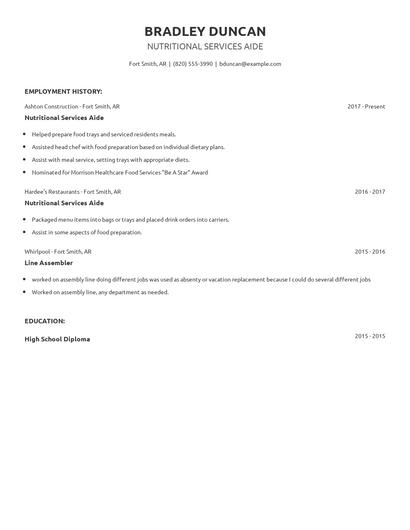
Choose from 10+ customizable nutritional services aide resume templates
Build a professional nutritional services aide resume in minutes. Our AI resume writing assistant will guide you through every step of the process, and you can choose from 10+ resume templates to create your nutritional services aide resume.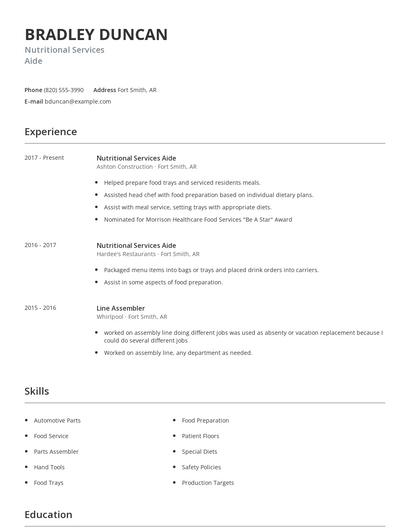
Compare different nutritional services aides
Nutritional services aide vs. Seafood clerk
A seafood clerk is well-trained personnel who has a diverse knowledge of seafood and answers customer questions as well as advises them on the best product to buy depending on what they are looking for. They oversee almost all activities that take place between the time the product is ready for sale to the point where the customer is ready to purchase the product. Their duties and responsibilities include providing customer service and answering all questions related to the products in the market.
These skill sets are where the common ground ends though. The responsibilities of a nutritional services aide are more likely to require skills like "patients," "dishes," "food service," and "patient care." On the other hand, a job as a seafood clerk requires skills like "math," "basic math," "pallets," and "sales floor." As you can see, what employees do in each career varies considerably.
Seafood clerks earn the highest salaries when working in the retail industry, with an average yearly salary of $32,238. On the other hand, nutritional services aides are paid more in the health care industry with an average salary of $29,506.seafood clerks tend to reach similar levels of education than nutritional services aides. In fact, seafood clerks are 0.1% more likely to graduate with a Master's Degree and 0.2% more likely to have a Doctoral Degree.Nutritional services aide vs. Deli worker
A deli worker specializes in handling deli products and providing customer service in retail stores. They are primarily responsible for packaging and labeling products according to their weight and type, assigning prices, sorting out quality, and arranging them on display, all while following food safety and health guidelines. They must also respond to inquiries, suggest products, resolve any issues or concerns, handle special orders, and maintain cleanliness and sanitation. Furthermore, it is crucial to implement all policies and regulations, maintaining a safe and healthy environment for everyone.
While some skills are similar in these professions, other skills aren't so similar. For example, resumes show us that nutritional services aide responsibilities requires skills like "patients," "dishes," "patient care," and "meal service." But a deli worker might use other skills in their typical duties, such as, "premier customer service," "food safety," "deli meats," and "customer orders."
Deli workers may earn a higher salary than nutritional services aides, but deli workers earn the most pay in the energy industry with an average salary of $29,969. On the other hand, nutritional services aides receive higher pay in the health care industry, where they earn an average salary of $29,506.deli workers earn similar levels of education than nutritional services aides in general. They're 0.0% less likely to graduate with a Master's Degree and 0.2% more likely to earn a Doctoral Degree.Nutritional services aide vs. Sandwich artist
Sandwich artists are employees at any restaurant that specializes in sandwiches. They manage the sandwich station and answer any inquiries that customers may have on the different ingredients available. As such, sandwich artists must be familiar with all the ingredients and menu offerings that the restaurant has. They also provide recommendations to customers, crafting sandwiches based on what the customer likes. Once the customer has chosen the contents of the sandwich or a specific menu item, the sandwich artist assembles the order and serves it to the customer.
The required skills of the two careers differ considerably. For example, nutritional services aides are more likely to have skills like "patients," "dishes," "food service," and "patient care." But a sandwich artist is more likely to have skills like "quality standards," "sanitation standards," "professional appearance," and "exceptional guest."
Sandwich artists make a very good living in the retail industry with an average annual salary of $25,042. On the other hand, nutritional services aides are paid the highest salary in the health care industry, with average annual pay of $29,506.sandwich artists typically earn similar educational levels compared to nutritional services aides. Specifically, they're 0.5% less likely to graduate with a Master's Degree, and 0.1% less likely to earn a Doctoral Degree.Nutritional services aide vs. Bakery clerk
A bakery clerk is an employee who is responsible for running the bakery department of supermarkets, boutique bakeries, or baking facilities. Bakery clerks are usually tasked to manage the bakery's cash register, bagging baked goods and then taking customers' payments. They ensure that the display cases inside the bakery are fully stocked with fresh bread and other baked goods. They also assist bakers with baking tasks such as measuring ingredients, mixing dough, or pouring batter.
Even though a few skill sets overlap between nutritional services aides and bakery clerks, there are some differences that are important to note. For one, a nutritional services aide might have more use for skills like "patients," "dishes," "food service," and "patient care." Meanwhile, some responsibilities of bakery clerks require skills like "basic math," "bakery products," "math," and "food safety. "
In general, bakery clerks earn the most working in the retail industry, with an average salary of $30,395. The highest-paying industry for a nutritional services aide is the health care industry.The average resume of bakery clerks showed that they earn similar levels of education compared to nutritional services aides. So much so that theyacirc;euro;trade;re 0.1% more likely to earn a Master's Degree and more likely to earn a Doctoral Degree by 0.1%.Types of nutritional services aide
Updated January 8, 2025
