
Automatically apply for jobs with Zippia
Upload your resume to get started.
Performance manager skills for your resume and career

15 performance manager skills for your resume and career
1. Performance Management
- Developed a core suite of integrated and streamlined Performance Management reports and processes based on corporate, fiduciary and compliance requirements.
- Manage global communications, systems, process improvement and implementation of annual talent and performance management initiatives for over 4,500 employees.
2. Project Management
- Applied Lean Six Sigma Black Belt and Human Performance Technology methodologies to manage department initiatives using Agile project management principles.
- Prepare and brief operational status reports Conduct internal inspections, investigations Project management Operational Logistics Administrative operations
3. Customer Service
Customer service is the process of offering assistance to all the current and potential customers -- answering questions, fixing problems, and providing excellent service. The main goal of customer service is to build a strong relationship with the customers so that they keep coming back for more business.
- Sustained office operations and sales numbers without a storefront, culminating in retail facility earning a regional customer service recognition honor.
- Ensured teams provided consistent customer service and procedural accuracy meeting or exceeding customer and company standards and expectations.
4. Process Improvement
- Identified and managed process improvement programs which upgraded productivity, product quality and facilitated better cost of poor quality metrics.
- Collaborated in development and implementation of business process improvements with the primary objective of reducing cost and increasing efficiency.
5. Performance Improvement
Performance improvement means an overall improvement of a business process to accomplish and achieve enhancement of the efficiency of the function/process, and to make it more profitable and economical, while the stated goals or objectives are accurately achieved and in a cost and time-efficient manner. Performance improvements can occur at several levels, including the employee level, the team level, the department or unit level, and the organization as a whole.
- Facilitate, develop and provide in-service training for all departments as necessary to address performance improvement opportunities and risk reduction strategies.
- Conducted full-scale operational reviews and worked with dealership management to identify opportunities for targeted performance improvement(s).
6. Continuous Improvement
Continuous improvement is an ongoing process of improvement of products, services, and processes with the help of innovative ideas. It is an organized approach that helps an organization to find its weaknesses and improve them.
- Created a comprehensive Inclusion training program directed to improve inclusive management behavior, diversity in the workplace and continuous improvement.
- Leverage KeyCorp's continuous improvement model through the use of performance analysis, productivity analysis, and quality assurance programs.
Choose from 10+ customizable performance manager resume templates
Build a professional performance manager resume in minutes. Our AI resume writing assistant will guide you through every step of the process, and you can choose from 10+ resume templates to create your performance manager resume.7. Business Development
Business development is the ideas or initiatives that work to make business work better. Selling, advertising, product development, supply chain management, and vendor management are only a few of the divisions involved with it. There is still a lot of networking, negotiating, forming alliances, and trying to save money. The goals set for business development guide and coordinate with all of these various operations and sectors.
- Control project costs, identify business development opportunities, and mentor/manage performance of team members.
- Developed dashboards and chose metrics to inform managers about the progress of business development activities
8. SQL
- Slashed overhead costs by developing R scripts and SQL queries to streamline analyses previously done in Excel.
- Developed and scheduled packages in SQL Server to facilitate daily data processing and report on status.
9. Data Analysis
- Determined specified performance problems using statistics and modeling; examine for solutions using data analysis practices and arrange analysis reports.
- Created methodologies and procedures for carrying out effectual data analysis.
10. Performance Metrics
- Generated production reports for IT leadership which tracked IT divisional expenses, service level performance metrics and customer/employee satisfaction survey results.
- Create performance metrics for reporting and analysis of individual vendor performance and monitor their adherence to contractual Service Level Agreements.
11. Sigma
In Greek alphabets, sigma is the 18th letter that means "to sum up". In statistics, the lower case symbol of sigma is the unit of measurement for standard deviation which is used to assess the variability in a given set of data. While the upper case symbol is for summation notation means to add up all the given numbers in the data set.
- Build and implemented Lean Six Sigma problem solving capability under NCE Focused Improvement Pillar resulting in $3Mio in annual savings.
- Developed and delivered lean six sigma and quality improvement training to health commissioner's staff and to the six commissions.
12. KPIs
- Monitored supplier performance through annual performance reviews, developed supplier performance measurements and KPIs.
- Managed KPIs for Sales channel managers, monitored sales provisioning from E2E, and replaced local terminology with corporate definitions.
13. Sales Process
- Developed Standard Operating Procedures to minimize inventory loss and streamline sales processes.
- Conducted integrity investigations to ensure sales process, design was executed.
14. Lean Six Sigma
- Led Lean Six Sigma projects across all business units.
- Lean Champion, led site to attaining the highest lean six sigma evaluation score across all operations within 9 months.
15. Data Collection
Data collection means to analyze and collect all the necessary information. It helps in carrying out research and in storing important and necessary information. The most important goal of data collection is to gather the information that is rich and accurate for statistical analysis.
- Consolidated data sources and refined data collection processes by designing and developing an interim CRM system.
- Designed, coordinated and managed the performance of data collection and regulatory data entry.
5 Performance Manager resume examples
Build a professional performance manager resume in minutes. Browse through our resume examples to identify the best way to word your resume. Then choose from 5+ resume templates to create your performance manager resume.

What skills help Performance Managers find jobs?
Tell us what job you are looking for, we’ll show you what skills employers want.
List of performance manager skills to add to your resume
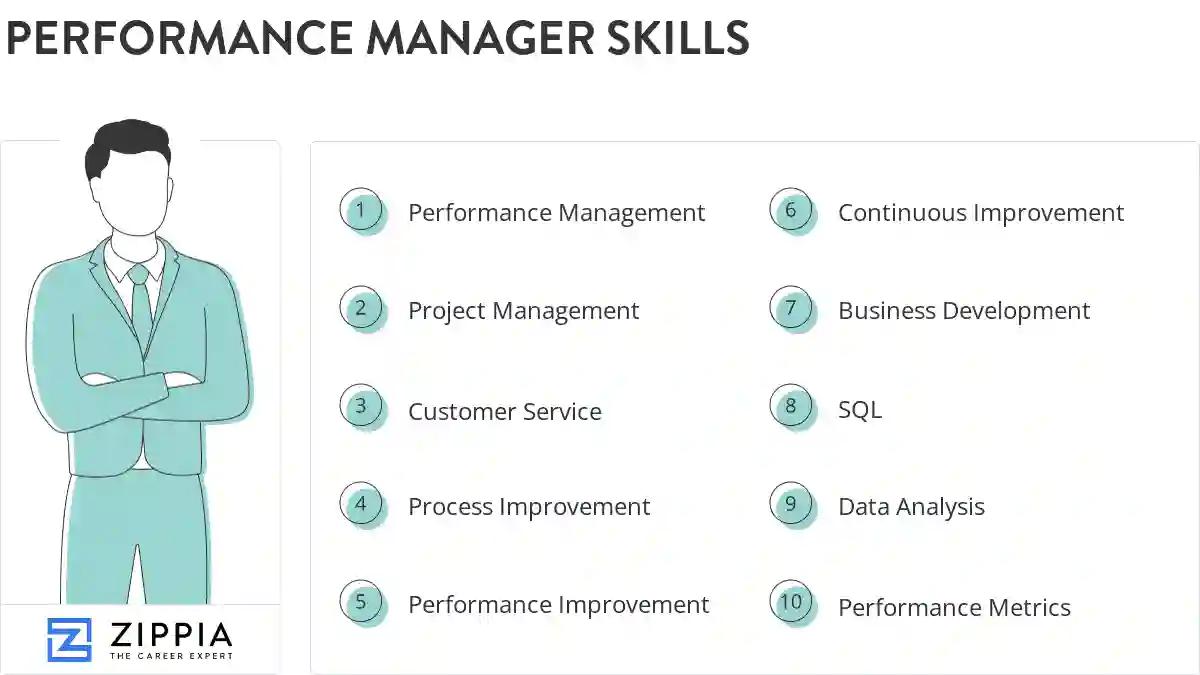
The most important skills for a performance manager resume and required skills for a performance manager to have include:
- Performance Management
- Project Management
- Customer Service
- Process Improvement
- Performance Improvement
- Continuous Improvement
- Business Development
- SQL
- Data Analysis
- Performance Metrics
- Sigma
- KPIs
- Sales Process
- Lean Six Sigma
- Data Collection
- Digital Marketing
- Customer Satisfaction
- Performance Reviews
- PMO
- HR
- Prototyping
- Corrective Action
- Shared Services
- Strong Analytical
- Medicare
- Strategic Sourcing
- Operational Performance
- Sales Performance
- Financial Analysis
- Lifecycle Management
- Performance Data
- OSHA
- Performance Issues
- QA
- CRM
- Quality Standards
- Team Work
- Performance Measures
- CMS
- Training Materials
- Ongoing Support
- ROI
- Management System
- Strategic Plan
- Calculation
- Employee Engagement
- STARS
Updated January 8, 2025
