What does a process chemist do?
Process chemists are lab professionals who perform qualitative and quantitative analyses of chemicals in laboratories for quality control or to develop new products. These chemists are required to develop synthetic plans and run experiments to test their suitability for large-scale use. They must use different analytical methods and modeling software to monitor the reaction processes of chemicals as well as determine how changes in the process affect the final product. Process chemists must also be familiar with regulations from the Food and Drug Administration (FDA), Environmental Protection Agency (EPA), and Occupational Safety & Health Administration (OSHA).
Process chemist responsibilities
Here are examples of responsibilities from real process chemist resumes:
- Manage synthesis and production of specialty chemicals for carpet and textile industry.
- Support new, modify and existing chemical processes by developing and validating HPLC and GC methods with a rapid turnaround time.
- Analyze unknown materials with FTIR, Raman, and SEM-EDS.
- Display improving working knowledge of business processes as they relate to GMP manufacturing.
- Create titration solution and other solutions such as stock solutions used in analysis.
- Show a desire to learn about and understand advance chemistry principles underlying project assignments.
- Establish a formal program for housekeeping, safety, and ISO compliance for the lab.
- Develop QC methodology using UV/Vis.
- Perform element analysis using AA spectrometer.
- Experience with computer interface GC analysis and troubleshooting.
- Develop HPLC methods for purity analysis of intermediates and final product.
- Investigate synthetic routes towards novel templates for SAR development using traditional medicinal chemistry.
- Monitor manufacturing systems via GC analysis and perform adjustments in accordance with standard operating procedures.
- Coordinate with chemical suppliers and implement ISO standard quality systems and registering chemicals through government agencies protocols.
- Manufacture many peptides under cGMP using various modern high performance liquidchromatography techniques, standard laboratory instruments and equipment.
Process chemist skills and personality traits
We calculated that 7% of Process Chemists are proficient in Lab Equipment, HPLC, and R. They’re also known for soft skills such as Analytical skills, Communication skills, and Math skills.
We break down the percentage of Process Chemists that have these skills listed on their resume here:
- Lab Equipment, 7%
Manage calibration and preventative maintenance of lab equipment.
- HPLC, 6%
Developed HPLC methods for purity analysis of intermediates and final product.
- R, 5%
Used R, SSL, and SQL programming to identify and fix multiple processing and GUI problems with StarLIMS v9.
- GMP, 5%
Train new and existing chemists in GMP compliance and manufacturing procedures.
- NMR, 4%
Maintained sophisticated NMR equipment as a value-added service to Process Development.
- Sigma, 4%
Investigate out of specification products and process variance for root-cause utilizing all resources with a six sigma approach.
"lab equipment," "hplc," and "r" are among the most common skills that process chemists use at work. You can find even more process chemist responsibilities below, including:
Analytical skills. To carry out their duties, the most important skill for a process chemist to have is analytical skills. Their role and responsibilities require that "chemists and materials scientists need to evaluate the results of experiments to ensure accuracy in their research." Process chemists often use analytical skills in their day-to-day job, as shown by this real resume: "recorded data per fda 21 cfr. "
Communication skills. Many process chemist duties rely on communication skills. "chemists and materials scientists must be able to convey information clearly in reports and presentations for both technical and nontechnical audiences.," so a process chemist will need this skill often in their role. This resume example is just one of many ways process chemist responsibilities rely on communication skills: "communicate detailed ideas concisely through written communication by writing technical reports. "
Math skills. This is an important skill for process chemists to perform their duties. For an example of how process chemist responsibilities depend on this skill, consider that "chemists and materials scientists regularly use calculus, algebra, statistics, and other math for calculations." This excerpt from a resume also shows how vital it is to everyday roles and responsibilities of a process chemist: "performed process validation and scale up experiments on glucose, quantitative and qualitative hcg assays. ".
Organizational skills. For certain process chemist responsibilities to be completed, the job requires competence in "organizational skills." The day-to-day duties of a process chemist rely on this skill, as "chemists and materials scientists must document processes carefully when conducting experiments, tracking outcomes, and analyzing results." For example, this snippet was taken directly from a resume about how this skill applies to what process chemists do: "well versed in implementing standard operating procedures, organizational policies, and analytical methodologies accurately and consistently. "
Problem-solving skills. Another crucial skill for a process chemist to carry out their responsibilities is "problem-solving skills." A big part of what process chemists relies on this skill, since "chemists’ and materials scientists’ work involves posing questions during research and finding answers through results." How this skill relates to process chemist duties can be seen in an example from a process chemist resume snippet: "created safe procedural solutions for chemical reactions to run that were initially identified as problematic. "
Time-management skills. While "time-management skills" is last on this skills list, don't underestimate its importance to process chemist responsibilities. Much of what a process chemist does relies on this skill, seeing as "chemists and materials scientists usually need to meet deadlines and must be able to prioritize tasks while maintaining quality." Here is a resume example of how this skill is used in the everyday duties of process chemists: "replaced customer recommended solvent and reduced distillation time by 60%. "
The three companies that hire the most process chemists are:
- System One3 process chemists jobs
- Cambrex2 process chemists jobs
- Celanese2 process chemists jobs
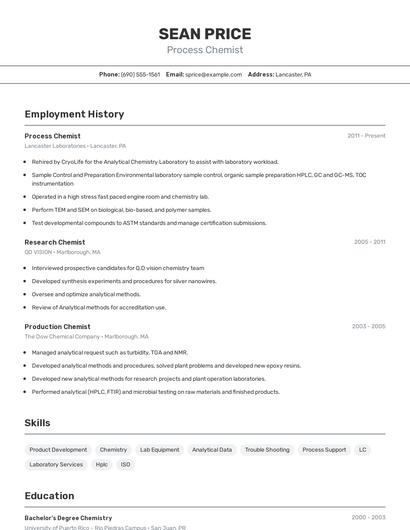
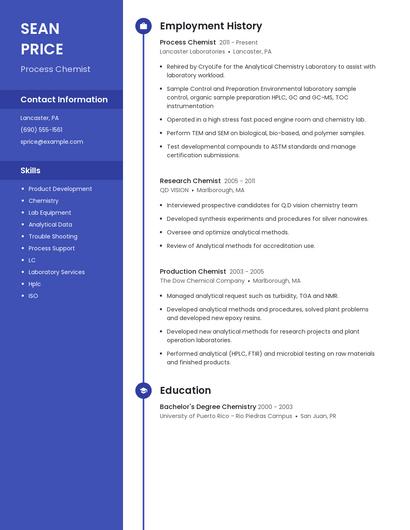
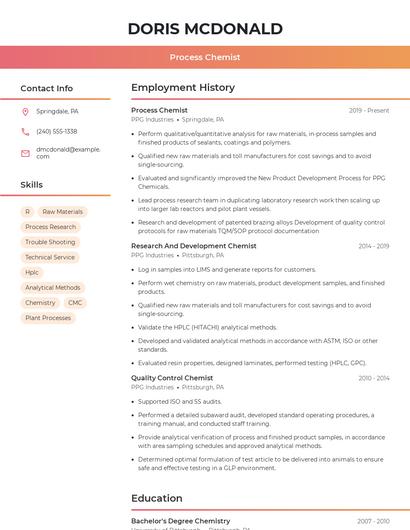
Choose from 10+ customizable process chemist resume templates
Build a professional process chemist resume in minutes. Our AI resume writing assistant will guide you through every step of the process, and you can choose from 10+ resume templates to create your process chemist resume.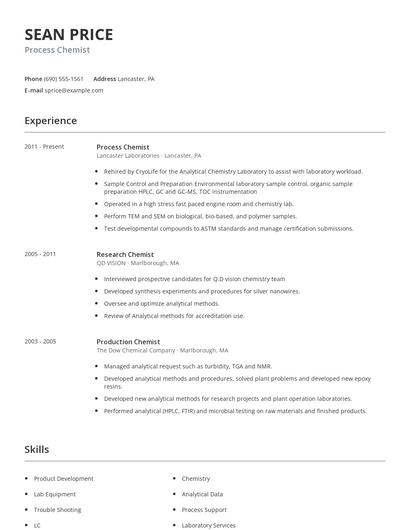
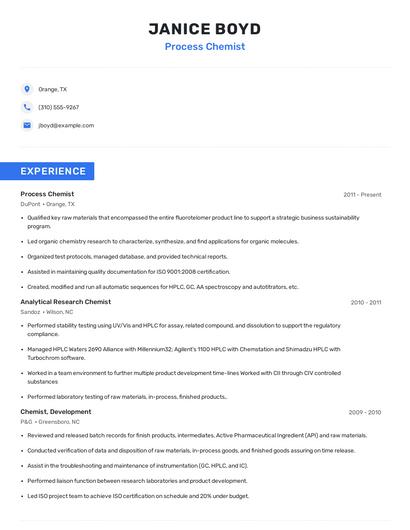
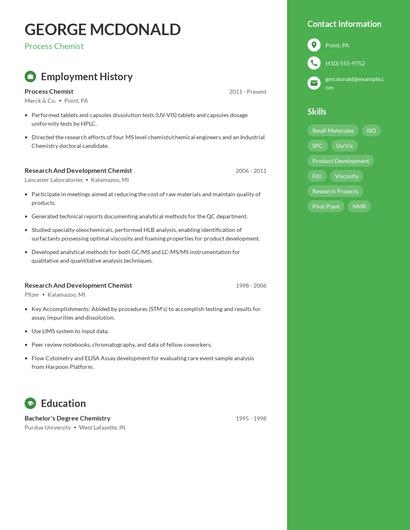
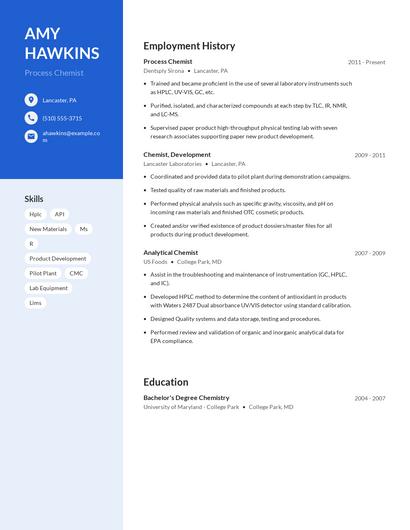
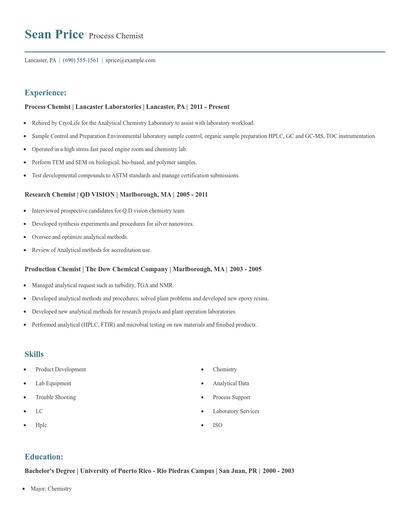
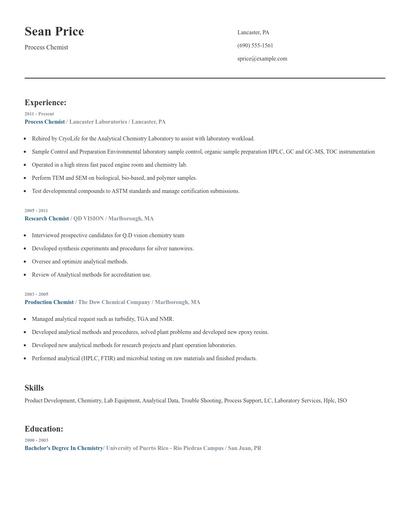
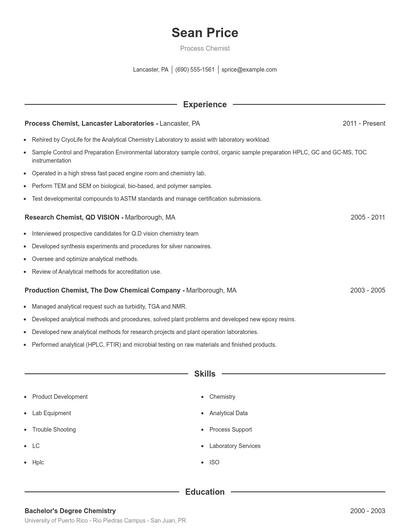
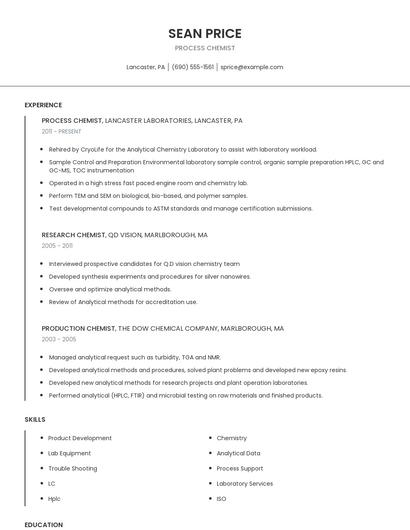
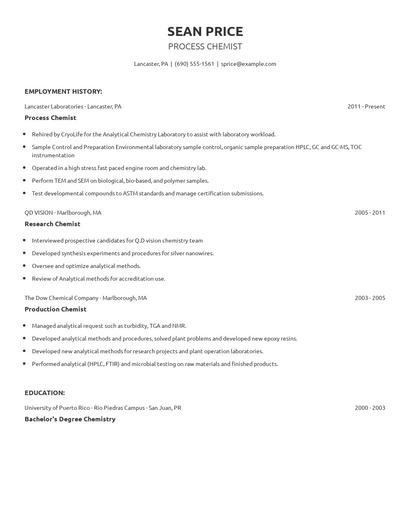
Compare different process chemists
Process chemist vs. Quality control
As the name entails, the job of a quality control inspector is to inspect, maintain, and improve the quality and standard of products. They are responsible for ensuring the company's reputation is not damaged due to defective products or inferior manufacturing processes. This can be done by detecting and resolving the problem early on, and returning the product for repair. A quality control inspector should also notify the supervisors immediately when issues arise and coordinate with them to address the problem.
While similarities exist, there are also some differences between process chemists and quality control. For instance, process chemist responsibilities require skills such as "lab equipment," "nmr," "sigma," and "chemical processes." Whereas a quality control is skilled in "quality checks," "safety standards," "laboratory equipment," and "test results." This is part of what separates the two careers.
Quality controls earn the highest salaries when working in the technology industry, with an average yearly salary of $36,096. On the other hand, process chemists are paid more in the manufacturing industry with an average salary of $86,118.The education levels that quality controls earn slightly differ from process chemists. In particular, quality controls are 6.0% less likely to graduate with a Master's Degree than a process chemist. Additionally, they're 6.7% less likely to earn a Doctoral Degree.Process chemist vs. Quality control associate
In a manufacturing setting, a quality control associate is in charge of conducting various tests to ensure that the products meet the company's standard criteria. Their responsibilities revolve around inspecting the workforce and workload involved in the production process, identifying errors or inconsistencies, recommending solutions and alterations, and maintaining records and documentation. Furthermore, as a quality control associate, it is essential to coordinate with department staff and produce progress reports, all while adhering to the company's policies and regulations.
Each career also uses different skills, according to real process chemist resumes. While process chemist responsibilities can utilize skills like "lab equipment," "nmr," "sigma," and "chemical processes," quality control associates use skills like "laboratory equipment," "test methods," "environmental monitoring," and "test results."
Quality control associates earn a lower average salary than process chemists. But quality control associates earn the highest pay in the health care industry, with an average salary of $54,631. Additionally, process chemists earn the highest salaries in the manufacturing with average pay of $86,118 annually.quality control associates earn similar levels of education than process chemists in general. They're 4.0% less likely to graduate with a Master's Degree and 6.7% less likely to earn a Doctoral Degree.What technology do you think will become more important and prevalent for process chemists in the next 3-5 years?
Dr. Betsy Smith
Assistant Professor of Chemistry, Elmira College
Process chemist vs. Quality control analyst
Quality assurance representatives are professionals who are responsible for ensuring the quality of units produced or manufactured is following the standards set by the industry. These representatives supervise the entire production process to identify erroneous methods or tools being used by workers and observing produced for visible defects. They are required to perform various tests to check for the durability of the product and other desirable characteristics. Quality assurance representatives must also collaborate with the manufacturing engineer to implement quality control programs and preparing training manuals and quality guidelines.
There are many key differences between these two careers, including some of the skills required to perform responsibilities within each role. For example, a process chemist is likely to be skilled in "gmp," "nmr," "sigma," and "chemical processes," while a typical quality control analyst is skilled in "microbiology," "test methods," "test results," and "environmental monitoring."
Quality control analysts earn the highest salary when working in the manufacturing industry, where they receive an average salary of $62,870. Comparatively, process chemists have the highest earning potential in the manufacturing industry, with an average salary of $86,118.quality control analysts typically earn similar educational levels compared to process chemists. Specifically, they're 1.7% less likely to graduate with a Master's Degree, and 6.6% less likely to earn a Doctoral Degree.Process chemist vs. Quality control coordinator
A quality control coordinator is in charge of organizing and overseeing an organization's quality control procedures, ensuring efficiency and smooth workflow. They coordinate teams and activities, delegate tasks, conduct audits, set goals, establish guidelines, gather and analyze client feedback, and develop strategies to optimize operations. They must also conduct inspections to ensure the facility's compliance with state laws and standards. Furthermore, a quality control coordinator must monitor the progress of all operations, resolving issues promptly and efficiently while adhering to the company's policies and regulations.
Types of process chemist
Updated January 8, 2025
