What does a process improvement manager do?

Process Improvement Managers oversee the operational processes of the company. These processes are usually related to production, sales, marketing, human resources, or finance. Process Improvement Managers are in charge of creating policies and procedures to guide the company's different departments. They analyze related data and craft recommendations to improve the procedures. They ensure that their recommendations lead to higher efficiency. Process Improvement Managers also ensure that these new processes are implemented properly and yield results.
Process improvement manager responsibilities
Here are examples of responsibilities from real process improvement manager resumes:
- Manage enterprise applications such as ERP, CRM and commissions calculating software.
- Manage projects and require personnel utilizing PMI tools and best practices from project initiation to close down.
- Lead department through SharePoint implementation.
- Focus are process, resource management and governance improvement opportunities to achieve breakthrough performance.
- Lead successful, on-time, and on budget implementation of antiquate plant systems infrastructure and manufacturing enterprise applications.
- Coordinate product re-launch project to execute Kanban program achieving target inventory level requirements improving lead time reduction from 12wks to 2wks.
- Identify KPI (key process inputs) and KPO's (key process outputs).
- Upgrade operator HMI and electrical interface systems.
- Execute rapid improvement, DMAIC and VSA events ship-wide.
- Prepare study teams for FDA inspections and other audit activities.
- Provide DCS programming for ABB Bailey INFI-90 and Honeywell TDC3000.
- Create and implement SalesForce CRM apps and modules to provide greater visibility across departments.
- Prepare for and represent the engineering department in FDA, ISO and internal audits.
- Facilitate activities to drive culture change toward the continuous improvement journey using the PDCA methodology.
- Implement a visual KanBan system for paint & sealers, which eliminate shortages for those items.
Process improvement manager skills and personality traits
We calculated that 15% of Process Improvement Managers are proficient in Sigma, Lean Six Sigma, and Project Management. They’re also known for soft skills such as Leadership skills, Management skills, and Communication skills.
We break down the percentage of Process Improvement Managers that have these skills listed on their resume here:
- Sigma, 15%
Championed cross-functional process improvement initiatives using Six Sigma methodologies to improve quality, productivity, issue resolution, and operational readiness.
- Lean Six Sigma, 13%
Championed and performed Lean Six Sigma/CPI projects within Marine Aircraft Group 24 in Kaneohe Bay, HI.
- Project Management, 10%
Mentored twenty project facilitators in the use of continuous improvement concepts, project facilitation, and project management principles.
- Process Improvement, 8%
Spearheaded the development of project hopper, which identified and prioritized process improvement projects that improved turnaround time for patients nationally.
- Kaizen, 3%
Facilitated KAIZEN events within 4 operational departments in 2015 with $78,000 in savings in both material and productivity.
- Value Stream, 3%
Reported to Plant manager for Team development and execution of the Lean Transformation and Strategy Deployment Plans for all Value Streams.
Common skills that a process improvement manager uses to do their job include "sigma," "lean six sigma," and "project management." You can find details on the most important process improvement manager responsibilities below.
Leadership skills. One of the key soft skills for a process improvement manager to have is leadership skills. You can see how this relates to what process improvement managers do because "top executives must be able to shape and direct an organization by coordinating policies, people, and resources." Additionally, a process improvement manager resume shows how process improvement managers use leadership skills: "provided team leadership and hr subject matter expertise for the reorganization of over 120 field sales positions into a market-focused team. "
Communication skills. process improvement managers are also known for communication skills, which are critical to their duties. You can see how this skill relates to process improvement manager responsibilities, because "top executives must be able to convey information clearly and persuasively." A process improvement manager resume example shows how communication skills is used in the workplace: "created internal sharepoint system to consolidate and streamline communication processes and increase access to critical business data and policies. "
Time-management skills. A big part of what process improvement managers do relies on "time-management skills." You can see how essential it is to process improvement manager responsibilities because "top executives do many tasks concurrently to ensure that their work gets done and that the organization meets its goals." Here's an example of how this skill is used from a resume that represents typical process improvement manager tasks: "follow up as a pm all the requirements and activities needed to achieve goals, deadlines and process improvement initiatives. "
Problem-solving skills. Another crucial skill for a process improvement manager to carry out their responsibilities is "problem-solving skills." A big part of what process improvement managers relies on this skill, since "top executives need to identify and resolve issues within an organization." How this skill relates to process improvement manager duties can be seen in an example from a process improvement manager resume snippet: "completed several major initiatives including the implementation of a salary planning solution and co-managing a major erp upgrade. "
The three companies that hire the most process improvement managers are:
- Elevance Health
28 process improvement managers jobs
- PRA Group Careers14 process improvement managers jobs
- DoorDash11 process improvement managers jobs
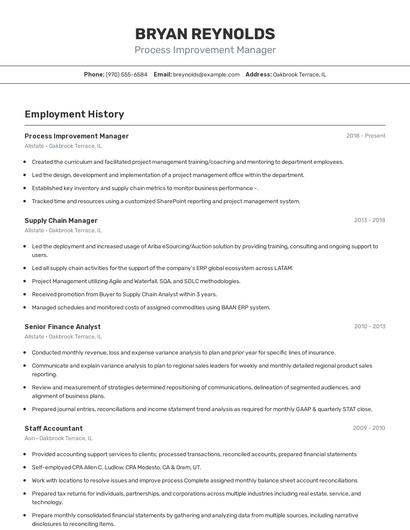
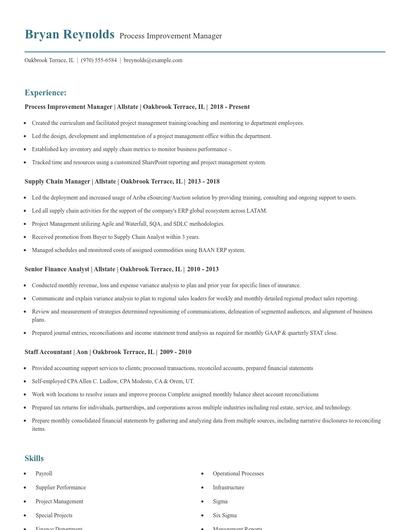
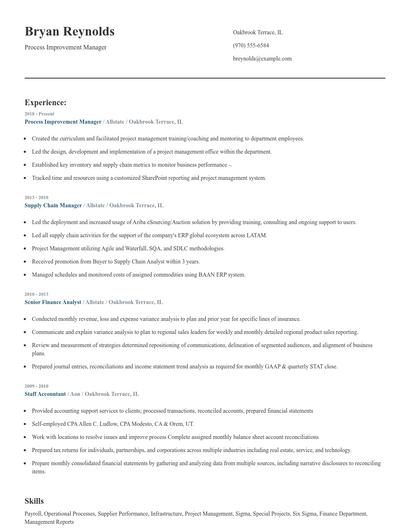
Choose from 10+ customizable process improvement manager resume templates
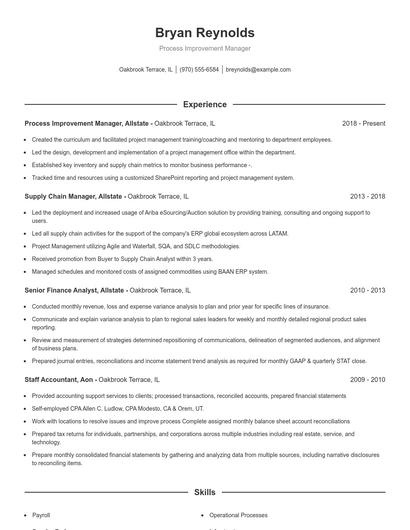
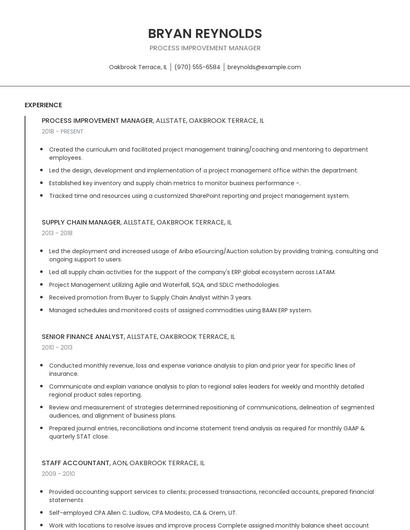
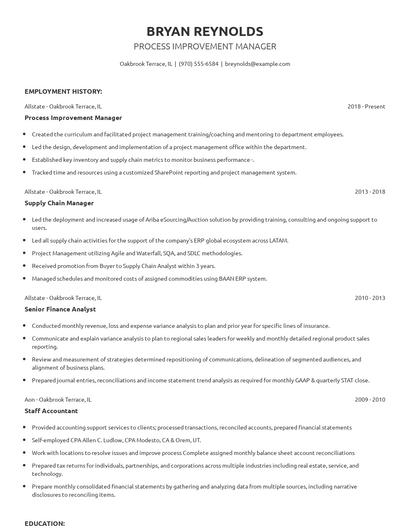
Build a professional process improvement manager resume in minutes. Our AI resume writing assistant will guide you through every step of the process, and you can choose from 10+ resume templates to create your process improvement manager resume.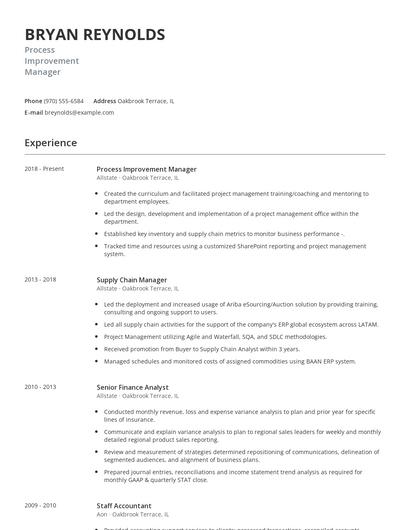


Compare different process improvement managers
Process improvement manager vs. Business leader
Business Leaders are considered trailblazers in their field. They are innovative thinkers who often introduce solutions to their industry's challenges. They inspire people pursuing careers in their field and even those outside the industry to strive harder and create their paths to success. Employees often look up to Business Leaders, which is why they must be motivating. They also oversee their business operations and often set long-term targets and strategies to achieve these targets. They think outside the box to set their business apart from their competitors.
There are some key differences in the responsibilities of each position. For example, process improvement manager responsibilities require skills like "value stream," "dmaic," "management process," and "kpis." Meanwhile a typical business leader has skills in areas such as "digital transformation," "analytics," "customer service," and "business process." This difference in skills reveals the differences in what each career does.
Business leaders tend to make the most money working in the pharmaceutical industry, where they earn an average salary of $128,816. In contrast, process improvement managers make the biggest average salary, $99,802, in the technology industry.On average, business leaders reach similar levels of education than process improvement managers. Business leaders are 1.4% more likely to earn a Master's Degree and 0.1% more likely to graduate with a Doctoral Degree.Process improvement manager vs. Day manager
A day manager oversees the daily operations of an organization, ensuring everything runs smoothly and efficiently according to company standards and regulations. As a day manager, it is their duty to set priorities and goals, establish timelines and guidelines, manage budgets, delegate responsibilities among teams, and supervise staff performances, solving issues or concerns when any arise. They are also responsible for coordinating with night workers or managers, developing reports as necessary. Moreover, they lead staff to reach goals and implement company regulations and policies.
Each career also uses different skills, according to real process improvement manager resumes. While process improvement manager responsibilities can utilize skills like "sigma," "lean six sigma," "project management," and "process improvement," day managers use skills like "pet," "cpr," "customer service," and "safety standards."
Day managers earn lower levels of education than process improvement managers in general. They're 12.8% less likely to graduate with a Master's Degree and 0.1% less likely to earn a Doctoral Degree.Process improvement manager vs. Studio manager
A studio manager is responsible for monitoring a studio's operations and managing the staff's performance and duties, depending on the industry they are employed. Studio managers ensure that the studio operations maintain maximum productivity and efficiency to provide the customers' best services and improve company profits. They also process client accounts, maintaining studio resources, and creating marketing campaigns to promote the business. A studio manager must have excellent communication and leadership skills, especially negotiating contracts with the clients and responding to their inquiries and concerns.
The required skills of the two careers differ considerably. For example, process improvement managers are more likely to have skills like "sigma," "lean six sigma," "project management," and "process improvement." But a studio manager is more likely to have skills like "grass," "cleanliness," "yoga," and "marketing campaigns."
Most studio managers achieve a lower degree level compared to process improvement managers. For example, they're 12.3% less likely to graduate with a Master's Degree, and 0.5% less likely to earn a Doctoral Degree.Process improvement manager vs. Night manager
A night manager is an individual employee who is responsible for all hotel operations during the night. Night managers must assist the front office manager in all areas of the department, including managing front desk staff, payroll, and enforcing financial control. They collaborate and train associates to respond to customers' queries and complaints positively. They must also maintain a professional and high-quality service-oriented environment. Night managers must possess a bachelor's degree in hotel management or related field.
Even though a few skill sets overlap between process improvement managers and night managers, there are some differences that are important to note. For one, a process improvement manager might have more use for skills like "sigma," "lean six sigma," "project management," and "process improvement." Meanwhile, some responsibilities of night managers require skills like "cash handling," "customer service," "safety procedures," and "front desk. "
The professional industry tends to pay the highest salaries for night managers, with average annual pay of $42,066. Comparatively, the highest process improvement manager annual salary comes from the technology industry.The average resume of night managers showed that they earn lower levels of education compared to process improvement managers. So much so that theyacirc;euro;trade;re 14.8% less likely to earn a Master's Degree and less likely to earn a Doctoral Degree by 0.3%.Types of process improvement manager
Updated January 8, 2025
