What does a program trainer do?
A program trainer is a training specialist or expert who teaches the use of computer programs or applications. Software trainers are expected to have the ability to effectively explain the technical aspects and complexities of computer software. They teach the basics of spreadsheets, word processors, advanced network systems software, and other computer applications. Knowledge in computer software, technical skills, teaching skills, and strong analytical thinking is a must in this job.
Program trainer responsibilities
Here are examples of responsibilities from real program trainer resumes:
- Lead project management, curriculum writing and pilot facilitation in collaboration with advisory team.
- Serve insurance members with complete and accurate information regarding Medicare, Medicaid and insurance coverage benefits.
- Maintain cleanliness and sanitation of restaurant including all tables, floors, windows, and beverage station, restroom, etc
- Deliver train-the-trainer curriculum to SME appoint trainers.
- Develop eLearning modules that simulate mainframe system.
- Assist Medicare beneficiaries with eligibility questions, coverage and claim issues.
- Monitor group of individuals diagnose with autism and other severe mental disorders.
- Develop and maintain departmental training material through SharePoint and the company learning management system.
- Cite for excellence in interpersonal communications, teamwork, compassion, flexibility and reliability.
- Create and execute individual development plans design to assist youth residents who are diagnosed with autism.
- Conceptualize and supervise company-wide sales competition performance, with consistent focus on reaching quarterly and fiscal year goals.
- Monitor budgets and payroll records, and review financial transactions to ensure that expenditures are authorize and budget adequately.
- Create feedback and progress reports regarding development for on boarding new associates and provide official information on a SharePoint database.
- Receive recognition as top level trainer for training to sales conversions in addition to winning numerous company presentation/vehicle walk around competitions.
- Coordinate with BOH manager in formulating employee performance improvement plans
Program trainer skills and personality traits
We calculated that 15% of Program Trainers are proficient in Work Ethic, PowerPoint, and On-The-Job Training. They’re also known for soft skills such as Analytical skills, Creativity, and Instructional skills.
We break down the percentage of Program Trainers that have these skills listed on their resume here:
- Work Ethic, 15%
Developed occupational workshops on work ethics and performance.
- PowerPoint, 14%
Go over a PowerPoint presentation with New Hires and Trainer.
- On-The-Job Training, 12%
Received on-the-job training in customer service excellence and cash handling while working at the Pac Tower Caf .
- Professional Development, 8%
Facilitated professional development training for second year teachers.
- Training Classes, 7%
Conducted job training classes for new employees teaching principles, techniques, procedures and methods of At&T U- Verse.
- Customer Service, 5%
Conducted quality assurance testing for proprietary file management and customer service management systems which improved the user experience across departments.
"work ethic," "powerpoint," and "on-the-job training" are among the most common skills that program trainers use at work. You can find even more program trainer responsibilities below, including:
Analytical skills. To carry out their duties, the most important skill for a program trainer to have is analytical skills. Their role and responsibilities require that "training and development specialists must evaluate training programs, methods, and materials and choose those that best fit each situation." Program trainers often use analytical skills in their day-to-day job, as shown by this real resume: "performed weekly group presentations for financial analysis on market sector analysis and forecast. "
Creativity. Another soft skill that's essential for fulfilling program trainer duties is creativity. The role rewards competence in this skill because "specialists should be resourceful when developing training materials." According to a program trainer resume, here's how program trainers can utilize creativity in their job responsibilities: "utilized effective presentation and facilitation skills with creative training techniques. "
Instructional skills. This is an important skill for program trainers to perform their duties. For an example of how program trainer responsibilities depend on this skill, consider that "training and development specialists deliver employee training programs." This excerpt from a resume also shows how vital it is to everyday roles and responsibilities of a program trainer: "created, designed, modified and prepared instructional material like videos, power point presentations, charts etc for various training programs".
Communication skills. program trainer responsibilities often require "communication skills." The duties that rely on this skill are shown by the fact that "training and development specialists must convey information clearly and facilitate learning to diverse audiences." This resume example shows what program trainers do with communication skills on a typical day: "designed, produced training/professional development communications system. "
The three companies that hire the most program trainers are:
- Express Oil Change & Tire Engineers67 program trainers jobs
- Quad15 program trainers jobs
- Palm Beach Tan12 program trainers jobs
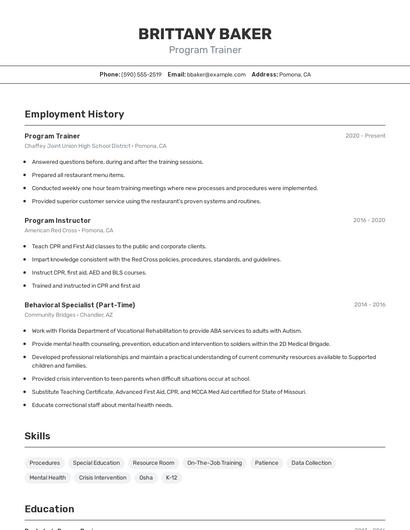
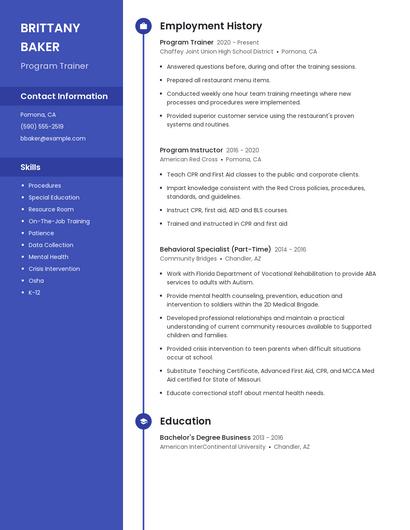
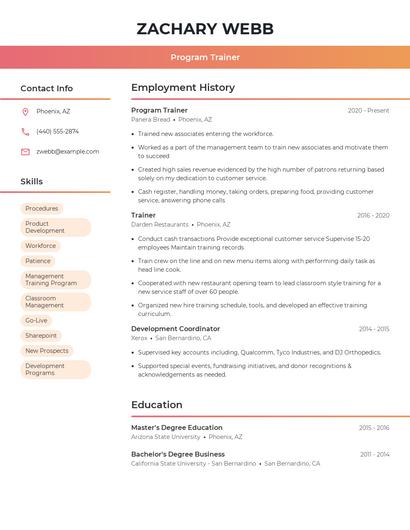
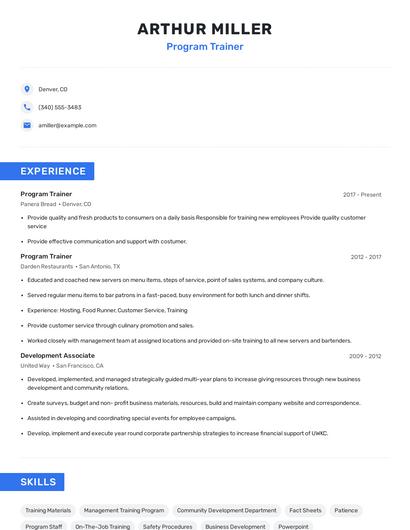
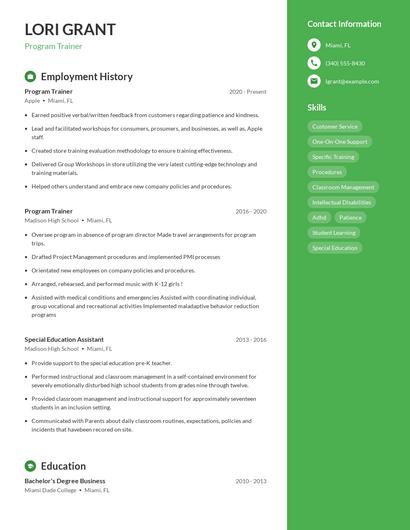
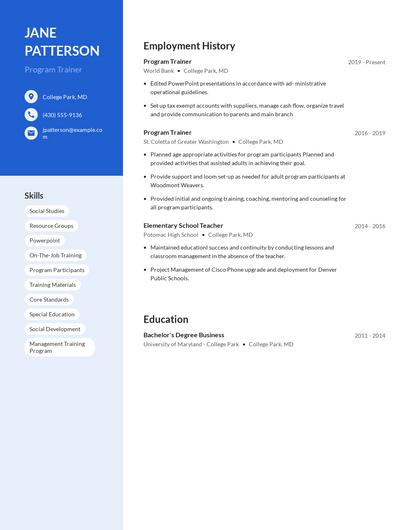
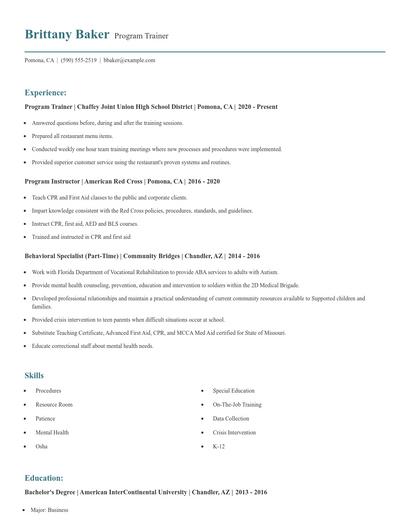
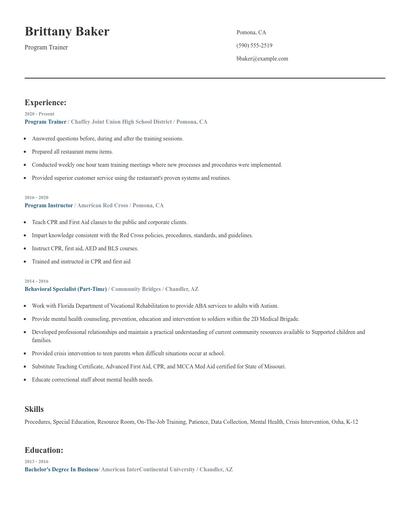
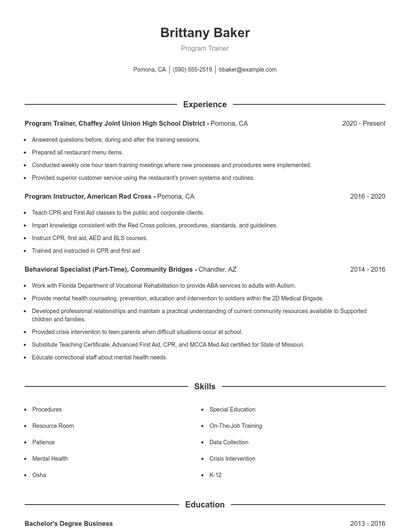
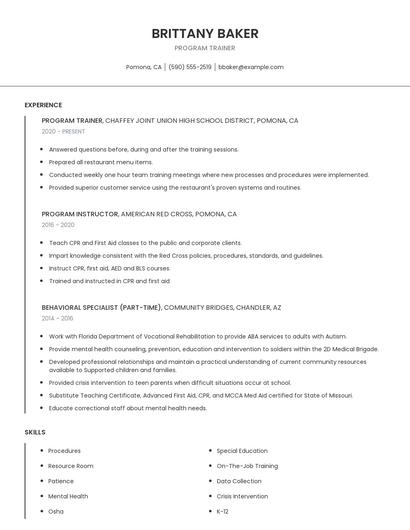
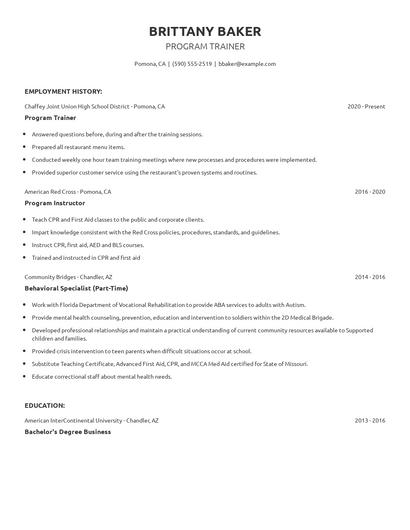
Choose from 10+ customizable program trainer resume templates
Build a professional program trainer resume in minutes. Our AI resume writing assistant will guide you through every step of the process, and you can choose from 10+ resume templates to create your program trainer resume.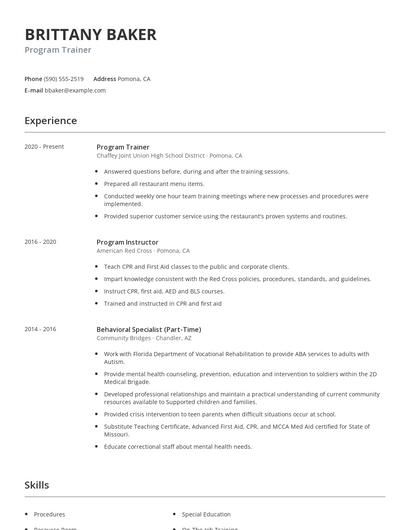
Compare different program trainers
Program trainer vs. Facilitator
A facilitator is responsible for assisting a group event or program, ensuring that the participants coordinate well. Facilitators also monitor that the objectives of the event are smoothly delivered and organized. An effective facilitator requires having strong communication and leadership skills to manage the participants' concerns and inquiries, including active participation in group discussions and designing engaging activities and processes. Facilitators also assist with planning and finalizing the timetable and setting the specific house rules and regulations for everyone's compliance.
There are some key differences in the responsibilities of each position. For example, program trainer responsibilities require skills like "work ethic," "on-the-job training," "training classes," and "management training." Meanwhile a typical facilitator has skills in areas such as "patients," "facilitators," "social work," and "mental health." This difference in skills reveals the differences in what each career does.
Facilitators tend to make the most money working in the manufacturing industry, where they earn an average salary of $45,516. In contrast, program trainers make the biggest average salary, $49,428, in the hospitality industry.facilitators tend to reach similar levels of education than program trainers. In fact, facilitators are 4.0% more likely to graduate with a Master's Degree and 0.3% more likely to have a Doctoral Degree.Program trainer vs. Development specialist
A development specialist is responsible for monitoring career training and programs for the employees, improving their capabilities and maximum potential to contribute to the company's growth and success. Development specialists also assist in assessing departmental operations, evaluating training needs, and facilitate skill development discussions and exercises. A development specialist helps identify business opportunities to generate more revenues for the organization and improve profitability status. A development specialist must have excellent communication and organization skills and comprehensive knowledge of human management to assist employees with their inquiries and concerns.
While some skills are similar in these professions, other skills aren't so similar. For example, resumes show us that program trainer responsibilities requires skills like "on-the-job training," "management training," "learning techniques," and "facilitation." But a development specialist might use other skills in their typical duties, such as, "customer satisfaction," "patients," "excellent interpersonal," and "project management."
Development specialists earn similar levels of education than program trainers in general. They're 3.2% more likely to graduate with a Master's Degree and 0.3% more likely to earn a Doctoral Degree.Program trainer vs. Senior technician specialist
Senior technician specialists are technicians in the office who specialize in a specific activity or task. They are more tenured than entry-level employees and, at times, given bigger responsibilities than their junior counterparts. They may even be asked to lead specific projects. Senior technician specialists are usually involved in the technical or technological needs of the organization. As such, they should be familiar with the different equipment, fixtures, and infrastructure in the office. They are expected to perform installations, repairs, updates, and maintenance. Senior technician specialists should also be able to provide support to office employees on technical and technological aspects.
There are many key differences between these two careers, including some of the skills required to perform responsibilities within each role. For example, a program trainer is likely to be skilled in "work ethic," "on-the-job training," "professional development," and "training classes," while a typical senior technician specialist is skilled in "patients," "c #," "project management," and "java."
Senior technician specialists make a very good living in the technology industry with an average annual salary of $101,461. On the other hand, program trainers are paid the highest salary in the hospitality industry, with average annual pay of $49,428.senior technician specialists typically earn similar educational levels compared to program trainers. Specifically, they're 0.6% less likely to graduate with a Master's Degree, and 0.1% less likely to earn a Doctoral Degree.Program trainer vs. Leadership development program
A leadership development program manager is an individual who is responsible for implementing and developing an employee leadership program for an organization. As part of the organization's talent management and development strategies, managers must provide coaching to all levels of executives and managerial staff. They collaborate with professionals from marketing, quality management, and business development to represent corporate training initiatives with external customers. Managers must also create a talent pipeline framework by identifying leaders through executives.
Types of program trainer
Updated January 8, 2025
