
Automatically apply for jobs with Zippia
Upload your resume to get started.
Records analyst skills for your resume and career

15 records analyst skills for your resume and career
1. Data Entry
Data entry means entering data into a company's system with the help of a keyboard. A person responsible for entering data may also be asked to verify the authenticity of the data being entered. A person doing data entry must pay great attention to tiny details.
- Perform administrative and clerical duties using computers including large amounts of data entry.
- Received several awards of recognition for exceeding company expectations with imaging & data entry
2. PowerPoint
- Use Microsoft Office applications (MSWord, Excel, PowerPoint, etc) to document drawing disposition and track team progress.
- Created email and newsletter communications for both employee and student body distribution utilizing Microsoft Publisher, Word and PowerPoint.
4. Retention Schedules
- Ordered archived files and reviewed record retention schedules weekly; maintained daily file interoffice delivery spreadsheet for supervisory staff.
- Researched and created records retention requirements by utilizing existing electronic retention schedules and identify document content.
5. Hard Copy
- Manage disposal of obsolete records, and keep track of all hard copy records in-house for period of 6 months.
- Developed a project plan for the conversion of 3.5M hard copy files into electronic format.
6. FAA
FAA (Federal Aviation Administration) is an aviation regulatory body in the USA.
- Managed the research, processing and auditing of maintenance records from all maintenance facilities to ensure FAA compliance.
- Maintain aircraft records, maintenance data and flight data in accordance with FAA regulations and company policies.
Choose from 10+ customizable records analyst resume templates
Build a professional records analyst resume in minutes. Our AI resume writing assistant will guide you through every step of the process, and you can choose from 10+ resume templates to create your records analyst resume.7. Retrieve Data
- Establish case/project files, enter and retrieve data from data bases.
- Enter and retrieve data from data bases.
8. Computer System
- Reviewed and implemented changes to maintenance programs, inspections, and time-controlled parts in the company computer system (SCEPTRE).
- Compiled stacks of related paperwork and supervised scanning of all airplane files into newly created computer systems.
9. Provide Customer Support
- Facilitate inter-departmental communication to effectively provide customer support and update internal procedures for internationals department.
10. Word Processing Software
- Relied on to create and manipulate spreadsheets, prepare and correct reports and correspondence using word processing software.
- Used database and word processing software.
11. EHR
Electronic Health Records, or simply EHR, contains all the information about a patient whether they are new or old. It includes the record of diagnosis, medication, progress note, medical history, radiology, and laboratory results. A health facility or hospital has this kind of document to track a patient's record electronically.
- Answer and resolve majority of support calls from 300+ end users using problem solving skills and EHR best practices.
- Reviewed Potential new EHR's for facility.
12. Law Enforcement Agencies
- Requested and evaluate additional criminal history information provided by courts or other law enforcement agencies.
- Managed the acquisition & disposal of properties seized & forfeited by federal law enforcement agencies & United States Attorneys.
13. HIPAA
- Release protected health information (PHI) accordingly in regards HIPAA, state, and federal laws (etc.)
- Ensured compliance with all HIPAA requirements
14. Subpoenas
Subpoenas are formal and legal documents issued mostly by a court or some other government agency that demands the presence of the person the document is addressed to, to show up at court. Subpoenas are issued to individuals whom the court wants to appear either as a witness in a particular case in order to testify or to provide any evidence such as an object or a document.
- Write and execute subpoenas to businesses.
- Fulfilled subpoenas to different law enforcement agencies.
15. DOJ
- Represented DOJ at an ODNI language training conference.
- Conducted financial investigations, drafted and filedpleadings and collaborated with other DOJ agencies.
5 Records Analyst resume examples
Build a professional records analyst resume in minutes. Browse through our resume examples to identify the best way to word your resume. Then choose from 5+ resume templates to create your records analyst resume.

What skills help Records Analysts find jobs?
Tell us what job you are looking for, we’ll show you what skills employers want.
What skills stand out on records analyst resumes?
David Feldman Ph.D.
Professor of Urban Planning and Public Policy and Political Science, Director, Water UCI, Director, MPP Program, University of California, Irvine
List of records analyst skills to add to your resume
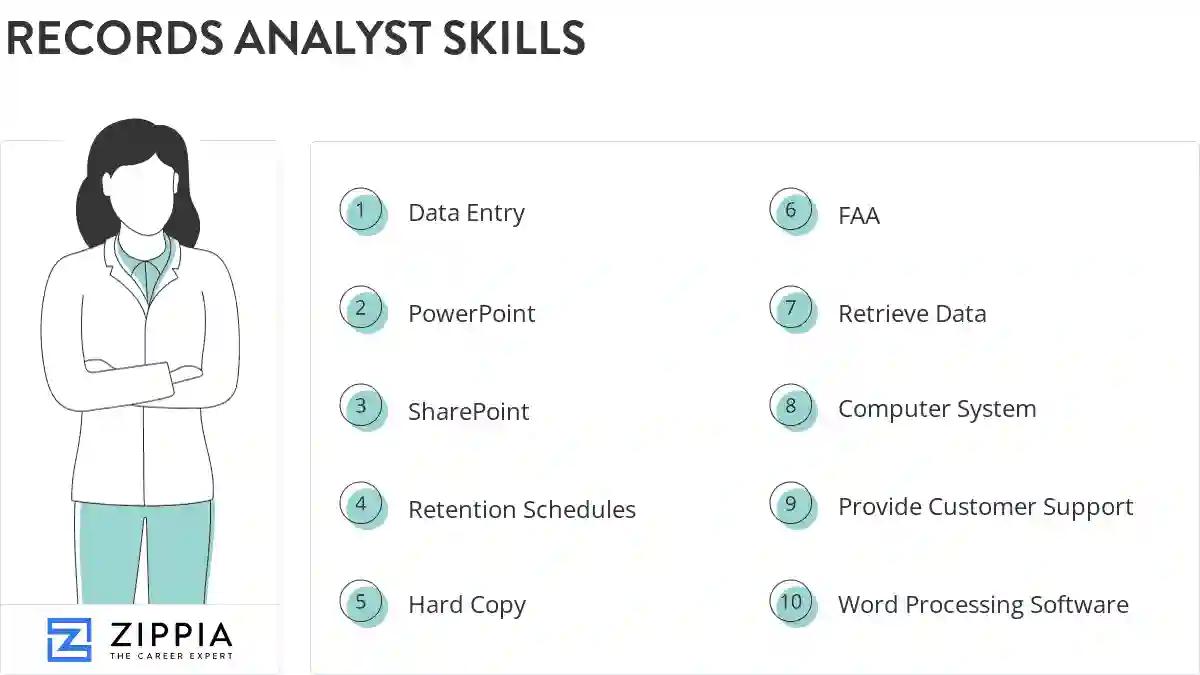
The most important skills for a records analyst resume and required skills for a records analyst to have include:
- Data Entry
- PowerPoint
- SharePoint
- Retention Schedules
- Hard Copy
- FAA
- Retrieve Data
- Computer System
- Provide Customer Support
- Word Processing Software
- EHR
- Law Enforcement Agencies
- HIPAA
- Subpoenas
- DOJ
- Training Materials
- Off-Site Storage
- Background Checks
- Asset Forfeiture
- CPT
- Patient Charts
- SQL
- Medicaid
- DEA
- Enterprise Content Management
- GIS
- Local Agencies
- Nara
- Division Order
- Federal Agencies
- ATF
Updated January 8, 2025
