What does a reimbursement analyst do?
A reimbursement analyst is responsible for determining patients' billing statements and approving reimbursement claims. Reimbursement analysts review reimbursement requests, respond to patients' inquiries and concerns, and resolve billing discrepancies. They also validate patients' information and medical documents to support claims and process reimbursement efficiently. A reimbursement analyst must have excellent analytical and communication skills, as well as have extensive knowledge of the reimbursement policies and procedures to release payments and manage the patients' eligibility for reimbursement.
Reimbursement analyst responsibilities
Here are examples of responsibilities from real reimbursement analyst resumes:
- Cultivate relationships with key contacts at insurance companies and manage care organizations, CMS and medical professional societies.
- Contract interpretation and enforcement of the agreement with multiple medical insurance companies through written and oral appeals is accomplished daily.
- Coordinate third party audits, defend preferential reporting practices and maintain current knowledge of Medicare and Medicaid reimbursement regulations.
- Update Meditech charge master with correct pharmacy pricing and HCPCS codes.
- Provide overall follow-up and coordination with Medicare and Medicare HMO plans and process with Medicare and Medicare HMO adjustments.
- Train on and implement eClinicalworks for several physician practices, taking them live from paper to full electronic medical records.
- Verify proper use of ICD-9 and CPT codes along with modifiers for claim submission to insurance companies including third party carriers.
- Audit general ledger reconciliations to ensure accuracy.
- Complete third party general ledger account reconciliations.
- Support and maintain clinic software eClinicalWorks applications throughout TexomaCare.
- Increase Medicaid rate by completing construction additions reports detailing all financial aspect of project.
- Obtain prior authorization, coverage exceptions and appeals assistance to secure coverage and reimbursement.
- Process and record patient information accurately assisting patients in the reimbursement process and research payer policies.
- Gather require information for internal and external auditors for company audits and for state Medicaid audits.
- Assist and familiarize physicians with the DRG system and proper documentation techniques to insure optimum reimbursement.
Reimbursement analyst skills and personality traits
We calculated that 11% of Reimbursement Analysts are proficient in Patients, Medicare, and Medicaid. They’re also known for soft skills such as Integrity, Technical skills, and Detail oriented.
We break down the percentage of Reimbursement Analysts that have these skills listed on their resume here:
- Patients, 11%
Analyzed hospital operating costs pertaining to Medicare patients in order to properly prepare and submit Medicare/Medicaid Cost Report to government agencies.
- Medicare, 7%
Facilitated and coordinated department revenue cycle meetings to discuss monthly financial impact of Medicare and South Carolina Medicaid program denials.
- Medicaid, 7%
Gather required information for internal and external auditors for company audits and for state Medicaid audits.
- Home Health, 5%
Partnered with hospital and home health chains to discuss changes impacting organizational reimbursements.
- Appeals, 5%
Assist consultant in preparation of appeals relating to Graduate Medical Education, Disproportionate Share and other reimbursement issues.
- Revenue Cycle, 4%
Develop and implement processes and procedures to support business office and revenue cycle operation and improve cash collections
"patients," "medicare," and "medicaid" are among the most common skills that reimbursement analysts use at work. You can find even more reimbursement analyst responsibilities below, including:
Integrity. One of the key soft skills for a reimbursement analyst to have is integrity. You can see how this relates to what reimbursement analysts do because "health information technicians work with patient data that are required, by law, to be kept confidential." Additionally, a reimbursement analyst resume shows how reimbursement analysts use integrity: "maintained integrity and compliance with hipaa guidelines regarding protection and non-disclosure of patient's private health information. "
Technical skills. Many reimbursement analyst duties rely on technical skills. "health information technicians must use coding and classification software and the electronic health record (ehr) system that their healthcare organization or physician practice has adopted.," so a reimbursement analyst will need this skill often in their role. This resume example is just one of many ways reimbursement analyst responsibilities rely on technical skills: "provided technical support for timely and effective insurance claims and risk financing for the risk management program. "
Detail oriented. This is an important skill for reimbursement analysts to perform their duties. For an example of how reimbursement analyst responsibilities depend on this skill, consider that "health information technicians must be accurate when recording and coding patient information." This excerpt from a resume also shows how vital it is to everyday roles and responsibilities of a reimbursement analyst: "increased medicaid rate by completing construction additions reports detailing all financial aspect of project. ".
Analytical skills. A big part of what reimbursement analysts do relies on "analytical skills." You can see how essential it is to reimbursement analyst responsibilities because "health information technicians must understand and follow medical records and diagnoses, and then decide how best to code them in a patient’s medical records." Here's an example of how this skill is used from a resume that represents typical reimbursement analyst tasks: "analyzed physician fee schedules to ensure maximum reimbursement. "
Interpersonal skills. Another crucial skill for a reimbursement analyst to carry out their responsibilities is "interpersonal skills." A big part of what reimbursement analysts relies on this skill, since "health information technicians need to be able to discuss patient information, discrepancies, and data requirements with other professionals such as physicians and finance personnel." How this skill relates to reimbursement analyst duties can be seen in an example from a reimbursement analyst resume snippet: "applied interpersonal, analytical and computer skills to troubleshoot incoming problems and disbursed cases to the appropriate information systems team members. "
The three companies that hire the most reimbursement analysts are:
- Danbury Hospital27 reimbursement analysts jobs
- Advance Auto Parts6 reimbursement analysts jobs
- Mercy Health4 reimbursement analysts jobs
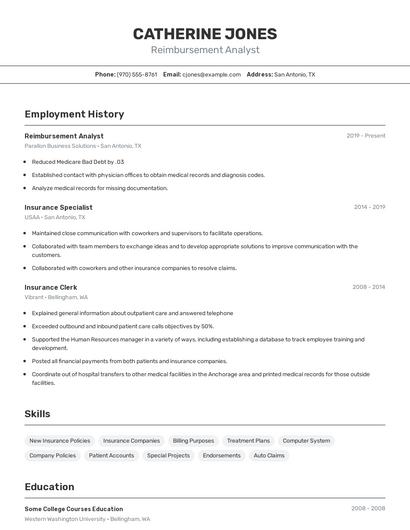
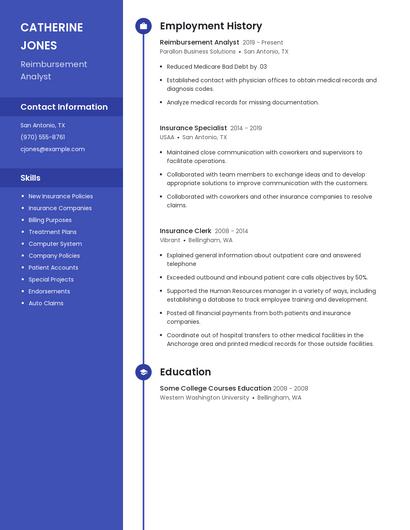
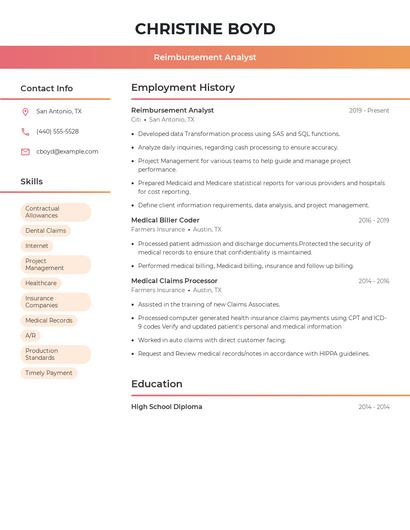
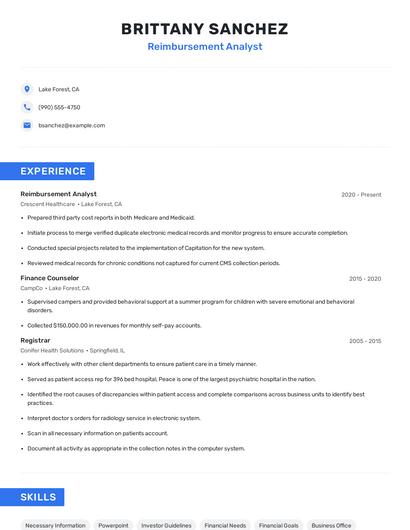
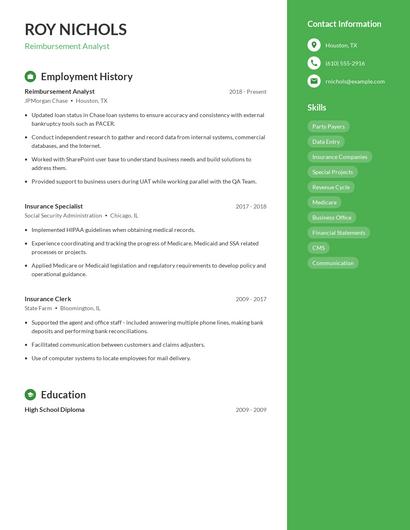
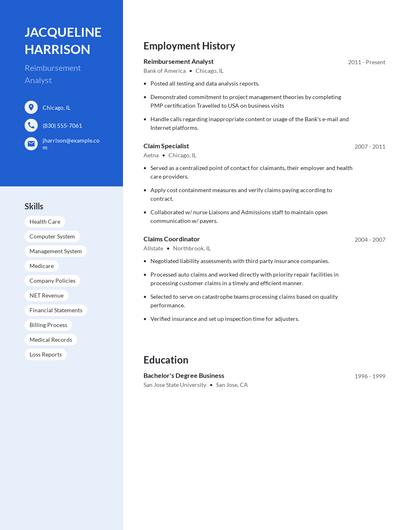
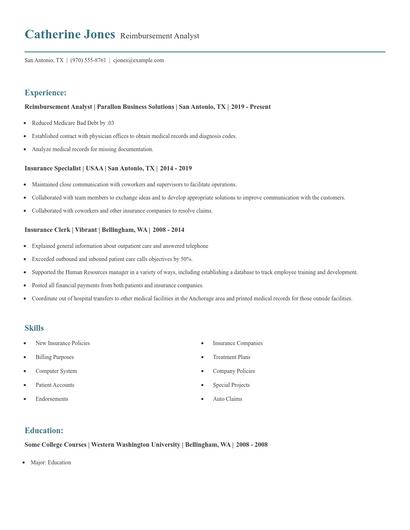
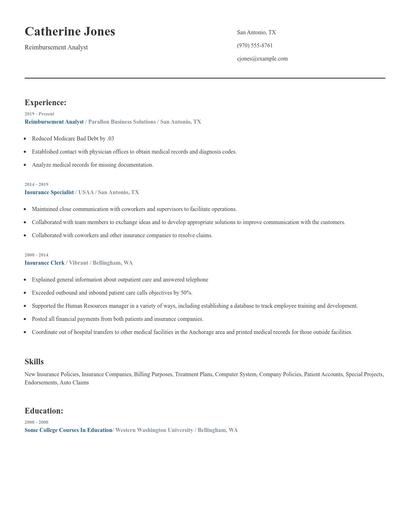
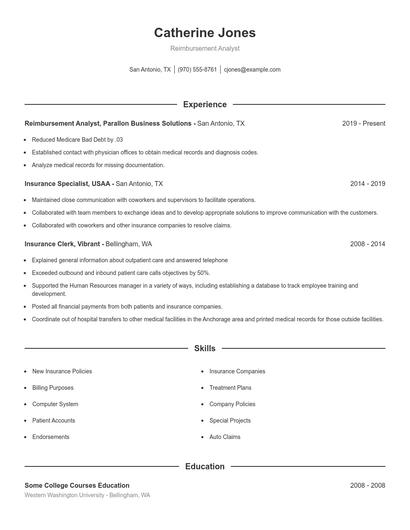
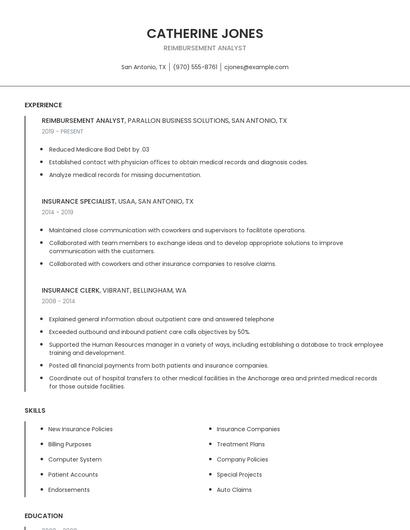
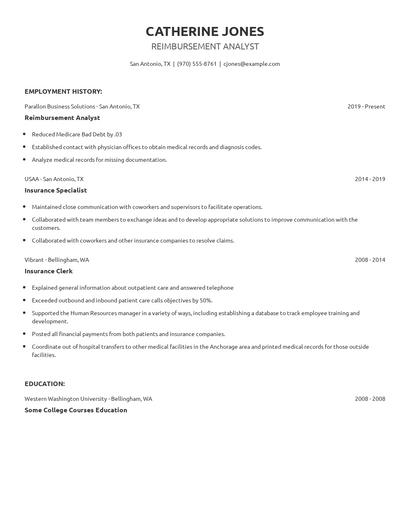
Choose from 10+ customizable reimbursement analyst resume templates
Build a professional reimbursement analyst resume in minutes. Our AI resume writing assistant will guide you through every step of the process, and you can choose from 10+ resume templates to create your reimbursement analyst resume.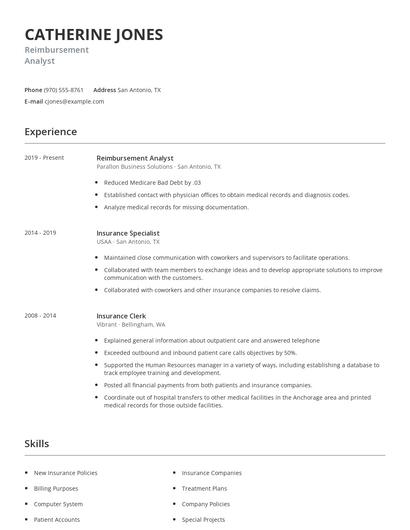
Compare different reimbursement analysts
Reimbursement analyst vs. Health information technician
A health information technician is primarily responsible for managing and handling patient information, ensuring accuracy and confidentiality. They coordinate with various health care workers to gather patient data, laboratory results, test findings, and medical histories, encoding them in clinical databases in a timely and efficient manner. They must analyze every information to detect any inconsistencies, performing corrective measures right away. Furthermore, as a health information technician, it is essential to utilize particular software and systems when processing information, all while adhering to the hospital's policies and regulations.
While similarities exist, there are also some differences between reimbursement analysts and health information technician. For instance, reimbursement analyst responsibilities require skills such as "medicare," "appeals," "revenue cycle," and "strong analytical." Whereas a health information technician is skilled in "customer service," "patient care," "office equipment," and "transcription." This is part of what separates the two careers.
Health information technicians really shine in the government industry with an average salary of $35,705. Comparatively, reimbursement analysts tend to make the most money in the pharmaceutical industry with an average salary of $80,354.The education levels that health information technicians earn slightly differ from reimbursement analysts. In particular, health information technicians are 6.2% less likely to graduate with a Master's Degree than a reimbursement analyst. Additionally, they're 0.3% more likely to earn a Doctoral Degree.Reimbursement analyst vs. Medical service technician
A medical service technician provides health care and treatments to patients under the supervision or directives of a more experienced physician. Most of their responsibilities revolve around assessing a patient's condition, administering required aid, diagnosing patients, conducting check-ups, and counseling patients. There are also instances when a medical service technician may prescribe medications, conduct inspections at facilities to ensure sanitary conditions, and coordinate with hospital staff for requesting supplies. Furthermore, it is crucial to have accurate documentation of all processes and transactions, all while adhering to the hospital's policies and standards.
Each career also uses different skills, according to real reimbursement analyst resumes. While reimbursement analyst responsibilities can utilize skills like "medicare," "medicaid," "appeals," and "revenue cycle," medical service technicians use skills like "customer service," "pet," "vital signs," and "infection control."
Medical service technicians may earn a lower salary than reimbursement analysts, but medical service technicians earn the most pay in the government industry with an average salary of $39,185. On the other hand, reimbursement analysts receive higher pay in the pharmaceutical industry, where they earn an average salary of $80,354.Average education levels between the two professions vary. Medical service technicians tend to reach lower levels of education than reimbursement analysts. In fact, they're 6.3% less likely to graduate with a Master's Degree and 0.3% more likely to earn a Doctoral Degree.Reimbursement analyst vs. Medical records technician
A medical records technician is responsible for performing administrative duties, handling patients' medical records for medical purposes. Medical records technicians keep an organized database of patients' information, including medical history, diagnosis, healthcare treatments, laboratory schedules, and insurance details using specific healthcare coding procedures. Medical records technicians must be detail-oriented and highly organizational, especially on maintaining the accuracy and confidentiality of patients' information. This job is critical in the healthcare industry for the doctors' reference and determining treatment costs.
The required skills of the two careers differ considerably. For example, reimbursement analysts are more likely to have skills like "medicare," "home health," "appeals," and "revenue cycle." But a medical records technician is more likely to have skills like "patient care," "customer service," "medical facilities," and "medical charts."
Medical records technicians earn the best pay in the government industry, where they command an average salary of $40,715. Reimbursement analysts earn the highest pay from the pharmaceutical industry, with an average salary of $80,354.Most medical records technicians achieve a lower degree level compared to reimbursement analysts. For example, they're 6.9% less likely to graduate with a Master's Degree, and 0.1% less likely to earn a Doctoral Degree.Reimbursement analyst vs. Medical biller coder
A medical biller coder is responsible for handling the billing processes and insurance within a hospital, clinic, or similar facility. They must gather patient information and records to analyze and translate them into codes according to the insurance and medical guidelines. Moreover, it is crucial to verify all patient forms and ensure their accuracy as it will serve as a basis on essential documents and medical record-keeping. There may also be instances where a medical biller coder must devise payment plans for patients, communicate with families and guardians, and coordinate with physicians.
Types of reimbursement analyst
Updated January 8, 2025
