What does a requirements analyst do?
To make programs and projects work, a requirements analyst must perform extensive research and analysis to identify and understand its needs. In the information technology industry, a requirements analyst is primarily in charge of gathering and analyzing feedback from clients, producing comprehensive reports, and presenting them to the software development teams. Moreover, a requirements analyst is also in charge of bridging the communication between stakeholders and information technology workforce for an efficient and smooth workflow, updating them with progress reports as needed.
Requirements analyst responsibilities
Here are examples of responsibilities from real requirements analyst resumes:
- Develop and manage issues using SharePoint functions.
- Manage multiple aspects of product design and end user analysis objectives medical practice management & HIPAA compliance applications.
- Test and execute QA defect and notification reports; identifying project risks and errors.
- Work with development, test, training, and help desk teams to verify requirements base on detail engineering prototyping.
- Project scheduling and resource management using Visio.
- Master prototyping software to depict user interaction with CareFirst systems.
- Provide solution as SME and lead business analyst and ensuring high quality e-discovery solution is implemented.
- Perform functional, regression and integrate testing of new/update requirements including creation of test cases, documentation, and defect/change management.
- Perform functional, regression and integrate testing of new/update requirements including creation of test cases, documentation, and defect/change management.
Requirements analyst skills and personality traits
We calculated that 8% of Requirements Analysts are proficient in DOD, Architecture, and Project Management. They’re also known for soft skills such as Interpersonal skills, Problem-solving skills, and Time-management skills.
We break down the percentage of Requirements Analysts that have these skills listed on their resume here:
- DOD, 8%
Project: As the requirement analysts, provided support to Defense Travel Management Office the DoD Center for Travel Excellence.
- Architecture, 6%
Supported solution architects in the development of architecture and design models.
- Project Management, 6%
Authored detailed project management reports and business/marketing plans and presentations for senior management, and project proposals for clients.
- User Stories, 5%
Analyzed customer change requests to develop user stories and supplementary documentation for the backlog in preparation for upcoming releases.
- SDLC, 4%
Helped drive industry standards for Agile and Waterfall SDLC best practices, and enforced implementation of said practices in client environments.
- Jira, 4%
Perform Functional testing, as components are made available by the developers and track the bugs in JIRA.
Most requirements analysts use their skills in "dod," "architecture," and "project management" to do their jobs. You can find more detail on essential requirements analyst responsibilities here:
Analytical skills. requirements analyst responsibilities often require "analytical skills." The duties that rely on this skill are shown by the fact that "analysts must interpret complex information from various sources and decide the best way to move forward on a project." This resume example shows what requirements analysts do with analytical skills on a typical day: "analyzed the department's document repository to prepare for the transition to sharepoint. "
Communication skills. A commonly-found skill in requirements analyst job descriptions, "communication skills" is essential to what requirements analysts do. Requirements analyst responsibilities rely on this skill because "analysts work as a go-between with management and the it department and must explain complex issues in a way that both will understand." You can also see how requirements analyst duties rely on communication skills in this resume example: "maintained continuous communication with the stakeholders, subject matter experts and team engineers; conducted all requirements meetings and session. "
Creativity. Lastly, "creativity" is an important element of what a requirements analyst does. Requirements analyst responsibilities require this skill because "because analysts are tasked with finding innovative solutions to computer problems, an ability to “think outside the box” is important." This resume example highlights how requirements analyst duties rely on this skill: "led the requirements gathering and business analysis for the inventory and warehousing erp modules. "
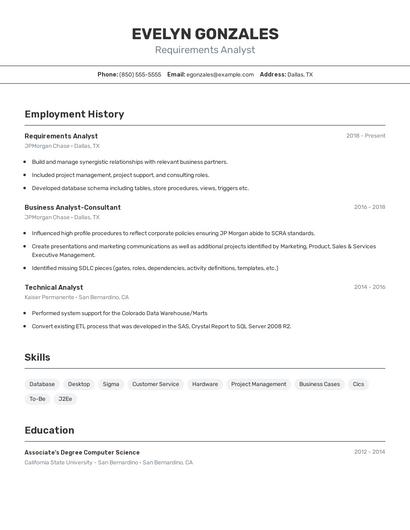
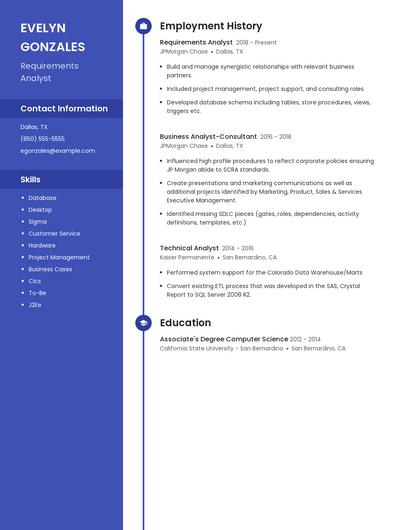
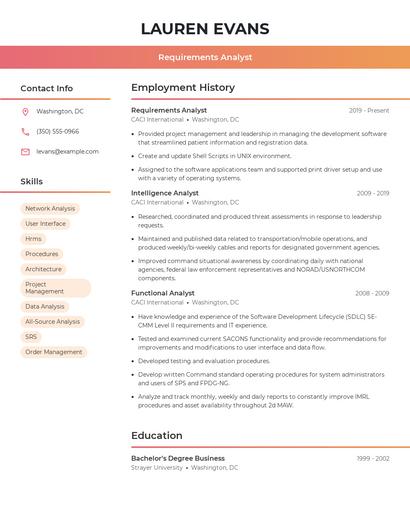
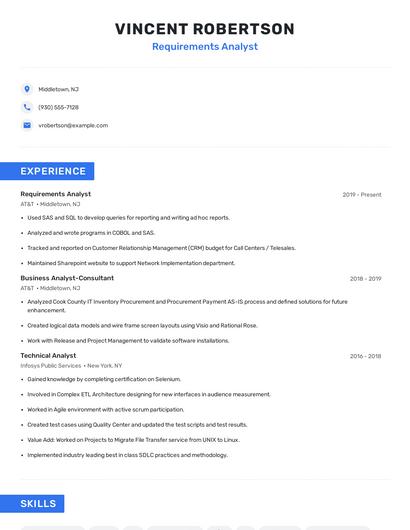
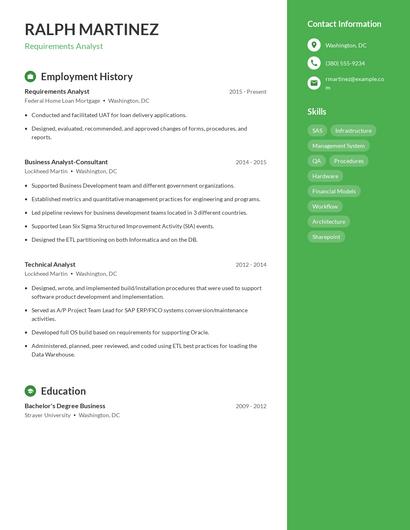
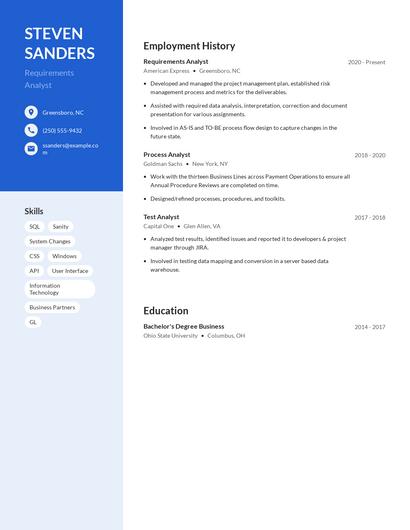
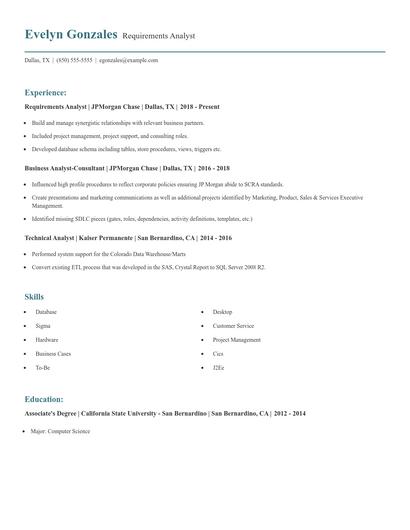
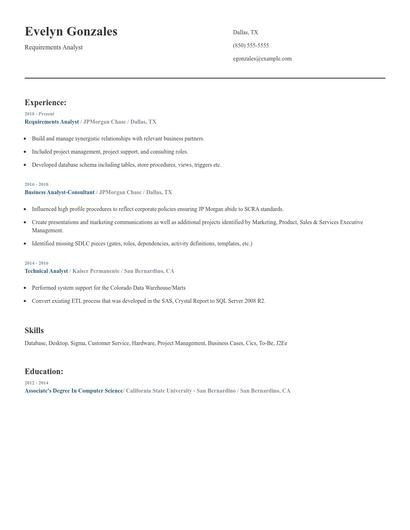
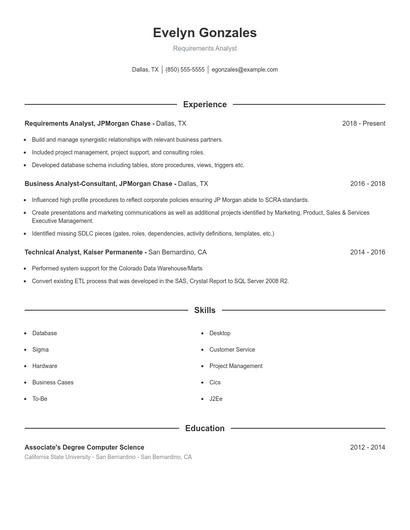
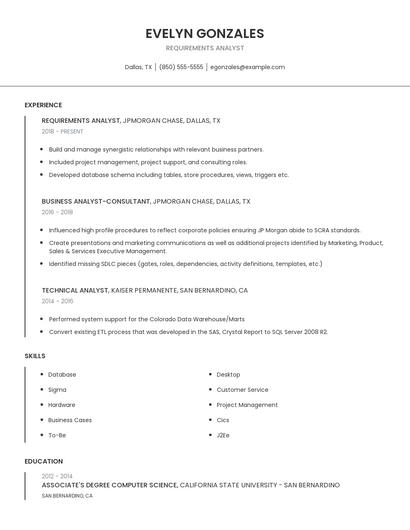
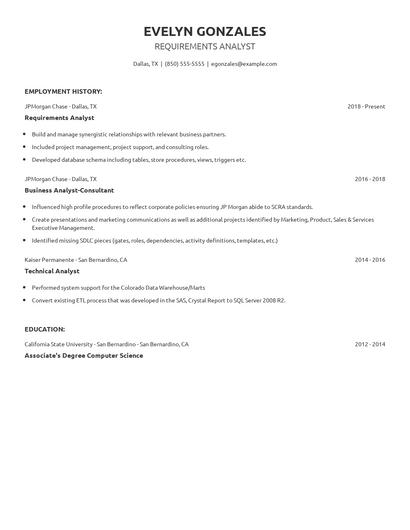
Choose from 10+ customizable requirements analyst resume templates
Build a professional requirements analyst resume in minutes. Our AI resume writing assistant will guide you through every step of the process, and you can choose from 10+ resume templates to create your requirements analyst resume.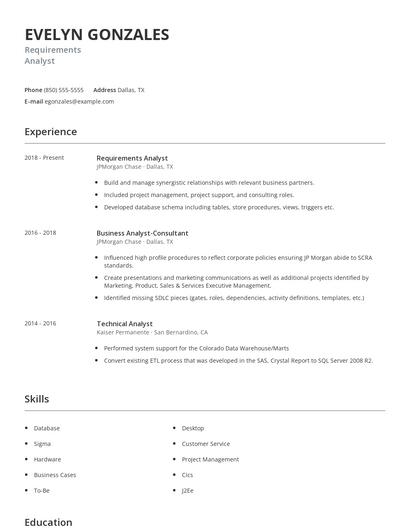
Compare different requirements analysts
Requirements analyst vs. Business analyst/quality analyst
A business analyst/quality analyst is responsible for evaluating business outputs and operational processes to ensure that everything adheres to the quality standards and business regulations. Business analysts/quality analysts support senior management in determining solutions to improve the company's services and provide the highest satisfaction for the customers and clients. They also conduct data and statistical analysis by assessing the market trends to identify opportunities that would generate more revenue resources and increase profitability for the business.
While similarities exist, there are also some differences between requirements analysts and business analyst/quality analyst. For instance, requirements analyst responsibilities require skills such as "dod," "architecture," "project management," and "subject matter experts." Whereas a business analyst/quality analyst is skilled in "qa," "microsoft visio," "regression," and "powerpoint." This is part of what separates the two careers.
Business analysts/quality analysts earn the highest salaries when working in the finance industry, with an average yearly salary of $94,836. On the other hand, requirements analysts are paid more in the transportation industry with an average salary of $91,464.On average, business analysts/quality analysts reach higher levels of education than requirements analysts. Business analysts/quality analysts are 8.4% more likely to earn a Master's Degree and 0.2% less likely to graduate with a Doctoral Degree.Requirements analyst vs. Quality assurance analyst
Quality Administrators are responsible for managing the quality processes of an organization. Their duties include creating data collection processes, conducting data cleansing, tracks quality milestones, and develop training programs for internal teams. They undertake daily audits, work with the quality coordinator to determine root cause, and assist with feedback and complaints. Quality administrators also write daily reports for purchase orders that are overdue, open service jobs, quotations needing to follow up, unconfirmed hires, and processed sales orders.
While some skills are similar in these professions, other skills aren't so similar. For example, resumes show us that requirements analyst responsibilities requires skills like "dod," "architecture," "project management," and "user stories." But a quality assurance analyst might use other skills in their typical duties, such as, "qa," "regression," "manual test cases," and "selenium webdriver."
Quality assurance analysts earn a lower average salary than requirements analysts. But quality assurance analysts earn the highest pay in the retail industry, with an average salary of $82,227. Additionally, requirements analysts earn the highest salaries in the transportation with average pay of $91,464 annually.Average education levels between the two professions vary. Quality assurance analysts tend to reach similar levels of education than requirements analysts. In fact, they're 0.9% less likely to graduate with a Master's Degree and 0.2% less likely to earn a Doctoral Degree.What technology do you think will become more important and prevalent for requirements analysts in the next 3-5 years?
Rebecca Sarver
Lecturer in Human Services Studies, Elmira College
Requirements analyst vs. Analyst lead
The duties of an analyst lead depend on one's line of work or industry of employment. Typically, their responsibilities revolve around performing research and analysis, coordinating with different departments to gather leads and data, reviewing findings, and producing reports and presentations for the stakeholders and other higher-ranking officials. Through the results, an analyst lead can provide advice, devise strategies for business optimization, spearhead the development of processes, identify strengths and weaknesses, and offer recommendations on areas in need of improvement. All of this is done while in adherence to the company's vision and mission.
The required skills of the two careers differ considerably. For example, requirements analysts are more likely to have skills like "architecture," "user stories," "jira," and "scrum." But a analyst lead is more likely to have skills like "analytics," "customer service," "excellent interpersonal," and "powerpoint."
Analyst leads earn the highest salary when working in the finance industry, where they receive an average salary of $110,488. Comparatively, requirements analysts have the highest earning potential in the transportation industry, with an average salary of $91,464.When it comes to education, analyst leads tend to earn similar degree levels compared to requirements analysts. In fact, they're 2.4% more likely to earn a Master's Degree, and 0.5% more likely to graduate with a Doctoral Degree.Requirements analyst vs. Contractor-business analyst
A contractor-business analyst is responsible for analyzing business processes and strategizing on efficient project management techniques to enhance productivity goals and achieve maximum performance. Contractor-business analysts conduct data and statistical analysis to determine areas of improvement and identify business opportunities that would generate more revenue resources and increase profits. They also review client accounts, measure sales performance, and design solutions by utilizing various software applications and system tools. A contractor-business analyst advises the management of necessary training for the staff to enhance services and close more business partnerships.
Even though a few skill sets overlap between requirements analysts and contractor-business analysts, there are some differences that are important to note. For one, a requirements analyst might have more use for skills like "dod," "architecture," "development life," and "application development." Meanwhile, some responsibilities of contractor-business analysts require skills like "data entry," "hr," "financial analysis," and "qa. "
In general, contractor-business analysts hold similar degree levels compared to requirements analysts. Contractor-business analysts are 1.4% more likely to earn their Master's Degree and 1.1% more likely to graduate with a Doctoral Degree.Types of requirements analyst
Updated January 8, 2025
