What does a research clerk do?
A research clerk executes and performs clerical activities in the research department. They also research and verify data useful for business clients as well as conducting research on client products or services to improvise business opportunities. Their duties and responsibilities also include assigning topics to other team members, verifying data before submission, and ensuring research does not violate best practices.
Research clerk responsibilities
Here are examples of responsibilities from real research clerk resumes:
- Demonstrate strong math skills in managing inmate s accounts and calmly and effectively deescalating outbursts of belligerent inmates.
- Re-created personal and commercial bank statements as requested by customers or in compliance with court-issu subpoenas.
- Process work to the proof operators to encode checks.
- Assist tellers in posting all deposit slips and withdrawals in NCR machine
- Balance deposits make by customers, micro encode checks & deposit slips.
- Create accounting worksheets and post entries for 3rd party lockbox, credit card settlements and product billing.
- Encode and balance transactions from all branches (internal and external) by hand keying amounts into the NCR proof machine.
- Handle ATM balancing and oversee ATM operation/money ordering.
- Minimize loss by effectively balancing ATM transactions, along with all necessary adjustments.
- Perform research source fact checking, assist with protocol editing, assist with protocol powerpoint presentations
- Perform basic business office duties and handle highly confidential documents regarding doctor s prognosis and medical history of patients.
- Point of contact for all CYP services.
- Secure revenue for the island of Antigua by collecting tariffs on import & export goods & services.
Research clerk skills and personality traits
We calculated that 16% of Research Clerks are proficient in Telephone Inquiries, Customer Accounts, and Financial Institutions. They’re also known for soft skills such as Computer skills, Integrity, and Math skills.
We break down the percentage of Research Clerks that have these skills listed on their resume here:
- Telephone Inquiries, 16%
Resolved and responded to telephone inquiries from internal department and customers.
- Customer Accounts, 9%
Prepare documentation to support any adjustments to customer accounts.
- Financial Institutions, 9%
Perform operational duties associated with check processing and investigating inquiries received from financial institutions and other Federal Reserve offices.
- Subpoenas, 8%
Produce all documentation required for subpoenas and summons.
- Exception Reports, 8%
Generate loan list and exception reports through internal databases and clean reports in Microsoft applications to present flawless reporting.
- Legal Research, 7%
Performed legal research and prepared written materials summarizing significant cases, statutes and court rules
Common skills that a research clerk uses to do their job include "telephone inquiries," "customer accounts," and "financial institutions." You can find details on the most important research clerk responsibilities below.
Computer skills. The most essential soft skill for a research clerk to carry out their responsibilities is computer skills. This skill is important for the role because "bookkeeping, accounting, and auditing clerks need to be comfortable using computer spreadsheets and bookkeeping software." Additionally, a research clerk resume shows how their duties depend on computer skills: "maintained computerized accounts receivable/payable; handled outgoing communications on word processing system and company e-mail. "
Integrity. Another essential skill to perform research clerk duties is integrity. Research clerks responsibilities require that "bookkeeping, accounting, and auditing clerks have control of an organization’s financial documentation, which they must use properly and keep confidential." Research clerks also use integrity in their role according to a real resume snippet: "researched and resolved issues surrounding corporate trust clients; enhanced client satisfaction, quality control, and compliance with custodial agreements. "
Math skills. This is an important skill for research clerks to perform their duties. For an example of how research clerk responsibilities depend on this skill, consider that "bookkeeping, accounting, and auditing clerks deal with numbers daily and should be comfortable with basic arithmetic." This excerpt from a resume also shows how vital it is to everyday roles and responsibilities of a research clerk: "support staff for braille department, general ed, math, and media. ".
Detail oriented. A big part of what research clerks do relies on "detail oriented." You can see how essential it is to research clerk responsibilities because "bookkeeping, accounting, and auditing clerks are responsible for producing accurate financial records." Here's an example of how this skill is used from a resume that represents typical research clerk tasks: "utilize imaging system to view check detail and post transactions to proper customer accounts. "
The three companies that hire the most research clerks are:
- Cass Information Systems5 research clerks jobs
- Inmar4 research clerks jobs
- Academy Sports + Outdoors3 research clerks jobs
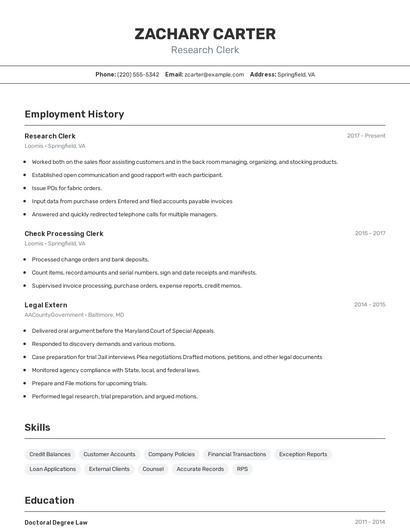
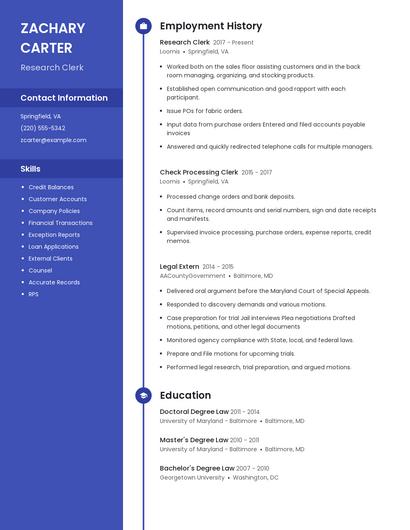
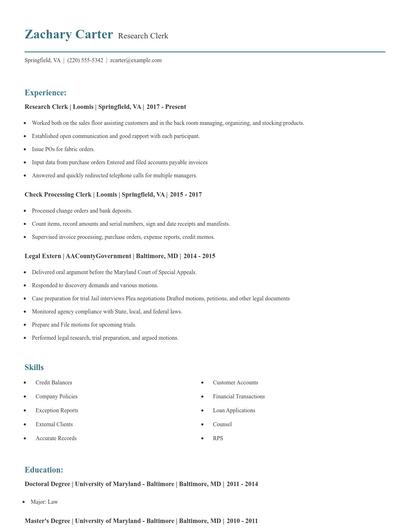
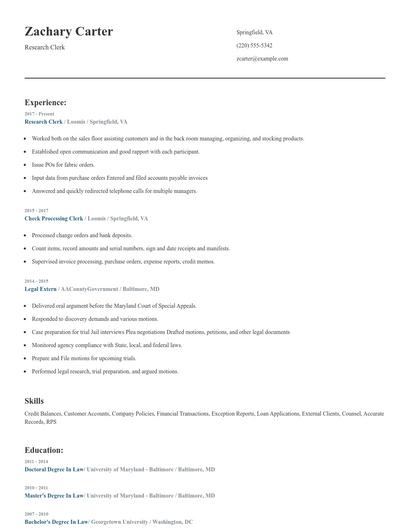
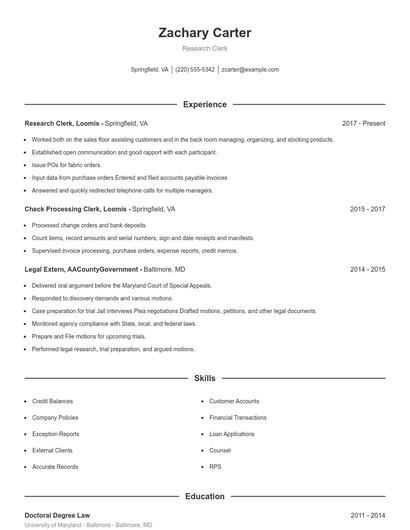
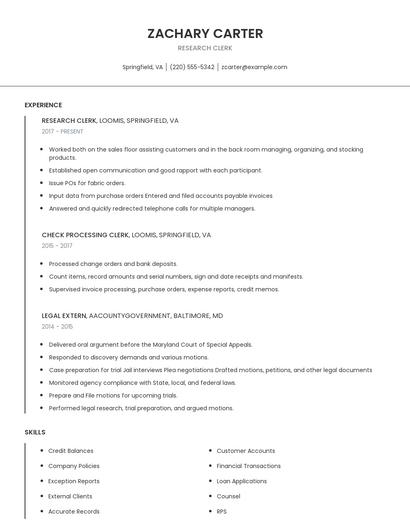
Choose from 10+ customizable research clerk resume templates
Build a professional research clerk resume in minutes. Our AI resume writing assistant will guide you through every step of the process, and you can choose from 10+ resume templates to create your research clerk resume.



Compare different research clerks
Research clerk vs. Payment processor
A payment processor is responsible for managing and informing the clients of their payment obligations for the services offered by a financial institution or other related organizations. Payment processors record transactions and ensure the timely completion of account statements. They discuss the terms and conditions of the service contract with the clients and respond to their inquiries and concerns. A payment processor must have excellent communication and organizational skills, especially in coming up with repayment plans and solutions for clients who are not able to pay services in time.
There are some key differences in the responsibilities of each position. For example, research clerk responsibilities require skills like "telephone inquiries," "subpoenas," "exception reports," and "legal research." Meanwhile a typical payment processor has skills in areas such as "customer service," "patients," "data entry," and "ach." This difference in skills reveals the differences in what each career does.
Payment processors tend to make the most money working in the insurance industry, where they earn an average salary of $38,534. In contrast, research clerks make the biggest average salary, $35,046, in the government industry.The education levels that payment processors earn slightly differ from research clerks. In particular, payment processors are 0.1% more likely to graduate with a Master's Degree than a research clerk. Additionally, they're 4.8% less likely to earn a Doctoral Degree.Research clerk vs. Clerk typist
A clerk typist is responsible for data entry procedures and document transcriptions, alongside other clerical and administrative duties as required by the employer. Clerk typists create reports and presentation materials, transcribe audio meetings, write business drafts, and send documents to appropriate office personnel or clients. A clerk-typist must show excellent organizational and time-management skills, especially with handling various typing tasks under strict deadlines and minimal supervision. They also respond and take calls from clients and customers, assisting with their inquiries and concerns.
In addition to the difference in salary, there are some other key differences worth noting. For example, research clerk responsibilities are more likely to require skills like "customer accounts," "financial institutions," "exception reports," and "legal research." Meanwhile, a clerk typist has duties that require skills in areas such as "data entry," "customer service," "payroll," and "office equipment." These differences highlight just how different the day-to-day in each role looks.
On average, clerks typist earn a lower salary than research clerks. Some industries support higher salaries in each profession. Interestingly enough, clerks typist earn the most pay in the education industry with an average salary of $32,312. Whereas research clerks have higher pay in the government industry, with an average salary of $35,046.Average education levels between the two professions vary. Clerks typist tend to reach similar levels of education than research clerks. In fact, they're 0.5% less likely to graduate with a Master's Degree and 4.8% less likely to earn a Doctoral Degree.Research clerk vs. Administrative clerk
An administrative clerk provides support to staff and does clerical works. These clerical duties include answering and making phone calls, typing documents, compiling and filing records, and scheduling appointments. The clerks often set up office meetings and invite reliable speakers. Also, they do research and prepare reports or presentations. Candidates for the job must be organized, detail-oriented, and can manage their time well. They must be tech-savvy and have a basic knowledge of bookkeeping. The salary depends on their experience, industry, and location of the job.
The required skills of the two careers differ considerably. For example, research clerks are more likely to have skills like "telephone inquiries," "customer accounts," "financial institutions," and "subpoenas." But a administrative clerk is more likely to have skills like "customer service," "data entry," "patients," and "word processing."
Administrative clerks make a very good living in the finance industry with an average annual salary of $33,044. On the other hand, research clerks are paid the highest salary in the government industry, with average annual pay of $35,046.When it comes to education, administrative clerks tend to earn similar degree levels compared to research clerks. In fact, they're 0.5% less likely to earn a Master's Degree, and 4.5% less likely to graduate with a Doctoral Degree.Research clerk vs. Receptionist/billing clerk
A receptionist/billing clerk is responsible for performing administrative and clerical duties as needed to maintain a smooth flow of operations for the business. Receptionist/billing clerks process the customers' payment transactions, manage account payables, releasing invoices, and immediately resolve account discrepancies. A receptionist/billing clerk must have excellent communication and analytical skills, responding to customers' inquiries and concerns, escalating high-level complaints to the billing management. They should also maintain records of financial documentation for reference and reconciliation as needed.
Types of research clerk
Updated January 8, 2025
