What does a sas programmer do?

Statistical analysis system (SAS) programmers are information technology (IT) professionals who oversee data collection and analysis. Their main job typically includes creating statistical tables showing information, converting raw data into data sets, and aggregating and manipulating data to analyze productivity and projects. Other duties include managing and maintaining databases, designing and writing programs, and writing macros to make the dataset commands simpler. SAS programmers are also responsible for preparing and presenting operations reports to all management levels.
Sas programmer responsibilities
Here are examples of responsibilities from real sas programmer resumes:
- Lead the system testing and work with the users to do UAT.
- Lead migration from an NT SAS environment to a Unix SAS environment including porting code and designing the Unix environment.
- Reduce previous single 26 file game into one easy to manage SWF file by making static content dynamic XML driven.
- Serve as a UNIX system administrator for ERP system.
- Prepare and present training materials for ERP, ECM and SharePoint releases.
- Program development and support in COBOL IMS in a batch and CICS environment.
- Develop online CICS and batch COBOL programs in support of (COPICS) plant logistics.
- Perform risk base approach as per FDA expectations for determining the level of validation and documentation appropriate for SAS programs.
- Participate in writing custom safety and efficacy reports that direct SAS output to RTF and HTML files using SAS ODS facility.
- Design flowcharts for the system design using Visio application.
- Provide statistical programming support using SAS, SPSS, and NCSS
- Work on responsive web design using CSS, bootstrap etc.
- Establish document libraries; manage/administer SharePoint team sites and wiki space.
- Involve developing specification for data sets base on STDM and Adam standards.
- Help develop tools in Matlab for the visualization of copy number segments.
Sas programmer skills and personality traits
We calculated that 8% of SAS Programmers are proficient in Macro, Data Analysis, and SAS Macros. They’re also known for soft skills such as Concentration, Detail oriented, and Troubleshooting skills.
We break down the percentage of SAS Programmers that have these skills listed on their resume here:
- Macro, 8%
Developed Utility Macros and extensively used existing macros for Validation, Analysis, Report generation and Integration of Data.
- Data Analysis, 6%
Required to make recommendations based upon data analysis and provide analytic consultation to other business areas, leadership or external customers.
- SAS Macros, 6%
Created, implemented and maintained SAS macro library for production of statistical tables/figures/listings; Developed data editing checks in SAS.
- Statistical Analysis, 5%
Developed macros for report generation using SAS/Macros as per the statisticians' requirements and programs for statistical analysis and data displays.
- SAS/SQL, 5%
Create safety and efficacy TLF-derived analysis reports by using SAS/BASE, SAS/STAT, SAS/SQL, SAS/GRAPH, SAS/MACRO;.
- SAS Procedures, 4%
Developed loss prediction model using Enterprise miner modeling solutions and SAS procedures.
"macro," "data analysis," and "sas macros" are among the most common skills that sas programmers use at work. You can find even more sas programmer responsibilities below, including:
Concentration. The most essential soft skill for a sas programmer to carry out their responsibilities is concentration. This skill is important for the role because "programmers must focus their attention on their work as they write code or check existing code for errors." Additionally, a sas programmer resume shows how their duties depend on concentration: "worked with concentration and pharmacology data and was involved in pk/pd data analysis. "
Detail oriented. Another soft skill that's essential for fulfilling sas programmer duties is detail oriented. The role rewards competence in this skill because "computer programmers must closely examine the code they write because a small mistake can affect the entire computer program." According to a sas programmer resume, here's how sas programmers can utilize detail oriented in their job responsibilities: "involved in detailed qc methods with different types of priorities and maintained documentation. "
Troubleshooting skills. This is an important skill for sas programmers to perform their duties. For an example of how sas programmer responsibilities depend on this skill, consider that "an important part of a programmer’s job is to check the code for errors and fix any they find." This excerpt from a resume also shows how vital it is to everyday roles and responsibilities of a sas programmer: "involved in troubleshooting issues related to backend database and asp.net errors. ".
Analytical skills. A big part of what sas programmers do relies on "analytical skills." You can see how essential it is to sas programmer responsibilities because "computer programmers must understand complex instructions in order to create computer code." Here's an example of how this skill is used from a resume that represents typical sas programmer tasks: "conducted, documented and reported data validation inspection in compliance with the fda regulations and other regulatory compliance. "
The three companies that hire the most sas programmers are:
- Bank of America33 sas programmers jobs
- Veristat
19 sas programmers jobs
- Kaiser Permanente6 sas programmers jobs
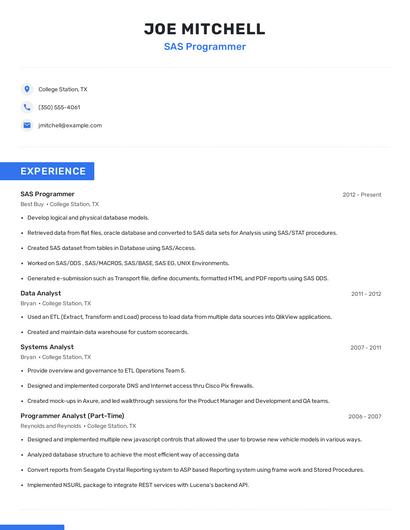
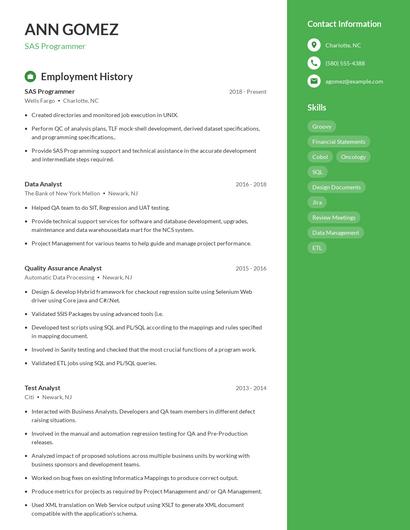
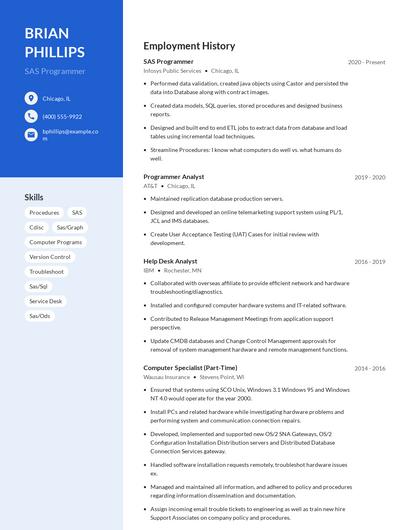
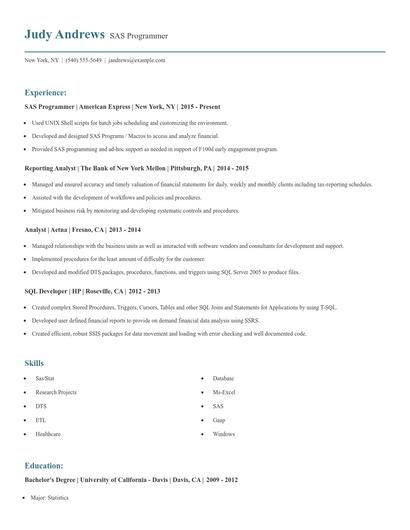
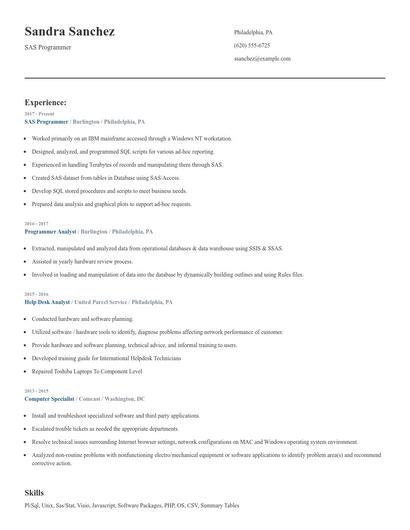
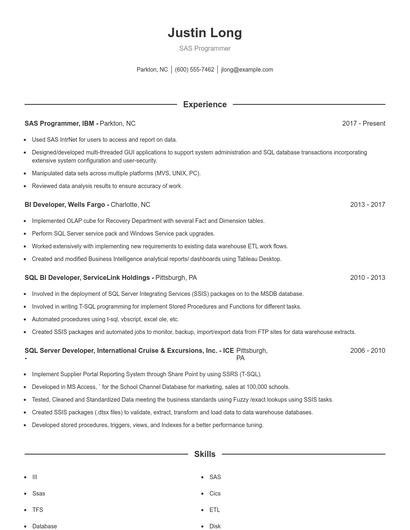
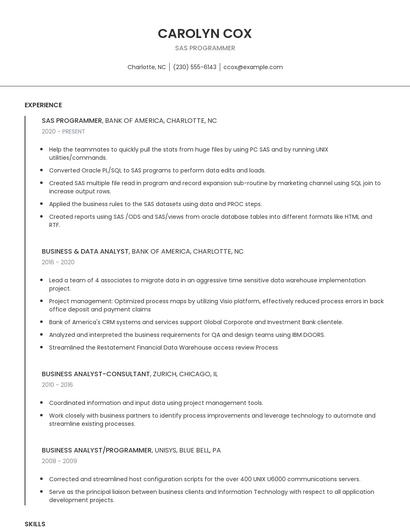
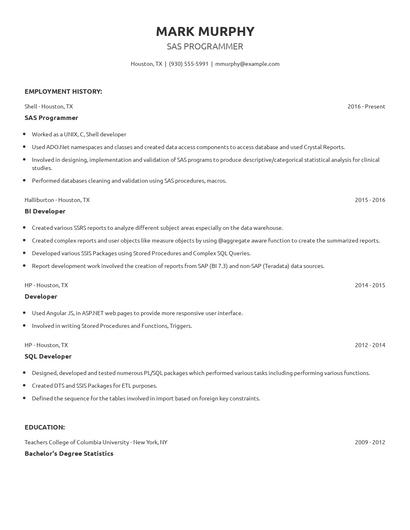
Choose from 10+ customizable sas programmer resume templates
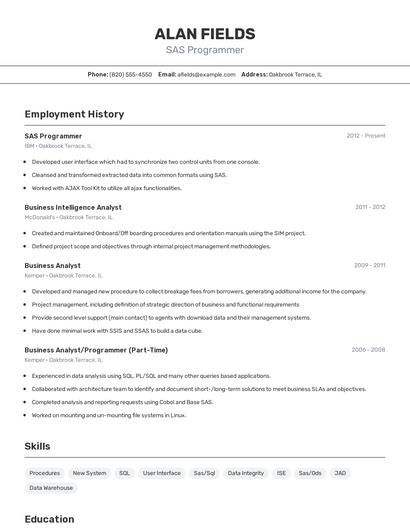
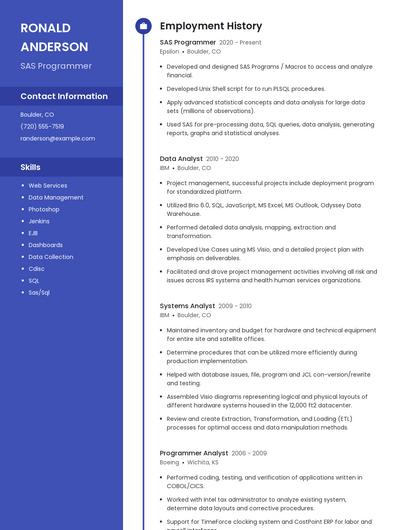
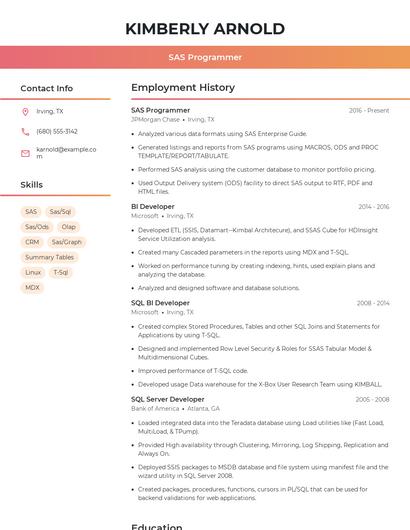
Build a professional sas programmer resume in minutes. Our AI resume writing assistant will guide you through every step of the process, and you can choose from 10+ resume templates to create your sas programmer resume.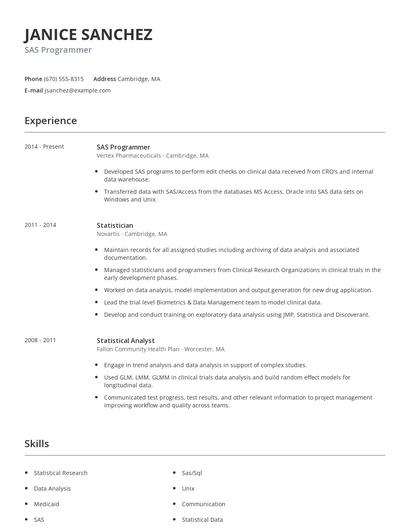
Compare different sas programmers
Sas programmer vs. Mobile applications developer
A mobile application developer is responsible for designing programming applications for mobile devices according to clients' specifications and business demands. Mobile application developers must have excellent knowledge of the technology industry, as well as computer system commands to develop efficient scripts and smooth navigation of operating systems. They analyze the clients' needs and recommend application solutions within their budget limitations and timeframe. A mobile application developer identifies inconsistencies and glitches with the output before submission to ensure its stability and optimal performance.
While similarities exist, there are also some differences between sas programmers and mobile applications developer. For instance, sas programmer responsibilities require skills such as "macro," "data analysis," "sas macros," and "statistical analysis." Whereas a mobile applications developer is skilled in "c++," "c #," "mobile development," and "react native." This is part of what separates the two careers.
Mobile applications developers really shine in the pharmaceutical industry with an average salary of $107,574. Comparatively, sas programmers tend to make the most money in the retail industry with an average salary of $93,781.mobile applications developers tend to reach lower levels of education than sas programmers. In fact, mobile applications developers are 9.1% less likely to graduate with a Master's Degree and 2.2% less likely to have a Doctoral Degree.Sas programmer vs. Web application developer
A web application developer is responsible for designing website and system applications following clients' specifications and business' needs. Web application developers utilize their expertise in programming languages and system codes, ensuring the efficiency and smooth navigation of the website. They also run multiple diagnostic tests on the output before release, identifying inconsistencies, and addressing incompatibilities on browsers and devices. A web application developer should be detail-oriented and highly-technical as this job requires excellent digital knowledge to manage complex systems.
In addition to the difference in salary, there are some other key differences worth noting. For example, sas programmer responsibilities are more likely to require skills like "macro," "data analysis," "sas macros," and "statistical analysis." Meanwhile, a web application developer has duties that require skills in areas such as "javascript," "web application," "css," and "database." These differences highlight just how different the day-to-day in each role looks.
On average, web application developers earn a higher salary than sas programmers. Some industries support higher salaries in each profession. Interestingly enough, web application developers earn the most pay in the finance industry with an average salary of $88,928. Whereas sas programmers have higher pay in the retail industry, with an average salary of $93,781.Average education levels between the two professions vary. Web application developers tend to reach lower levels of education than sas programmers. In fact, they're 17.1% less likely to graduate with a Master's Degree and 2.2% less likely to earn a Doctoral Degree.What technology do you think will become more important and prevalent for sas programmers in the next 3-5 years?
Dr. Mark Fridline Ph.D.
Associate Chair, University of Akron
Sas programmer vs. Developer
Developers are usually system or application developers in a company who work on specific projects related to networks or applications from conception to implementation. They attend planning sessions to ensure that the program is feasible. They are responsible for designing the system through coding and basic user interface design. They also work on troubleshooting any challenges that may be met at the testing stage of the program's development. They solve challenges and ensure that minimal problems will arise upon publishing the system or application. They also manage the evaluation to ensure that the program's goals are accomplished and that the end-users are satisfied with the results.
Some important key differences between the two careers include a few of the skills necessary to fulfill the responsibilities of each. Some examples from sas programmer resumes include skills like "macro," "data analysis," "sas macros," and "statistical analysis," whereas a developer is more likely to list skills in "javascript," "python," "c++," and "api. "
Developers earn the highest salary when working in the finance industry, where they receive an average salary of $104,286. Comparatively, sas programmers have the highest earning potential in the retail industry, with an average salary of $93,781.Most developers achieve a lower degree level compared to sas programmers. For example, they're 14.0% less likely to graduate with a Master's Degree, and 2.2% less likely to earn a Doctoral Degree.Sas programmer vs. Applications developer
An application developer is responsible for creating program applications for devices based on clients' specifications and business needs. Application developers must have excellent knowledge of computer systems, as well as a strong command of programming languages to develop customized programs. Duties of an application developer also include running diagnostic tests to ensure the application's performance and stability, providing instruction manuals for reference, performing troubleshooting for any inconsistencies, upgrading design codes for optimization, and launching the application following the client's timetable.
Types of sas programmer
Updated January 8, 2025
